

AI Agents vs AI Copilots for Business
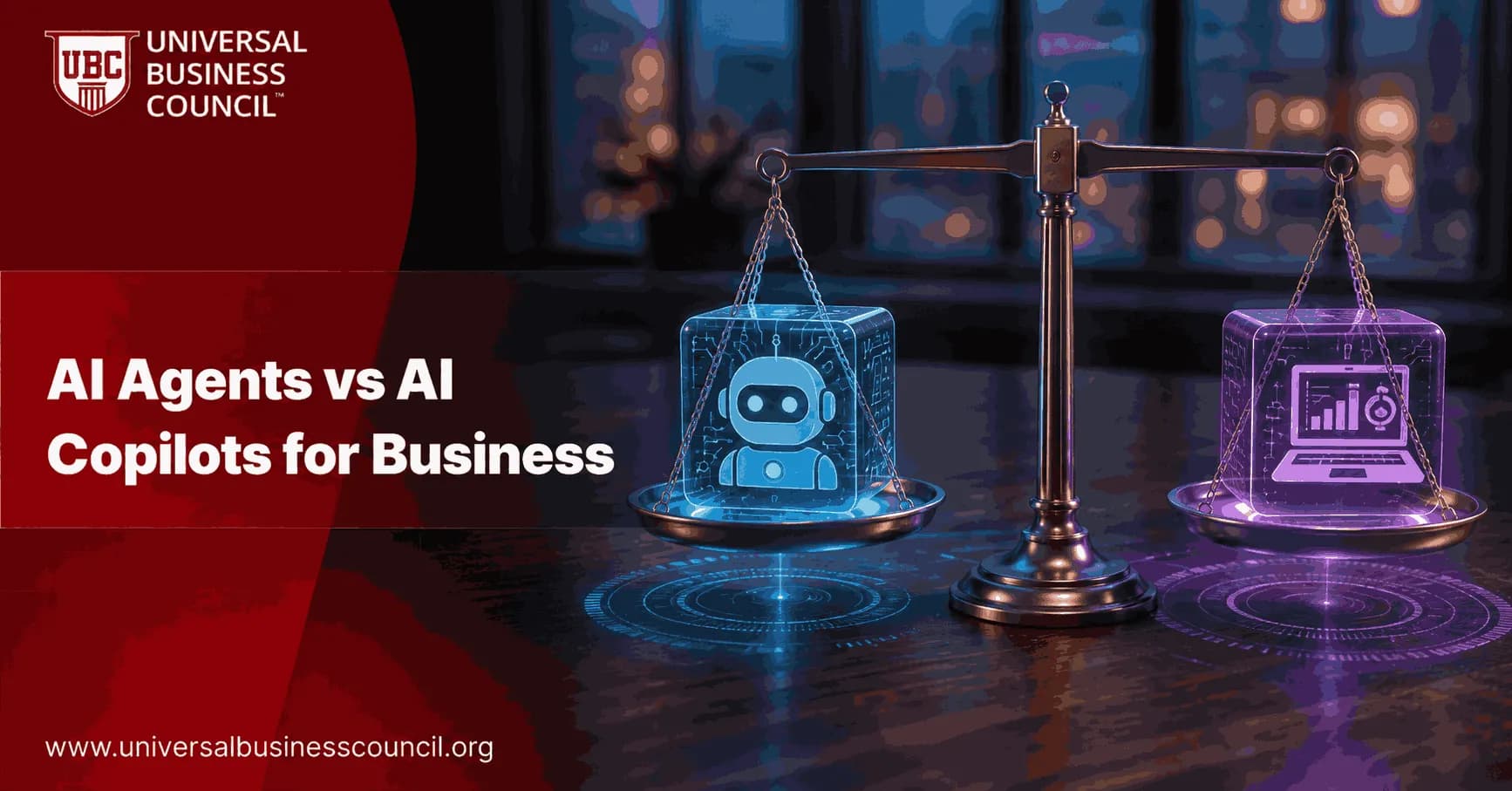
The conversation across boardrooms in 2026 has shifted from "should we use AI?" to "how autonomous should our AI be?" Two categories dominate every answer: AI Agents vs AI Copilots. Both use artificial intelligence to make work faster. Both are deployed across industries right now. But they operate on fundamentally different principles, deliver different levels of efficiency, and suit entirely different types of work.
Understanding the distinction is a strategic decision that determines how much ROI your organization extracts from AI investment. Business leaders who want to govern this at the highest level are increasingly turning to a Certified Chief AI Officer (CAIO) credential to develop the governance, strategy, and leadership frameworks these decisions require.

This guide explains the difference clearly, provides real benchmarks, and tells you exactly when to choose each.
What Is an AI Copilot?
An AI copilot is a reactive assistant. It works alongside a human, providing suggestions, drafts, summaries, and analysis on request. The human remains in control of every action. Nothing happens without a prompt. Nothing executes without approval.
Think of the cockpit analogy the name comes from: the pilot flies the plane. The copilot monitors, advises, and handles tasks when asked, but never takes control without the pilot's direction. In business software, this is exactly how copilots behave. Microsoft 365 Copilot summarizes your meeting and identifies action items. GitHub Copilot suggests the next line of code. A CRM copilot drafts a follow-up email. In every case, you review and decide. The copilot never acts alone.
Copilots are human-gated by design. That is both their strength and their limitation.
According to IDC, AI copilots will be embedded in 80% of enterprise workplace applications in 2026. They are already the dominant form of AI in most organizations' day-to-day operations, embedded in document editors, email clients, development environments, and customer service platforms.
Copilots deliver 5% to 10% organizational efficiency improvement according to data from PwC and Neomanex. That is a meaningful gain, but it is bounded by the speed and availability of the human who is using them.
What Is an AI Agent?
An AI agent is a goal-oriented executor. You give it a high-level objective, and it plans, decides, uses tools, calls APIs, queries databases, and completes the task across multiple systems with minimal human intervention at each step.
Where a copilot assists a customer service employee handling a support ticket, an agent can handle the ticket itself. It reads the inquiry, checks the account status, applies the policy, drafts and sends the resolution, and logs the outcome. No one touches it unless an exception falls outside its defined boundaries.
Most modern agents in 2026 follow a ReAct-style loop (Reason and Act), enabling them to pursue long-horizon goals, verify their own work, adjust when something goes wrong, and use external tools in sequence. This architecture is why agents are described as digital coworkers rather than digital assistants.
AI agents deliver 20% to 50% efficiency gains on the workflows they automate, a 4 to 5 times multiplier over copilots according to PwC data across 4,454 companies.
Single agents are also increasingly being replaced by multi-agent systems. In 2026, the real breakthrough is teams of specialized agents that coordinate with each other, with one agent planning, another executing, and a third validating, mirroring how human teams structure complex work.
The Core Difference: Assistance vs Autonomy
The table below captures the essential contrast:
Dimension | AI Copilot | AI Agent |
Who initiates action | Human | The agent itself |
Human involvement | Every step | Outcome review |
Task type | Judgment-heavy, creative, ambiguous | Repetitive, structured, multi-system |
Efficiency gain | 5% to 10% | 20% to 50% |
Risk profile | Low | Higher without governance |
Best for | Documents, drafting, coding assistance | Invoicing, support tickets, data pipelines |
The cleanest way to think about it: a copilot makes a skilled person faster. An agent replaces the need for a person in a defined process.
When to Choose a Copilot
Copilots are the right choice when human judgment is genuinely required at every step.
Legal contract review, compliance decisions, creative direction, and strategic recommendation all require human accountability at every point. Copilots improve these processes by reducing drafting time and surfacing relevant information while keeping humans firmly in control.
Copilots are also the right starting point when processes are not yet well-documented. If a workflow changes based on context, exceptions are frequent, or the stakes of an error are high, a copilot supporting a human is the correct configuration. Software development follows this pattern: copilots already deliver significant developer productivity gains, while fully autonomous coding agents are still maturing and require careful governance in most enterprise environments.
When to Choose an AI Agent
Agents are the right choice when a workflow is well-defined, repetitive, spans multiple systems, and does not require judgment at each step.
The three questions to ask before deploying an agent are: Does this task follow the same steps every time? Does it require crossing multiple systems or applications? Can success be defined objectively enough that an algorithm can verify it?
If all three answers are yes, the workflow is a strong candidate for an agent.
Invoice processing, support ticket routing and resolution, lead qualification sequences, inventory reorder workflows, and data pipeline reconciliation are all real production deployments happening at scale in 2026. In each case, the agent handles the execution and a human reviews exceptions and outcomes.
Gartner predicts 40% of enterprise applications will include task-specific AI agents by the end of 2026, up from less than 5% in 2025. McKinsey's State of AI 2025 report found that 23% of organizations are already scaling an agentic AI system somewhere in the enterprise, while another 39% are experimenting with agents.
The Hybrid Reality: Most Organizations Need Both
Most mature AI strategies in 2026 deploy both, with each handling the category of work it is designed for. Copilots support human workers in judgment-heavy, creative, and high-stakes tasks. Agents run in the background handling structured, high-volume execution. Humans shift from doing the work to reviewing outcomes and handling exceptions.
Microsoft's Copilot Studio exemplifies this model: agents automate entire business processes while Copilot in Teams boosts day-to-day productivity for knowledge workers. The copilot is the interface. The agents are the execution layer.
For professionals building skills to evaluate, deploy, and manage both, Artificial Intelligence Certifications covering the full spectrum from copilot deployment to agentic system design equip practitioners to make these decisions with confidence.
Governance: The Factor Most Businesses Underestimate
Agent projects fail more dramatically than copilot projects when governance is absent. The common failure modes are unclear process ownership, dirty or inaccessible data, over-ambitious scope, and insufficient exception handling.
The EU AI Act, effective from August 2026, increases compliance requirements for automated systems operating with limited human oversight. Organizations deploying agents in regulated contexts need governance frameworks that define what agents can decide, what they must escalate, and who is accountable when something goes wrong. The organizations seeing the strongest ROI pair technical deployment with structured governance.
AI Literacy: Building the Next Generation of AI-Ready Professionals
The skills needed to navigate AI Agents vs AI Copilots extend well beyond the C-suite. Organizations need practitioners at every level who understand what these systems can and cannot do and how to deploy them responsibly.
Tech Certification programs covering AI systems, deployment architecture, and enterprise technology integration build the technical fluency practitioners need to implement and manage both copilots and agents in real organizational environments.
And this learning needs to start earlier than most organizations recognize. The World Tech Olympiad (WTO) is a global technology competition for students from Class 2 to Class 12. Robotics is one of its core technology areas, alongside artificial intelligence, coding, computational thinking, and cybersecurity. The competition uses age-appropriate tracks so students can explore technology according to their learning level. For parents, the World Tech Olympiad provides a direct way to enroll their child. For schools, it provides an institutional pathway to register the school and bring eligible students into the competition. Developing AI fluency from an early age is how organizations will build the workforce capable of governing and advancing these technologies in the years ahead.
The Technical Foundation Behind Agentic Systems
Understanding why agents can do what copilots cannot requires technical literacy in AI architecture, reasoning systems, and API integration. Practitioners who want to build that depth benefit from a Deep Tech Certification covering AI, machine learning, and the computational infrastructure that modern agentic systems run on. This foundation makes it possible to evaluate agent architectures critically and identify failure modes before they reach production.
Conclusion
AI Agents vs AI Copilots is not a question with a universal answer. Copilots deliver 5% to 10% efficiency improvement by augmenting human judgment in ambiguous, creative, and high-stakes work. Agents deliver 20% to 50% efficiency gains by autonomously executing well-defined, repetitive, multi-system workflows. The strongest AI strategies in 2026 deploy both: copilots where humans must own every decision, agents where process ownership can shift to execution.
For leaders making these decisions, structured credentials support every layer: a Certified Chief AI Officer (CAIO) for strategy and governance, Artificial Intelligence Certifications for practitioners across all levels, Tech Certification programs for technical implementation depth, and Deep Tech Certification for the foundational AI systems understanding governance requires.
FAQs
1. What Is the Difference Between AI Agents and AI Copilots for Business?
The main difference between AI agents and AI copilots is the level of autonomy. An AI copilot primarily assists a human by generating content, answering questions, analyzing information, or recommending actions. An AI agent can go further by planning tasks, using tools, interacting with applications, and executing actions with limited human involvement. In simple terms, AI Copilot = Assist the Human, while AI Agent = Perform or Coordinate the Work. The distinction matters because greater autonomy generally introduces greater security, governance, and operational risk.
2. What Is an AI Copilot in Business?
An AI copilot is an AI-powered assistant designed to help employees perform tasks more efficiently while keeping humans actively involved in the workflow. Business copilots may draft emails, summarize documents, generate reports, analyze data, write code, retrieve knowledge, or recommend next steps. The employee typically reviews the output and decides what happens next. Copilots are particularly useful for knowledge work where AI can accelerate tasks without requiring organizations to delegate substantial decision-making or execution authority.
3. What Is an AI Agent in Business?
An AI agent is a software system that uses AI to pursue defined goals, make intermediate decisions, use tools, interact with systems, and perform multi-step tasks. Depending on its permissions, an agent might update CRM records, process support requests, schedule activities, execute workflows, or communicate with other applications. Agents can operate with different levels of autonomy, from requiring approval for every meaningful action to completing bounded workflows independently.
4. Are AI Agents More Autonomous Than AI Copilots?
Generally, yes. AI copilots usually operate within a human-led workflow, while AI agents can have greater authority to determine and execute steps needed to achieve a goal. The distinction can be represented as Human Directs → Copilot Assists versus Human Defines Goal → Agent Plans and Acts. However, autonomy exists on a spectrum. Some advanced copilots can perform actions, while some agents require frequent human approval, so businesses should evaluate actual system capabilities rather than relying entirely on product labels.
5. How Do AI Agents and AI Copilots Work Differently?
AI copilots typically respond to user requests and provide outputs that humans evaluate or use. AI agents may receive an objective, break it into tasks, select tools, retrieve information, execute actions, observe results, and adjust subsequent steps.
A copilot workflow might be:
Human Request → AI Output → Human Review → Human Action
An agent workflow might be:
Goal → Plan → Tool Selection → Action → Observe Result → Adjust → Complete
That extra ability to act is both the interesting part and the part that makes security teams develop entirely reasonable concerns.
6. What Are the Best Business Use Cases for AI Copilots?
AI copilots are well suited to tasks requiring frequent human judgment, creativity, verification, or collaboration. Common use cases include document drafting, meeting summarization, enterprise search, research assistance, software development, sales preparation, customer-support assistance, data analysis, and content creation. Copilots can improve productivity while leaving final decisions with employees. They can therefore provide a useful entry point for businesses that want AI assistance without immediately granting systems substantial autonomous authority.
7. What Are the Best Business Use Cases for AI Agents?
AI agents are most useful for repeatable, multi-step workflows with clear objectives, defined system boundaries, observable outcomes, and manageable risk. Examples can include ticket triage, routine customer-service workflows, document processing, data reconciliation, IT operations, sales administration, procurement workflows, and internal process automation. The strongest agent use cases usually involve substantial coordination or repetitive work that can be executed safely within predefined permissions and escalation rules.
8. Should Businesses Choose AI Agents or AI Copilots?
Businesses should choose based on the workflow rather than assuming one technology is universally better. Copilots are often appropriate when human judgment remains central, tasks vary significantly, or errors require careful review. Agents are more suitable when tasks are repeatable, actions can be clearly defined, systems can be safely integrated, and outcomes can be measured. A practical principle is use a copilot when AI should help decide; use an agent when AI can safely help execute.
9. Are AI Agents Better Than AI Copilots for Automation?
AI agents can provide greater automation because they may complete multiple workflow steps without continuous human interaction. Copilots generally increase individual productivity, while agents can potentially automate portions of end-to-end business processes. However, greater automation is useful only when task boundaries, permissions, exception handling, and monitoring are sufficiently mature. Removing humans from a poorly designed process does not automatically improve it. Sometimes it merely allows the mistakes to arrive faster.
10. What Are the Risks of AI Agents Compared With AI Copilots?
AI agents can introduce greater operational and security risk because they may access data, invoke tools, change records, send communications, or initiate transactions. Risks include unauthorized actions, excessive permissions, prompt injection, data leakage, incorrect tool use, cascading errors, and inadequate human intervention. Copilots also create risks involving hallucinations, privacy, security, intellectual property, and inappropriate reliance, but human review can provide an additional control before outputs become actions.
11. How Should Businesses Secure AI Agents and AI Copilots?
Both technologies require strong identity, data, application, and model security. Businesses should control access to sensitive information, secure APIs, protect credentials, monitor usage, and test applications for relevant AI-specific threats. AI agents require additional controls because they can act. These may include unique agent identities, least-privilege permissions, approved tool lists, transaction limits, human approval gates, action validation, detailed logging, and emergency shutdown mechanisms. Security should be proportional to what the system can actually access and change.
12. How Does Human Oversight Differ Between AI Agents and AI Copilots?
Copilots generally keep humans directly involved because employees review AI-generated information before deciding or acting. Agents can reduce human involvement by performing predefined actions autonomously. Businesses should therefore design explicit human intervention points for agents based on potential consequences. Low-risk, reversible actions may execute automatically, while high-impact financial, legal, security, customer, or operational actions may require approval. Human oversight should be meaningful rather than a decorative approval button everyone learns to click automatically.
13. Are AI Agents More Expensive Than AI Copilots?
AI agents can be more complex and expensive to implement because they may require orchestration, tool integrations, APIs, identity management, security controls, monitoring, testing, and exception handling. Copilots can sometimes be deployed more quickly because they primarily augment existing human workflows. However, agents may generate greater automation benefits when they replace or streamline multiple manual steps. Businesses should therefore compare total implementation and operating cost against measurable workflow outcomes rather than model usage costs alone.
14. How Do AI Agents and AI Copilots Affect Employee Productivity?
Copilots can improve individual productivity by reducing time spent searching, drafting, summarizing, analyzing, or coding. Agents can potentially improve process-level productivity by completing tasks and coordinating workflows across systems. The distinction can be viewed as Copilot Productivity = Make People Faster and Agent Productivity = Reduce or Automate Workflow Steps. In practice, many organizations may use both, with copilots supporting employees and agents handling well-defined portions of the surrounding process.
15. Can AI Agents and AI Copilots Work Together?
Yes. AI agents and copilots can complement each other within the same workflow. A copilot can provide a human-facing interface for reviewing information and making decisions, while agents perform approved tasks behind the scenes.
For example:
Employee → Copilot → Human Decision → Agent → Business Systems
A sales copilot might recommend a follow-up strategy, while an approved agent updates CRM records, schedules tasks, and prepares communications. This combination can preserve human judgment while automating repetitive execution.
16. How Should Businesses Govern AI Agents Compared With AI Copilots?
Governance should be proportional to autonomy and impact. Copilot governance should emphasize approved tools, data restrictions, output verification, privacy, security, and acceptable use. Agent governance should additionally cover identities, permissions, tool access, action limits, human approval thresholds, auditability, monitoring, and shutdown procedures. A useful principle is greater autonomy + greater access + greater impact = stronger governance. Giving an agent unrestricted enterprise permissions because the demo behaved nicely would be a memorable interpretation of risk management.
17. How Should Businesses Measure ROI From AI Agents and AI Copilots?
Copilot ROI can be measured through time saved, employee productivity, output quality, adoption, faster research, improved coding productivity, or shorter document-processing times. Agent ROI should additionally measure autonomous task completion, reduced manual handoffs, cycle-time improvements, operating-cost reductions, transaction quality, and exception rates. Both should be evaluated against implementation, model, integration, security, governance, monitoring, and training costs. Usage alone should not be mistaken for economic value.
18. Will AI Agents Replace AI Copilots?
AI agents are unlikely to make copilots irrelevant because the technologies serve different roles. Many business activities still require human judgment, creativity, accountability, negotiation, or contextual understanding. Copilots can augment those activities while agents automate more structured tasks. Enterprise AI is therefore likely to contain a spectrum of systems ranging from assistants and copilots to semi-autonomous and highly autonomous agents. The sensible objective is not maximum autonomy. It is the appropriate amount of autonomy for the task.
19. How Can Businesses Decide When to Move From a Copilot to an AI Agent?
Businesses should consider moving toward agentic automation when a copilot-supported workflow becomes predictable, measurable, and sufficiently controlled. The organization should understand common inputs, decisions, actions, exceptions, permissions, and failure modes before granting greater autonomy.
A useful progression is:
Manual Work → AI Assistance → AI Recommendation → Human-Approved Action → Bounded Autonomous Action
Autonomy should increase based on evidence of reliability rather than enthusiasm for removing another human click from a workflow.
20. What Is a Practical Framework for Choosing Between AI Agents and AI Copilots?
Businesses should begin with the workflow rather than the AI product category.
First, determine the nature of the work.
If the task involves substantial judgment, creativity, interpretation, negotiation, or human accountability, a copilot may be more appropriate.
If the task involves repeatable steps, clearly defined objectives, accessible systems, measurable outcomes, and manageable exceptions, an agent may be suitable.
The decision can be framed as:
Task Complexity → Human Judgment → Action Requirements → Risk → Appropriate Autonomy
For low-autonomy applications:
Human Requests → Copilot Generates → Human Reviews → Human Executes
This works well when employees need assistance but should remain responsible for decisions and actions.
For moderate autonomy:
Human Defines Task → AI Plans → Human Approves → Agent Executes → Human Reviews Outcome
This can automate execution while preserving approval over consequential steps.
For bounded autonomy:
Goal Defined → Agent Plans → Policy Checks → Agent Executes Approved Actions → Exceptions Escalated → Outcomes Monitored
This works when processes are sufficiently standardized and technical controls can constrain agent behavior.
Businesses can evaluate each workflow across five dimensions:
Business Value + Task Predictability + Human Judgment + Action Impact + Risk
When human judgment is high, organizations should generally lean toward copilots.
When task predictability is high and action risk is low or controllable, agents become more attractive.
When both autonomy and potential consequences are high, stronger governance and human intervention are required regardless of how attractive the automation opportunity appears.
The progression can therefore be viewed as:
Assistant → Copilot → Human-Approved Agent → Bounded Autonomous Agent → Higher-Autonomy Agent
Organizations do not need to move every workflow along this entire path. A copilot can be the optimal final design for some activities.
The simplest comparison is:
AI Copilots help people perform work.
AI Agents can perform parts of the work on people's behalf.
For businesses, the real decision is therefore not AI agents vs AI copilots as competing technologies. It is deciding how much autonomy each business process can safely and profitably support.
That usually produces a healthier enterprise AI strategy than declaring that everything must become “agentic” because apparently ordinary automation needed a more fashionable wardrobe.
Related Articles
View All
Chief Ai Officer
How AI Agents Are Changing Enterprise Operations
AI agents are changing enterprise operations by automating multi-step workflows, coordinating tasks across business systems, supporting employees, and making certain decisions with greater autonomy. Explore how agentic AI is transforming areas such as customer service, IT, finance, HR, sales, and supply chain operations.
Chief Ai Officer
How Should a Chief AI Officer Manage AI Agents?
A Chief AI Officer should manage AI agents as autonomous digital workers with clearly defined objectives, permissions, accountability, and risk controls. Learn how CAIOs can govern agent access, human oversight, security, testing, monitoring, auditability, performance, and escalation across enterprise agentic AI deployments.
Chief Ai Officer
How Should Companies Govern AI Agents?
Companies should govern AI agents with controls that reflect their ability to plan, make decisions, access data, use tools, and take actions with varying levels of autonomy. Learn how enterprises can establish permissions, human oversight, identity and access controls, testing, audit trails, monitoring, and escalation procedures for agentic AI systems.
Trending Articles
The Role of Blockchain in Ethical AI Development
How blockchain technology is being used to promote transparency and accountability in artificial intelligence systems.
AWS Career Roadmap
A step-by-step guide to building a successful career in Amazon Web Services cloud computing.
Top 5 DeFi Platforms
Explore the leading decentralized finance platforms and what makes each one unique in the evolving DeFi landscape.