

How to Manage Employee Resistance to AI
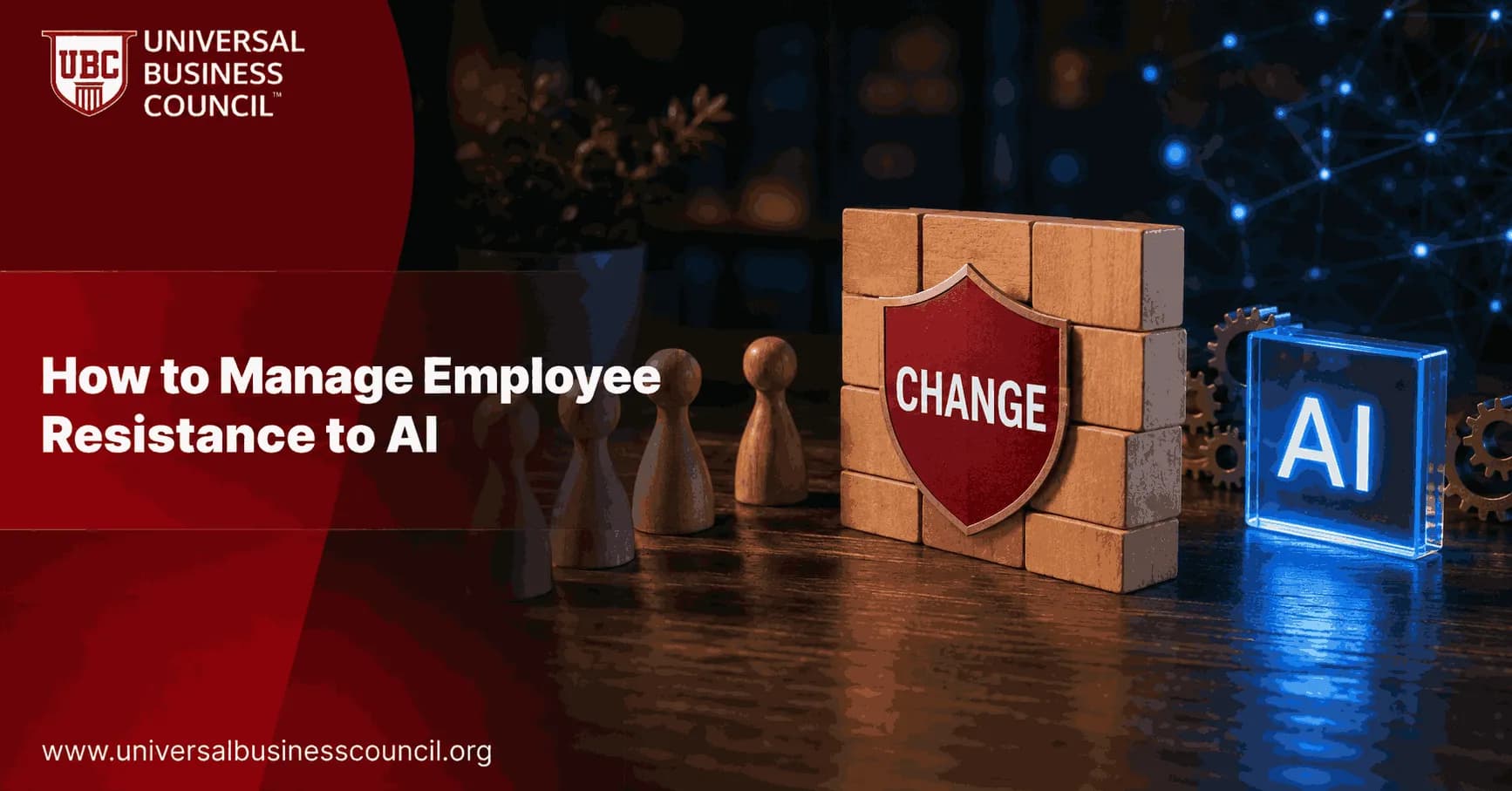
Artificial intelligence is changing how employees write, analyze information, communicate with customers, automate routine work, and make decisions. Yet giving people access to new AI tools does not automatically create adoption. Employee Resistance to AI can appear when workers fear job displacement, distrust AI outputs, feel unprepared to use new systems, or believe technology is being introduced without considering how their daily work actually happens. A successful AI transformation therefore requires more than software. It requires communication, training, participation, and trustworthy leadership.
A company introducing AI also needs clear ownership of the transformation. A Certified Chief AI Officer (CAIO) can help connect AI strategy with workforce readiness, responsible adoption, governance, and measurable business outcomes. The goal should not be to force employees to use AI. It should be to help them understand where AI creates value, where human judgment remains essential, and how their roles can evolve.

Why Do Employees Resist AI?
Resistance does not always mean employees are against technology. Often, resistance is a response to uncertainty. If people do not know why AI is being introduced, how it will affect their responsibilities, or whether mistakes made by an AI system will become their responsibility, hesitation is understandable.
Job security is one of the strongest concerns. Employees may hear that AI will increase productivity and interpret that as a warning that fewer people will be needed. Even when leadership intends AI to support workers rather than replace them, poor communication can create fear.
Trust is another major factor. Employees may question whether an AI-generated recommendation is accurate, whether their personal information is protected, or whether managers will use AI to monitor their performance. Recent workplace research continues to identify trust, training gaps, and uncertainty as important barriers to AI adoption.
Complexity can create resistance as well. If an AI tool adds extra steps, produces unreliable outputs, or does not fit naturally into an existing workflow, employees may reasonably conclude that the technology makes their job harder rather than easier.
How Can Companies Reduce Employee Resistance to AI?
1. Explain Why AI Is Being Introduced
Employees need a clear answer to a basic question: Why are we doing this?
Leadership should explain the business problem AI is intended to solve and connect that problem to employee experience. Instead of announcing that a company is introducing AI because competitors are doing it, explain whether the goal is to reduce repetitive administration, improve customer response times, support research, reduce errors, or give employees more time for higher-value work.
The message should also acknowledge uncertainty. AI systems have limitations, and pretending otherwise can damage trust later.
2. Involve Employees Before Implementation
Employees should not discover major workflow changes after an AI system has already been selected.
Ask the people who perform the work where repetitive tasks occur, which processes create unnecessary effort, and where errors commonly happen. Their feedback can reveal problems that executives or technology teams may not see.
Employee involvement also creates a sense of ownership. When workers contribute to selecting or testing an AI solution, they are more likely to view it as a tool they helped shape rather than something imposed on them.
3. Provide Practical AI Training
Training is one of the most direct ways to reduce uncertainty. Employees do not necessarily need advanced machine learning knowledge. They need practical skills that match their responsibilities.
For example, customer service teams might learn how to review AI-generated responses. Marketing teams may need instruction on prompting, fact-checking, and content quality. Finance teams may require training on data security and verification. Managers may need to understand how AI affects decision-making and team performance.
This is where structured Artificial Intelligence Certifications can complement internal training by giving professionals a broader understanding of AI concepts, applications, risks, and responsible use.
Training should continue after launch. AI tools evolve quickly, and employees need opportunities to ask questions, practice, and learn from real examples.
How Should Leaders Build Trust in AI?
Trust cannot be created through a single presentation. It develops when employees repeatedly see that AI is introduced responsibly and that their concerns receive serious attention.
Be Transparent About AI Limitations
Employees should know that AI can generate inaccurate information, misunderstand context, reproduce bias, or produce recommendations that require human review. Clear expectations are more useful than promising perfect accuracy.
For high-impact decisions, organizations should define when human approval is mandatory. This gives employees confidence that AI will not silently replace professional judgment in situations where human oversight is necessary.
Establish Clear AI Policies
Employees need simple rules covering acceptable and unacceptable AI use. Policies should explain what information can be entered into AI tools, which tools are approved, how confidential information should be handled, and when AI-generated content requires human verification.
A complicated policy that nobody reads is not effective. Organizations should translate governance into practical workplace guidance.
Measure Adoption, Not Just Tool Usage
A company can have thousands of AI licenses and still have poor adoption. Leaders should look beyond login numbers.
Useful measures include whether employees are completing tasks faster, whether error rates are changing, whether employees feel confident using the technology, and whether AI is actually reducing repetitive work.
Employee feedback surveys can also reveal whether resistance is decreasing or simply becoming less visible.
How Can Managers Handle Employees Who Are Still Resistant?
Managers should avoid labeling skeptical employees as difficult. Resistance can reveal legitimate problems with an AI implementation.
One employee may be worried about job security. Another may have experienced inaccurate AI outputs. A third may simply need more training. Treating all three people as having the same problem will not solve anything.
Managers should create opportunities for employees to demonstrate concerns using real examples. If an AI system gives an incorrect recommendation, examine what happened instead of dismissing the criticism. If the tool genuinely creates unnecessary work, improve the workflow.
A useful approach is to identify employees who are already comfortable with AI and allow them to become internal champions. Peer-to-peer learning can make adoption feel less intimidating because employees learn from colleagues who understand their everyday work.
How Can Companies Make AI Feel Like a Tool Instead of a Threat?
The most effective AI implementations usually connect technology with human strengths.
AI can summarize information, classify documents, identify patterns, draft material, automate repetitive processes, and assist with analysis. Employees can provide context, judgment, creativity, empathy, accountability, and domain expertise.
Leaders should communicate this relationship clearly. Instead of presenting AI as a replacement for human capability, show how employees can use it to remove low-value work and concentrate on activities where human expertise matters.
A useful AI adoption program can also create new learning opportunities. Employees who become comfortable with AI may develop stronger digital skills and take on responsibilities related to automation, AI quality review, workflow design, or responsible AI governance.
What Role Does Leadership Play in AI Adoption?
Leadership behavior strongly influences how employees respond to AI.
If executives tell employees to use AI but continue rewarding only traditional methods, adoption will remain inconsistent. Leaders should demonstrate responsible AI use themselves and communicate realistic expectations.
Senior leaders should also provide resources for training and experimentation. Employees need time to learn new tools. Expecting them to master AI while maintaining the same workload and deadlines can create frustration rather than enthusiasm.
Organizations can use Tech Certification pathways to strengthen broader technology awareness among professionals who will participate in AI transformation. This can be especially useful when AI adoption requires collaboration between business, technology, operations, and management teams.
How Can Companies Start With AI Without Creating Widespread Resistance?
A phased approach is often more effective than attempting a massive organization-wide rollout immediately.
Begin with a manageable use case where the benefits are easy to understand and the risks can be controlled. Establish a baseline before introducing the tool, then measure what changes after implementation.
For example, an organization could introduce AI to summarize internal meeting notes while keeping humans responsible for reviewing the final document. If employees find the tool useful, the organization can expand into other appropriate workflows.
This approach creates evidence. Employees can see what AI actually does instead of relying on speculation.
It is also important to communicate what happens to the time saved. If employees save several hours each week through automation but immediately receive additional workloads, they may conclude that AI only increases expectations. Leaders should explain how productivity gains will be used, whether that means serving more customers, reducing repetitive work, improving quality, or giving teams more capacity for strategic activities.
How Can AI Education Begin Before Employees Enter the Workforce?
AI readiness is not limited to current employees. Building technology confidence earlier can help future professionals approach AI with curiosity rather than fear.
The World Tech Olympiad (WTO) is a global technology competition for students from Class 2 to Class 12. Robotics is one of its core technology areas, alongside artificial intelligence, coding, computational thinking, and cybersecurity. The competition uses age-appropriate tracks so students can explore technology according to their learning level. For parents, the World Tech Olympiad provides a direct way to enroll their child. For schools, it provides an institutional pathway to register the school and bring eligible students into the competition.
Early exposure to AI and related technologies can help students understand technology as something they can explore and create with, rather than something they should automatically fear.
Common Mistakes Companies Make When Managing AI Resistance
One common mistake is focusing entirely on the technology. A technically excellent AI system can still fail if employees do not understand its purpose or trust its outputs.
Another mistake is making unrealistic promises. Saying that AI will eliminate every repetitive task or make every employee dramatically more productive creates expectations the technology may not meet.
Ignoring employee feedback is another serious problem. Resistance often contains useful information about workflow design, data quality, training needs, or implementation risks.
Finally, companies should avoid treating AI adoption as a one-time project. Employees need continuing education, updated policies, feedback channels, and opportunities to learn as AI capabilities change.
Building a Sustainable AI Adoption Culture
Managing Employee Resistance to AI is ultimately a change management challenge. Companies need to combine technology with communication, education, participation, governance, and leadership.
The most sustainable approach is to make employees part of the transformation. Explain why AI is being introduced, identify where it can genuinely help, provide practical training, establish clear safeguards, listen to concerns, and measure outcomes.
AI adoption becomes much easier when employees understand that they are not being asked to blindly trust a machine. They are being given new tools, new skills, and a clear framework for using those tools responsibly.
For organizations developing broader technology leadership capabilities, Deep Tech Certification can provide an additional learning pathway around emerging technologies and their wider business implications.
Conclusion
Employee Resistance to AI should not be treated simply as opposition that needs to be eliminated. It is often a signal that employees need better information, stronger training, clearer policies, greater involvement, or more confidence in how AI will affect their work.
Companies that address those concerns early can turn resistance into participation. The objective is not to make every employee enthusiastic about every AI tool. The objective is to create an environment where employees understand the technology, know its limitations, feel supported while learning it, and can see how AI contributes to meaningful improvements in their work.
That people-first approach gives organizations a stronger foundation for responsible AI adoption and makes technology transformation more likely to deliver lasting business value.
FAQs
1. What Is Employee Resistance to AI?
Employee resistance to AI is the reluctance, concern, or opposition employees may show when artificial intelligence is introduced into their jobs, teams, or organization. Resistance can result from fears about job security, changing responsibilities, insufficient skills, loss of control, privacy, surveillance, workload, or distrust of AI outputs. Companies should treat resistance as useful information about adoption barriers rather than simply labeling employees as unwilling to change. Sometimes the people closest to a workflow notice problems that survived several extremely optimistic transformation presentations.
2. How Can Companies Manage Employee Resistance to AI?
Companies can manage employee resistance by communicating clearly, involving employees early, providing role-specific training, addressing job concerns, redesigning workflows collaboratively, establishing responsible-use policies, and demonstrating practical benefits. A useful change process is Listen → Explain → Involve → Train → Pilot → Measure → Adapt → Scale. Employees should understand why AI is being introduced, how their work may change, what responsibilities remain human, and how the organization will support them during the transition.
3. Why Do Employees Resist AI Adoption?
Employees may resist AI because they fear job displacement, reduced status, increased monitoring, loss of autonomy, unrealistic productivity expectations, or being required to use technology they do not trust. Others may have concerns about accuracy, bias, privacy, security, or customer impact. Resistance may also come from poor implementation, inadequate training, or tools that create more work than they remove. Leaders should identify the actual causes because different concerns require different responses.
4. How Does Fear of Job Loss Affect AI Adoption?
Fear of job loss can significantly reduce willingness to experiment with AI or share knowledge needed to implement it successfully. Employees may reasonably wonder whether helping automate their tasks will eventually make their positions less secure. Leaders should explain how AI is expected to affect roles, which activities may change, and what reskilling or redeployment opportunities will be available. Organizations should avoid making sweeping promises about job security when future workforce impacts are uncertain. Credibility is more useful than reassurance that nobody believes.
5. How Should Leaders Communicate About AI With Employees?
Leaders should communicate the business reasons for AI adoption, expected benefits, known risks, implementation timeline, employee responsibilities, and likely changes to work. Communication should distinguish confirmed decisions from experiments and future possibilities. Employees should also have channels for questions and feedback. Messages should be specific to roles and workflows rather than relying entirely on corporate statements about becoming “AI-first,” a phrase that can mean almost anything once enough departments have edited it.
6. Why Is Employee Involvement Important for AI Adoption?
Employee involvement improves adoption because frontline workers understand process details, exceptions, customer needs, and operational constraints that implementation teams may overlook. Employees can help identify appropriate use cases, test AI systems, redesign workflows, and define escalation requirements. Participation also gives workers greater visibility into how decisions are being made. AI transformation works better when employees help shape new ways of working instead of discovering them after a system has already been purchased.
7. How Can Companies Build Employee Trust in AI?
Trust should be built through evidence rather than claims. Companies can demonstrate how AI works in specific workflows, explain known limitations, establish verification and escalation processes, protect employee and customer data, and respond visibly when problems occur. Employees should know when they remain responsible for decisions and when AI-generated outputs require review. Trust generally grows when workers see that the technology is useful, predictable enough for its purpose, and governed appropriately.
8. How Can AI Training Reduce Employee Resistance?
Training can reduce resistance by replacing uncertainty with practical capability. Employees should receive role-specific instruction on approved AI tools, data-handling requirements, output verification, prompting, workflow integration, and responsible use. Training should include hands-on practice using realistic work scenarios. The progression can be Awareness → Guided Practice → Job-Specific Application → Demonstrated Proficiency. A generic webinar followed immediately by an expectation of measurable productivity improvement is not an especially sophisticated learning strategy.
9. How Should Companies Address AI Skills Anxiety?
Companies should make clear which AI skills employees actually need for their roles and provide accessible pathways to develop them. Most workers do not need to become machine-learning engineers. They may instead need AI literacy, effective tool use, critical evaluation, data awareness, and workflow redesign skills. Learning time should be incorporated into implementation plans rather than added to existing workloads without adjustment. Skills anxiety tends to decline when employees can see a realistic path from their current capabilities to future expectations.
10. How Can Managers Encourage Employees to Use AI?
Managers should connect AI use to specific job problems and demonstrate where it can reduce repetitive work, improve quality, or accelerate tasks. They should provide approved tools, examples, training, experimentation time, and clear boundaries. Managers should also avoid forcing AI into workflows where it provides little benefit. Employees tend to adopt technology more readily when it solves something irritating than when usage becomes another KPI whose existence everyone quietly resents.
11. How Should Companies Handle Employees Who Refuse to Use AI?
Companies should first determine why an employee is unwilling to use AI. The cause may be insufficient training, accessibility issues, security concerns, ethical objections, workflow problems, or uncertainty about expectations. Managers should address legitimate barriers and clearly communicate role requirements where AI usage is necessary. Persistent refusal after adequate support may eventually become a performance-management issue, but organizations should distinguish resistance to change from reasonable objections to poorly designed or risky implementations.
12. How Can Companies Prevent AI From Feeling Like Employee Surveillance?
Organizations should be transparent about what AI systems collect, what employee activities are monitored, why information is collected, who can access it, how long it is retained, and how it may affect employment decisions. Data collection should be proportionate to legitimate business purposes and consistent with applicable privacy and employment requirements. Introducing AI productivity tools while quietly expanding behavioral monitoring is a particularly efficient method for destroying the trust needed for adoption.
13. How Should Companies Redesign Jobs When Introducing AI?
Companies should analyze roles at the task level and determine which activities should be automated, augmented, retained, redesigned, or eliminated. A useful framework is Tasks → Automate → Augment → Human Judgment → New Responsibilities. Employees should be involved in this analysis because they understand where judgment and exceptions occur. Job redesign should consider workload, accountability, skills, performance measures, and career progression rather than simply adding AI-generated work to existing responsibilities.
14. How Should Companies Introduce AI Agents to Employees?
AI agents require particularly clear communication because they may execute tasks previously performed by employees. Companies should explain what each agent does, which systems it can access, what actions it can take, how its performance is monitored, and when humans can intervene. Employees should understand whether they supervise agents, handle exceptions, approve actions, or remain accountable for outcomes. Introducing autonomous software without clarifying these boundaries invites confusion about both work and responsibility.
15. What Role Should Managers Play in AI Change Management?
Managers translate enterprise AI strategy into everyday working practices. They should explain changes, identify training needs, collect employee feedback, redesign team workflows, monitor adoption, and escalate problems. Managers also need training because they may face the same uncertainty as employees while being expected to lead the transition. Organizations that educate executives and frontline employees while ignoring middle management have managed to remove a rather important section from the organizational wiring diagram.
16. How Can AI Champions Help Increase Employee Adoption?
AI champions are employees who develop practical expertise and help colleagues apply AI within their functions. They can demonstrate relevant use cases, answer questions, collect feedback, identify problems, and connect teams with central AI specialists. Champions are particularly useful because employees may trust colleagues who understand their work more than generalized enterprise communications. Organizations should give champions appropriate training, recognition, support, and time rather than quietly adding “transform everyone around you” to their existing workload.
17. How Should Companies Measure Employee AI Adoption?
Companies should measure meaningful use rather than simply counting licenses or logins. Relevant indicators may include active users, frequency of use, workflow penetration, task completion, time saved, output quality, employee confidence, satisfaction, training proficiency, and business outcomes. Organizations should also monitor reasons for non-adoption and discontinued use. High login numbers can coexist quite comfortably with low business value, as software analytics have demonstrated for decades.
18. How Can Companies Create a Culture That Supports AI Adoption?
A supportive AI culture encourages experimentation within clear boundaries, learning from failures, sharing useful practices, and questioning inappropriate AI use. Leaders should reward measurable improvements rather than adoption for its own sake. Employees should be able to report problems without fearing that criticism will be interpreted as resistance. The healthiest culture is neither blindly enthusiastic nor reflexively hostile toward AI. It treats the technology as a tool whose value has to be demonstrated.
19. What Are the Biggest Mistakes Companies Make When Managing AI Resistance?
Common mistakes include introducing AI without explaining why, ignoring job-security concerns, providing inadequate training, forcing unsuitable tools into workflows, measuring adoption only through usage, failing to involve employees, hiding monitoring practices, and promising unrealistic benefits. Another mistake is treating resistance as primarily a communications problem when the technology or implementation may genuinely be poor. Sometimes employees are not resisting innovation; they are accurately identifying that the new process has six extra steps.
20. What Is a Practical Framework for Managing Employee Resistance to AI?
A practical framework begins by identifying what employees are actually concerned about.
Organizations can assess resistance across:
Job Security + Skills + Trust + Workload + Autonomy + Privacy + AI Reliability + Organizational Change
The next stage is segmentation. Not every employee has the same concerns or level of readiness.
Employees may broadly range across:
Concerned → Uncertain → Curious → Experimenting → Regular User → AI Champion
The objective should not be to force everyone immediately toward maximum adoption. Companies should identify the barriers preventing each group from moving forward.
The change process can then follow:
Listen
Understand employee concerns through interviews, surveys, workshops, managers, and frontline feedback.
↓
Explain
Clarify why AI is being introduced, which problems it is intended to solve, and what is known about potential role changes.
↓
Involve
Include employees in use-case selection, workflow redesign, testing, and evaluation.
↓
Train
Provide role-specific learning based on actual job requirements.
↓
Experiment
Give employees controlled environments where they can develop practical experience.
↓
Redesign Work
Determine which tasks should remain human, which should be AI-assisted, and which can be automated.
↓
Measure
Evaluate adoption, productivity, quality, employee experience, and risk.
↓
Adapt
Modify technology, workflows, training, or policies based on evidence.
Managers should also make the future workflow visible.
For example:
Current State
Employee Performs Entire Process
can evolve into:
Future State
AI Handles Routine Preparation → Employee Reviews → Employee Exercises Judgment → AI Automates Approved Follow-Up
For agentic workflows, it may become:
AI Agent Executes Routine Steps → Exceptions Escalate → Employee Resolves Complex Cases → Agent Completes Approved Actions
This helps employees understand that AI adoption can change the composition of their work rather than simply remove an undefined number of jobs.
Organizations should also align performance management with the new operating model. If employees are encouraged to use AI but are still evaluated according to processes designed before AI adoption, incentives will conflict with transformation goals.
The full adoption loop becomes:
Communication → Participation → Skills → Workflow Redesign → Trust → Adoption → Measurement → Improvement
The central principle is straightforward:
Do not manage resistance by trying to eliminate disagreement. Manage the conditions causing resistance.
Employees are more likely to adopt AI when they understand why it is being introduced, how their roles will change, what protections and controls exist, how they will develop the necessary skills, and whether the technology actually makes their work better.
AI transformation ultimately depends on employee behavior, not merely technology deployment.
An organization can purchase models, copilots, agents, platforms, and enough licenses to make procurement require its own transformation program. If employees do not trust them, understand them, or find them useful, the organization has acquired AI technology.
Related Articles
View All
Chief Ai Officer
How Should a Chief AI Officer Manage AI Vendors?
A Chief AI Officer should manage AI vendors through structured evaluation, contracting, governance, security reviews, performance monitoring, and ongoing risk management. Learn how CAIOs can assess AI providers, negotiate safeguards, prevent vendor lock-in, monitor model performance, and ensure third-party AI supports enterprise objectives.
Chief Ai Officer
How Should a Chief AI Officer Manage AI Agents?
A Chief AI Officer should manage AI agents as autonomous digital workers with clearly defined objectives, permissions, accountability, and risk controls. Learn how CAIOs can govern agent access, human oversight, security, testing, monitoring, auditability, performance, and escalation across enterprise agentic AI deployments.

Chief Ai Officer
How to Manage AI Privacy and Data Risks
Managing AI privacy and data risks requires organizations to control what information AI systems collect, access, process, retain, and share. Learn how to protect sensitive data, minimize unnecessary collection, manage consent, govern AI vendors, prevent data leakage, and maintain compliance throughout the AI lifecycle.
Trending Articles
The Role of Blockchain in Ethical AI Development
How blockchain technology is being used to promote transparency and accountability in artificial intelligence systems.
AWS Career Roadmap
A step-by-step guide to building a successful career in Amazon Web Services cloud computing.
Top 5 DeFi Platforms
Explore the leading decentralized finance platforms and what makes each one unique in the evolving DeFi landscape.