

What Is an Enterprise AI Maturity Model?
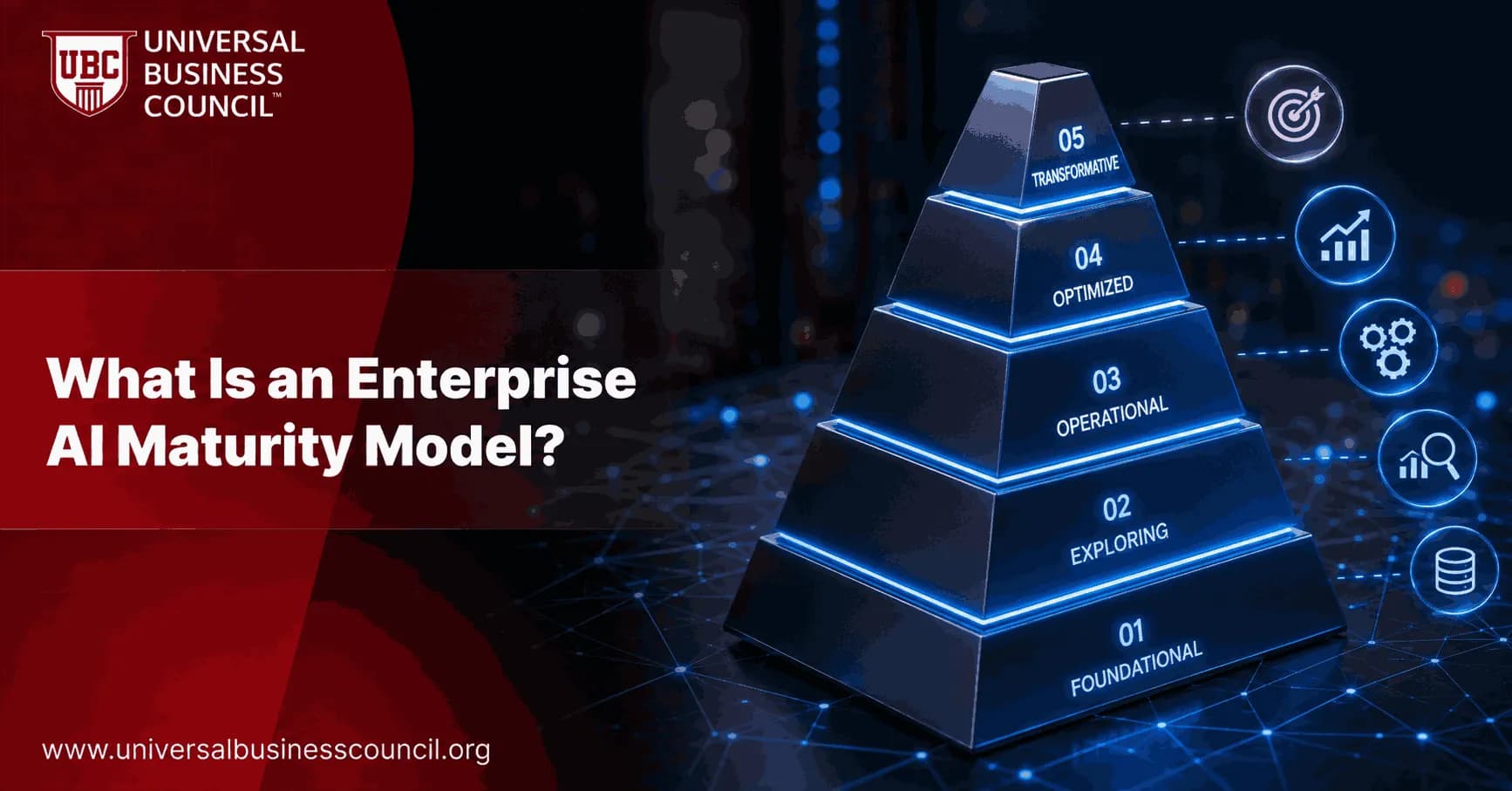
An Enterprise AI Maturity Model is a structured framework that helps an organization understand how prepared it is to adopt, scale, govern, and generate measurable value from artificial intelligence. Instead of asking only how many AI tools a company uses, a maturity model examines the broader capabilities behind successful AI adoption, including strategy, data, technology, governance, talent, workflows, and business outcomes.
This matters because AI maturity is not the same as AI experimentation. An organization can run dozens of pilots and still struggle to move successful projects into production. Research published by IBM in 2026 highlights that enterprise AI maturity increasingly depends on the systems surrounding AI, including scalable infrastructure, governance, security, and integration, rather than simply the sophistication of individual models.

For executives responsible for enterprise transformation, understanding maturity can also support the broader capabilities associated with a Certified Chief AI Officer (CAIO) role. A mature AI organization needs leadership that can connect technology decisions with business priorities, risk management, and measurable results.
What Is an Enterprise AI Maturity Model?
An Enterprise AI Maturity Model provides a way to evaluate an organization's current AI capabilities and identify what needs to improve before it can reach the next stage.
The model typically looks at both business and technical capabilities. IBM's enterprise AI maturity work, for example, treats AI maturity as a journey rather than a final destination and evaluates capabilities across multiple dimensions. Its more recent generative AI model describes five phases, progressing from consuming generic models and localized experimentation toward enterprise-wide governance, quantitative measurement, continuous refinement, and secure optimization.
A useful enterprise model therefore answers questions such as:
Is AI connected to business strategy?
Can the organization provide reliable data?
Does the technology environment support AI at scale?
Are AI risks governed consistently?
Do employees have the necessary skills?
Can successful AI use cases move from pilot to production?
Can leadership demonstrate measurable business value?
The answers reveal where the organization is strong and where investment is required.
Why Do Enterprises Need an AI Maturity Model?
AI adoption can happen unevenly across a large organization. One department may have sophisticated AI workflows while another is still experimenting with basic tools. Without a common assessment, leadership may struggle to understand the overall situation.
A maturity model creates a shared language.
It can help executives compare business units, prioritize investments, identify capability gaps, and establish realistic expectations for AI transformation.
It also prevents a common mistake: assuming that purchasing advanced AI technology automatically creates an advanced AI organization.
A company may have access to powerful models but lack the data governance, infrastructure, employee skills, security controls, or workflow integration needed to use them effectively.
In 2026, IBM reported that only 25% of surveyed executives strongly agreed that their organization's IT infrastructure could support scaling generative AI across the enterprise. The finding illustrates why infrastructure and organizational systems are important parts of AI maturity.
The Core Dimensions of Enterprise AI Maturity
A useful maturity model should examine multiple dimensions rather than assigning a score based on technology adoption alone.
AI Strategy and Leadership
The first question is whether AI has a clear strategic purpose.
An immature organization may have disconnected experiments initiated by individual teams. A more mature organization has an enterprise AI strategy, defined priorities, executive sponsorship, investment criteria, and clear ownership.
Leadership should understand which AI initiatives are strategic, which are experimental, and which should be discontinued.
The organization should also establish decision rights. Someone needs authority over AI priorities, governance, risk escalation, and enterprise standards.
Data and Information Readiness
Data is one of the most important foundations of enterprise AI.
Organizations should evaluate whether important data is accessible, accurate, consistent, secure, and appropriately governed. They should also understand who owns critical datasets and how information can be used by AI applications.
Poor data can prevent an otherwise promising AI project from reaching production.
A mature organization therefore treats data quality and governance as ongoing capabilities rather than one-time technical projects.
Technology and Infrastructure
Technology maturity involves more than access to an AI model.
Enterprises need infrastructure capable of supporting AI applications reliably. This can include cloud platforms, APIs, model management, integration architecture, identity controls, monitoring, cybersecurity, and computing resources.
As AI moves toward agents that can interact with business systems and perform actions, technical maturity becomes even more important. AI systems need secure access to tools and data, clear permissions, monitoring, and appropriate human oversight.
Governance and Responsible AI
Governance determines whether AI can be deployed safely and consistently.
A mature organization should have processes for privacy, security, intellectual property, model evaluation, bias, explainability, human oversight, vendor management, incident response, and regulatory compliance.
This area is becoming increasingly important as AI systems become more autonomous. McKinsey's 2026 AI trust research identifies strategy, risk management, data and technology, governance, and agentic AI controls as important dimensions of responsible AI maturity.
Governance should be integrated into the AI lifecycle rather than added after deployment.
People and AI Skills
Technology cannot create enterprise transformation without people who understand how to use it.
AI maturity therefore includes employee training, technical expertise, leadership capability, change management, and AI literacy.
Employees should know what approved AI tools can do, where human judgment is required, how to verify outputs, and what information should not be entered into AI systems.
Organizations developing these capabilities can explore Artificial Intelligence Certifications as part of a broader professional learning strategy.
AI Adoption and Workflow Integration
An organization can have sophisticated AI technology and still have low maturity if employees rarely use it or if AI remains disconnected from everyday workflows.
Mature organizations redesign processes around AI where appropriate.
For example, an AI assistant should not simply be added to a customer service process while employees continue performing every manual step around it. The workflow itself may need to change.
IBM's current enterprise AI research emphasizes this broader systems perspective, arguing that mature AI capabilities depend on integration into the organization's operating fabric rather than isolated tools.
Business Value and Measurement
The final question is whether AI is producing measurable value.
Organizations should connect AI initiatives to metrics such as revenue, cost reduction, productivity, customer satisfaction, quality, cycle time, risk reduction, or employee capacity.
A mature organization knows which AI initiatives are producing value and which should be redesigned or stopped.
Five Levels of Enterprise AI Maturity
There is no single universal maturity scale that every company must use. However, a five-level model can make the concept easy to understand.
Level 1: Experimental
AI use is mostly individual or departmental. Employees experiment with available tools, but there is little standardization, limited governance, and no consistent enterprise strategy.
The organization is learning what AI can do, but adoption is fragmented.
Level 2: Emerging
The organization begins identifying priority use cases and establishing basic governance.
Pilot projects become more structured. Employees receive introductory training, and leadership begins evaluating AI investments more systematically.
The organization is moving beyond curiosity toward intentional adoption.
Level 3: Managed
AI governance, data practices, and technology standards become more consistent.
Successful pilots begin moving into production. The organization establishes clearer ownership, measurement processes, and enterprise standards.
This is often the stage where AI shifts from isolated experimentation toward a coordinated business capability.
Level 4: Scaled
AI is integrated into important workflows across multiple functions.
The organization has stronger monitoring, governance, training, infrastructure, and investment processes. AI capabilities may be reused across departments rather than rebuilt separately for every project.
Level 5: Transformative
AI becomes part of how the organization operates and competes.
The enterprise continuously identifies opportunities, redesigns workflows, integrates AI into products and services, and uses data to improve AI-enabled operations.
At this level, AI is no longer treated as a collection of projects. It becomes part of the operating model.
How Should an Enterprise Assess Its AI Maturity?
A practical assessment can score each major dimension from one to five.
For example, a company could assess strategy, data, technology, governance, talent, adoption, and business value separately.
Suppose technology scores 4 but governance scores 2. The organization may be technically capable of deploying AI but not organizationally prepared to scale it safely.
Similarly, strong governance combined with weak data readiness indicates a different investment priority.
The purpose of scoring is not to create an impressive dashboard. It is to identify the next most important capability gap.
AI Maturity Is a Journey, Not a Final Score
AI capabilities change rapidly. A company that reaches a high maturity level today may face new challenges as AI agents, multimodal systems, autonomous workflows, and new regulatory expectations become more widespread.
IBM's generative AI maturity model similarly describes maturity as progression toward continuous refinement, stronger governance, quantitative measurement, and increasingly sophisticated AI capabilities.
For this reason, enterprises should reassess maturity periodically.
A six-month or annual assessment can reveal whether the organization is improving, where new risks have appeared, and whether its AI strategy still matches business priorities.
Common Enterprise AI Maturity Mistakes
One mistake is measuring maturity by the number of AI applications deployed. More applications do not automatically mean greater maturity.
Another is focusing entirely on technology while ignoring people and processes.
Some companies also create complicated maturity frameworks that generate scores but do not lead to decisions.
A useful model should answer a practical question:
What capability should we improve next to create greater AI value with manageable risk?
That answer is more important than the score itself.
The Role of Technology Leadership
Enterprise AI maturity requires leaders who understand the relationship between business strategy, AI, data, infrastructure, cybersecurity, governance, and organizational change.
Technical knowledge helps leaders evaluate platforms and architecture. Business knowledge helps them prioritize use cases. Governance knowledge helps them manage risk.
Professionals seeking broader technology knowledge can explore Tech Certification options alongside specialized AI learning.
For large enterprises, this responsibility may involve a Chief AI Officer working closely with the CIO, CTO, CDO, CISO, legal teams, finance, human resources, and business-unit leaders.
How to Improve Enterprise AI Maturity
Improvement should begin with the weakest capabilities that are most important to the organization's AI goals.
If data is the main constraint, improve data quality and accessibility.
If governance is weak, establish risk classification, approval processes, monitoring, and clear accountability.
If employee adoption is poor, improve training and redesign workflows.
If pilots are not reaching production, examine infrastructure, integration, ownership, funding, and operational readiness.
This approach is more effective than trying to improve every dimension simultaneously.
Encouraging Technology Learning From an Early Age
Technology learning can begin well before students enter higher education or professional careers. Designed to encourage technology learning among school students, the World Tech Olympiad (WTO) brings together participants from Class 2 to Class 12 through different technology-focused challenges. Its areas include robotics, AI, programming, computational thinking, and cybersecurity, with competition levels structured to suit different age groups and abilities.
The Olympiad supports participation through separate routes for families and educational institutions. Parents can enroll their children directly, while schools can register as institutions and facilitate participation for students who meet the eligibility requirements. Early exposure to these areas can help students develop problem-solving, computational thinking, and technology skills that may provide a useful foundation for advanced education and future careers in AI, engineering, cybersecurity, and other technology fields.
Conclusion
An Enterprise AI Maturity Model gives organizations a structured way to understand where they are on their AI journey and what they need to do next.
The strongest models evaluate strategy, leadership, data, technology, governance, people, adoption, workflow integration, and business value. They recognize that AI maturity is not determined by the number of models or tools an organization owns.
The real measure is whether an enterprise can repeatedly identify valuable AI opportunities, deploy them responsibly, integrate them into real work, measure their outcomes, and scale successful capabilities.
As enterprises move toward increasingly autonomous AI systems, maturity will become less about experimenting with individual tools and more about building the systems, governance, infrastructure, and workforce capabilities required to make AI a durable part of the business.
For professionals interested in emerging technology beyond conventional AI, Deep Tech Certification can complement AI-focused learning with broader exposure to advanced technology domains.
FAQs
1. What is an Enterprise AI Maturity Model?
An Enterprise AI Maturity Model is a structured framework used to assess how capable an organization is at adopting, deploying, governing, scaling, and creating business value from artificial intelligence.
It typically evaluates areas such as AI strategy, leadership, use cases, data, technology, governance, security, talent, operating models, adoption, and ROI. The purpose is not merely to determine whether a company “uses AI,” but whether it can repeatedly convert AI investments into measurable and responsibly managed business outcomes.
2. Why do companies need an Enterprise AI Maturity Model?
Companies use an Enterprise AI Maturity Model to understand their current AI capabilities, identify gaps, establish priorities, and create a realistic improvement roadmap.
Without a maturity framework, organizations may invest heavily in advanced models while lacking basic data, governance, employee skills, or production capabilities.
The model gives executives a common way to discuss readiness and determine what must improve before AI can scale. Buying increasingly sophisticated AI tools is, regrettably, not a substitute for organizational capability.
3. What does an Enterprise AI Maturity Model measure?
A comprehensive model measures both the organization's AI capabilities and its ability to generate business outcomes.
Common dimensions include strategy, executive leadership, use-case portfolio management, data readiness, technology architecture, AI governance, cybersecurity, talent, operating model, delivery processes, adoption, and value measurement.
More mature organizations demonstrate repeatable capabilities across these areas instead of relying on isolated teams or individual AI projects.
4. What are the main dimensions of enterprise AI maturity?
A practical Enterprise AI Maturity Model can evaluate twelve dimensions:
Strategy and Leadership, Use Cases, Data, Technology, Governance, Responsible AI, Cybersecurity, Talent, Operating Model, Delivery, Adoption, and ROI Measurement.
These dimensions are interconnected. Weak data can limit model performance, poor governance can prevent scaling, and inadequate adoption can destroy the economics of an otherwise successful system.
That is why evaluating AI maturity solely through technology gives a rather flattering and incomplete picture.
5. What are the five levels of AI maturity?
A common approach uses five AI maturity levels representing increasing organizational capability.
Level | Maturity Stage | Description |
|---|---|---|
1 | Initial | AI is experimental and fragmented |
2 | Developing | Formal pilots and basic capabilities emerge |
3 | Operational | AI reaches production through repeatable processes |
4 | Scaled | AI is standardized across the enterprise |
5 | Transformational | AI is embedded in strategy and operating models |
Organizations may use different names, but the basic progression generally moves from experimentation toward repeatable enterprise-scale value creation.
6. What does Level 1 AI maturity look like?
At Level 1: Initial, AI activity is largely experimental and decentralized.
Individual teams may test generative AI, machine learning, or automation tools without an enterprise strategy. AI ownership is unclear, governance is limited, data readiness varies significantly, and most projects remain proofs of concept.
Success is often measured through activity, such as the number of pilots, rather than business outcomes.
The company is learning about AI, but it does not yet have repeatable capabilities for managing it.
7. What does Level 2 AI maturity look like?
At Level 2: Developing, the organization begins introducing structure around AI.
Leadership may establish AI priorities, approved tools, early governance policies, training programs, and formal pilot processes. Some business units start identifying use cases systematically.
However, implementation remains inconsistent and scaling is difficult.
Organizations at this stage are moving from uncontrolled experimentation toward coordinated adoption, though different departments may still be enthusiastically reinventing approximately the same AI assistant.
8. What does Level 3 AI maturity look like?
At Level 3: Operational, organizations can move selected AI initiatives from business case to production through repeatable processes.
Clearer ownership, technical standards, governance, evaluation, monitoring, and data practices are established. Employees begin using AI within real workflows, and business outcomes are increasingly measured.
AI is no longer primarily experimental.
The major challenge shifts from proving that AI can work to determining how successful capabilities can be scaled economically and consistently.
9. What does Level 4 AI maturity look like?
At Level 4: Scaled, AI capabilities are standardized and reused across departments, products, or geographies.
The organization has mature shared platforms, governance, security, monitoring, talent development, portfolio management, and adoption programs.
Successful use cases can be replicated efficiently rather than rebuilt independently.
Leadership increasingly manages AI as an enterprise investment portfolio, comparing projected and realized value while reallocating resources toward applications producing stronger results.
10. What does Level 5 AI maturity look like?
At Level 5: Transformational, AI becomes deeply embedded in business strategy, products, workflows, decision-making, and operating models.
The organization may redesign end-to-end processes around human-AI collaboration, develop AI-enabled products, use carefully governed AI agents, and continuously optimize its AI portfolio.
Importantly, Level 5 does not mean automating everything because someone discovered agents.
It means AI capabilities are deployed strategically where they create sustainable advantage while appropriate human oversight and governance remain in place.
11. How is enterprise AI maturity assessed?
An enterprise AI maturity assessment typically combines leadership interviews, employee surveys, documentation reviews, technology assessments, AI inventories, portfolio data, governance evidence, adoption metrics, and financial performance information.
Each maturity dimension is scored using predefined criteria.
Evidence is important because organizations often perceive themselves as more mature than their operational practices suggest.
A written AI policy, for example, demonstrates considerably less maturity if nobody follows it and nobody knows where it is stored.
12. How do you calculate an Enterprise AI Maturity Score?
Organizations can assign each dimension a score from 1 to 5 and calculate either a simple average or a weighted score.
A weighted formula is:
Enterprise AI Maturity Score = Σ(Dimension Score × Dimension Weight)
For example:
Dimension | Weight | Score |
|---|---|---|
Strategy & Leadership | 15% | 4 |
Use Cases | 10% | 3 |
Data | 15% | 3 |
Technology | 10% | 4 |
Governance & Security | 15% | 2 |
Talent | 10% | 3 |
Operating Model | 10% | 3 |
Adoption | 10% | 2 |
ROI Measurement | 5% | 2 |
The overall score provides a useful summary, while individual dimension scores reveal where action is required.
13. How should AI maturity dimensions be weighted?
Weights should reflect the organization's strategy, industry, risk profile, and AI ambitions.
A highly regulated organization might assign greater weight to governance, security, data, and responsible AI. An AI-native technology business might emphasize engineering, data, innovation, and product capabilities.
Weights should be defined before assessment results are known.
Changing them afterward because leadership dislikes the resulting score would certainly improve the number, though perhaps not the organization.
14. What is the difference between current and target AI maturity?
Current AI maturity describes the organization's capabilities today, while target AI maturity defines the level required to execute its future AI strategy.
The gap between the two determines the capability-building roadmap.
For example, a company might currently score Level 2 in governance but require Level 4 because it plans to deploy AI across regulated customer processes.
The objective is not necessarily to reach Level 5 everywhere. Target maturity should reflect actual business requirements.
15. Does every company need to reach the highest AI maturity level?
No. Companies should pursue the maturity required by their strategy rather than automatically targeting the highest level.
A smaller company using AI mainly for internal productivity may not require the same architecture, governance, specialist teams, or operating model as a global financial institution deploying AI into critical customer decisions.
A useful principle is:
Required AI Maturity = Strategic Importance + Scale + Complexity + Business Criticality + Risk
Maturity should therefore be purposeful rather than competitive score collecting.
16. How does AI governance change across maturity levels?
AI governance typically evolves from informal controls toward systematic lifecycle management.
At lower maturity levels, organizations may rely on basic acceptable-use policies and manual reviews. Intermediate maturity introduces AI inventories, risk classifications, approval processes, evaluations, documentation, and monitoring.
Higher maturity integrates governance directly into development, procurement, deployment, and production operations.
Governance becomes more automated and risk-based as scale increases, allowing lower-risk applications to move faster while higher-risk systems receive stronger scrutiny.
17. How does employee AI adoption change across maturity levels?
Employee adoption generally progresses through several stages:
Experimentation → Approved Access → Regular Usage → Workflow Integration → Operating-Model Transformation
At lower maturity, employees independently experiment with AI tools. At intermediate levels, organizations provide approved systems, training, and role-specific use cases.
At higher maturity, AI becomes embedded in everyday workflows and processes are deliberately redesigned around human-AI collaboration.
The meaningful measure is not how many employees have access. It is whether AI changes work and improves measurable outcomes.
18. How does AI ROI measurement change as maturity increases?
At lower maturity, companies often measure activity through pilots, licenses, users, prompts, or demonstrations.
Intermediate organizations begin tracking productivity, adoption, process improvements, and project-level ROI.
Advanced organizations measure realized financial value, payback, portfolio ROI, risk-adjusted returns, and forecast-versus-actual performance.
The progression can be summarized as:
AI Activity → AI Adoption → Operational Impact → Financial Value → Portfolio Optimization
This is roughly the point at which the CFO becomes considerably more interested in the AI maturity discussion.
19. How often should an Enterprise AI Maturity Model be reassessed?
A comprehensive assessment can generally be conducted annually, although organizations undergoing rapid AI transformation may benefit from reviews every six months.
Specific dimensions such as governance, adoption, technology, and portfolio performance may need more frequent monitoring.
The assessment methodology should remain reasonably consistent so progress can be compared over time.
Otherwise, organizations risk improving their maturity score primarily by changing the questions, which is efficient but somewhat misses the educational purpose.
20. What is a practical Enterprise AI Maturity Model framework?
A practical Enterprise AI Maturity Model should evaluate organizational capabilities across consistent dimensions and translate assessment results into an improvement roadmap.
Dimension | Level 1 | Level 3 | Level 5 |
|---|---|---|---|
Strategy | Ad hoc AI | Defined AI strategy | AI embedded in corporate strategy |
Leadership | Fragmented | Clear ownership | Enterprise accountability |
Use Cases | Experiments | Prioritized portfolio | Continuous portfolio optimization |
Data | Fragmented | Managed for priority AI | Enterprise AI-ready data |
Technology | Isolated tools | Production architecture | Reusable AI ecosystem |
Governance | Informal | Defined controls | Integrated lifecycle governance |
Security | Reactive | AI security standards | Continuous AI security management |
Talent | Individual experts | Structured capability | Enterprise AI workforce |
Operating Model | Unclear | Defined roles | Integrated cross-functional model |
Adoption | Experimentation | Workflow adoption | AI-enabled operating model |
Delivery | Pilots | Repeatable production | Continuous scalable delivery |
ROI | Activity metrics | Project value | Portfolio-level optimization |
The maturity journey can then be visualized as:
LEVEL 1: INITIAL
Scattered experiments and limited controls.
↓
LEVEL 2: DEVELOPING
Formal pilots, approved tools, early governance, and growing AI literacy.
↓
LEVEL 3: OPERATIONAL
Repeatable production deployment, defined ownership, and measurable outcomes.
↓
LEVEL 4: SCALED
Shared platforms, enterprise governance, widespread adoption, and portfolio management.
↓
LEVEL 5: TRANSFORMATIONAL
AI embedded in strategy, products, workflows, workforce design, and business models.
A company can use the model through a straightforward process:
Assess Current State → Score Each Dimension → Define Target State → Identify Gaps → Prioritize Capabilities → Build Roadmap → Invest → Measure Progress → Reassess
The most useful output is therefore not the final maturity number.
It is the gap between the organization's AI ambition and its ability to execute that ambition.
For example:
High AI Ambition + Low Governance Maturity = Risk
High AI Ambition + Low Data Maturity = Execution Problems
High Technology Maturity + Low Adoption = Weak Value
High Adoption + Low Security Maturity = Exposure
High AI Spending + Low ROI Maturity = Unclear Returns
A good Enterprise AI Maturity Model makes these imbalances visible.
Ultimately, enterprise AI maturity means an organization can repeatedly move from:
Business Need → Prioritized AI Use Case → Production Deployment → Adoption → Measurable Value → Responsible Scale
That is a considerably higher standard than possessing an AI strategy document, a collection of pilots, and several executives who have recently learned the phrase “agentic workflow.”
Related Articles
View All
Chief Ai Officer
How to Choose the Right AI Model for an Enterprise
Choosing the right AI model for an enterprise requires balancing business requirements with accuracy, cost, latency, security, privacy, scalability, and integration needs. Learn how to evaluate proprietary and open models, benchmark them against real workloads, and select models based on measurable business outcomes rather than leaderboard scores alone.
Chief Ai Officer
How to Build an Enterprise AI Agent Strategy
An enterprise AI agent strategy defines how organizations can identify, deploy, govern, and scale agentic AI across business operations. Learn how to prioritize high-value agent use cases, design the right architecture, establish permissions and human oversight, manage security risks, and measure business outcomes.
Chief Ai Officer
How AI Agents Are Changing Enterprise Operations
AI agents are changing enterprise operations by automating multi-step workflows, coordinating tasks across business systems, supporting employees, and making certain decisions with greater autonomy. Explore how agentic AI is transforming areas such as customer service, IT, finance, HR, sales, and supply chain operations.
Trending Articles
The Role of Blockchain in Ethical AI Development
How blockchain technology is being used to promote transparency and accountability in artificial intelligence systems.
AWS Career Roadmap
A step-by-step guide to building a successful career in Amazon Web Services cloud computing.
Top 5 DeFi Platforms
Explore the leading decentralized finance platforms and what makes each one unique in the evolving DeFi landscape.