

Essential AI Tools for Digital Marketers to Grow Campaigns
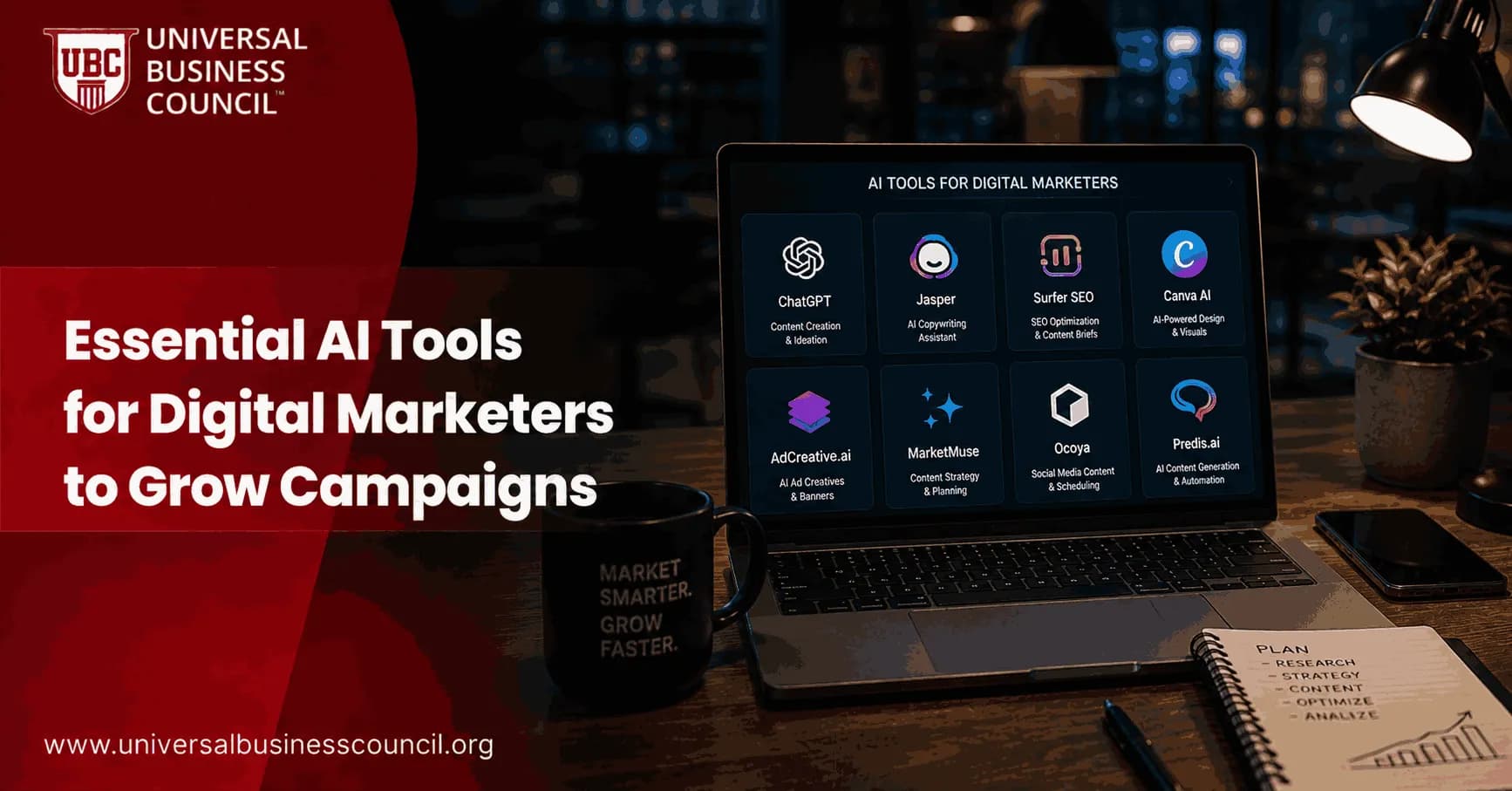
AI tools for digital marketers have moved from optional experiments to an essential part of modern campaign growth. Leading teams now use artificial intelligence across content creation, search engine optimization, paid media, analytics, personalization, and automation. The goal is not to replace marketing judgment, but to help professionals plan faster, test more ideas, and optimize campaigns with better data.
Industry guidance from organizations such as the Digital Marketing Institute consistently frames AI as a co-pilot for marketers. The most effective teams combine human strategy with AI-enabled execution, supported by clear governance, strong prompts, and performance measurement. For professionals developing these skills, Universal Business Council programmes in digital marketing, business analytics, and marketing management provide relevant learning pathways.

Why AI Matters for Campaign Growth
Campaign growth depends on speed, relevance, experimentation, and measurement. AI supports each of these priorities by helping teams:
Create more campaign assets without proportional increases in headcount.
Analyze audience behavior, search intent, and funnel friction more quickly.
Personalize messaging across email, ads, landing pages, and CRM journeys.
Automate repetitive tasks such as reporting, scheduling, segmentation, and lead routing.
Improve creative and copy testing through rapid variation generation.
The strongest marketers do not rely on a single tool. They build a practical AI marketing stack that connects ideation, content, creative, media buying, analytics, and automation.
1. Generative AI Assistants and Copywriting Tools
Generative AI assistants are often the starting point for AI adoption because they support everyday marketing work. Tools such as ChatGPT, Claude, Google Gemini, Jasper, and Copy.ai help marketers brainstorm, draft, rewrite, and adapt content.
How marketers use them
Generate blog outlines, content briefs, and first drafts.
Create headline, description, and call-to-action variations for ads.
Draft nurture email sequences and sales enablement messages.
Adapt content for different personas, regions, or buying stages.
Summarize research, customer interviews, and campaign performance notes.
These tools are most effective when marketers provide structured prompts, brand voice rules, target audience details, and campaign goals. Human review remains essential for accuracy, legal compliance, originality, and strategic fit.
2. SEO and Content Optimization Tools
AI-assisted content is only valuable if it attracts the right audience and satisfies search intent. SEO platforms such as Surfer SEO, Clearscope, and ContentShake AI help bridge the gap between writing and ranking.
Campaign growth applications
Identify keyword opportunities and topic clusters for content calendars.
Analyze top-ranking pages to understand search intent.
Improve on-page keyword coverage, structure, and readability.
Refresh existing content to capture more organic traffic.
Inform landing page structure for paid and organic campaigns.
A strong workflow may begin with ChatGPT or Claude for ideation, continue with Surfer SEO or Clearscope for optimization, and finish with human editing for authority and brand consistency. This approach improves both content velocity and search quality.
3. AI Creative Tools for Images, Video, Audio, and Design
Creative production has historically limited the number of campaign tests marketers could run. AI design, image, video, and audio tools reduce this bottleneck by helping teams produce more variations for social media, display ads, landing pages, ecommerce, and short-form video.
Representative tools include DALL-E 3, Midjourney, Lexica Art, Canva Magic Studio, Adobe Express, Runway, Descript, Kling AI, ElevenLabs, LALAL.AI, and PhotoRoom.
Where they add value
Create ad concepts, social graphics, and blog thumbnails quickly.
Produce short-form vertical videos for social platforms.
Repurpose webinars, podcasts, and long videos into campaign clips.
Generate voiceovers and localized audio assets.
Improve product images through background removal and enhancement.
Creative AI should be used with clear brand guidelines, image rights awareness, and review procedures. For enterprises, approvals and asset governance matter as much as production speed.
4. AI Advertising and Campaign Optimization Platforms
Paid media performance depends on budget allocation, bid decisions, targeting, creative testing, and message relevance. AI advertising platforms such as Albert.ai, Adext, and Acquisio help automate optimization across channels. Language-focused tools such as Persado and Phrasee support copy testing and message refinement.
Common use cases
Shift budgets toward high-performing campaigns, audiences, or creatives.
Optimize bids based on real-time performance signals.
Generate and test email subject lines, ad headlines, and descriptions.
Improve click-through rates and conversion rates through continuous testing.
Coordinate optimization across search, social, and programmatic campaigns.
These tools are especially useful for organizations managing larger budgets or many campaigns at once. Even so, marketers still need to define success metrics, monitor data quality, and prevent automation from optimizing toward the wrong goal.
5. Analytics, Personalization, and CRM Intelligence
AI campaign growth is strongest when connected to customer data. Platforms such as HubSpot AI, Salesforce Einstein, Optimove, Mixpanel, Pendo, and FullStory help marketers identify audience segments, predict intent, and improve customer journeys.
How these tools improve performance
Score leads based on likelihood to convert.
Segment audiences using behavioral and CRM data.
Identify funnel drop-off points on websites and apps.
Personalize content, offers, and follow-up messages.
Forecast pipeline and campaign contribution more accurately.
This category is critical for moving beyond one-size-fits-all campaigns. With better data and predictive insights, marketers can prioritize high-intent users, improve retention, and coordinate marketing with sales and customer success.
6. Social Media Marketing and Community Growth Tools
Social media requires consistent publishing, audience listening, and fast response. AI tools such as FeedHive, Flick AI, and Brand24 support content planning, hashtag strategy, post scheduling, social listening, and performance analysis.
Practical applications
Create and schedule multi-platform content calendars.
Recycle high-performing posts into new formats.
Identify the best posting times and hashtags.
Track brand mentions, sentiment, and influencer activity.
Monitor competitor conversations and industry trends.
When combined with generative copy and design tools, AI social platforms help small teams operate with the consistency of larger content operations.
7. Data Collection and Market Intelligence Tools
Campaign strategy improves when marketers understand competitor offers, customer language, market trends, and product demand. Tools such as Browse AI, Paradigm AI, and Algolia help collect, structure, and activate data.
Browse AI can monitor competitor websites, review platforms, pricing pages, and marketplace listings. Algolia applies AI to on-site search and product recommendations, helping ecommerce and content-heavy websites improve conversion from existing traffic.
8. Conversational Marketing and Meeting Intelligence
AI also supports campaign growth through real-time engagement and customer insight capture. Tools such as Chatfuel, Userbot.ai, ChatSpot.ai, Fireflies, and Guidde help marketers qualify leads, summarize meetings, and create support or onboarding content.
Use chatbots to answer common landing page questions and capture leads after hours.
Analyze sales calls to identify objections and message gaps.
Create video tutorials that improve product adoption and customer success.
Feed customer language back into ad copy, website copy, and email campaigns.
9. Automation, Workflows, and Agentic AI
AI becomes more powerful when integrated into repeatable workflows. Zapier, Gumloop, Notion AI, v0, and Durable help teams connect tools, automate campaign tasks, document processes, and build landing pages faster.
Examples of workflow automation
Send new leads from landing pages to CRM and email platforms automatically.
Trigger personalized follow-ups after downloads, demo requests, or webinar attendance.
Generate internal campaign briefs from form submissions or meeting notes.
Create rapid landing page prototypes for A/B testing.
Agentic AI is likely to become more important as tools gain the ability to complete multi-step tasks across systems. Marketers will need skills in workflow design, data governance, and quality control.
How to Choose the Right AI Marketing Stack
Instead of chasing every new tool, evaluate AI tools for digital marketers using a structured checklist:
Use case fit: Does the tool solve a real campaign bottleneck?
Data integration: Can it connect with your CRM, analytics, ad platforms, or CMS?
Governance: Does it support brand safety, privacy, review, and access control?
Measurement: Can you connect usage to traffic, leads, revenue, retention, or cost savings?
Team capability: Do marketers know how to prompt, evaluate, and improve outputs?
Professionals who want to strengthen these capabilities can explore Universal Business Council learning pathways in digital marketing strategy, AI in business, analytics, and management. These areas align closely with the skills required to evaluate tools, manage ethical risks, and lead AI-enabled marketing teams.
Conclusion
AI tools for digital marketers are now essential for campaign growth, but success depends on more than tool adoption. The strongest results come from combining generative AI, SEO optimization, creative production, advertising automation, analytics, CRM intelligence, social listening, and workflow orchestration into a coherent system.
Marketers should treat AI as a strategic capability rather than a shortcut. With clear goals, reliable data, human oversight, and continuous testing, AI can help teams create better campaigns faster and make more informed decisions. As AI becomes embedded in mainstream marketing platforms, professionals who build AI literacy and workflow design skills will be better prepared to lead the next phase of digital marketing performance.
FAQs
1. What Are AI Tools for Digital Marketers?
AI tools for digital marketers are software solutions that use artificial intelligence to automate tasks, analyze data, create content, optimize campaigns, and improve marketing performance.
2. Why Are AI Tools Important for Modern Marketing?
AI tools help marketers work more efficiently, make data-driven decisions, personalize customer experiences, and scale marketing efforts without proportionally increasing resources.
3. How Can AI Improve Content Marketing?
AI can assist with content ideation, article writing, content optimization, social media creation, video scripting, and content repurposing.
4. What AI Tools Are Commonly Used for Content Creation?
Marketers often use AI writing assistants, image generation platforms, video creation tools, and content optimization solutions to streamline content production.
5. How Can AI Support SEO Campaigns?
AI can help with keyword research, search intent analysis, content optimization, technical audits, competitor research, and ranking insights.
6. What AI Tools Are Useful for Keyword Research?
AI-powered SEO platforms can identify keyword opportunities, uncover topic clusters, analyze search intent, and reveal content gaps.
7. How Does AI Improve Email Marketing?
AI can personalize email content, optimize send times, automate customer journeys, segment audiences, and improve campaign performance.
8. What AI Tools Help with Marketing Automation?
Marketing automation platforms use AI to trigger campaigns, manage workflows, nurture leads, and personalize customer interactions across channels.
9. How Can AI Enhance Social Media Marketing?
AI can generate captions, recommend hashtags, schedule content, analyze audience behavior, monitor engagement, and identify trends.
10. What AI Tools Are Useful for Paid Advertising?
AI-powered advertising platforms can optimize bidding strategies, improve audience targeting, automate budget allocation, and enhance ad performance.
11. How Does AI Improve Customer Segmentation?
AI analyzes customer data to identify audience groups based on behavior, preferences, demographics, engagement patterns, and purchasing activity.
12. What Role Do AI Chatbots Play in Marketing?
AI chatbots support lead generation, customer engagement, customer support, appointment scheduling, and automated conversations.
13. How Can AI Improve Marketing Analytics?
AI can process large datasets, identify trends, automate reporting, forecast outcomes, and provide actionable performance insights.
14. What AI Tools Support Personalization?
Personalization platforms use AI to deliver customized content, product recommendations, offers, and experiences across customer touchpoints.
15. How Can AI Assist with Video Marketing?
AI can generate video scripts, create captions, edit content, repurpose videos, optimize performance, and automate production workflows.
16. What Is the Role of AI in Customer Journey Optimization?
AI helps identify customer behaviors, predict future actions, personalize interactions, and improve experiences throughout the buyer journey.
17. How Can Businesses Select the Right AI Marketing Tools?
Organizations should evaluate business goals, integration capabilities, scalability, ease of use, security requirements, and expected return on investment.
18. What Challenges Can Arise When Implementing AI Marketing Tools?
Challenges include integration complexity, data quality issues, employee training requirements, privacy concerns, and maintaining governance standards.
19. What Common Mistakes Should Marketers Avoid?
Common mistakes include adopting too many tools, automating poor processes, neglecting data quality, ignoring human oversight, and focusing on features instead of business outcomes. Acquiring twenty AI platforms does not automatically create a marketing strategy, despite what some software sales pages may imply.
20. What Are the Most Essential AI Tool Categories for Digital Marketers?
The most essential categories include content creation tools, SEO platforms, marketing automation systems, email marketing solutions, analytics tools, chatbot platforms, personalization engines, paid advertising optimization tools, customer data platforms, and social media management solutions. Together, these tools help marketers improve efficiency, scale campaigns, and drive measurable business growth.
Related Articles
View AllDigital Marketing
KPIs for Digital Marketing Campaigns in Programmatic Advertising
Learn how to choose KPIs for digital marketing campaigns using programmatic advertising, from reach and CTR to CPA, ROAS, CAC, and revenue impact.
Digital Marketing
How Digital Marketing and Programmatic Advertising Drive Smarter Campaigns
Learn how digital marketing and programmatic advertising combine strategy, data, automation, and measurement to build smarter campaigns.

Digital Marketing
AI-Powered Customer Segmentation: A Practical Guide for Digital Marketers
A practical guide to AI-powered customer segmentation for digital marketers, covering data inputs, models, use cases, implementation, and governance.
Trending Articles
The Role of Blockchain in Ethical AI Development
How blockchain technology is being used to promote transparency and accountability in artificial intelligence systems.
AWS Career Roadmap
A step-by-step guide to building a successful career in Amazon Web Services cloud computing.
Top 5 DeFi Platforms
Explore the leading decentralized finance platforms and what makes each one unique in the evolving DeFi landscape.