

Marketing Measurement with AI: Better Attribution, MMM, and Incrementality Testing
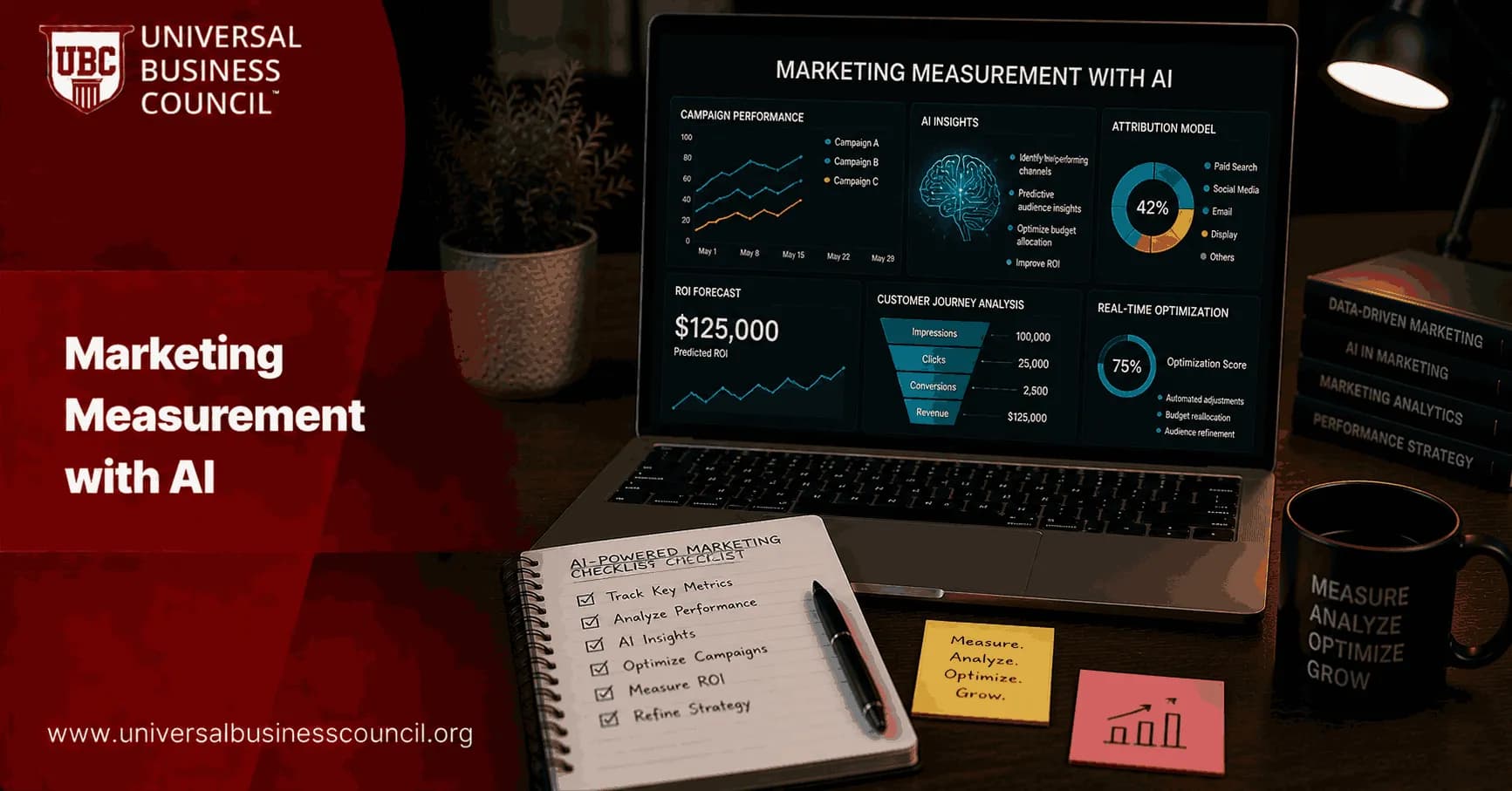
Marketing measurement with AI is rapidly becoming the standard approach for teams that need reliable performance insights amid privacy restrictions, fragmented media, and AI-mediated discovery. Traditional last-click attribution was built for a more observable customer journey. Today, browsers limit tracking, mobile platforms restrict identifiers, and discovery often happens in recommendation feeds or AI-generated answers where referrers and clicks can be incomplete or missing.
The practical response is a hybrid measurement stack that combines AI-enhanced marketing mix modeling (MMM) for strategic planning, probabilistic attribution where signal exists, and systematic incrementality testing to validate what is truly causal. This article explains how the stack works, what AI changes, and how to implement measurement that holds up under uncertainty.

As measurement becomes more complex across privacy-restricted and AI-driven environments, a Digital Marketing Expert must be able to interpret performance signals from multiple sources rather than relying on a single attribution model. This shift requires a stronger understanding of causality, data quality, and cross-channel measurement frameworks.
Why Marketing Measurement Is Being Rebuilt
Several structural forces are pushing organizations to modernize measurement:
Privacy and signal loss: Browser tracking prevention, iOS app tracking controls, cookie deprecation, and regulations such as GDPR and CCPA reduce user-level visibility and break cross-site paths.
AI-mediated discovery: Consumers increasingly discover brands through AI-ranked feeds, recommendations, and LLM-style experiences where click-based tracking is less transparent.
Channel fragmentation: Walled gardens, retail media, CTV, influencers, affiliates, and offline channels rarely share identifiers, limiting deterministic attribution.
Faster decision cycles: Businesses want weekly or even daily planning feedback loops. Legacy MMM often took weeks, relied on scarce specialists, and produced outputs too slowly for modern operations.
Measurement platforms and enterprise vendors increasingly position AI as a way to make marketing measurement faster and more accessible by automating data preparation and accelerating model building. In parallel, practitioner consensus is converging on triangulation: MMM for budget planning, attribution for tactical optimization where feasible, and experiments to validate incrementality.
How AI Changes Marketing Measurement Workflows
AI is not a single model that replaces analytics. In practice, it is a set of capabilities applied across the measurement pipeline, from data readiness to causal validation.
1) Data Unification and Quality Control
Many measurement failures are data problems, not model problems. AI is increasingly used to:
Automate schema matching and normalization across ad platforms, CRM, web analytics, and offline sources.
Detect anomalies and outliers in spend, conversions, and tagging, then flag or auto-correct common issues.
Improve entity resolution - for example, mapping inconsistent campaign naming conventions into a consistent taxonomy.
This reduces the operational burden of maintaining an analysis-ready dataset, which is foundational for MMM, attribution, and experimentation.
2) Modern MMM for Planning and Forecasting
Marketing mix modeling has evolved from occasional econometric studies into more continuous, AI-augmented systems. Modern MMM estimates the incremental contribution of each channel while controlling for non-media drivers such as seasonality, pricing, promotions, macro conditions, and distribution changes. AI helps MMM scale to more variables and update more frequently.
Enterprise solutions position AI-powered MMM as a way to unify performance, spend, and external factor data, then produce scenario plans and optimization recommendations. Industry research commissioned by major vendors reports that 61% of marketers consider faster and more reliable MMM essential for long-term scenario planning and growth, reflecting strong demand for modernized workflows.
3) Probabilistic Attribution Beyond Last-Click
Attribution still matters, but deterministic user-path models are less reliable when identifiers disappear and journeys span many environments. AI-driven attribution increasingly means probabilistic, model-based approaches that estimate contribution from partial, aggregated, or incomplete data.
Common modeling approaches include Markov chain removal effects, Shapley value credit allocation, and time-to-conversion models. The goal is not perfect reconstruction of every path, but a more realistic estimate of contribution than last-click - particularly for upper-funnel channels that drive demand without capturing the final conversion event.
4) Incrementality Testing and Uplift Modeling
Incrementality asks a causal question: What happened because of marketing that would not have happened otherwise? As platforms and algorithms optimize toward proxy metrics, incrementality becomes the check that keeps measurement honest.
AI contributes by improving experiment design - for example, selecting matched geographies - reducing noise in analysis through hierarchical approaches, and enabling uplift modeling to predict which audiences are most likely to respond incrementally.
Marketing Mix Modeling with AI: What Professionals Should Know
MMM is often the backbone of marketing measurement with AI because it is privacy-resilient and can include both online and offline channels. It typically operates on aggregated time-series data, which makes it well-suited to a world with fewer user-level identifiers.
What Has Changed Versus Legacy MMM
Higher frequency: Updates can run weekly or faster, rather than quarterly or annually.
Greater granularity: Models may estimate impact by region, product line, audience group, or campaign cluster.
Richer controls: Non-media factors such as promotions, pricing, and macro indicators can be incorporated more flexibly.
Scenario planning: Teams can simulate budget shifts, forecast outcomes, and estimate marginal ROI at different spend levels.
AI and ML Techniques Used in Modern MMM
Vendors may abstract the details, but practitioners benefit from understanding what is under the hood:
Regularized regression (ridge, LASSO, elastic net) to handle many correlated inputs.
Bayesian hierarchical models to share information across regions or segments and stabilize estimates.
Non-linear response curves to represent saturation and diminishing returns, often via transformations or flexible functional forms.
Automated model selection to balance fit, stability, and interpretability.
The best MMM programs translate model outputs into business-ready artifacts: incremental contribution, ROI, marginal ROI, confidence ranges, and recommended budget allocations.
Attribution with AI: Moving from Deterministic to Probabilistic
Last-click attribution is easy to explain and implement, but it is structurally biased toward channels that sit closest to conversion. It also breaks when journeys are incomplete due to privacy restrictions or when discovery happens in non-click environments.
When Probabilistic Attribution Is Useful
In-platform optimization where consistent signals exist within a walled garden.
Owned-data environments with reliable first-party identifiers and consented event collection.
Partner and affiliate ecosystems where influence may occur without a clean last-click, including mention-based discovery in AI-generated results.
One emerging use case is measuring influence in AI-mediated experiences by detecting brand or partner citations in AI outputs and modeling how that presence relates to downstream conversions. While still evolving, it reflects a broader shift: measuring influence beyond the click.
Incrementality Testing: The Validation Layer for AI-Optimized Media
Models infer; experiments validate. MMM and attribution can be distorted by seasonality, competitor activity, demand shocks, and platform-reported conversions that may not be causal. Incrementality testing provides a credible counterfactual and a check on model accuracy.
Common Experiment Approaches
Geo experiments: Useful when user-level randomization is difficult. AI can help select matched regions and adjust for macro variation.
Holdouts: Audience or campaign holdouts to estimate lift versus no exposure.
Platform lift studies: Helpful, but best interpreted alongside internal models and independent experiments.
Advanced teams embed always-on testing into key channels - paid search, paid social, and retail media - and use AI to prioritize what to test, reduce noise, and generalize learnings across markets.
Building a Hybrid Measurement Stack: A Practical Blueprint
Most organizations should avoid searching for a single source of truth. A more reliable approach is to align measurement methods to specific decisions.
Step 1: Define Decisions and Success Metrics
Strategic: annual and quarterly budget allocation, channel mix, regional investment.
Tactical: creative rotation, bidding, audience targeting, frequency management.
Executive: revenue impact, profit, payback period, risk, and uncertainty.
Step 2: Establish a Data Foundation That Survives Privacy Constraints
Standardize campaign taxonomy and cost data across platforms.
Maintain consistent conversion definitions across teams.
Integrate offline signals where relevant - promotions, distribution, pricing.
Use aggregated, privacy-aware measurement where user-level data is unavailable.
Building a resilient measurement infrastructure requires expertise in data systems, analytics platforms, automation, and privacy-aware technologies. A Tech Certification can help professionals strengthen their understanding of the technical foundations that support modern marketing measurement and decision-making.
Step 3: Deploy MMM for Planning and Marginal ROI
Run AI-enhanced MMM as an always-on system where feasible. Use it to estimate response curves, forecast scenarios, and identify diminishing returns. Treat MMM outputs as directional guidance and validate with experiments before making major budget shifts.
Step 4: Use Probabilistic Attribution for Within-Channel Optimization
Apply attribution where signal is strong and decisions are granular. Keep the focus on relative comparisons and incremental proxies rather than absolute truth. When channels or environments are opaque, rely more heavily on MMM and experiments.
Step 5: Institutionalize Incrementality Testing
Create an experiment calendar and minimum testing standards. For example:
Reserve a fixed percentage of spend for tests and holdouts.
Prioritize tests where budgets are large or uncertainty is high.
Feed experiment results back into MMM priors, response curves, and governance.
Skills and Governance: What Teams Need to Operate Marketing Measurement with AI
As AI automates the mechanics of measurement, the differentiator becomes judgment: asking good causal questions, stress-testing assumptions, and aligning stakeholders around shared definitions.
Causal literacy: Understanding counterfactuals, bias, and when correlation fails as a guide to action.
Model interpretation: Reading ROI and marginal ROI with appropriate uncertainty, not as fixed numbers.
Cross-functional alignment: Marketing, analytics, finance, and product agreeing on definitions and decision rules.
Ethics and privacy: Ensuring measurement practices meet regulatory and consent expectations.
For teams building formal capability, structured training and certification can help establish consistent standards. Universal Business Council programs in Digital Marketing, Marketing Analytics, AI for Business, and Data Science can support measurement literacy across marketing and leadership functions.
As AI becomes central to measurement and forecasting, an AI Certification can help professionals better evaluate models, interpret insights, and apply AI responsibly in marketing analytics and decision-making.
Conclusion: Triangulated, AI-Assisted Measurement
Marketing measurement with AI is best understood as a disciplined system, not a dashboard upgrade. Privacy constraints, AI-mediated discovery, and fragmented channels make last-click attribution insufficient as a standalone approach. Organizations that adapt are building hybrid stacks: AI-enhanced MMM for strategic allocation, probabilistic attribution for tactical optimization where signal exists, and always-on incrementality testing to validate what is truly causal.
The outcome is not perfect certainty. It is better decision-making under uncertainty, with clear governance, faster feedback loops, and measurement that stays credible as the ecosystem continues to evolve.
FAQs
1. What Is Marketing Measurement?
Marketing measurement is the process of tracking, analyzing, and evaluating marketing activities to understand their impact on business outcomes such as revenue, conversions, customer acquisition, and brand growth.
2. Why Is Marketing Measurement Important?
Marketing measurement helps businesses identify what is working, optimize budget allocation, improve campaign performance, and make data-driven decisions.
3. How Is AI Transforming Marketing Measurement?
AI can process large datasets, uncover hidden patterns, improve forecasting accuracy, automate analysis, and provide deeper insights into marketing effectiveness.
4. What Is Marketing Attribution?
Marketing attribution is the practice of determining which marketing channels, campaigns, or touchpoints contribute to customer conversions and business results.
5. Why Is Attribution Challenging in Modern Marketing?
Customers often interact with multiple channels before converting, making it difficult to accurately determine which touchpoints influenced the final decision.
6. How Can AI Improve Attribution Models?
AI can analyze complex customer journeys, identify channel interactions, and assign credit more accurately than traditional rule-based attribution models.
7. What Are the Most Common Attribution Models?
Common attribution models include first-touch attribution, last-touch attribution, linear attribution, time-decay attribution, position-based attribution, and data-driven attribution.
8. What Is Data-Driven Attribution?
Data-driven attribution uses machine learning and statistical analysis to assign conversion credit based on the actual impact of each customer touchpoint.
9. What Is Marketing Mix Modeling (MMM)?
Marketing Mix Modeling (MMM) is a statistical technique used to measure the impact of various marketing channels and external factors on business performance.
10. Why Is MMM Becoming More Important?
As privacy regulations and tracking limitations increase, MMM provides a privacy-friendly way to evaluate marketing effectiveness using aggregated data.
11. How Does AI Enhance Marketing Mix Modeling?
AI improves MMM by processing larger datasets, identifying nonlinear relationships, generating faster insights, and producing more accurate forecasts.
12. What Is Incrementality Testing?
Incrementality testing measures whether a marketing activity generated additional outcomes that would not have occurred without the campaign.
13. Why Is Incrementality Testing Important?
Incrementality testing helps marketers distinguish between conversions truly driven by marketing efforts and conversions that would have happened naturally.
14. How Does AI Support Incrementality Testing?
AI can analyze control and test group data, detect patterns, estimate lift, and improve the accuracy of incremental impact calculations.
15. What Is Marketing Lift Measurement?
Lift measurement evaluates the increase in desired outcomes, such as sales or conversions, that can be directly attributed to a marketing campaign.
16. How Can Businesses Use AI to Improve Budget Allocation?
AI can identify the most effective channels, predict campaign performance, and recommend budget adjustments that maximize return on investment.
17. What Challenges Exist in AI-Powered Marketing Measurement?
Challenges include data quality issues, fragmented data sources, attribution complexity, privacy regulations, model transparency, and implementation costs.
18. How Can Businesses Measure Cross-Channel Marketing Performance?
Businesses can combine attribution models, MMM, incrementality testing, customer journey analytics, and AI-powered insights to evaluate performance across channels.
19. What Metrics Are Most Important in Modern Marketing Measurement?
Key metrics include customer acquisition cost (CAC), return on ad spend (ROAS), marketing ROI, customer lifetime value (CLV), conversion rate, incremental lift, and revenue contribution. Because counting clicks alone is a bit like judging a restaurant entirely by how many people looked at the menu.
20. What Is the Future of AI in Marketing Measurement?
The future includes more advanced attribution models, real-time marketing analytics, privacy-preserving measurement techniques, AI-driven forecasting, automated budget optimization, and increasingly accurate assessments of marketing effectiveness across complex customer journeys.
Related Articles
View All
Digital Marketing
AI Social Media Marketing: Tools and Tactics for Faster Creation and Better Engagement
Learn how AI social media marketing tools speed up creation, improve engagement, and support data-driven workflows for planning, listening, testing, and optimization.
Digital Marketing
KPIs for Digital Marketing Campaigns in Programmatic Advertising
Learn how to choose KPIs for digital marketing campaigns using programmatic advertising, from reach and CTR to CPA, ROAS, CAC, and revenue impact.
Digital Marketing
How AI and Automation Power Programmatic Advertising in Modern Digital Marketing
AI now drives programmatic advertising through automated bidding, targeting, creative optimization, privacy-safe identity, and cross-channel measurement.
Trending Articles
The Role of Blockchain in Ethical AI Development
How blockchain technology is being used to promote transparency and accountability in artificial intelligence systems.
AWS Career Roadmap
A step-by-step guide to building a successful career in Amazon Web Services cloud computing.
Top 5 DeFi Platforms
Explore the leading decentralized finance platforms and what makes each one unique in the evolving DeFi landscape.