

Supply Chain Professional Career Path: From Entry-Level Roles to Leadership
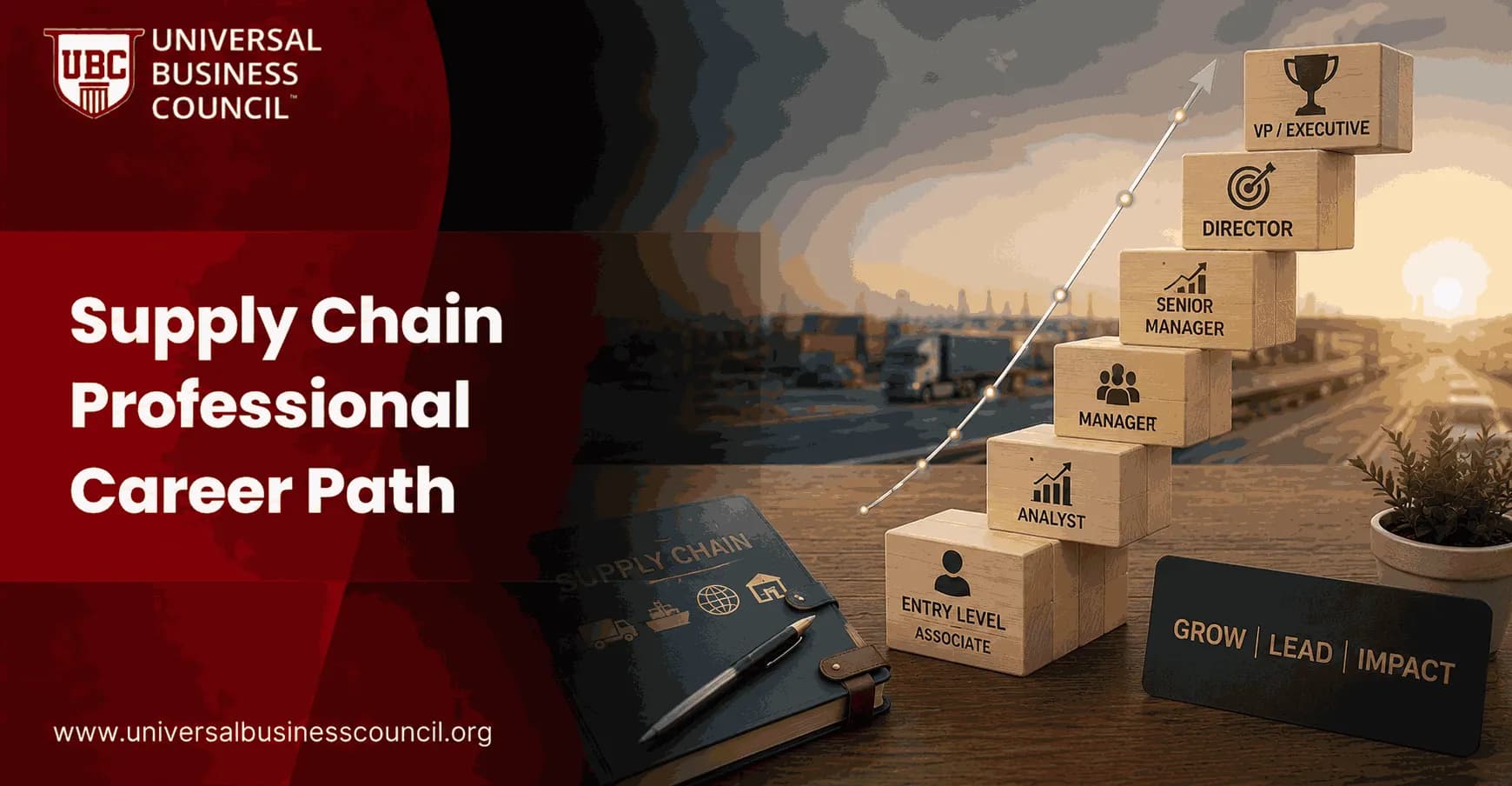
The supply chain professional career path is one of the clearer routes in modern management. You start close to the work, learn how goods, data, suppliers, and money move, then grow into planning, leadership, and enterprise strategy. The path is rarely straight. Good people move from logistics into buying, from demand planning into analytics, or from warehouse operations into management. That flexibility is a strength, not a detour.
Demand is strong too. ASCM has reported that 95 percent of supply chain professionals kept their jobs during the pandemic, while the U.S. Bureau of Labor Statistics projected 28 percent growth for logisticians from 2021 to 2031. More recent figures put job growth for supply chain managers at around 17 percent between 2024 and 2034, with a median annual salary near 80,880 USD. In plain terms, this is a practical career with room to move.

As organizations continue investing in resilient and technology-driven operations, professionals with a Certified Supply Chain Management credential are increasingly valued for their ability to connect procurement, logistics, planning, and inventory management with measurable business outcomes throughout the supply chain.
What the Supply Chain Career Path Looks Like
A typical supply chain manager career path moves through four stages. Titles vary by company size and industry, but the responsibility pattern holds.
Entry-level, 0 to 3 years: Logistics Coordinator, Supply Chain Assistant, Inventory Analyst, Entry-level Buyer, Procurement Support, Supply Chain Analyst.
Mid-level, 3 to 7 years: Supply Chain Manager, Procurement Manager, Demand Planning Manager, Logistics Manager, Category Manager.
Senior level, 7 to 12 years: Senior Supply Chain Manager, Director of Supply Chain, Operations Director, Global Procurement Director, Materials Manager.
Executive level, 12+ years: VP of Supply Chain, Chief Supply Chain Officer, Chief Operations Officer.
Do not treat those years as a rule. A planner in a high-growth e-commerce firm may manage a team after four years. A procurement specialist in aerospace may spend longer mastering compliance, supplier qualification, and contract risk before moving up. Context decides the pace.
Entry-Level Supply Chain Roles: 0 to 3 Years
Common starting jobs
Entry-level supply chain roles put you near the transactions. That is good. You learn the real system, not the slide-deck version.
Logistics Coordinator
Supply Chain Coordinator
Warehouse or Transport Scheduler
Inventory Analyst
Inventory Planner
Import/Export Documentation Assistant
Buyer or Procurement Support
Supply Chain Analyst
Your daily work may include purchase orders, shipment tracking, inventory reconciliation, carrier updates, supplier follow-ups, and KPI reporting. You will probably live in Excel at first. Learn it properly: XLOOKUP, pivot tables, Power Query, and basic error checks. A surprising number of expensive problems start with a broken spreadsheet.
One mistake bites new analysts fast. They trust ERP data without checking the item master. If the unit of measure says cases in one field and eaches in another, your inventory report can show a false shortage or a false surplus. That tiny setup issue can trigger emergency freight, missed orders, or a buyer placing stock the company does not need. Look at the data source before you defend the report.
Skills to build early
Operational discipline: Follow-ups, documentation, clean records, and deadline control.
Data basics: Excel, dashboards, inventory turns, service level, fill rate, OTIF, and forecast error.
Communication: You will talk to suppliers, warehouse teams, finance, sales, and transport providers. Be concise.
Process curiosity: Ask why a shipment is late, why cycle counts fail, why purchase orders get changed after approval.
A bachelor's degree in supply chain management, business, logistics, engineering, or analytics helps, but it is not the only entry route. Plenty of people come from warehouse roles, transportation, customer service, and manufacturing supervision. Those backgrounds are valuable because you already understand the floor-level reality.
Mid-Level Roles: 3 to 7 Years
Mid-level supply chain jobs are where your career changes shape. You stop only processing work and start improving the system. You may manage buyers, planners, analysts, or coordinators. You may also own supplier performance, forecast quality, inventory levels, or distribution cost.
Typical mid-level roles
Supply Chain Manager
Procurement Manager
Category Manager
Demand Planning Manager
Logistics Manager
Distribution Manager
Continuous Improvement Specialist
This stage is not just about promotion. It is about choosing your lane. Procurement fits people who like negotiation, supplier markets, contracts, and risk. Planning fits people who like uncertainty, statistics, and cross-functional tension. Logistics suits people who can make quick decisions with imperfect information. Analytics fits people who enjoy systems, SQL, Power BI, Tableau, and root-cause work.
To be blunt, do not chase a management title before you can explain trade-offs. Lower inventory improves working capital but can damage service. Faster freight may protect revenue but wreck margin. A cheaper supplier may create quality risk. Leadership listens when you can quantify those choices.
As AI-powered forecasting, inventory optimization, and supply chain analytics become more common, organizations also need professionals who understand how machine learning models are deployed, monitored, and maintained in production. Building these operational AI capabilities through a Certified MLOps Expert program can strengthen the ability to support reliable, enterprise-scale decision systems.
Certifications that help at this stage
Professionals often add credentials once they know which direction they want to pursue. Common external certifications include the ASCM Certified Supply Chain Professional, ASCM Certified in Planning and Inventory Management, Certified Professional in Supply Management, and Lean Six Sigma programs. ASCM has reported that professionals with an undergraduate degree plus APICS/ASCM certification saw a 21 percent promotion rate during the pandemic period.
You can pair supply chain development with related Universal Business Council management certifications and courses, especially if your goal is team leadership, business operations, or strategic management. Supply chain leaders are managers first once they own people, budgets, and performance reviews.
Senior Supply Chain Leadership Roles: 7 to 12 Years
Senior roles expand your scope. You may own a region, a plant network, a procurement category portfolio, or a full planning function. The work becomes less about today's shipment and more about the operating model.
Common senior titles
Senior Supply Chain Manager
Director of Supply Chain
Director of Operations
Global Procurement Director
Materials Manager
At this level, leadership tracks metrics such as inventory turns, OTIF, cost-to-serve, forecast accuracy, supplier defect rates, expedited freight spend, cash conversion cycle, and working capital. If you cannot connect your function to P&L and cash, director-level conversations will be a struggle.
You will also handle harder trade-offs. Where to place inventory. Whether to dual-source a critical component. When to automate a warehouse process. How much resilience the company can actually afford. The cheapest supply chain is often fragile. The safest one can become too expensive. Your job is to find the commercial balance.
Executive Roles: 12+ Years
Executive supply chain leadership roles include Vice President of Supply Chain, Chief Supply Chain Officer, and Chief Operations Officer. These roles sit close to corporate strategy because supply chain now affects growth, customer promise, margin, risk, and sustainability.
Executives set the end-to-end strategy across planning, sourcing, manufacturing, logistics, returns, technology, and talent. They also sponsor digital transformation. That may mean ERP modernization with SAP or Oracle, advanced analytics in Power BI or Tableau, warehouse automation, AI-assisted forecasting, or supplier risk platforms.
Here is the catch: technology does not fix unclear process ownership. I have watched teams buy better planning tools while sales incentives still rewarded late forecast changes. The tool took the blame, but the governance was the real issue. Senior leaders know this. They ask who owns the decision, how exceptions get handled, and what behavior the metric encourages.
Education and Skill Requirements Across the Path
The supply chain professional career path increasingly rewards hybrid capability. You need operational knowledge, analytical skill, and people judgment.
Technical skills
Excel, SQL, Power BI, Tableau, and basic statistics
ERP systems such as SAP, Oracle, Microsoft Dynamics, or NetSuite
Demand planning, inventory management, procurement, logistics, and S&OP
Cost modeling, supplier scorecards, and contract basics
Management skills
Coaching and performance management
Cross-functional influence with sales, finance, manufacturing, and customer service
Project management and change control
Executive communication, including concise business cases
Many entry and mid-level professionals hold bachelor's degrees. Reported figures suggest around 70 percent of supply chain managers hold one, and the field keeps shifting toward data-heavy work. At senior levels, an MBA or specialized master's degree can help, especially when you move from functional leadership into enterprise decision-making.
Salary and Job Market Outlook
Compensation rises as scope increases. Available benchmarks put supply chain managers around a median annual salary of 80,880 USD, while ASCM-related career data places Supply Chain Director roles in a range near 125,184 to 180,000 USD. Materials Manager roles can sit around 95,750 to 130,000 USD, depending on sector and location.
Geography matters. So does industry. A logistics coordinator in a high cost-of-living market can earn far more than the same title in a smaller regional market. Regulated industries, complex manufacturing, and global procurement roles often pay more because the risk and decision complexity are higher.
How to Move Faster Without Skipping the Work
Master one function first. Become genuinely good at inventory, procurement, logistics, planning, or analytics before trying to be a generalist.
Learn the numbers leadership cares about. Tie your work to margin, cash, service, risk, and customer retention.
Document improvements. Keep a simple record of cost savings, service gains, forecast improvements, and process changes you led.
Build systems fluency. ERP and BI skills separate strong candidates from people who only know theory.
Add certification at the right moment. Use certification to validate experience, not to replace it.
Take cross-functional projects. S&OP, supplier transitions, warehouse redesign, and ERP cleanup work teach faster than routine tasks.
Which Path Should You Choose?
If you like negotiation and external markets, choose procurement. If you like data and ambiguity, choose planning or analytics. If you like live operations and quick problem-solving, choose logistics. If your long-term goal is COO, get exposure across all three: planning, sourcing, and operations.
The wrong choice is staying too narrow for too long. A brilliant buyer who never learns planning will struggle to run the full supply chain. A strong planner who ignores supplier risk will hit a ceiling. Get depth first, then broaden on purpose.
Next Step for Your Supply Chain Career
Pick your next role based on the capability it builds, not only the title. If you are early-career, target an analyst, coordinator, inventory, logistics, or buyer support role where you can touch real data and daily operations. If you are mid-career, strengthen leadership, ERP, analytics, and financial fluency. If you are preparing for senior leadership, connect your supply chain decisions to business strategy.
For structured development, review Universal Business Council's management certification catalog and pair it with recognized supply chain training in planning, procurement, logistics, or operations. Then apply one lesson at work this week. Clean a KPI definition, map a broken handoff, or quantify the cost of a recurring exception. That is how the career path starts moving.
As artificial intelligence continues to transform forecasting, procurement, logistics, inventory planning, and supply chain decision-making, professionals can further strengthen their expertise through a Certified Artificial Intelligence (AI) Expert program, combining AI capabilities with practical supply chain knowledge to prepare for leadership roles in increasingly digital and data-driven organizations.
FAQs
1. What is the typical supply chain career path?
A typical supply chain career begins with entry-level roles such as Supply Chain Coordinator, Logistics Coordinator, Procurement Assistant, Inventory Analyst, or Operations Analyst. With experience, professionals often advance to specialist, supervisor, manager, director, vice president, and executive leadership positions such as Chief Supply Chain Officer (CSCO).
2. What are the best entry-level supply chain jobs?
Popular entry-level roles include Supply Chain Analyst, Inventory Coordinator, Logistics Coordinator, Procurement Assistant, Warehouse Supervisor, Demand Planning Analyst, Purchasing Assistant, Transportation Coordinator, Operations Coordinator, and Customer Supply Chain Representative.
3. What skills should entry-level supply chain professionals develop?
Professionals should build skills in Microsoft Excel, ERP systems, inventory management, logistics, procurement, demand forecasting, data analysis, communication, problem-solving, teamwork, and business process improvement. Familiarity with AI and automation tools is becoming increasingly valuable.
4. How can someone start a career in supply chain management?
Many professionals begin with a degree in supply chain management, business, logistics, operations, engineering, or a related field. Internships, graduate trainee programs, certifications, and practical experience with supply chain software also help build a strong foundation.
5. How long does it take to advance in a supply chain career?
Career progression depends on performance, education, certifications, leadership abilities, and industry demand. Many professionals move into management positions after gaining several years of relevant experience, though timelines vary between organizations and industries.
6. What certifications help advance a supply chain career?
Highly regarded certifications include ASCM Certified Supply Chain Professional (CSCP), Certified in Planning and Inventory Management (CPIM), Certified in Logistics, Transportation and Distribution (CLTD), ISM Certified Professional in Supply Management (CPSM), CIPS qualifications, Lean Six Sigma, and PMP.
7. What is the next step after becoming a Supply Chain Analyst?
Professionals often progress to roles such as Senior Supply Chain Analyst, Supply Planner, Procurement Specialist, Logistics Manager, Operations Manager, Inventory Manager, Demand Planning Manager, or Supply Chain Manager.
8. How can professionals transition into supply chain leadership?
Leadership development involves building cross-functional experience, managing projects, mentoring teams, improving business performance, strengthening communication skills, learning financial management, and successfully leading strategic supply chain initiatives.
9. What does a Supply Chain Manager do?
A Supply Chain Manager oversees procurement, inventory management, production planning, logistics, supplier relationships, transportation, warehouse operations, risk management, and continuous process improvement to ensure efficient end-to-end supply chain performance.
10. What are the responsibilities of a Supply Chain Director?
Supply Chain Directors develop long-term supply chain strategies, oversee multiple operational teams, manage budgets, improve operational performance, strengthen supplier partnerships, lead digital transformation initiatives, and align supply chain operations with organizational goals.
11. What is a Chief Supply Chain Officer (CSCO)?
A Chief Supply Chain Officer (CSCO) is a senior executive responsible for the organization's overall supply chain strategy, including procurement, manufacturing, logistics, inventory, sustainability, digital transformation, risk management, and global operations.
12. What technical skills become more important at senior levels?
Senior professionals benefit from expertise in ERP platforms, AI, predictive analytics, business intelligence, digital supply chains, cloud technologies, automation, financial analysis, supply chain planning, and strategic performance management.
13. What soft skills are essential for supply chain leadership?
Leadership roles require strong communication, negotiation, strategic thinking, change management, stakeholder management, decision-making, conflict resolution, coaching, collaboration, and the ability to lead cross-functional teams through complex business challenges.
14. Which industries offer the strongest supply chain career opportunities?
Manufacturing, retail, e-commerce, healthcare, pharmaceuticals, automotive, aerospace, technology, food and beverage, energy, logistics, consumer goods, and consulting firms all provide strong long-term career opportunities.
15. How does AI influence supply chain career growth?
AI is changing supply chain roles by automating routine processes while increasing demand for professionals who can manage AI-driven planning, predictive analytics, automation, digital transformation, and data-informed decision-making. Technology skills are becoming an important factor in career advancement.
16. Can professionals switch into supply chain from other careers?
Yes. Individuals with backgrounds in operations, engineering, manufacturing, procurement, finance, project management, business analysis, IT, military logistics, or consulting often transition successfully into supply chain management by developing industry-specific knowledge.
17. How can professionals accelerate their supply chain careers?
Career growth can be accelerated by earning respected certifications, gaining cross-functional experience, mastering data analytics and ERP systems, leading improvement projects, building leadership skills, expanding professional networks, and staying current with emerging technologies.
18. What are the future leadership roles in supply chain management?
Emerging leadership positions include Director of Digital Supply Chain, Head of Supply Chain Analytics, AI Supply Chain Manager, Sustainability Supply Chain Director, Supply Chain Transformation Leader, Vice President of Global Operations, and Chief Supply Chain Officer.
19. What are the biggest challenges when advancing into leadership?
Professionals moving into leadership often face challenges such as managing larger teams, balancing strategic and operational priorities, leading organizational change, navigating global supply chain disruptions, driving digital transformation, and making data-driven decisions under uncertainty.
20. Why is supply chain management a strong long-term career path?
Supply chain management offers diverse career opportunities across nearly every major industry. As organizations continue investing in AI, automation, sustainability, resilience, and global operations, demand for skilled professionals is expected to remain strong. Those who continuously develop technical expertise, business knowledge, leadership capabilities, and digital skills will be well positioned to advance from entry-level roles to executive leadership and play a critical role in shaping the future of global commerce.
Related Articles
View All
Management
What Does a Supply Chain Professional Do? Roles, Responsibilities, and Daily Tasks
Learn what a supply chain professional does, including planning, procurement, logistics, inventory, analytics, compliance, and daily tasks.

Management
The Future of Supply Chain Careers: Emerging Roles, Technologies, and Skills
Supply chain careers are shifting toward AI, analytics, automation, and sustainability. Learn the roles and skills shaping the next decade.

Management
Procurement vs. Supply Chain Management: Differences, Skills, and Career Opportunities
Compare procurement vs. supply chain management, including scope, metrics, career paths, skills, technology trends, and certification options.
Trending Articles
The Role of Blockchain in Ethical AI Development
How blockchain technology is being used to promote transparency and accountability in artificial intelligence systems.
AWS Career Roadmap
A step-by-step guide to building a successful career in Amazon Web Services cloud computing.
Top 5 DeFi Platforms
Explore the leading decentralized finance platforms and what makes each one unique in the evolving DeFi landscape.