

Top Supply Chain Skills Every Professional Needs to Succeed in 2026
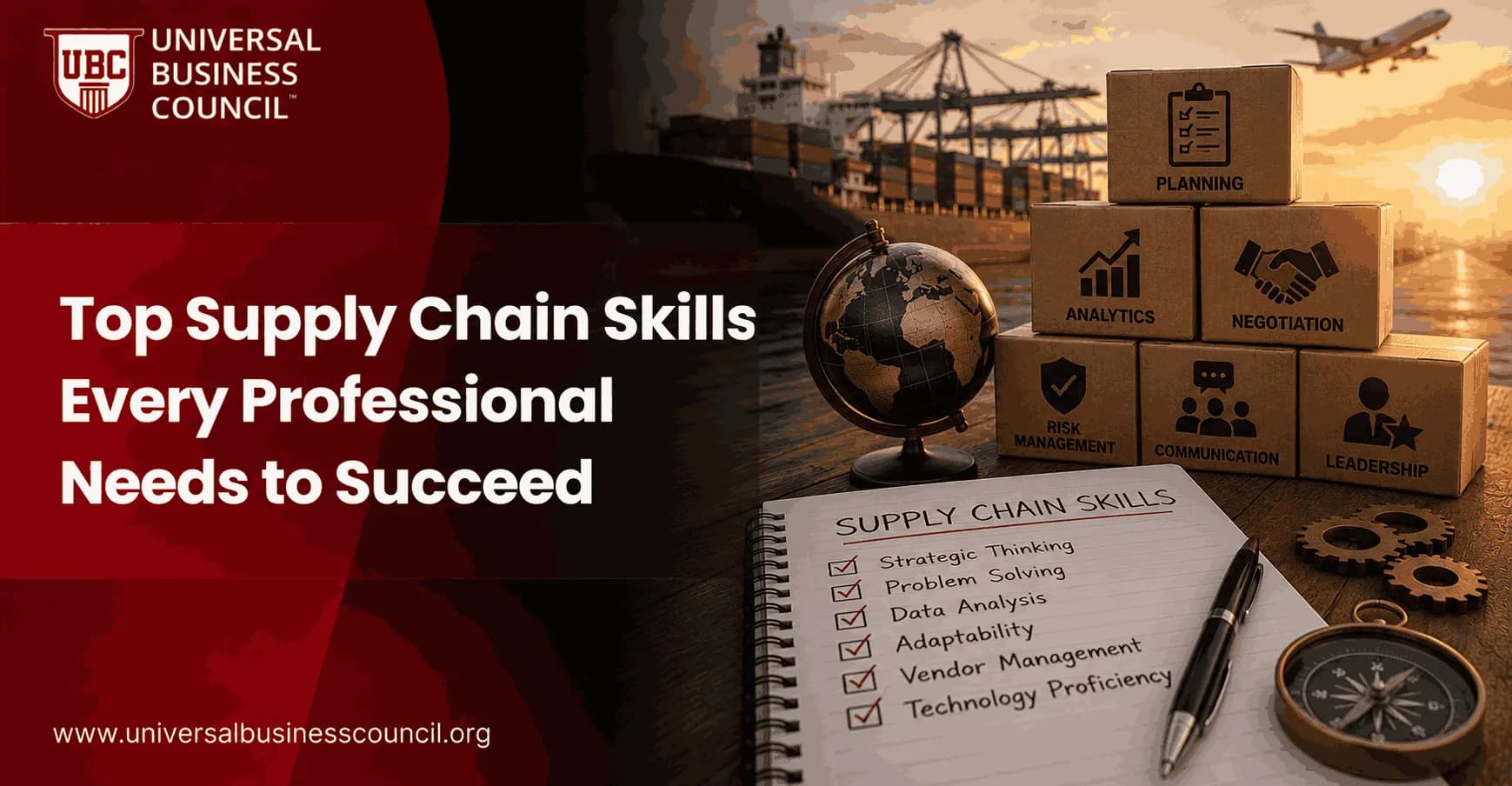
Supply chain skills in 2026 are no longer limited to moving goods, cutting costs, or chasing late shipments. You need data judgment, ESG literacy, risk thinking, operational discipline, and the ability to get finance, sales, procurement, and logistics to agree on a single plan.
That mix matters because supply chains now sit close to revenue, working capital, customer experience, and corporate risk. Digital fluency and data analytics rank among the top in-demand supply chain and procurement skills for 2026. Demand is not fading either: roughly 26,400 logistician jobs are projected to open each year in the United States through 2034.

As supply chains become more digital, resilient, and data-driven, professionals with a Certified Supply Chain Management credential are increasingly recognized for their ability to connect planning, procurement, logistics, and operational strategy with measurable business outcomes.
1. Digital fluency and data analytics
If you can only report what happened last week, you are behind. The stronger supply chain professionals in 2026 will use data to explain what is likely to happen next, what it will cost, and which trade-off leadership should accept.
Around half of supply chain leaders now view AI-driven transformation as a top strategic priority through 2028. That does not mean every planner needs to become a machine learning engineer. It does mean you should understand data quality, forecasting logic, dashboards, and exception-based decision making.
Skills to build
Excel competence: pivot tables, XLOOKUP, Power Query, conditional formatting, and clean date logic.
Visualization: Tableau, Power BI, or similar tools for showing inventory turns, OTIF, forecast accuracy, and cost-to-serve.
ERP literacy: confidence working with SAP, Oracle, Microsoft Dynamics, NetSuite, or advanced planning systems.
Analytics judgment: knowing when a forecast is statistically neat but commercially useless.
Here is a detail that trips people up. A dashboard can show 96 percent on-time delivery while your largest customer is still furious. Why? The metric may count shipments, not order value or strategic account priority. Know how the KPI is built before you defend it in a meeting.
2. Data governance and clean master data
Automation fails quietly when master data is weak. Wrong lead times, duplicate supplier records, outdated minimum order quantities, and messy units of measure create bad plans at scale.
Real-time visibility and predictive analytics depend on data integrity. That is not a technical footnote. It is daily work. If your supplier lead time is stored as 14 days but the real confirmed average is 29 days, your MRP run is already lying to you.
Build the habit of asking three questions:
Who owns this data field?
When was it last validated?
What business decision depends on it?
Those questions sound simple. They save money.
As AI-powered forecasting and planning systems become more common across supply chain operations, organizations also need professionals who can manage model deployment, monitoring, and continuous improvement. Building these production AI capabilities through a Certified MLOps Expert program helps ensure machine learning solutions remain reliable, scalable, and aligned with business goals.
3. Sustainability, ESG, and circular economy knowledge
Sustainability is becoming part of the supply chain job, not a side project handled by corporate affairs. ESG compliance now sits among the core in-demand skills for 2026, with rising demand across markets such as Singapore, Ireland, and Hong Kong.
You should understand how sourcing, transport mode, packaging, supplier labor practices, and waste affect ESG reporting. You do not need to memorize every regulation on day one. You do need enough fluency to ask the right supplier questions.
What matters in practice
Responsible sourcing: supplier codes of conduct, audit evidence, and corrective action plans.
Carbon-aware logistics: mode selection, route consolidation, load utilization, and shipment frequency.
Circular economy thinking: reuse, repair, remanufacturing, recycling, and material recovery.
ESG reporting inputs: emissions data, supplier declarations, product origin, and labor compliance.
Be careful with green claims. If your company cannot trace the data, do not put it in a supplier scorecard as fact. Procurement teams are being asked to prove claims, not repeat them.
4. Risk management and supply chain resilience
The lowest-cost supply chain is often the most fragile. That lesson has repeated through pandemic disruption, port congestion, geopolitical tension, sanctions, and demand shocks.
In 2026, you need to map risk before the disruption lands. That includes single-source suppliers, long replenishment lanes, high-risk customs routes, constrained components, and plants with no practical backup capacity.
Core resilience skills
Scenario planning: model what happens if demand rises 20 percent, a supplier misses two weeks, or freight rates spike.
Supplier diversification: know when dual sourcing is worth the cost and when it just adds complexity.
Inventory strategy: use safety stock where it protects service, not as a blanket fix for poor planning.
Trade compliance: understand customs, sanctions, documentation, origin rules, and restricted-party screening.
To be blunt, resilience is not the same as hoarding inventory. Extra stock can hide weak planning and drain cash. A better approach is to classify items by margin, criticality, lead time, and substitution options, then choose the right buffer.
5. Operational excellence in logistics, inventory, and warehousing
Digital skills will not rescue you if you do not understand the physical flow. Logistics remains an essential supply chain skill, and purchasing, inventory management, and warehouse skills stay high on employer lists for 2026 roles.
For early-career professionals, this is where you can stand out fast. Learn how a warehouse cut-off time affects carrier pickup. Learn why a partial pallet slows receiving. Learn how one incorrect HS code can delay an international shipment.
Operational areas to master
Inventory management: reorder points, safety stock, cycle counting, ABC analysis, and obsolete stock controls.
Transportation: carrier selection, service levels, accessorial charges, claims, and delivery appointment discipline.
Warehousing: slotting, picking accuracy, labor planning, dock scheduling, and WMS transactions.
Procurement basics: purchase orders, lead times, supplier confirmations, contract terms, and expediting.
Regulated environments add another layer. Credentials such as TDG and WHMIS stay in demand for roles involving hazardous materials. In those jobs, compliance is not paperwork. It is safety and legal exposure.
6. Communication and stakeholder influence
Supply chain work is full of translation. You translate supplier constraints into sales consequences. You translate forecast changes into production decisions. You translate freight delays into customer promises.
Communication and negotiation are essential supply chain skills, and high-performing professionals pair technical ability with strong stakeholder management.
The best people are clear under pressure. They do not write, Shipment delayed due to operational issue. They write: Carrier missed pickup on PO 4817. New ETA is Thursday 10:00. Customer service has been notified. We can split ship 40 units by air today at an added cost of $620.
That level of clarity gets decisions made.
7. Negotiation and supplier management
Negotiation is not just asking for a lower price. Sometimes the better deal is shorter lead time, better payment terms, guaranteed capacity, improved packaging, or shared forecast visibility.
A common mistake is pushing a supplier too hard on unit price, then paying it back through expedite fees and poor service. If a 3 percent price cut causes chronic late shipments, finance may like the purchase price variance while operations absorbs the damage.
Build negotiation around total cost. Include freight, defects, minimum order quantity, inventory carrying cost, service failure, and administrative effort.
8. Strategic and financial acumen
Supply chain decisions shape cash and profit. You need to speak that language.
Know the difference between gross margin and contribution margin. Understand working capital. Track inventory turns, days inventory outstanding, cost-to-serve, forecast bias, OTIF, and supplier performance. If leadership asks why you want to add a second supplier, answer in risk, service, and cash terms, not just operations language.
A useful formula:
Inventory turns = Cost of goods sold / Average inventory value
If turns fall, ask why. It may be demand softness, poor forecasting, large minimum order quantities, slow-moving SKUs, or a deliberate service strategy. The number alone is not the answer.
9. Problem solving and time management
Real supply chain days are messy. A truck misses the dock. A supplier sends 800 units instead of 8,000. Sales changes a priority account order after production has already started. You need a calm method.
Use a simple structure:
Define the customer or business impact.
Separate confirmed facts from assumptions.
List options with cost, time, and risk.
Escalate with a recommendation, not a complaint.
Document the root cause after the fire is out.
Time management matters because everything can feel urgent. It is not. Prioritize by customer impact, revenue risk, regulatory exposure, and operational dependency.
10. Continuous learning and professional certification
The shelf life of supply chain knowledge keeps shrinking. AI planning tools, ESG reporting rules, trade requirements, and customer delivery expectations all shift year to year.
Industry certifications are worth the effort. Bodies such as ASCM offer the CSCP, CPIM, and CLTD credentials, and professionals often add Lean Six Sigma or the CPSM to validate specialist knowledge.
For internal development, you can explore related certification pathways in management, business analytics, strategy, and operations through the Universal Business Council certification catalog. Those are natural next steps if you want structured learning that connects supply chain execution with leadership and business performance.
Which supply chain skills should you prioritize first?
If you are early in your career, start with Excel, ERP basics, inventory fundamentals, shipment coordination, and clear written communication. These skills get noticed quickly.
If you are a manager, focus on analytics, supplier strategy, risk mapping, ESG, and financial acumen. Your value comes from better decisions across functions.
If you want a senior leadership role, build the full set: digital fluency, resilience, sustainability, commercial judgment, and people leadership. A supply chain leader who cannot explain trade-offs to the CFO, sales director, and operations team will struggle, even with strong technical knowledge.
Next step
Choose one weak area this week. Pull a real KPI report, such as OTIF, forecast accuracy, inventory turns, or supplier lead-time adherence. Audit the data behind it, identify one decision it should improve, and document what skill you need to strengthen next. Then match that gap to a relevant Universal Business Council learning pathway or recognized supply chain certification.
As artificial intelligence continues to improve forecasting, inventory optimization, supplier analytics, and operational planning, professionals can further strengthen their expertise through a Certified Artificial Intelligence (AI) Expert program, combining advanced AI knowledge with practical supply chain management skills to support smarter, more resilient business operations.
FAQs
1. What are the most important supply chain skills in 2026?
The most valuable supply chain skills include demand forecasting, inventory management, procurement, logistics planning, data analytics, artificial intelligence (AI), ERP systems, warehouse management, risk management, sustainability, and strategic decision-making. These skills help professionals manage increasingly digital and global supply chains.
2. Why are supply chain skills changing in 2026?
Supply chains are becoming more technology-driven due to AI, automation, IoT, cloud computing, predictive analytics, and digital transformation. As a result, employers increasingly seek professionals who can combine operational expertise with digital and analytical capabilities.
3. Why is data analytics an essential supply chain skill?
Data analytics enables professionals to interpret operational data, improve demand forecasting, optimize inventory, monitor KPIs, reduce costs, identify risks, and make faster, evidence-based decisions that improve overall supply chain performance.
4. How important is AI knowledge for supply chain professionals?
AI knowledge is becoming increasingly valuable as businesses adopt AI for demand forecasting, inventory optimization, supplier risk analysis, warehouse automation, transportation planning, predictive maintenance, and decision support. Understanding how AI is applied can help professionals work more effectively with modern supply chain systems.
5. What ERP systems should supply chain professionals learn?
Common ERP platforms include SAP, Oracle ERP Cloud, Microsoft Dynamics 365, NetSuite, Infor, and Oracle NetSuite. Familiarity with these systems helps professionals manage procurement, inventory, production planning, finance, logistics, and reporting more efficiently.
6. Why are inventory management skills important?
Inventory management skills help businesses maintain optimal stock levels, reduce carrying costs, prevent stockouts, improve inventory turnover, and support efficient warehouse and distribution operations while meeting customer demand.
7. What logistics skills are essential for supply chain careers?
Important logistics skills include transportation planning, route optimization, carrier management, freight coordination, warehouse operations, international shipping, customs compliance, delivery tracking, and cost optimization.
8. How important is procurement knowledge?
Procurement professionals help organizations secure quality materials at competitive prices while managing supplier relationships and reducing risks. Even professionals outside procurement benefit from understanding sourcing strategies and supplier management.
9. Why is demand forecasting a critical skill?
Demand forecasting enables businesses to anticipate customer demand, optimize production schedules, reduce inventory costs, improve procurement planning, and minimize both stock shortages and excess inventory.
10. What soft skills are most valuable in supply chain management?
Key soft skills include communication, negotiation, leadership, collaboration, adaptability, critical thinking, analytical reasoning, problem-solving, time management, stakeholder management, and decision-making under pressure.
11. How important is risk management in supply chain careers?
Risk management has become a core competency due to global disruptions, geopolitical uncertainty, cyber threats, climate-related events, and supplier instability. Professionals must identify, assess, and mitigate risks while maintaining business continuity.
12. Why is sustainability knowledge important for supply chain professionals?
Organizations increasingly focus on reducing carbon emissions, improving supplier transparency, implementing responsible sourcing, minimizing waste, and meeting ESG goals. Professionals with sustainability expertise are becoming more valuable across industries.
13. What technical skills should supply chain professionals develop?
Important technical skills include Microsoft Excel, SQL, Power BI, Tableau, ERP systems, Warehouse Management Systems (WMS), Transportation Management Systems (TMS), AI-powered analytics, cloud platforms, and basic automation tools.
14. How does digital transformation affect supply chain careers?
Digital transformation requires professionals to understand cloud computing, AI, IoT, blockchain, robotics, predictive analytics, and digital collaboration tools. These technologies improve efficiency, visibility, and responsiveness across supply chain operations.
15. How can professionals improve their supply chain skills?
Professionals can strengthen their expertise through certifications, hands-on projects, online courses, ERP training, AI and analytics education, industry conferences, mentorship, and practical experience managing supply chain operations.
16. Which certifications help build supply chain skills?
Recognized certifications include ASCM Certified Supply Chain Professional (CSCP), Certified in Planning and Inventory Management (CPIM), ISM Certified Professional in Supply Management (CPSM), CIPS qualifications, Lean Six Sigma, PMP, and data analytics certifications.
17. What industries need skilled supply chain professionals?
Manufacturing, retail, healthcare, pharmaceuticals, automotive, aerospace, food and beverage, technology, energy, logistics, e-commerce, construction, and government organizations all require professionals with strong supply chain capabilities.
18. What future skills will become more valuable in supply chain management?
Growing skills include AI implementation, generative AI, digital twins, Edge AI, predictive analytics, supply chain cybersecurity, autonomous planning, sustainability reporting, ESG compliance, advanced data visualization, and AI-assisted decision-making.
19. How can students prepare for future supply chain careers?
Students should build a strong foundation in supply chain management, business analytics, logistics, procurement, inventory management, ERP systems, Excel, SQL, AI fundamentals, communication, and project management. Internships and real-world projects can also provide valuable experience.
20. Why are supply chain skills essential for career success in 2026?
Supply chains are evolving into intelligent, connected ecosystems that depend on technology, analytics, and collaboration. Professionals who combine operational knowledge with digital skills, strategic thinking, and continuous learning will be better equipped to solve complex business challenges, adapt to changing market conditions, and advance into leadership roles. In 2026 and beyond, success in supply chain management will depend not only on moving products efficiently but also on interpreting data, leveraging emerging technologies, and making informed decisions that drive long-term business value.
Related Articles
View All
Management
How to Become a Supply Chain Professional: Education, Skills, and Certification Steps
Learn how to become a supply chain professional with the right education, analytics skills, hands-on experience, and recognized certifications.

Management
The Future of Supply Chain Careers: Emerging Roles, Technologies, and Skills
Supply chain careers are shifting toward AI, analytics, automation, and sustainability. Learn the roles and skills shaping the next decade.

Management
Procurement vs. Supply Chain Management: Differences, Skills, and Career Opportunities
Compare procurement vs. supply chain management, including scope, metrics, career paths, skills, technology trends, and certification options.
Trending Articles
The Role of Blockchain in Ethical AI Development
How blockchain technology is being used to promote transparency and accountability in artificial intelligence systems.
AWS Career Roadmap
A step-by-step guide to building a successful career in Amazon Web Services cloud computing.
Top 5 DeFi Platforms
Explore the leading decentralized finance platforms and what makes each one unique in the evolving DeFi landscape.