

How to Become a Supply Chain Professional: Education, Skills, and Certification Steps
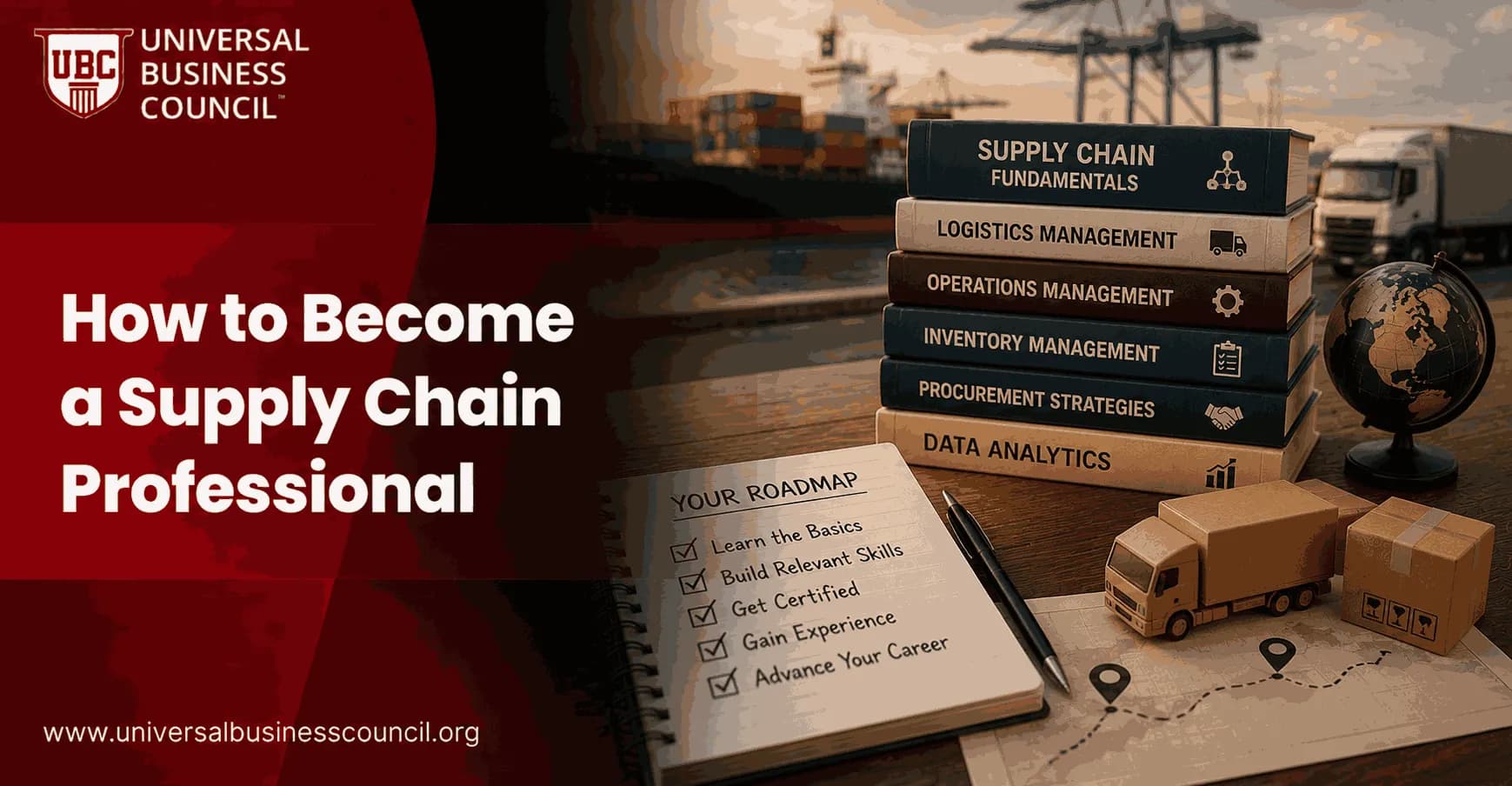
Becoming a supply chain professional usually takes three things: a relevant education, hands-on exposure to operations, and credible certification. The work is not just moving boxes. You manage inventory, supplier risk, demand signals, transport capacity, cost, service levels, and increasingly, AI-assisted decisions.
The career case is strong. The US Bureau of Labor Statistics reports that logisticians had a median annual wage of $80,880 in May 2024, with employment projected to grow 17 percent from 2024 to 2034. That is much faster than the average occupation. ASCM salary research also shows that certified supply chain professionals often earn a clear premium over non-certified peers.

As organizations continue investing in resilient and technology-driven operations, professionals with a Certified Supply Chain Management credential are increasingly valued for their ability to connect procurement, planning, logistics, inventory management, and operational strategy with measurable business outcomes.
What Does a Supply Chain Professional Do?
A supply chain professional plans and coordinates how goods, services, materials, and information move through an organization. You might work in manufacturing, retail, healthcare, technology, logistics, government, consumer goods, or transportation.
Typical responsibilities include:
Forecasting demand and planning inventory
Coordinating suppliers, warehouses, carriers, and production teams
Reducing stockouts, excess inventory, and freight cost
Using ERP, planning, and analytics systems to support decisions
Managing disruption risk, compliance, and customer service targets
The detail matters. A small unit-of-measure error, cases entered as eaches, can make a demand plan look fine on Monday and create a warehouse fire drill by Thursday. This is why good supply chain people are part analyst, part operator, and part translator between teams.
Why Supply Chain Careers Are Growing
Demand has risen because supply chains have become more visible and more complex. E-commerce, reshoring, geopolitical risk, sustainability rules, and automation have pushed supply chain work into board-level discussions.
The Bureau of Labor Statistics estimates about 26,400 openings for logisticians each year over the current decade. MIT's supply chain program has also noted strong demand for well-qualified graduates as companies adopt e-commerce models and advanced technologies.
Pay reflects that demand. Recent supply chain salary reporting found average salaries near $103,000, with average compensation rising roughly 8 percent year over year. New hires reported average salary increases of around 16 percent compared with their prior roles. That does not mean every entry-level analyst starts near six figures, but it does show a tight market for proven skills.
Step 1: Build the Right Education Foundation
Most employers expect at least a bachelor's degree for supply chain analyst, logistics, planning, and procurement roles. The degree does not always need to say supply chain on the diploma, but it should build business, analytical, and operational thinking.
Useful undergraduate paths
Supply Chain Management or Logistics
Operations Management
Industrial Engineering
Business Administration with an operations focus
Data analytics, economics, or information systems with relevant electives
Changing careers from finance, IT, engineering, sales operations, or warehouse supervision? You may not need a second degree. Start with structured coursework in supply chain fundamentals, then add a certification that proves you understand planning, sourcing, production, logistics, and returns.
When a master's degree makes sense
A specialized master's in supply chain management, logistics, operations research, or an MBA with a supply chain concentration can help if you want senior planning, network design, procurement leadership, or global operations roles. Graduate programs pay off most when they add analytics, optimization, sourcing strategy, and leadership work, not just textbook terminology.
Explore Universal Business Council management courses and related professional certification pathways for operations, business strategy, and leadership development to support this stage.
Step 2: Learn the Core Skills Employers Actually Test
Hiring managers rarely ask only, Do you know supply chain? They ask whether you can solve the messy version of a business problem. Can you explain why service levels fell while inventory rose? Can you challenge a forecast without alienating sales? Can you tell whether expedited freight is solving a customer problem or hiding a planning failure?
Technical and analytical skills
Excel and spreadsheets: pivots, lookups, scenario tables, inventory calculations, and clean data habits.
ERP systems: SAP, Oracle, Microsoft Dynamics, NetSuite, or similar platforms.
Planning tools: demand planning, MRP, inventory optimization, warehouse management, and transportation management systems.
Data analytics: SQL basics, dashboard interpretation, Power BI, Tableau, or Google Looker Studio.
AI literacy: forecasting models, anomaly detection, automated replenishment, route optimization, and model risk.
Business skills
Communication with sales, finance, operations, suppliers, and carriers
Cost-to-serve thinking, not just cheapest freight or lowest unit cost
Negotiation and supplier relationship management
Risk assessment and scenario planning
Change management, especially when implementing new systems
To be blunt, the soft skills are not optional. A planner with a perfect model who cannot get sales to explain a promotion will still miss the forecast.
As AI-powered forecasting, inventory optimization, and decision support become part of modern supply chain operations, organizations also need professionals who understand how machine learning models are deployed, monitored, and continuously improved. Developing these production AI capabilities through a Certified MLOps Expert program can help bridge the gap between analytics and reliable operational execution.
Step 3: Get Practical Experience Early
Supply chain is easier to understand when you have seen the floor, the dock, the carrier portal, or the supplier scorecard. Internships and rotational programs help, but so do entry-level roles in inventory control, purchasing coordination, warehouse operations, production planning, transportation, or customer operations.
Look for work that exposes you to measurable outcomes. Strong starter metrics include:
On-time in-full delivery, often called OTIF
Inventory turns
Forecast accuracy and forecast bias
Fill rate
Days of inventory on hand
Supplier on-time delivery
Expedite cost as a percentage of freight spend
Track results. If you reduce aged inventory, improve cycle count accuracy, or cut detention fees, record the baseline, the action, and the outcome. Your resume should show operational impact, not a list of software names.
Step 4: Choose the Right Supply Chain Certification
Certification matters because it gives employers a common signal. ASCM data has shown that APICS-certified professionals can earn higher median salaries than non-certified peers, and salary research has found premiums for professionals who combine a degree with APICS certification.
Common supply chain certifications include:
APICS Certified in Planning and Inventory Management (CPIM): best for planning, inventory, MRP, and production environments.
APICS Certified Supply Chain Professional (CSCP): best for end-to-end supply chain design, sourcing, operations, logistics, and returns.
APICS Certified in Logistics, Transportation and Distribution (CLTD): best for logistics, transport, warehousing, and distribution roles.
CSCMP SCPro: useful for broader supply chain management capability.
ISM Certified Professional in Supply Management (CPSM): best for procurement and strategic sourcing professionals.
Which certification should you start with?
Early in planning or inventory? Start with CPIM. If you already touch multiple functions, CSCP is the stronger general credential. If your work is carrier management, warehousing, distribution, or 3PL coordination, CLTD fits better. CPSM is the better choice when procurement is your target lane.
Exam candidates often underestimate the calculation and scenario questions. Safety stock, economic order quantity, reorder points, and capacity trade-offs can trip you up if you only memorize definitions. Practice the math by hand first. Then use software.
Step 5: Add Technology and AI Skills
Modern supply chains are becoming more automated. World Economic Forum reporting indicates that many employers see skills gaps as a major barrier to transformation, while most plan to prioritize upskilling. Gartner has also projected wider use of agentic AI in enterprise applications, including real-time operational decision support.
You do not need to become a machine learning engineer to be employable in supply chain. You do need to understand how automated recommendations are made, when they fail, and what business constraints they ignore.
Focus on practical use cases:
Demand sensing and forecast exception management
Carrier selection and route optimization
Inventory segmentation using ABC or XYZ analysis
Supplier risk monitoring
Warehouse labor planning
Digital twins for network scenario testing
The future role is not a planner clicking approvals all day. It is a professional who can question the model, explain the trade-off, and coordinate the response across functions.
Step 6: Build a Career Roadmap
Use a staged plan instead of collecting random courses.
First 0 to 2 years: learn operations basics, Excel, ERP transactions, inventory language, and service metrics.
Years 2 to 5: choose a lane such as planning, logistics, procurement, analytics, or manufacturing operations. Add CPIM, CSCP, CLTD, CPSM, or another relevant certification.
Years 5 to 8: lead cross-functional projects, own supplier or customer-facing metrics, and build financial fluency around working capital, margin, and cost-to-serve.
Senior stage: consider graduate education, advanced certification, and leadership development. This is where management training through Universal Business Council can support broader business decision making.
Future Outlook for Supply Chain Professionals
The next decade will reward people who combine operational judgment with data confidence. AI and automation will take over more routine transactions, including scheduling, rerouting, replenishment suggestions, and exception alerts. Humans will still own strategy, ethics, negotiation, escalation, and accountability.
Sustainability and resilience will also shape the profession. Companies need people who can model trade-offs between cost, emissions, lead time, supplier concentration, and regulatory exposure. Nearshoring, multi-sourcing, and transparent supplier networks are not slogans. They are planning problems with real cost and service consequences.
Your Next Step
If you want to become a supply chain professional, start with one practical move this week: pick a target role, compare three job descriptions, and list the repeated skills. Then close the biggest gap. For most people, that means strengthening analytics, getting closer to operations, or preparing for CPIM, CSCP, CLTD, CPSM, or another recognized credential. Pair that with Universal Business Council management learning when you are ready to move from execution into leadership.
As artificial intelligence continues to transform forecasting, procurement, logistics, supplier risk management, and inventory planning, professionals can further strengthen their expertise through a Certified Artificial Intelligence (AI) Expert program, combining AI capabilities with practical supply chain knowledge to lead data-driven and future-ready operations.
FAQs
1. What is a supply chain professional?
A supply chain professional manages the flow of goods, services, information, and resources from suppliers to customers. Depending on the role, responsibilities may include procurement, inventory management, logistics, transportation, warehouse operations, demand forecasting, production planning, and supplier relationship management.
2. How do you become a supply chain professional?
To become a supply chain professional, earn relevant education, develop core supply chain skills, gain practical experience through internships or entry-level jobs, learn industry software such as ERP systems, and pursue professional certifications that enhance your expertise and career prospects.
3. What education is required for a supply chain career?
Most employers prefer candidates with a bachelor's degree in Supply Chain Management, Logistics, Business Administration, Operations Management, Industrial Engineering, Manufacturing, Economics, or a related field. However, some entry-level roles may also accept candidates with relevant certifications and practical experience.
4. Which degree is best for supply chain management?
A degree in Supply Chain Management provides specialized knowledge, but Business Administration, Industrial Engineering, Logistics, Operations Management, Data Analytics, and Information Systems are also excellent choices depending on your career goals.
5. What skills do supply chain professionals need?
Essential skills include inventory management, procurement, logistics planning, demand forecasting, data analysis, ERP systems, Microsoft Excel, communication, problem-solving, project management, negotiation, leadership, and knowledge of AI and automation technologies.
6. Is coding required for supply chain management?
Coding is not typically required for most supply chain roles. However, knowledge of SQL, Python, Power BI, Tableau, or other analytics tools can improve your ability to analyze data, automate reports, and support digital transformation initiatives.
7. What certifications help you become a supply chain professional?
Popular certifications include ASCM Certified Supply Chain Professional (CSCP), Certified in Planning and Inventory Management (CPIM), Certified in Logistics, Transportation and Distribution (CLTD), ISM Certified Professional in Supply Management (CPSM), CIPS qualifications, Lean Six Sigma, and PMP.
8. How important are internships for supply chain careers?
Internships provide valuable hands-on experience with procurement, logistics, warehouse operations, inventory management, ERP systems, and cross-functional teamwork. They also help students build professional networks and improve employment opportunities after graduation.
9. What are the best entry-level supply chain jobs?
Common entry-level positions include Supply Chain Analyst, Logistics Coordinator, Procurement Assistant, Inventory Analyst, Warehouse Coordinator, Purchasing Assistant, Transportation Coordinator, Operations Analyst, and Demand Planning Assistant.
10. What software should supply chain professionals learn?
Professionals should become familiar with ERP systems such as SAP, Oracle ERP, Microsoft Dynamics 365, and NetSuite, as well as Warehouse Management Systems (WMS), Transportation Management Systems (TMS), Microsoft Excel, Power BI, Tableau, and supply chain analytics platforms.
11. How can beginners gain supply chain experience?
Beginners can gain experience through internships, graduate trainee programs, volunteer projects, supply chain simulations, university research, certification programs, warehouse operations, logistics roles, and entry-level positions in procurement or inventory management.
12. What industries hire supply chain professionals?
Supply chain professionals work in manufacturing, retail, healthcare, pharmaceuticals, automotive, aerospace, food and beverage, e-commerce, logistics, construction, technology, consumer goods, energy, and government organizations.
13. How long does it take to build a supply chain career?
Many professionals secure entry-level positions after completing their education or certifications. Career advancement into specialist, manager, or leadership roles typically depends on experience, performance, continuous learning, and the complexity of the organizations they work for.
14. What are the biggest challenges for new supply chain professionals?
Common challenges include understanding complex business processes, learning ERP systems, managing inventory accuracy, adapting to changing market conditions, improving analytical skills, collaborating across departments, and keeping up with rapidly evolving technologies.
15. How important is AI knowledge in supply chain careers?
AI is becoming increasingly important for demand forecasting, inventory optimization, procurement automation, warehouse management, transportation planning, predictive analytics, and supply chain decision-making. Understanding how AI supports these functions can improve long-term career prospects.
16. What soft skills are essential for supply chain professionals?
Important soft skills include communication, teamwork, negotiation, adaptability, leadership, critical thinking, analytical reasoning, time management, decision-making, stakeholder management, and the ability to solve operational problems under pressure.
17. How can professionals continue developing their supply chain careers?
Professionals should pursue advanced certifications, attend industry conferences, participate in professional organizations, build expertise in AI and analytics, gain cross-functional experience, develop leadership skills, and stay informed about emerging supply chain technologies.
18. What career opportunities are available after entering supply chain management?
Career progression may include Supply Chain Analyst, Procurement Specialist, Logistics Manager, Inventory Manager, Operations Manager, Supply Chain Manager, Supply Chain Director, Vice President of Supply Chain, and Chief Supply Chain Officer (CSCO).
19. What are the future trends shaping supply chain careers?
Key trends include AI-powered planning, automation, digital supply chains, blockchain, IoT, Edge AI, predictive analytics, sustainability, ESG reporting, warehouse robotics, autonomous logistics, and greater use of cloud-based supply chain platforms.
20. Why is becoming a supply chain professional a smart career choice?
Supply chain management is a dynamic and essential profession that offers opportunities across nearly every major industry. As businesses continue investing in digital transformation, automation, sustainability, and resilient global operations, demand for skilled supply chain professionals is expected to remain strong. By combining education, practical experience, technical expertise, and recognized certifications, aspiring professionals can build rewarding careers with excellent opportunities for growth, leadership, and long-term career stability.
Related Articles
View All
Management
Top Supply Chain Skills Every Professional Needs to Succeed in 2026
Learn the top supply chain skills professionals need in 2026, from analytics and ESG to risk management, logistics, negotiation, and leadership.

Management
The Future of Supply Chain Careers: Emerging Roles, Technologies, and Skills
Supply chain careers are shifting toward AI, analytics, automation, and sustainability. Learn the roles and skills shaping the next decade.

Management
Procurement vs. Supply Chain Management: Differences, Skills, and Career Opportunities
Compare procurement vs. supply chain management, including scope, metrics, career paths, skills, technology trends, and certification options.
Trending Articles
The Role of Blockchain in Ethical AI Development
How blockchain technology is being used to promote transparency and accountability in artificial intelligence systems.
AWS Career Roadmap
A step-by-step guide to building a successful career in Amazon Web Services cloud computing.
Top 5 DeFi Platforms
Explore the leading decentralized finance platforms and what makes each one unique in the evolving DeFi landscape.