

Supply Chain Professional Salary in the USA: Pay by Role, Experience, and Location
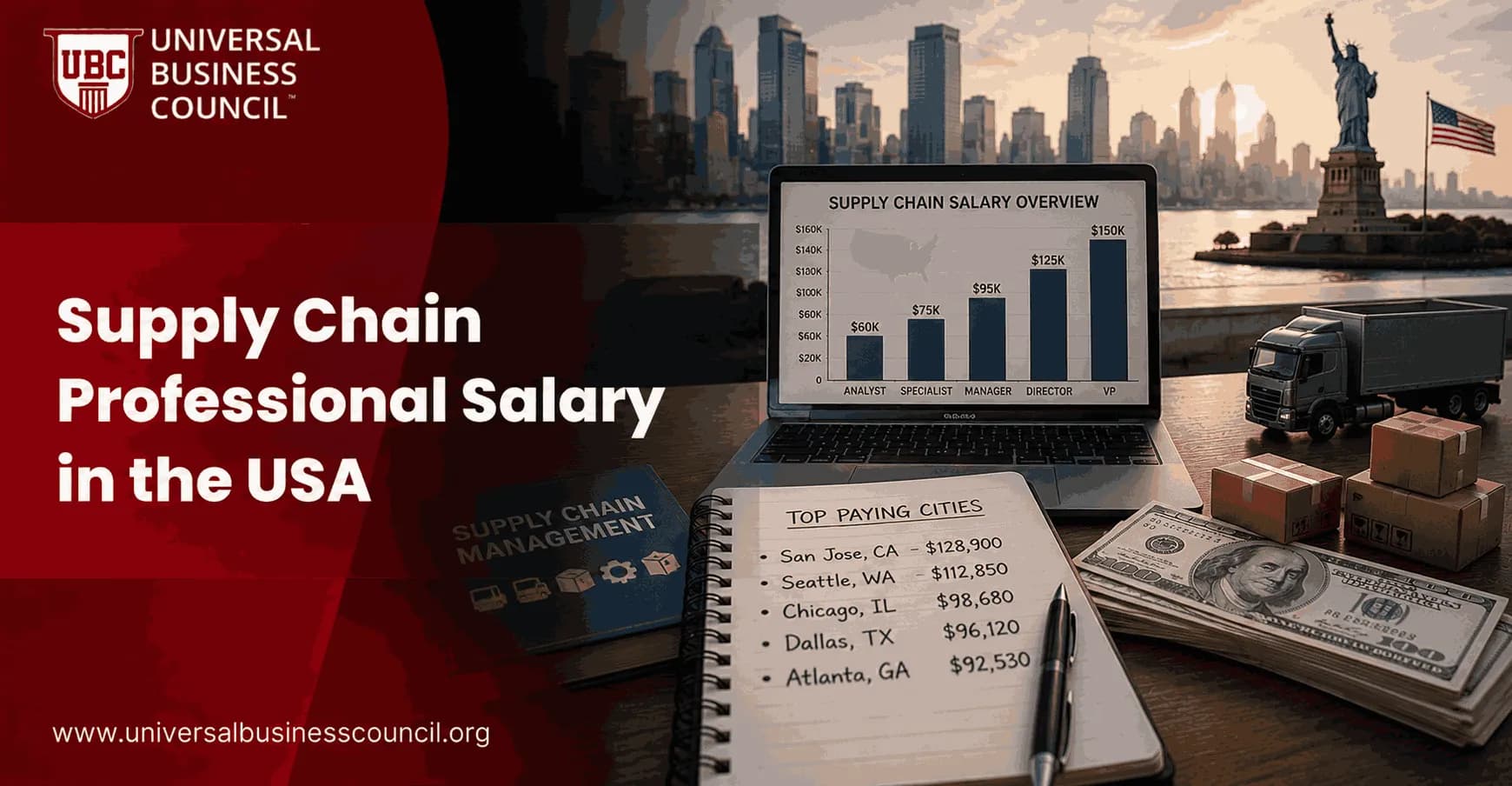
Supply chain professional salary in the USA typically sits around USD 95,000 to 105,000 in median base pay, but the real answer depends on your title, industry, location, and how close your work is to profit, risk, and customer service. ASCM reports a median US base salary of USD 98,500 for supply chain professionals, with median total compensation of USD 103,500. The US Bureau of Labor Statistics reports USD 80,880 as the median annual wage for logisticians, a category that overlaps many logistics, planning, and supply chain roles.
The spread is wide. A buyer may earn around USD 65,000, while a director of supply chain can clear USD 154,000 in median base salary. Vice presidents and chief supply chain officers often exceed USD 250,000 in total compensation, and some enterprise leaders reach USD 300,000 to 500,000 or more.

As organizations continue investing in resilient and technology-driven operations, professionals with a Certified Supply Chain Management credential are increasingly valued for their ability to improve procurement, planning, logistics, and inventory performance while supporting measurable business results.
Supply chain salary snapshot in the United States
The market is tight. BLS projects strong employment growth for logisticians through the mid-2030s, faster than the average for all occupations, with tens of thousands of openings each year. ASCM also reports that most supply chain professionals received a salary increase in the prior year.
That tracks with what hiring managers ask for now. They do not only want someone who can place purchase orders. They want people who can protect service levels, manage supplier risk, cut working capital, and explain trade-offs in plain English to finance and operations leaders.
To be blunt, the better-paid roles usually sit closer to decisions that affect margin. If you can tie your work to inventory turns, OTIF, forecast accuracy, supplier fill rate, cost-to-serve, or cash conversion cycle, you have a stronger salary case.
Average supply chain salary by role
Role scope is the cleanest salary divider. Recent salary surveys show a clear climb from analyst and planner titles into management, director, and executive positions.
Common US median base salaries by title
Director of Supply Chain: USD 154,000
Senior Supply Chain Manager: USD 141,000
Materials Manager: USD 110,500
Supply Chain Manager: USD 103,468
Planning Manager: USD 101,250
Procurement Manager: USD 100,360
Inventory Manager: USD 100,000
Operations Manager: USD 91,800
Purchasing Manager: USD 90,000
Supply Chain Analyst: USD 87,750
Logistics Manager: USD 86,500
Supply Chain Specialist: USD 83,300
Buyer/Planner: USD 81,250
Supply Planner: USD 78,000
Production Planner: USD 75,000
Buyer: USD 65,382
Other sources land in the same broad range. Indeed reports an average supply chain manager salary near USD 101,505. Payscale data places the median supply chain manager salary around USD 94,640, with the top decile near USD 127,000. Coursera's total compensation figures run higher, estimating median total pay around USD 145,000 for supply chain managers because they include bonus and equity.
That distinction matters. Base salary is not the full offer. In technology, e-commerce, and senior corporate roles, annual bonus and equity can change the number quickly. A USD 125,000 base with a 15 percent bonus target is a different job from a USD 125,000 base with no incentive plan.
Salary by experience level
Your first title matters less than the skill set you build in the first five years. Planning, procurement, logistics, and analytics can all pay well, but each rewards a different kind of proof.
Early career: 0-5 years
Entry-level supply chain salaries commonly fall in the USD 60,000 to 70,000 range. Analysis of logistics-related wage data puts professionals with five or fewer years of experience around USD 66,000. Other sources cite an entry-level average near USD 69,000. Practitioner reports often show first offers in the mid USD 50,000s to mid USD 60,000s, with higher starts in consulting, large consumer packaged goods firms, or technology-adjacent roles.
At this stage, do not chase title inflation. A real planner role that teaches you MRP exceptions, safety stock, supplier lead times, and S&OP beats a vague coordinator title with no decision rights.
Mid-career: 5-15 years
Mid-career professionals often move into the USD 90,000 to 130,000 band. Median salaries for supply chain manager, planning manager, and procurement manager sit around USD 100,000 to 103,000. Mid-level logistics positions run roughly USD 97,000 to 127,000.
This is where measurable results start to separate candidates. Hiring panels listen when you can say, for example, that you reduced aged inventory, improved forecast bias, or cut premium freight after changing reorder parameters. A small detail counts. In many operations reviews, leadership does not ask first about strategy slides. They ask why OTIF dropped, why inventory rose, and which supplier is causing the miss.
Senior and executive: 15+ years
Senior supply chain managers and directors are firmly in six-figure territory. Median base salaries run about USD 141,000 for senior supply chain managers and USD 154,000 for directors. Total compensation estimates are higher, around USD 178,000 for senior managers and USD 206,000 for directors.
At the top, the numbers jump. Vice presidents of supply chain can approach USD 285,000 in median total pay. Chief supply chain officers and similar executives often earn USD 300,000 to 500,000 or more in total compensation.
As AI-powered forecasting and analytics become part of modern supply chain operations, professionals who understand model deployment, monitoring, and lifecycle management gain an additional advantage. Many strengthen these production AI capabilities through a Certified MLOps Expert program to support reliable machine learning systems in business environments.
Salary by location
Location still matters, even with hybrid work. The San Francisco Bay Area typically pays 25 to 35 percent above national averages for supply chain roles. New York City often runs 20 to 30 percent above. Seattle and Los Angeles are commonly 15 to 25 percent above, while Boston is around 15 to 20 percent above.
For supply chain managers, competitive high-paying markets sit around USD 125,000 to 155,000, with more for specialized roles such as global category management, supply chain solutions architecture, and network design.
City-level total compensation examples show the spread clearly:
Plano, Texas: about USD 140,812
Sterling Heights, Michigan: about USD 125,612
Ontario, California: about USD 115,118
Chicago, Illinois: about USD 109,840
Miami, Florida: about USD 85,498
Cleveland, Ohio: about USD 75,031
Fort Myers, Florida: about USD 66,814
Do not assume the highest salary is the best offer. A USD 110,000 planning role in Indianapolis may give you more spending power than USD 135,000 in San Francisco. Look at rent, commute, state taxes, bonus reliability, and promotion pace.
Industries that pay more
Industry can move your pay as much as geography. Government, technology, and retail organizations often pay more for supply chain managers than wholesale or health care employers. Strong compensation also shows up in technology, advanced manufacturing, e-commerce, and consumer packaged goods.
Why? Complexity pays. Global sourcing, constrained supply, high SKU counts, tight service promises, and expensive inventory create pressure. If your decisions affect millions in working capital or service penalties, the company has a reason to pay for better judgment.
Procurement can be especially lucrative when it owns strategic categories, not just transactional purchasing. Demand planning pays well when it connects commercial forecasts to capacity, inventory, and finance. Logistics pays more when the role includes network design, carrier strategy, and cost-to-serve improvement.
How to increase your supply chain salary
If you want a higher supply chain professional salary in the USA, build evidence before you negotiate. Good intentions do not price well. Results do.
Track business metrics: Keep a record of inventory turns, service level, forecast accuracy, supplier on-time delivery, expedite freight, PPV, and working capital impact.
Learn the financial language: Understand gross margin, cash flow, carrying cost, and cost-to-serve. Finance leaders respect supply chain professionals who can connect operations to money.
Build systems fluency: Get comfortable with ERP and planning tools, plus Excel, Power BI, SQL basics, or analytics platforms. Google Sheets alone will not carry you into senior planning roles.
Choose a valuable lane: S&OP, demand planning, strategic sourcing, network optimization, and supply chain analytics tend to age well. Pure expediting is stressful and usually capped.
Use certification carefully: A certification will not replace results, but it can help you prove structured knowledge. Consider learning paths through Universal Business Council's management and business certification catalog, especially if you are moving from technical execution into team leadership.
What salary should you target?
Use these practical bands as a starting point:
Entry-level analyst, buyer, planner, or specialist: USD 60,000 to 75,000, with higher offers in large metros and major employers.
Experienced analyst, senior planner, procurement specialist, or logistics lead: USD 80,000 to 105,000.
Manager-level supply chain, procurement, inventory, or planning role: USD 95,000 to 130,000 nationally.
Senior manager or director: USD 140,000 to 210,000, depending on bonus, industry, and scope.
VP or C-suite supply chain leadership: USD 250,000 to 500,000 or more in total compensation.
Ask for the full compensation range before you anchor on base pay. Confirm bonus target, equity, relocation support, retirement match, health benefits, travel expectations, and whether the role owns people, budget, or only process coordination.
Best next step for your career
Supply chain pay in the USA is strong because companies need people who can make trade-offs under pressure. The fastest way to raise your value is to move from task ownership to outcome ownership.
Pick one measurable problem in your current role this month: late supplier deliveries, excess inventory, forecast misses, premium freight, or slow purchase order cycles. Quantify the baseline. Improve it. Document the result. Then pair that evidence with structured management training through Universal Business Council's management certification pathways or related business courses. That combination gives you something better than a salary opinion. It gives you proof.
As artificial intelligence continues to reshape forecasting, inventory optimization, procurement, and supply chain analytics, professionals can further strengthen their capabilities through a Certified Artificial Intelligence (AI) Expert program, combining AI expertise with practical supply chain knowledge to prepare for higher-impact leadership and decision-making roles.
FAQs
1. What is the average supply chain professional salary in the USA?
Supply chain salaries in the United States vary based on job title, experience, industry, location, education, and certifications. Entry-level professionals generally earn competitive salaries, while experienced managers, directors, and executives often receive significantly higher compensation, including bonuses and stock incentives.
2. How much do entry-level supply chain professionals earn?
Entry-level salaries depend on the role, company, and location. Positions such as Supply Chain Analyst, Logistics Coordinator, Inventory Analyst, Procurement Specialist, and Operations Coordinator typically provide competitive starting salaries with strong opportunities for career growth.
3. Which supply chain roles pay the highest salaries?
Senior positions such as Supply Chain Director, Vice President of Supply Chain, Chief Supply Chain Officer (CSCO), Global Supply Chain Manager, Procurement Director, Logistics Director, and Operations Director generally offer the highest compensation due to their strategic responsibilities.
4. How does experience affect supply chain salaries?
Professionals with several years of experience often earn higher salaries because they have developed expertise in planning, procurement, logistics, inventory management, leadership, and digital transformation. Leadership experience and measurable business results can significantly increase earning potential.
5. Which industries offer the highest supply chain salaries?
Technology, pharmaceuticals, healthcare, aerospace, automotive, energy, manufacturing, consulting, consumer goods, e-commerce, and semiconductor companies often provide some of the highest-paying supply chain positions.
6. Which US cities pay the highest supply chain salaries?
Major metropolitan areas such as San Francisco, San Jose, Seattle, New York City, Boston, Austin, Chicago, and Washington, D.C., often offer higher salaries. Compensation, however, is frequently influenced by the local cost of living and demand for skilled professionals.
7. How much do Supply Chain Managers earn in the USA?
Supply Chain Managers typically earn more than entry-level professionals because they oversee planning, procurement, logistics, inventory, supplier relationships, and cross-functional operations. Total compensation often includes bonuses and other performance-based incentives.
8. Do certifications increase supply chain salaries?
Professional certifications such as ASCM CSCP, CPIM, ISM CPSM, CIPS qualifications, Lean Six Sigma, and PMP can strengthen a candidate's qualifications. While certifications do not guarantee higher pay, they may support career advancement and improve competitiveness for higher-paying roles.
9. How do education levels affect supply chain salaries?
A bachelor's degree is commonly required for many supply chain positions. Advanced degrees such as an MBA or a master's in supply chain management, operations, or business analytics may support advancement into senior leadership roles, depending on the employer and industry.
10. How does company size impact supply chain salaries?
Large multinational corporations often offer higher compensation, broader benefits, and bonus opportunities due to the complexity of their global operations. Smaller organizations may offer lower base salaries but can provide faster career progression and broader responsibilities.
11. Can remote supply chain jobs offer competitive salaries?
Yes. Many organizations now offer remote or hybrid supply chain positions in planning, procurement, analytics, and supply chain consulting. Compensation policies vary, with some employers adjusting salaries based on employee location while others maintain standardized pay structures.
12. Which supply chain skills increase earning potential?
Skills in AI, data analytics, ERP systems (such as SAP or Oracle), supply chain planning, procurement, logistics optimization, warehouse management, predictive analytics, automation, sustainability, and leadership are increasingly associated with higher-paying roles.
13. How does AI impact supply chain salaries?
As AI becomes more integrated into supply chain operations, professionals who understand AI-driven forecasting, automation, predictive analytics, and digital transformation may qualify for specialized roles with greater responsibilities and competitive compensation.
14. What benefits do supply chain professionals receive besides salary?
In addition to base pay, many employers offer performance bonuses, annual incentives, health insurance, retirement plans, paid time off, tuition assistance, professional development funding, stock options, employee discounts, and flexible work arrangements.
15. Is supply chain management a high-paying career?
Supply chain management can be a financially rewarding career, particularly for professionals who advance into management or executive positions. Compensation often grows with experience, leadership responsibilities, technical expertise, and industry specialization.
16. What career growth opportunities exist in supply chain management?
Career progression may include roles such as Supply Chain Analyst, Supply Chain Planner, Procurement Manager, Logistics Manager, Supply Chain Manager, Operations Manager, Supply Chain Director, Vice President of Supply Chain, and Chief Supply Chain Officer (CSCO).
17. Which certifications help maximize salary potential?
Widely recognized certifications include ASCM CSCP, CPIM, CLTD, ISM CPSM, CIPS qualifications, Lean Six Sigma, PMP, and certifications in data analytics, ERP platforms, cloud technologies, and AI applications relevant to supply chain operations.
18. How can supply chain professionals increase their salary?
Professionals can improve earning potential by developing leadership skills, earning respected certifications, gaining expertise in AI and analytics, mastering ERP systems, leading successful business initiatives, building industry expertise, and consistently delivering measurable operational improvements.
19. What is the job outlook for supply chain professionals in the USA?
The outlook remains strong as organizations continue investing in digital transformation, automation, supply chain resilience, sustainability, and global operations. Demand is expected to remain high for professionals with technical, analytical, and strategic supply chain expertise.
20. Why is supply chain management considered a strong long-term career in the USA?
Supply chains are essential to nearly every industry, from healthcare and manufacturing to retail and technology. As businesses focus on resilience, automation, AI adoption, and sustainable operations, demand for skilled supply chain professionals is expected to remain robust. Those who continuously develop their technical knowledge, leadership abilities, and business acumen are well positioned for long-term career growth, competitive compensation, and opportunities to advance into senior leadership roles. After all, products rarely teleport themselves to customers, despite what overnight shipping sometimes seems to imply.
Related Articles
View All
Management
Top Supply Chain Skills Every Professional Needs to Succeed in 2026
Learn the top supply chain skills professionals need in 2026, from analytics and ESG to risk management, logistics, negotiation, and leadership.

Management
Supply Chain Professional Career Path: From Entry-Level Roles to Leadership
Explore the supply chain professional career path from entry-level roles to executive leadership, with skills, salaries, certifications, and growth outlook.

Management
How to Become a Supply Chain Professional: Education, Skills, and Certification Steps
Learn how to become a supply chain professional with the right education, analytics skills, hands-on experience, and recognized certifications.
Trending Articles
The Role of Blockchain in Ethical AI Development
How blockchain technology is being used to promote transparency and accountability in artificial intelligence systems.
AWS Career Roadmap
A step-by-step guide to building a successful career in Amazon Web Services cloud computing.
Top 5 DeFi Platforms
Explore the leading decentralized finance platforms and what makes each one unique in the evolving DeFi landscape.