

What Does a Supply Chain Professional Do? Roles, Responsibilities, and Daily Tasks
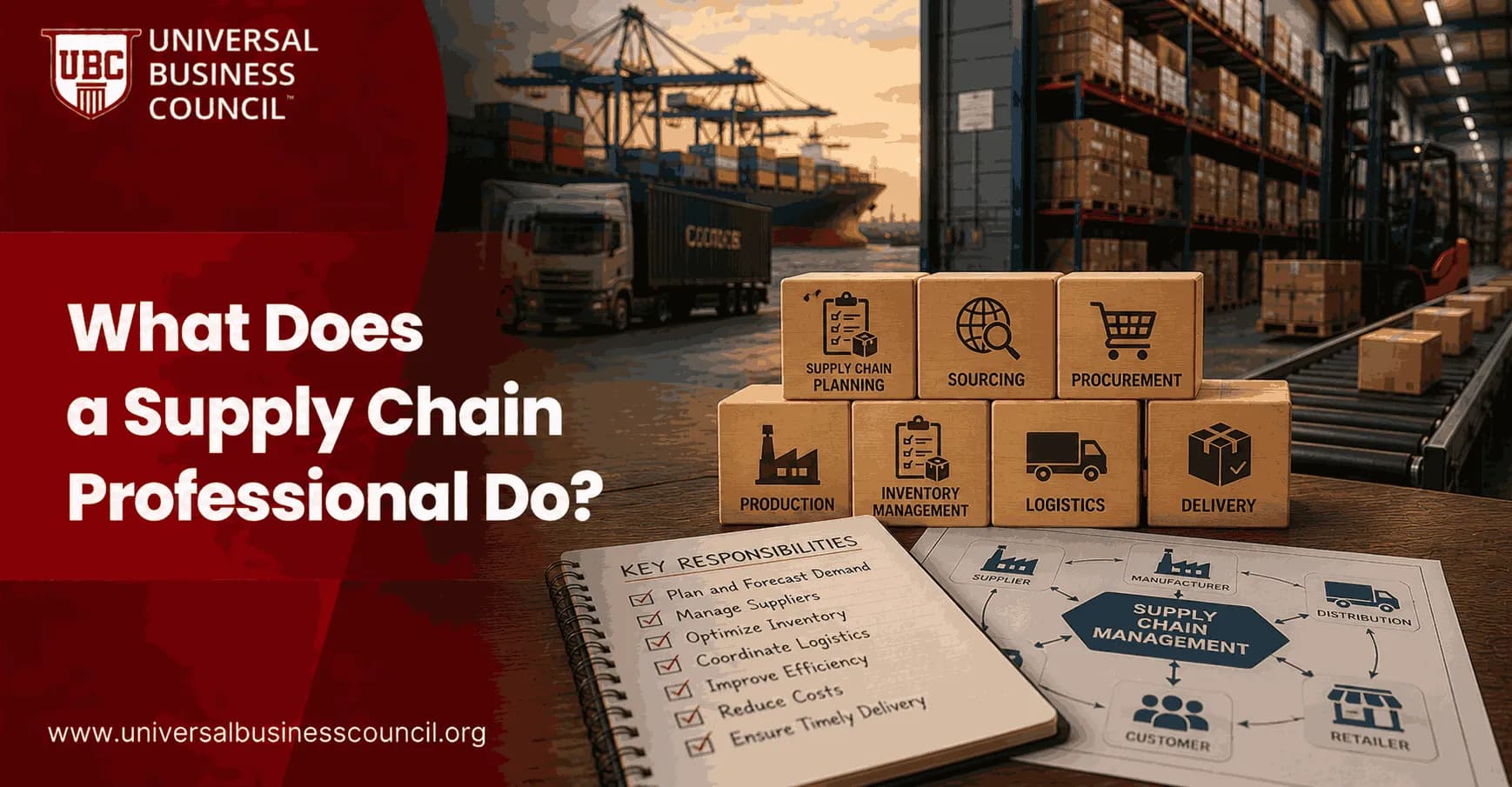
A supply chain professional keeps products, materials, information, and services moving from suppliers to customers without wasting cash, time, or trust. That sounds simple. It is not. The role sits at the point where demand forecasts, supplier performance, production capacity, transportation limits, inventory risk, and customer promises all collide.
On a normal day, you might review a late container, challenge a sales forecast, approve a purchase order, investigate a warehouse inventory mismatch, and explain to finance why a cheap supplier is not cheap once freight, defects, and expediting are added in. Good supply chain work is practical, numerical, and cross-functional.

As global operations become increasingly digital and interconnected, professionals with a Certified Supply Chain Management credential are helping organizations strengthen procurement, logistics, inventory management, and operational decision-making while improving overall business performance.
What Is a Supply Chain Professional?
A supply chain professional plans, coordinates, and controls activities across the chain, from raw material procurement to final delivery. These roles support the flow of materials and information needed to turn inputs into finished products for consumers and businesses.
Common job titles include:
Supply chain specialist
Supply chain analyst
Supply chain manager
Supply chain director
Buyer or purchasing manager
Logistics manager
Operations manager
Demand planner, master scheduler, or inventory manager
The titles differ, but the core objective is the same: get the right product to the right place at the right time, at a cost the business can support. That last part matters. A perfect service level with bloated inventory is not excellence. It is expensive comfort.
Core Responsibilities of a Supply Chain Professional
Demand Planning and Forecasting
Supply chain starts with a forecast, even when the forecast is wrong. You work with sales, marketing, finance, and production to estimate what customers will need and when they will need it.
Typical planning work includes:
Reviewing historical demand and seasonality
Comparing sales forecasts against actual orders
Building demand plans for key product families
Monitoring forecast accuracy, often with MAPE or forecast bias
Aligning production and purchasing plans with expected demand
A common mistake is letting the loudest salesperson override the forecast without evidence. I have seen a promotional forecast lifted by 30 percent after one confident sales call, only for the extra stock to sit for two quarters. The real discipline is not saying yes to every forecast increase. It is asking one question: what evidence changed?
Modern supply chains also rely on AI-powered forecasting, inventory optimization, and predictive analytics. Keeping these machine learning systems accurate, scalable, and reliable requires disciplined deployment and monitoring practices, which is why many professionals strengthen their operational AI capabilities through a Certified MLOps Expert program.
Sourcing and Procurement
Procurement is not just buying things. It covers supplier selection, price negotiation, contract management, quality review, and delivery follow-up. A buyer may place purchase orders daily, but a stronger procurement professional looks at total cost of ownership.
That includes:
Unit price
Minimum order quantities
Lead times
Payment terms
Defect rates
Freight cost
Supplier reliability
Ordering, planning, inventory, logistics, and orchestration all sit inside the broader profession, and that holds true in practice. A single supplier negotiation can affect warehouse space, cash flow, production uptime, and customer delivery dates at the same time.
Production and Operations Coordination
Supply chain professionals connect procurement with operations. If materials are late, production stops. If production changes the schedule without warning, procurement may buy the wrong parts. If engineering updates a product specification too close to launch, the old stock can become obsolete overnight.
You will often coordinate:
Material availability for production orders
New product launches
Engineering changes
Capacity constraints
Production schedule changes
Shortage meetings and recovery plans
In manufacturing, the best supply chain managers know the production floor. They know which component has a twelve-week lead time, which supplier keeps mislabelling cartons, and which machine creates a bottleneck every Friday afternoon. That detail is where plans become real.
Logistics, Warehousing, and Distribution
Logistics covers the physical movement and storage of goods. It includes inbound freight from suppliers, internal movement between sites, warehouse operations, and outbound delivery to customers.
Daily logistics tasks may include:
Booking transport
Tracking shipments
Managing carriers and freight forwarders
Reviewing warehouse capacity
Monitoring pick accuracy and dispatch times
Choosing between air, sea, rail, and road options
At senior levels, someone plans the logistics strategy, watches inventory, removes bottlenecks, and uses a warehouse management system to make better use of space and labour. Logistics stops being a shipping department problem and turns into a strategic cost and service decision.
Inventory Management and Traceability
Inventory is where supply chain decisions show up on the balance sheet. Too little inventory causes stockouts, missed sales, and production stoppages. Too much ties up cash and hides bad planning.
A supply chain professional tracks:
On-hand stock
Safety stock
Reorder points
Days of inventory
Inventory turns
Obsolete and slow-moving stock
Batch, lot, or serial traceability
In regulated industries, traceability is non-negotiable. Pharmaceutical supply chain specialists, for example, own inventory records, product traceability, distribution for clinical trials and market supply, and compliance with Good Distribution Practice. Lose traceability in pharmaceuticals and the issue is not merely operational. It becomes a regulatory risk.
Data, Systems, and Performance Reporting
Modern supply chain work runs through systems. You may use an ERP platform, a warehouse management system, transport management software, barcode scanning, or dashboards built in tools such as Power BI or Tableau.
The metrics leadership actually cares about usually include:
OTIF: on-time, in-full delivery
Inventory turns: how efficiently stock is used
Forecast accuracy: how close demand plans are to reality
Supplier OTIF: supplier delivery reliability
Freight cost per unit
Backorder value
Cash tied up in inventory
Big data and analytics, digitisation, and process standardisation keep showing up as leading supply chain trends. The direction is clear. If you want to move beyond coordination roles, get comfortable with data. Not just reading dashboards. Learn how the numbers are built in the first place.
What Does a Supply Chain Professional Do Each Day?
The day depends on the company and the industry, but many supply chain professionals work through a rhythm like this:
Check exceptions first. Review late shipments, stockouts, supplier delays, urgent orders, and inventory alerts.
Review demand and supply plans. Compare the forecast with open orders, production capacity, and stock levels.
Contact suppliers or carriers. Confirm delivery dates, push for recovery plans, or renegotiate quantities and timing.
Update systems. Adjust purchase orders, shipment dates, inventory records, or production schedules in the ERP or planning tool.
Join cross-functional meetings. Work with sales, operations, finance, quality, engineering, or customer service.
Analyse performance. Track OTIF, inventory turns, forecast error, cost variances, and the root causes of recurring problems.
Handle incidents. A delayed vessel, a failed quality inspection, a customs hold, or a sudden demand spike can rewrite the whole afternoon.
One quiet budget burner is expedited freight. A team misses the demand freeze, a supplier ships late, or production reshuffles priorities, and someone approves air freight to protect the customer date. Once or twice, fine. Every week, it points to a planning problem. Track expedite spend by cause code. That is where you will find the real leak.
Key Skills You Need in Supply Chain
Technical knowledge helps, but the job is not only technical. You need judgment under pressure.
Analytical thinking: You read data, challenge assumptions, and spot patterns.
Negotiation: Supplier discussions demand clarity, preparation, and real alternatives.
Communication: You explain constraints to people who may not understand lead times or inventory math.
Process discipline: Small errors in master data, units of measure, or lead times create large failures.
Risk management: You plan for supplier failure, transport disruption, demand swings, and compliance issues.
Systems fluency: ERP, WMS, TMS, spreadsheet modelling, and analytics tools are all part of the job.
For professional development, use this article as a starting point and then review the Universal Business Council certification catalog for relevant management, operations, business analytics, and leadership programmes. These learning paths suit professionals moving from coordinator roles into management responsibility.
How the Role Changes by Level
Entry-Level Supply Chain Specialist or Analyst
You focus on data accuracy, order follow-up, inventory reports, supplier communication, and exception handling. This is where you learn how the supply chain actually behaves, not how it looks in a process diagram.
Supply Chain Manager
You own a broader process. Manager job descriptions increasingly frame the role as a process owner responsible for materials supply, healthy inventory levels, and support for production or customer demand. You manage people, suppliers, performance targets, and the trade-offs between them.
Supply Chain Director
You set strategy. You decide where to standardise, which systems to implement, what risks deserve investment, and how supply chain supports business growth. You also defend those decisions to leadership, usually in financial terms.
Is Supply Chain a Good Career?
Yes, if you like practical problem solving, numbers, and cross-functional work. It is a poor fit if you want a predictable inbox and tidy handoffs. Supply chain is full of constraints. That is the job.
The career outlook is helped by digitisation, sustainability pressure, geopolitical risk, and the growing recognition that supply chain performance affects revenue, cash, customer loyalty, and resilience. In the Netherlands, a supply chain specialist often starts between roughly 32,000 and 40,000 euros per year, depending on responsibility and experience. Pay varies widely by country, sector, and seniority, but the path can move from analyst to manager, director, and executive operations roles.
Next Step for Your Career
If you are new to the field, learn inventory fundamentals, procurement basics, logistics terms, and Excel or analytics skills first. Then study demand planning and supplier management. If you already manage supply chain tasks, build your leadership and performance management capability next. Start by mapping one product flow from supplier to customer, list every delay point, and calculate the cash tied up in inventory. That single exercise will teach you why supply chain professionals matter.
As artificial intelligence continues to reshape demand forecasting, procurement, logistics, inventory optimization, and supply chain planning, professionals can further strengthen their expertise through a Certified Artificial Intelligence (AI) Expert program, combining advanced AI knowledge with practical supply chain skills to support smarter, more resilient business operations.
FAQs
1. What does a supply chain professional do?
A supply chain professional manages the flow of products, materials, information, and services from suppliers to customers. Their responsibilities may include procurement, inventory management, logistics, demand forecasting, warehouse operations, supplier coordination, transportation planning, and process improvement to ensure products are delivered efficiently and cost-effectively.
2. What are the primary responsibilities of a supply chain professional?
Core responsibilities include forecasting demand, managing inventory, sourcing suppliers, coordinating shipments, monitoring warehouse operations, analyzing supply chain performance, reducing costs, improving efficiency, managing risks, and ensuring customer orders are fulfilled on time.
3. What are the daily tasks of a supply chain professional?
Daily tasks often include reviewing inventory levels, tracking shipments, communicating with suppliers, analyzing supply chain data, resolving delivery issues, updating ERP systems, coordinating with warehouse teams, monitoring key performance indicators (KPIs), and supporting procurement or logistics activities.
4. What skills are required for a supply chain professional?
Essential skills include inventory management, procurement, logistics, demand forecasting, data analysis, ERP software, Microsoft Excel, communication, negotiation, problem-solving, project management, time management, and strategic thinking. Knowledge of AI and automation is becoming increasingly valuable.
5. Which departments do supply chain professionals work with?
Supply chain professionals regularly collaborate with procurement, manufacturing, logistics, warehouse operations, finance, sales, customer service, production planning, quality assurance, suppliers, and transportation providers to ensure smooth business operations.
6. What industries employ supply chain professionals?
Supply chain professionals are employed across manufacturing, retail, e-commerce, healthcare, pharmaceuticals, automotive, aerospace, food and beverage, technology, logistics, construction, consumer goods, energy, and government organizations.
7. How does a supply chain professional manage inventory?
Inventory management involves monitoring stock levels, forecasting demand, maintaining optimal inventory, preventing stock shortages, reducing excess inventory, coordinating replenishment, and using inventory management systems to improve accuracy and efficiency.
8. What role does procurement play in supply chain management?
Procurement involves sourcing suppliers, negotiating contracts, purchasing materials and services, evaluating vendor performance, and ensuring timely delivery of quality goods needed for production and business operations.
9. How does a supply chain professional support logistics operations?
Supply chain professionals coordinate transportation, optimize delivery routes, monitor shipments, select carriers, reduce freight costs, improve delivery performance, and resolve transportation-related issues to ensure products reach customers efficiently.
10. What technologies do supply chain professionals use?
Common technologies include Enterprise Resource Planning (ERP) systems, Warehouse Management Systems (WMS), Transportation Management Systems (TMS), barcode scanners, RFID, Microsoft Excel, Power BI, Tableau, AI-powered analytics, cloud platforms, and supply chain planning software.
11. How does data analysis help supply chain professionals?
Data analysis enables professionals to monitor KPIs, forecast demand, optimize inventory, identify inefficiencies, evaluate supplier performance, reduce operating costs, improve customer service, and make informed business decisions.
12. What are the biggest challenges supply chain professionals face?
Challenges include supply chain disruptions, supplier delays, inventory shortages, changing customer demand, rising transportation costs, geopolitical uncertainty, cybersecurity risks, sustainability requirements, and integrating new technologies with existing systems.
13. How does AI support supply chain professionals?
AI improves demand forecasting, inventory optimization, warehouse automation, procurement analysis, supplier risk assessment, transportation planning, predictive maintenance, and decision support by analyzing large amounts of operational data more efficiently.
14. What are the key performance indicators (KPIs) supply chain professionals monitor?
Common KPIs include inventory turnover, order fulfillment rate, on-time delivery, forecast accuracy, carrying costs, supplier performance, transportation costs, warehouse productivity, customer satisfaction, fill rate, and perfect order rate.
15. What qualifications are needed to become a supply chain professional?
Many employers prefer candidates with degrees in Supply Chain Management, Business Administration, Logistics, Operations Management, Engineering, or related fields. Certifications and practical experience can also strengthen career opportunities.
16. What career growth opportunities exist for supply chain professionals?
Career progression may include roles such as Supply Chain Analyst, Procurement Specialist, Logistics Manager, Inventory Manager, Operations Manager, Supply Chain Manager, Supply Chain Director, Vice President of Supply Chain, and Chief Supply Chain Officer (CSCO).
17. How does a supply chain professional improve business performance?
By optimizing inventory, reducing costs, improving supplier relationships, streamlining logistics, enhancing forecasting accuracy, minimizing risks, and increasing operational efficiency, supply chain professionals contribute directly to profitability and customer satisfaction.
18. What soft skills are important for supply chain professionals?
Strong communication, teamwork, adaptability, leadership, negotiation, critical thinking, problem-solving, decision-making, organization, and stakeholder management skills are essential for managing complex supply chain operations.
19. How is the supply chain profession changing?
The profession is evolving with greater adoption of AI, automation, digital supply chains, predictive analytics, IoT, Edge AI, blockchain, sustainability initiatives, and cloud-based planning platforms. Professionals increasingly combine operational expertise with technology and data-driven decision-making.
20. Why is the role of a supply chain professional important?
Supply chain professionals ensure products move efficiently from suppliers to customers while balancing cost, quality, speed, and reliability. Their work helps organizations maintain business continuity, improve operational efficiency, respond to market changes, and meet customer expectations. As global supply chains become more complex and technology-driven, their role continues to grow in strategic importance, making supply chain professionals essential contributors to long-term business success.
Related Articles
View All
Management
Supply Chain Professional Career Path: From Entry-Level Roles to Leadership
Explore the supply chain professional career path from entry-level roles to executive leadership, with skills, salaries, certifications, and growth outlook.

Management
The Future of Supply Chain Careers: Emerging Roles, Technologies, and Skills
Supply chain careers are shifting toward AI, analytics, automation, and sustainability. Learn the roles and skills shaping the next decade.

Management
Top Supply Chain Skills Every Professional Needs to Succeed in 2026
Learn the top supply chain skills professionals need in 2026, from analytics and ESG to risk management, logistics, negotiation, and leadership.
Trending Articles
The Role of Blockchain in Ethical AI Development
How blockchain technology is being used to promote transparency and accountability in artificial intelligence systems.
AWS Career Roadmap
A step-by-step guide to building a successful career in Amazon Web Services cloud computing.
Top 5 DeFi Platforms
Explore the leading decentralized finance platforms and what makes each one unique in the evolving DeFi landscape.