

Tesla Roadster: The First Flying Car Explained
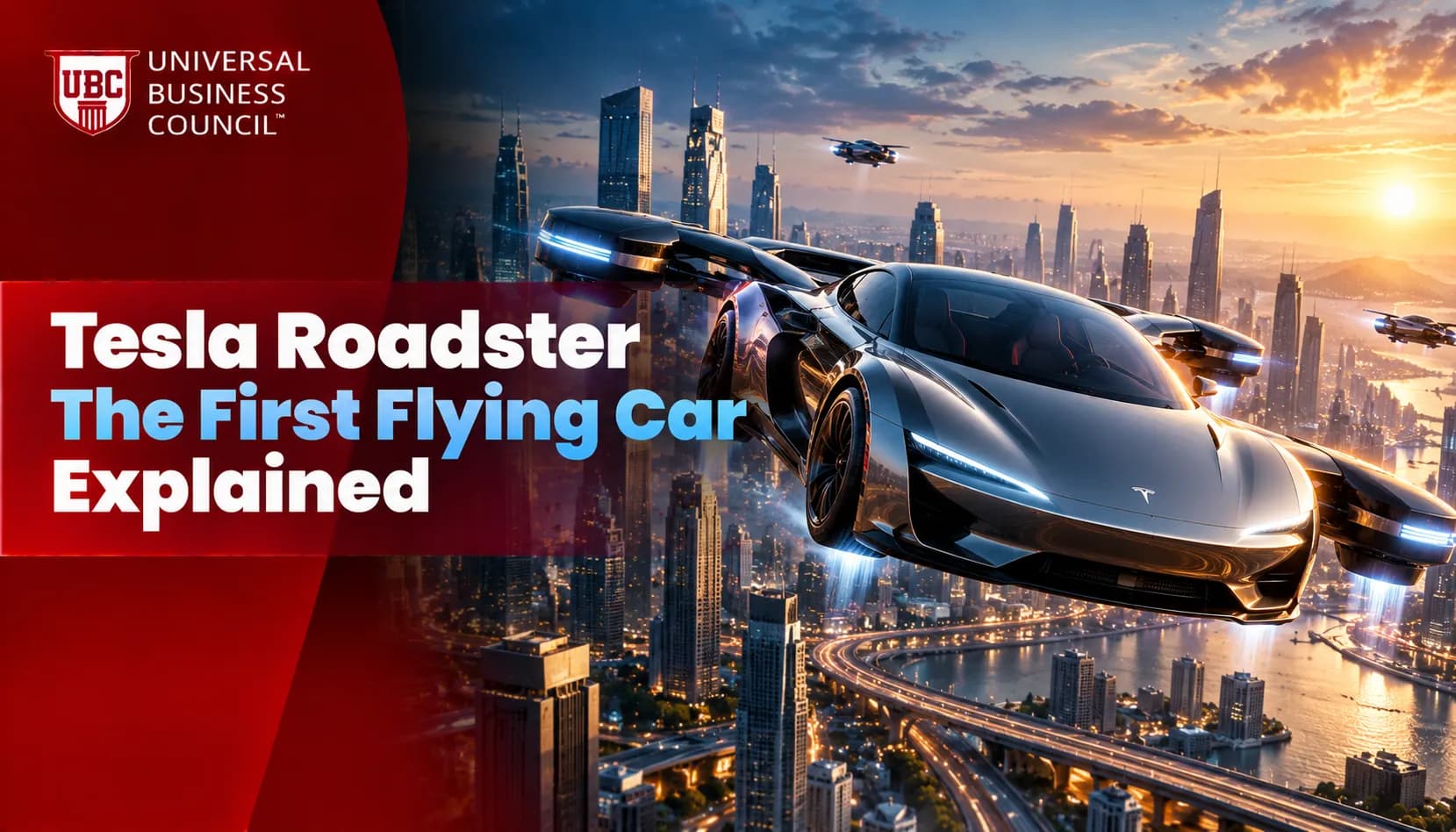
Tesla’s redesigned Roadster has set off a worldwide debate. Did the company just unveil the first real flying car, or was it an extremely polished stunt? The truth sits somewhere in the middle, and understanding it takes a little background. This guide breaks the Tesla flying car story into plain language, from how the thrusters work to what the reservation terms say, so that beginners and professionals can follow along. The launch was also a lesson in attention and storytelling, and anyone who wants to learn how such campaigns are planned can look at a Marketing Certification to see how brands turn big ideas into public moments.
The Tesla Flying Car in 60 Seconds
If you only have a minute, here is what matters:

What it is: A redesigned two-seat electric sports car, the next-generation Tesla Roadster.
When it was shown: October 15, 2026, at SpaceX’s test facility in McGregor, Texas.
What it did: Climbed an upside-down ramp, launched into the air, flipped and landed on its wheels. It also hopped over a line of other Tesla vehicles.
How it does it: Cold-gas thrusters push it through the air, and electric suction fans press it to the ground.
When you can buy one: Tesla says production starts in 2028, but no final price or guaranteed delivery date has been given.
Big caveat: The flying features are not approved for public roads, and an aviation expert told CNN the demo looked more like hopping than flying.
From a 2017 Promise to a 2026 Demonstration
To judge the news fairly, it helps to know the history. Tesla first showed a second-generation Roadster in 2017 as a four-seat supercar with a starting price around $200,000 and a promised range of roughly 620 miles. Deliveries were once expected around 2020. They never arrived. NBC News describes the October 2026 debut as coming eight years after the first announcement.
Over those years, Musk kept hinting that the car would be special. Before the event, he told a podcast host that the demo would be unforgettable and joked about a flying car. Many fans thought he was kidding. The unveiling showed that Tesla and SpaceX had been working on something unusual, even if it is still a prototype.
Following a story like this teaches an important habit: compare today’s claims with yesterday’s promises. A general Tech Certification can help you build that kind of critical thinking about technology products, timelines and specifications.
How the Tesla Flying Car Works Step by Step
Step 1: The Suction System Creates Grip
Four electric fans near the rear pull air from beneath the car. That creates suction and pushes the tires harder against the surface. Fox News explains that a sealing system helps hold the effect in place. This is why the prototype could cling to a ramp that curved over into an upside-down position.
Step 2: The Car Accelerates
Depending on the version, the Roadster accelerates using its electric motors alone or with extra help from thrusters. Tesla claimed a run from zero to 60 mph in about 0.81 seconds during the demonstration, though independent testing has not confirmed that figure.
Step 3: Cold-Gas Thrusters Fire
At the end of the ramp, highly compressed gas rushes out through nozzles. It works by pushing, like air escaping from a pressurized tank. No fuel is burned. The more powerful configuration uses about ten thrusters to control forward speed, lift and rotation.
Step 4: The Car Rotates and Lands
Thrusters around the vehicle help it turn in the air. In the demo, the car rolled about half a turn and landed back on its wheels. Fox News reports there was no driver inside, and Tesla used automated controls.
Step 5: Refilling
After a flight, the gas tanks need to be refilled. Tesla engineer Lars Moravy said the standard thruster setup uses a tank of about 200 liters and the Rocket version adds 400 liters, for around 600 liters total. Refilling the larger system currently takes about six to seven hours.
Why Cold-Gas Thrusters Instead of Jet Engines?
Cold-gas thrusters are simple and clean. They have few moving parts, produce no flame and respond quickly. They are known in spacecraft design for small movements and fine control. That makes them a good match for short bursts of force on a car-sized vehicle.
The trade-off is endurance. Compressed gas runs out fast, tanks are heavy and bulky, and the force is much smaller than a jet engine or large rotors can produce. That is why the Roadster hops rather than cruises. For true sustained flight, a vehicle needs wings, rotors or powerful lift engines, plus a lot of energy.
Specs at a Glance
All figures below are Tesla’s claims or projections, based on reports from Fox News and NBC News.
Version | Role | Claimed 0 to 60 mph | Notes |
|---|---|---|---|
Performance | Road-ready | Under 1.6 seconds | Suction system, no thrusters |
Thrust | Race-ready | Under 0.9 seconds | Four rear thrusters, limited release |
Rocket | Full flight system | Under 0.59 seconds | About 10 thrusters, one seat, invitation only |
Other claims include a top speed above 230 mph for the stronger versions and a range over 300 miles. The car also features a steer-by-wire yoke, lightweight magnesium and carbon fiber parts, and a Track Mode that lowers the suspension.
Is It Really the First Flying Car?
Here is the honest answer: probably not, depending on your definition. Inventors have been trying to combine cars and aircraft for many decades. Earlier designs, including mid-century roadable aircraft and newer machines from companies such as PAL-V, show that the idea is far from new. In addition, a growing number of companies are testing electric air taxis that fly for real distances with passengers.
What is new about the Tesla flying car is the method and the setting. It is a high-performance electric sports car that uses rocket-style gas thrusters rather than wings or rotors. It is also tied to two of the most famous names in engineering. Calling it the first fully practical flying car, however, would be a stretch.
The Roadster’s mixture of electric drive, rocket-inspired thrust and advanced control software shows how modern engineering crosses boundaries. If you are curious about such combinations across fields, a Deep Tech Certification can help you see how advanced technologies are connected, from computing to security to new hardware.
Price, Reservations and the Fine Print
Tesla did not announce a final purchase price at the unveiling. Musk says production should begin in 2028, but both Fox News and NBC News stress that this is a target, not a guarantee.
Reports about reservation payments are not identical:
NBC News and CBS News report a $5,000 deposit to reserve a non-flying Roadster.
Fox News reports that the Performance version requires $5,000 followed by $45,000 within 10 days, $50,000 in total.
Fox News adds that the Thrust version totals $250,000.
The Rocket version is invitation only, with no pricing disclosed.
Fox News also notes that Tesla’s reservation agreement lets customers cancel and receive a refund until they complete a configuration, but that the funds are not held in escrow or earning interest. Tesla states it cannot guarantee delivery dates or even delivery itself. Because the numbers differ across reports, always read Tesla’s current terms before sending money.
Roadblocks Between the Demo and the Driveway
Several challenges stand in the way:
Road rules: Tesla’s website says the flying model is not approved for public road use.
Aviation rules: Tech Insider notes that the FAA has not approved the vehicle, and CBS News points out that regulation has long held back the flying car industry.
Safety: Musk acknowledged that safety was not necessarily the top priority for the most extreme features and was unsure where they would be legal.
Practicality: Big gas tanks cost space and weight, and the Rocket version gives up the passenger seat.
Refill time: Hours of refilling do not suit daily use.
Track record: The Roadster has already missed its first delivery window by years.
Lessons From the Launch for Business Leaders
The unveiling was a case study in launching a product. Tesla picked a dramatic location, used a live stunt that anyone could understand without a technical background and attached a short, memorable message. It also released tiers so that different customers could participate at different price levels, and it leaned on its partnership with SpaceX to build credibility.
The risks are equally clear. A promise that goes unfulfilled for years can damage trust. The best teams pair big ideas with clear communication about what is proven, what is planned and what is still uncertain.
The People Behind Breakthrough Machines
Building something like this takes experts in batteries, controls, materials, software, aerodynamics and manufacturing. Companies that hire for such roles need fair, reliable ways to compare candidates.
AI tools can support parts of the hiring process, but employers still need transparent, job-relevant methods to evaluate applicants. Combining appropriate technology with human judgement can help maintain a thoughtful recruitment process. HireValid can be explored by organisations reviewing their candidate assessment approach.
For people who want to enter fields like this, the path starts with fundamentals. Study the basics, build small projects, document your work and learn to explain complex ideas simply.
What to Watch in the Coming Months
Whether Tesla announces official prices for each version
Independent tests of acceleration, range and braking
Any statement from road or aviation regulators
News on production plans, factory capacity and timelines
Improvements in gas storage and refill speed
Final Thoughts
The Tesla Roadster is an impressive blend of electric power and rocket-inspired engineering, and the unveiling gave the public a thrilling look at what is possible. As a flying car, though, it is still a prototype that makes short, controlled hops, backed by claims that outside experts have not tested. The smartest response is a mix of curiosity and caution. Enjoy the engineering, follow the independent reviews, read every reservation term carefully and remember that a spectacular demonstration is the beginning of a product story, not the end.
FAQs
1. What is the Tesla Roadster flying car?
The Tesla Roadster is an all-electric sports car that Tesla has redesigned with a flight-capable Rocket configuration. Developed with aerospace-inspired technology from SpaceX, this version uses cold-gas thrusters to perform brief aerial maneuvers. It represents an experimental approach to combining high-performance automotive engineering with rocket-inspired propulsion.
2. Is the Tesla Roadster the world's first flying car?
Tesla has described its Roadster Rocket as a flying car, but it cannot definitively be called the world's first flying car. Earlier projects have combined road travel with aircraft-style flight. Tesla's distinctive approach uses rocket-inspired thrusters to lift and maneuver a sports car briefly, rather than demonstrating conventional sustained flight.
3. When was the flying Tesla Roadster unveiled?
Tesla unveiled its redesigned, flight-capable Roadster at an event in Texas on October 15, 2026. The demonstration showed the vehicle moving along a specially designed curved ramp, leaving the surface, rotating in midair, and landing. The unveiling attracted attention because of its unusual combination of electric-car design and aerospace technology.
4. How does the Tesla flying Roadster work?
The Rocket configuration uses cold-gas thrusters that release compressed gas to generate thrust. These thrusters are positioned around the vehicle to help produce upward, forward, and rotational movement. A separate fan-powered suction system creates downforce and helps the car grip specially designed surfaces, including an inverted ramp.
5. What is the role of SpaceX in the Tesla Roadster?
SpaceX contributes aerospace engineering expertise to the flight-capable Roadster concept. The collaboration includes cold-gas thruster technology designed to produce controlled bursts of thrust. This approach brings rocket-inspired engineering into an electric sports car, although it does not make the vehicle equivalent to a conventional aircraft.
6. Can the Tesla Roadster really fly?
The demonstration showed the Roadster leaving the ground and performing short aerial maneuvers. However, this is different from flying over long distances or remaining airborne like an airplane or helicopter. Tesla has not established the final production vehicle's practical flight duration, range, or operating limitations.
7. How does the Tesla Roadster stay attached to an upside-down ramp?
Tesla describes a multi-mode fan and ground-sealing system that removes air from beneath the vehicle to generate suction. This produces additional downforce and can help the car remain attached to a specially designed inverted surface. The system is separate from the cold-gas thrusters that enable the Rocket configuration's aerial movements.
8. How fast is the Tesla Roadster?
Tesla has promoted a top speed exceeding 230 mph for the redesigned Roadster lineup. The Thrust version is also advertised as capable of accelerating from zero to 60 mph in under one second. These are manufacturer claims, and final production specifications and independent testing will be important for verifying real-world performance.
9. What are the different Tesla Roadster versions?
Tesla describes three configurations: Performance, Thrust, and Rocket. Performance is designed as a road-ready two-seat sports car, while Thrust adds rear-mounted cold-gas thrusters for enhanced performance. Rocket is an invite-only, single-seat configuration with thrusters positioned around the vehicle to support brief flight maneuvers.
10. When will the Tesla flying Roadster be available?
Tesla has announced a production target of 2028 for the redesigned Roadster. However, a target date does not guarantee that customer deliveries will begin on schedule. The project has experienced repeated delays, and the availability of the flight-capable Rocket configuration may differ from that of the road-going versions.
11. How much will the Tesla flying car cost?
Tesla has not publicly confirmed a final retail price for every Roadster configuration. Reservation payments have been listed for certain versions, while the Rocket model is offered by invitation only. Prospective buyers should distinguish between reservation deposits, the final purchase price, and any additional costs associated with specialized hardware.
12. Is the Tesla Roadster fully electric?
The Roadster is designed around an electric vehicle platform. Its flight-capable configuration adds compressed-gas propulsion hardware to enable aerial movements. The electric drivetrain and cold-gas thrusters serve different functions, and the final production design will determine how these systems work together.
13. Is the Tesla Roadster Rocket legal for public roads?
Tesla states that the Rocket configuration is not approved for public road use. The standard road-going versions are separate configurations with different intended uses. Buyers should check the legal status of the specific version in their jurisdiction rather than assuming the flight-capable model can be driven on public roads.
14. Is the Tesla flying Roadster safe?
Its safety has not been established through widespread production use or comprehensive public testing. Brief aerial maneuvers introduce risks involving thrust control, stability, landing, mechanical failure, and possible injury. Independent validation, emergency procedures, occupant protection, and clear regulatory requirements would be necessary before its capabilities could be considered suitable for routine use.
15. How is the Tesla Roadster different from an airplane?
An airplane generally uses aerodynamic lift from its wings to remain airborne and travel over distance. The Roadster Rocket instead uses bursts of compressed gas to produce brief aerial movements. Its demonstration does not show the sustained flight, navigation capabilities, or operating range associated with conventional aircraft.
16. How is the Tesla Roadster different from other flying cars?
Many flying-car projects use wings, rotors, or aircraft-style components to enable sustained flight alongside road travel. Tesla's Rocket configuration uses cold-gas thrusters integrated into a sports-car design. This gives it a different technical approach, but it does not establish that it is more practical or capable than other flying-vehicle designs.
17. What technology makes the Tesla Roadster different from ordinary electric cars?
The Roadster combines electric propulsion with active aerodynamics, a fan-powered suction system, and, in selected configurations, cold-gas thrusters. These systems aim to improve traction, acceleration, and specialized aerial movement. The combination is unusual, but its everyday benefits will depend on the final vehicle's capabilities and operating requirements.
18. Could the Tesla Roadster change the future of transportation?
The Roadster could encourage further research into aerospace-inspired vehicle technology. However, widespread use of flying cars depends on more than impressive demonstrations. Manufacturing costs, reliability, energy requirements, infrastructure, safety, and regulatory approval will all influence whether similar technology becomes practical for consumers.
19. Will the Tesla flying Roadster be available in India?
There is no confirmed general-release date for the flight-capable Rocket version in India. Tesla notes that the Rocket features are not available in every region, and the configuration is not approved for public road use. Any future Indian availability would depend on Tesla's market plans and the applicable vehicle, safety, and aviation-related regulations.
20. What should buyers know before reserving the Tesla Roadster?
Buyers should carefully review which configuration they are reserving, the payment and refund terms, the expected delivery schedule, and the final specifications. They should also verify whether the chosen version is approved for their intended use. The Rocket configuration's flight capability remains distinct from the more conventional road-going versions.
Related Articles
View All
News
Google Ads Smart Bidding Update 2026 Explained
Google Ads Smart Bidding has evolved in 2026 with enhanced AI-driven optimization, improved predictive bidding signals, and more transparent performance insights. Learn what the latest update means for advertisers and how to adapt your PPC strategy.

News
What Are the New Instagram and Facebook Teen Screen-Time Limits?
Meta’s new teen screen-time rules for Instagram and Facebook set a default two-hour daily limit for users under 18 across both apps, which teens can disable only with parental permission. The rules also include a midnight-to-6 a.m. block, muted notifications during school hours, and usage prompts after 60 and 90 minutes. The measures apply in participating U.S. states and territories under Meta’s newly approved agreement with state attorneys general.

News
Google expands Search Console to track Instagram, TikTok, X & YouTube performance
Google's new Search Console platform properties let teams measure Instagram, TikTok, X, and YouTube visibility in Search and Discover.
Trending Articles
The Role of Blockchain in Ethical AI Development
How blockchain technology is being used to promote transparency and accountability in artificial intelligence systems.
AWS Career Roadmap
A step-by-step guide to building a successful career in Amazon Web Services cloud computing.
Top 5 DeFi Platforms
Explore the leading decentralized finance platforms and what makes each one unique in the evolving DeFi landscape.