

Google expands Search Console to track Instagram, TikTok, X & YouTube performance
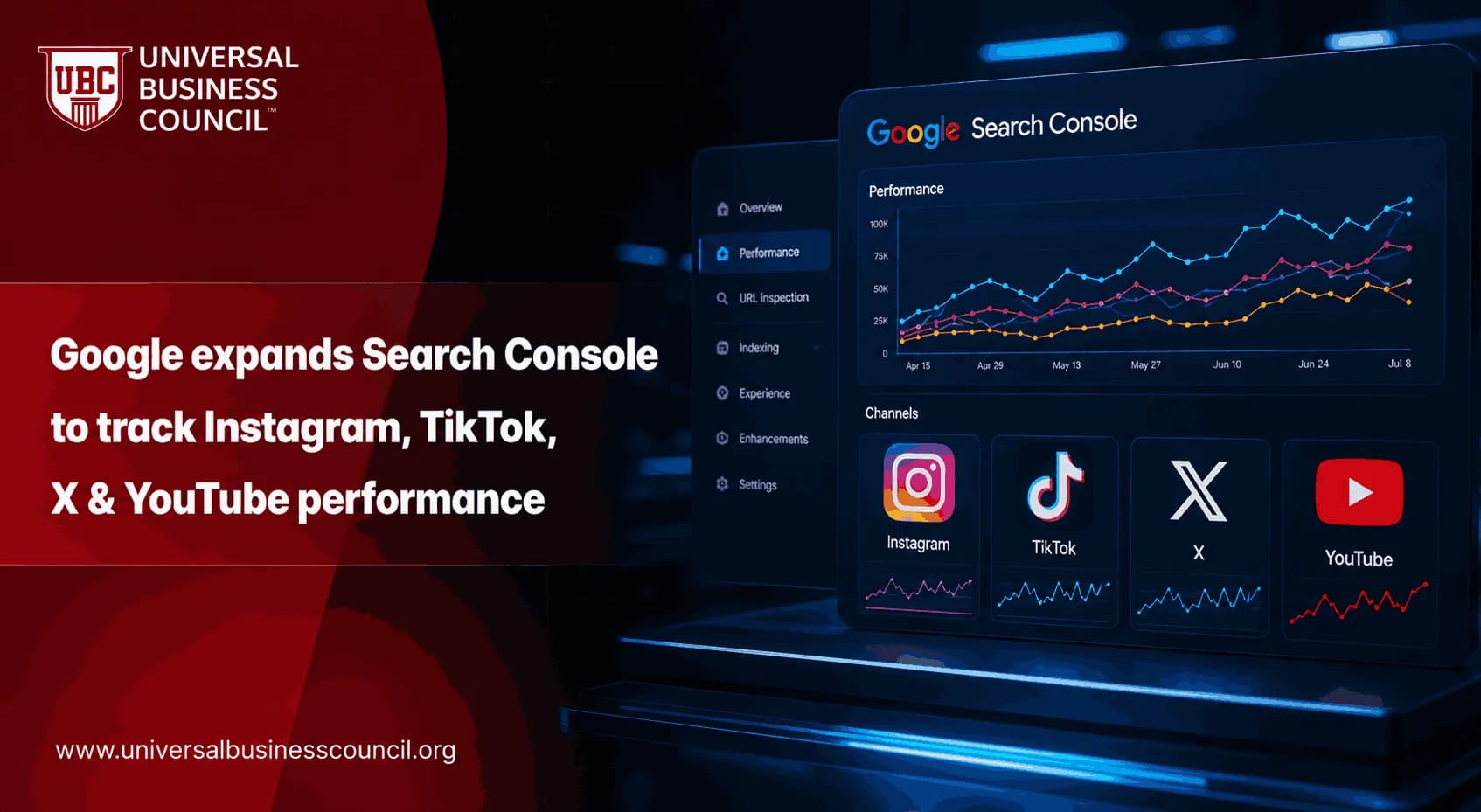
Google expands Search Console to track Instagram, TikTok, X & YouTube performance, giving creators, marketers, and brands a way to see how social and video posts appear in Google Search and Discover. The new feature, called platform properties, moves Search Console beyond website reporting and into social content visibility.
That matters. Until now, you could measure a TikTok inside TikTok analytics, a Reel inside Instagram Insights, and a video inside YouTube Studio. But if that same content showed up in Google Search, the reporting gap was obvious. You could see platform engagement, but not always the Google query that sent the user there.

As search and social media continue to converge, professionals with a Certified Digital Marketing Expert credential are increasingly equipped to interpret cross-channel performance data and turn search insights into stronger content and audience growth strategies.
Google announced platform properties through Search Central on July 7, 2026, with a gradual worldwide rollout. Search Engine Journal, Search Engine Roundtable, and other industry outlets have covered the release as a significant expansion of Search Console's role in multi-channel measurement.
What are platform properties in Google Search Console?
Platform properties are a new Search Console property type for accounts on external platforms. Instead of verifying a website domain or URL prefix, you verify a social or video account.
At launch, Google supports four platforms:
Instagram
TikTok
X, formerly Twitter
YouTube
Once verified, Search Console can report how your content from those accounts performs in Google Search and Discover. This includes posts, Reels, TikToks, X posts, YouTube Shorts, and longer YouTube videos, depending on what Google surfaces.
Do not confuse this with platform analytics. Search Console is not replacing Instagram Insights or YouTube Studio. It shows a narrower but valuable view: what happens when Google exposes your social and video content to searchers.
What Google now reports for Instagram, TikTok, X, and YouTube
The phrase Google expands Search Console to track Instagram, TikTok, X & YouTube performance sounds broad, but the data scope is specific. Google is tracking performance inside Search and Discover, not total platform performance.
Understanding how search queries influence the visibility of social content is becoming an essential SEO skill. Many professionals strengthen this capability through a Certified SEO Expert program, learning how to connect search intent, content optimization, and performance reporting across multiple digital platforms.
The core metrics include:
Clicks: visits from Google Search or Discover to your social or video content.
Impressions: how often your posts appeared in Search or Discover.
Queries: search terms that led users to your posts.
Post-level performance: reporting for individual videos, posts, or other supported content items.
Exports: downloadable data for deeper analysis in spreadsheets, BI tools, or client reports.
The query data is the part working marketers will care about first. A Reel that performs well on Instagram may be driven by the recommendation feed. A Reel that gets impressions from Google may be answering a searchable question. Those are different signals. Treat them differently.
The three reports available in platform properties
1. Performance report
The Performance report works in a familiar Search Console style. You can review clicks, impressions, queries, and posts, then filter the data to see which content is earning visibility.
For example, a service business might find that a TikTok about 'how much does commercial cleaning cost' earns more Google impressions than a polished brand video. That is not unusual. Search often rewards usefulness before production quality.
2. Insights report
The Insights report gives a higher-level view of recent trends, top posts, and discovery paths. This is useful when you need to brief a manager who does not want a 12-tab spreadsheet.
A practical note: do not report Insights as if it shows total social performance. I have seen teams make this mistake with regular Search Console data too. Search Console clicks are not the same as all visits, all views, or all engagements. Keep the label clear in dashboards.
3. Achievements section
The Achievements section tracks milestones, such as passing new thresholds for total clicks from Search during the last 28 days. Agencies will likely use this in client updates, but it should not become vanity reporting.
Use achievements as a prompt for investigation. If a YouTube Short crosses a new click threshold, ask which query caused it, whether the content answers the search intent, and whether you should create a supporting article, landing page, or longer video.
How to set up a platform property
Setup follows a verification workflow inside Search Console. Google requires this because you are claiming reporting access for an account on a platform you do not own as a domain.
Open Google Search Console.
Use the property selector or verification page.
Click Add property.
Select Instagram, TikTok, X, or YouTube.
Follow the on-screen authorization steps to connect the account securely.
There is one catch teams need to know before they build trend charts: data starts only after verification. Google is not backfilling historical social data from before the property was verified. If your leadership asks for a year-over-year comparison next week, you will not have it yet.
Set up the properties early. Even if you do not analyze the data immediately, you need the collection clock to start.
Why this changes SEO and social media reporting
This update blurs a line that was already getting weak. Social posts appear in Google. YouTube videos rank in Google. Short videos can surface in Discover. Your audience does not care which internal team owns the channel.
For professionals, the reporting model now needs to change in four ways.
Search visibility is no longer only about websites
Traditional SEO reporting focuses on pages, queries, crawlability, indexing, and technical quality. Those still matter. But platform properties confirm that social and video assets are now first-class search assets for measurement.
If you manage a brand with weak website content but strong YouTube tutorials, Search Console may now show that the videos carry more search demand than the blog. That is uncomfortable for some SEO teams. It is also useful.
Creators without websites get Search Console data
Google has positioned platform properties as useful for creators and brands, including those without dedicated websites. That is a meaningful shift. A TikTok-first educator or Instagram-first consultant can now see which Google searches expose their content.
This is not a substitute for owning a domain. To be blunt, if you are building a serious business, rented platforms still carry risk. But the data helps you decide what deserves a website page, newsletter issue, product page, or longer-form video.
Query data can shape social content planning
Most social planning meetings still overvalue format trends and undervalue search intent. Platform properties give you a corrective signal. If a post earns impressions for 'best CRM for small law firms', that phrase is not just a keyword. It is a content brief.
Use query data to refine:
Video titles and descriptions
On-screen text and captions
Hashtags, where they genuinely help discovery
Follow-up posts that answer related questions
Website content that supports high-intent searches
One common certification exam trap in digital marketing is confusing impressions with reach. This feature makes that distinction even more important. An impression in Search Console means content appeared in Google Search or Discover. It does not mean a unique person saw it, and it does not mean the content was viewed on the social platform.
Enterprise governance gets more complicated
Large organizations may run separate Instagram, TikTok, X, and YouTube accounts by region, product, or brand. Platform properties allow more granular reporting, but only if access is managed well.
Enterprises should document:
Who owns verification for each account
Which teams can view or export data
How Search Console data is labeled in dashboards
Whether creator or influencer accounts are included in campaign reporting
How exports are stored for compliance and audit needs
Influencer campaigns are the tricky case. If a creator posts on their own channel, the brand may not be able to verify that property. You need access terms in the contract before the campaign starts, not after results are due.
What this feature does not do
Platform properties are useful, but they are not magic. Industry coverage makes this point well: the feature is a measurement tool, not a way to index or rank your website.
It does not:
Force Google to index your social posts
Improve rankings by itself
Replace technical SEO for your website
Show all in-platform views, likes, comments, or shares
Provide historical data before verification
The wrong move is to treat this as another dashboard to admire. The right move is to connect it to decisions: what to publish, what to stop producing, what to turn into owned content, and where budget should move.
How professionals should use the data in the first 30 days
If you get access during the rollout, keep the first month simple. Do not build a complicated attribution model on day one.
Verify all eligible accounts. Start data collection immediately.
Create a baseline. Track clicks, impressions, top queries, and top posts for each platform.
Separate branded and non-branded queries. Leadership often tracks branded demand, but non-branded queries show market discovery.
Compare post formats. Look at Shorts versus longer videos, Reels versus static posts, and TikToks by topic.
Export the data. Keep a clean archive so you can build 28-day, quarterly, and campaign-level views later.
Turn high-query posts into owned assets. If a social post attracts valuable search demand, consider a blog article, landing page, FAQ, or downloadable guide.
For Universal Business Council learners, this connects directly to coursework in digital marketing, marketing management, social media strategy, analytics, and business reporting. The skill is not just reading the report. The skill is using the report to make a better commercial decision.
What may come next
Google has said platform properties build on an earlier December 2025 experiment that integrated social channel data into Search Console. That suggests this is not a one-off release.
Some predictions are reasonable, though they are not confirmed by Google. More platforms may be added if adoption is strong. Links to other Google products, such as Analytics or Ads, may become more practical. Training programs in SEO and digital marketing will likely need to cover social content as part of search visibility, not as a separate silo.
The bigger point is already clear. Search behavior is no longer confined to web pages. Your next step is straightforward. Verify your platform properties, wait for clean data to build, then use the first 28 days to identify which social assets deserve more investment, better metadata, or a permanent home on your own website.
As search platforms continue blending AI, social discovery, and traditional search signals, professionals can strengthen their long-term career growth by combining practical marketing experience with a Deep Tech Certification that builds technical understanding of emerging digital technologies. Complementing that knowledge with a broader Tech Certification can further prepare marketers and business leaders to adapt to the next generation of search, analytics, and digital transformation.
FAQs
1. What is Google's new Search Console update?
Google has expanded Search Console reporting to provide broader visibility into content performance across major social and video platforms, including Instagram, TikTok, X (formerly Twitter), and YouTube. The update is designed to help website owners, marketers, and creators better understand how their content contributes to online visibility.
2. Why did Google expand Search Console to include social media performance?
The update reflects how people increasingly discover information through social media and video platforms. By offering broader performance insights, Google aims to help businesses and creators measure their digital presence beyond traditional web search.
3. Which platforms are supported by the new Search Console update?
The expanded reporting includes insights related to Instagram, TikTok, X (formerly Twitter), and YouTube. These platforms are among the most influential channels for content discovery, audience engagement, and brand visibility.
4. What data can users expect to see in Search Console?
Users can access performance metrics that help evaluate how content performs across supported platforms. Depending on available reporting, this may include clicks, impressions, engagement-related insights, referral activity, and content visibility trends.
5. How does this update benefit SEO professionals?
SEO professionals can gain a more complete understanding of how social and video content supports search visibility. The additional insights help identify high-performing content, improve optimization strategies, and strengthen cross-channel marketing efforts.
6. Why is social media becoming more important for SEO?
Social platforms influence brand awareness, audience engagement, and content discovery. While social signals are not direct ranking factors in Google's search algorithms, strong social visibility can increase traffic, backlinks, and overall online presence.
7. How does the update help content creators?
Content creators can evaluate how their videos, posts, and short-form content contribute to audience growth and website visibility. These insights can guide future content planning and improve engagement across multiple platforms.
8. Can businesses measure YouTube performance in Search Console?
The expanded reporting provides greater visibility into YouTube's role in content discovery and audience engagement. Businesses can better understand how video content contributes to their broader digital marketing objectives.
9. How does Instagram tracking help marketers?
Instagram insights help marketers identify which content attracts engagement, supports brand awareness, and drives users toward business websites or other digital properties, allowing for more informed content strategies.
10. Why is TikTok performance tracking valuable?
TikTok has become a major content discovery platform. Performance tracking helps marketers understand which videos generate visibility, attract audiences, and support broader marketing and SEO initiatives.
11. How does X (formerly Twitter) reporting support digital marketing?
Tracking X performance helps businesses monitor content reach, engagement, and audience interaction while understanding how conversations and shared content contribute to overall online visibility.
12. Does this update replace existing social media analytics tools?
No. Native analytics from Instagram, TikTok, X, and YouTube remain important for detailed platform-specific insights. Search Console complements these tools by providing additional visibility into overall content performance and discovery.
13. How can marketers use the new Search Console data?
Marketers can compare content performance across platforms, identify successful topics, optimize publishing strategies, improve audience targeting, and align SEO with social media marketing efforts for better overall results.
14. What industries benefit most from this update?
E-commerce, media, publishing, education, healthcare, technology, travel, finance, entertainment, and digital marketing agencies can all benefit from improved visibility into cross-platform content performance.
15. How does this update support GEO and Answer Engine Optimization (AEO)?
Understanding how content performs across search, social, and video platforms helps businesses create authoritative, discoverable content that performs well in search engines, AI-powered search experiences, and answer engines.
16. What best practices should businesses follow after this update?
Businesses should create high-quality content, optimize videos and social posts with relevant keywords, maintain consistent branding, monitor performance regularly, and refine strategies based on measurable insights across all supported platforms.
17. Will this update change traditional SEO strategies?
Traditional SEO fundamentals such as producing high-quality content, improving website performance, optimizing metadata, and earning authoritative backlinks remain important. The update encourages organizations to integrate social media and video strategies into their broader search optimization efforts.
18. How can businesses improve performance across multiple platforms?
Organizations should publish valuable content consistently, optimize titles and descriptions, use relevant hashtags where appropriate, create engaging videos, encourage audience interaction, and analyze performance data to improve future campaigns.
19. What future trends could this update indicate?
The expansion suggests that search analytics may increasingly incorporate data from multiple digital channels as search behavior evolves. Businesses should continue monitoring official Google announcements for future reporting capabilities and feature enhancements.
20. Why is Google's expanded Search Console reporting important?
As online discovery extends beyond traditional search results, businesses need a more comprehensive view of how audiences find and engage with content. Expanded Search Console reporting helps marketers, publishers, and creators better understand cross-platform performance, refine content strategies, and make more informed decisions in an increasingly connected digital ecosystem.
Related Articles
View All
News
What Are the New Instagram and Facebook Teen Screen-Time Limits?
Meta’s new teen screen-time rules for Instagram and Facebook set a default two-hour daily limit for users under 18 across both apps, which teens can disable only with parental permission. The rules also include a midnight-to-6 a.m. block, muted notifications during school hours, and usage prompts after 60 and 90 minutes. The measures apply in participating U.S. states and territories under Meta’s newly approved agreement with state attorneys general.
News
Google Ads Smart Bidding Update 2026 Explained
Google Ads Smart Bidding has evolved in 2026 with enhanced AI-driven optimization, improved predictive bidding signals, and more transparent performance insights. Learn what the latest update means for advertisers and how to adapt your PPC strategy.

News
Tesla Roadster: The First Flying Car Explained
Tesla’s new Roadster leaped into the air at a SpaceX test site, sparking talk of the first flying car. See how it works, what it costs, what Tesla claims and what is still unproven.
Trending Articles
The Role of Blockchain in Ethical AI Development
How blockchain technology is being used to promote transparency and accountability in artificial intelligence systems.
AWS Career Roadmap
A step-by-step guide to building a successful career in Amazon Web Services cloud computing.
Top 5 DeFi Platforms
Explore the leading decentralized finance platforms and what makes each one unique in the evolving DeFi landscape.