SEO vs Paid Search: When to Invest in Organic Growth, How to Blend Channels, and What to Measure
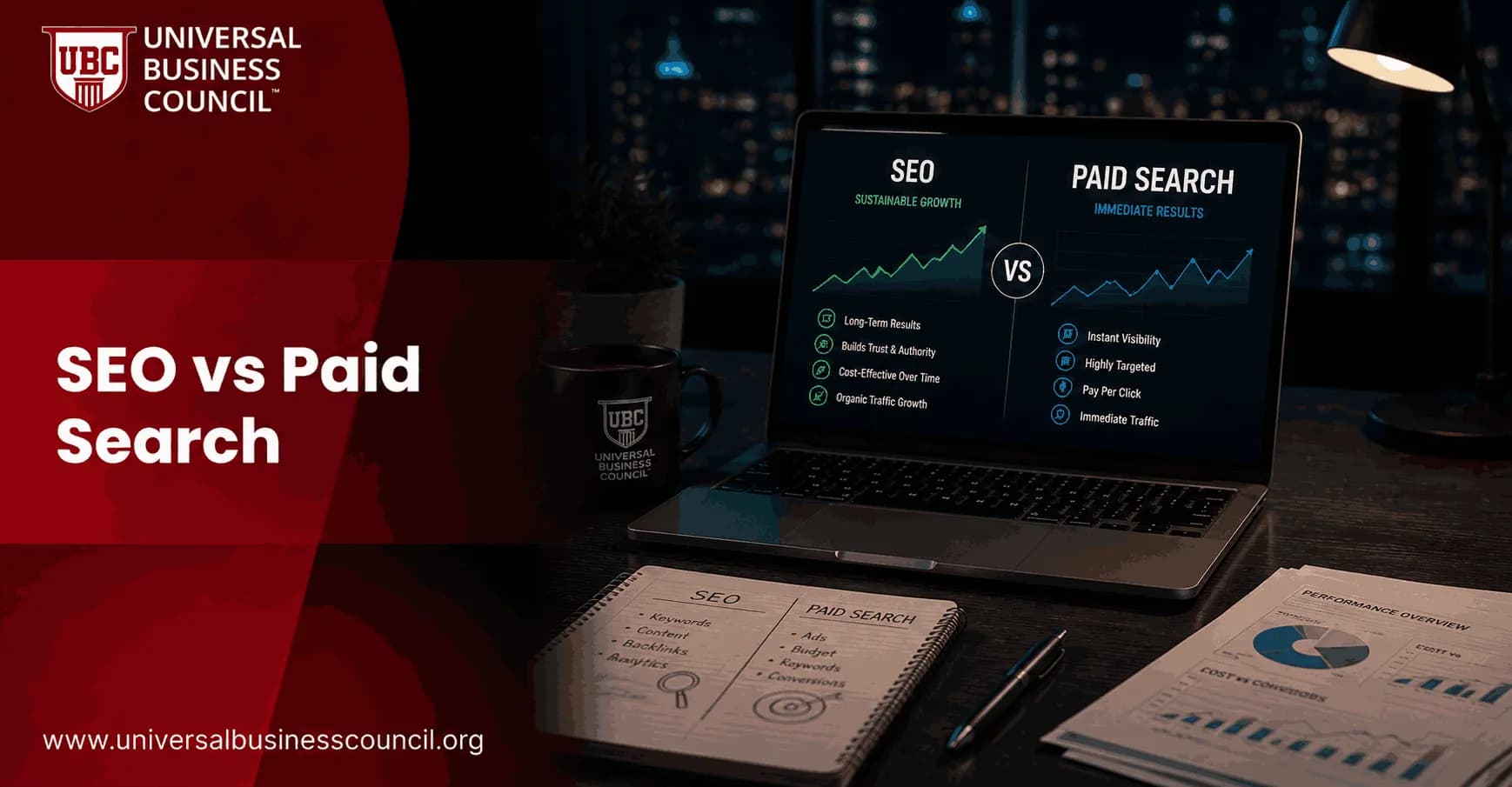
SEO vs paid search is not an either-or decision. In most organizations, they function as two complementary parts of a single search visibility system. Paid search (PPC) delivers speed and control for capturing existing demand, while SEO builds durable, compounding organic growth that reduces reliance on ongoing ad spend. The practical question is how to sequence investments, blend channels intelligently, and measure outcomes with the right time horizons.
For an SEO Expert and Digital Marketing Expert, the SEO versus PPC discussion is rarely about choosing a winner. The real objective is building a search strategy that balances immediate demand capture with long-term visibility, brand growth, and acquisition efficiency.

SEO vs paid search: the strategic difference
PPC and SEO can appear to compete because they both target search results pages. In practice, they solve different business problems.
What paid search (PPC) is best for
Paid search is auction-based advertising on platforms such as Google Ads and Microsoft Advertising. You bid on keywords and pay per click. Its primary strengths are:
Speed: campaigns can generate visibility and traffic the same day they go live if budgets and ad quality are sufficient.
Control: you can manage targeting, budgets, ad copy, landing pages, and geographic reach with precision.
Capturing high-intent demand: PPC is typically strongest on bottom-of-funnel queries like "pricing", "book", "buy", or "near me".
The trade-off is straightforward: traffic stops when spend stops. When you pause budgets, performance drops immediately.
What SEO (organic search) is best for
SEO improves the technical structure, content, and authority signals of a site so pages rank organically. Its core advantages are:
Compounding returns: once rankings are established, organic traffic can persist and grow for years with ongoing maintenance.
Lower marginal cost: there is no cost per click, although SEO requires sustained investment in content, technical work, and authority building.
Trust and credibility: many users perceive organic results as more trustworthy than ads, supporting long-term brand credibility.
The trade-off is timing. Most teams need 3-12 months to see meaningful SEO impact, depending on competition and site maturity.
How SERP changes and AI affect SEO vs paid search
Modern search results pages increasingly include AI-generated summaries, featured snippets, local packs, shopping units, videos, and "people also ask" modules. This reduces traditional organic link real estate for both SEO and PPC and changes how visibility is earned and measured.
AI as a third visibility layer
AI-powered SERP features now function as a third visibility layer alongside SEO and PPC. For some query types, AI summaries can reduce clicks to both organic and paid listings, particularly for informational searches where users receive answers directly on the results page without clicking through.
Brand signals matter more across both channels
Google evaluates brands holistically, using signals from websites, Google Business Profiles, reviews, press mentions, and other sources to build trust. This pushes teams toward integrated search strategies where content quality, reputation, and messaging consistency support both organic rankings and paid performance.
When to invest more in paid search
Invest more heavily in PPC when speed, control, or time sensitivity outweigh long-term compounding benefits.
You need immediate results or feedback: new product launches, new market entry, rapid pipeline needs, or fast validation of positioning and pricing.
The SERP is structurally hard to win organically: results dominated by marketplaces, aggregators, shopping units, or local packs.
Your campaign is time-bound: seasonal promotions, events, limited-time offers, or conference-driven spikes.
You have clear high-intent keywords: well-defined purchase intent can be captured predictably with PPC.
You need precise targeting: geo targeting, audience lists, and controlled experimentation across creative and landing pages.
When to invest more in SEO and organic growth
Invest more heavily in SEO when you want compounding traffic, lower long-run customer acquisition cost (CAC), and durable brand authority.
You want to lower CAC over time: once organic visibility is built, incremental visits typically carry minimal marginal cost.
Buyers have complex research behavior: in B2B SaaS, healthcare, finance, and education, users often research extensively before they convert.
You are building authority and trust: persistent organic presence supports credibility and demand creation.
You want to reduce paid media dependence: rising CPCs and budget volatility can make solely paid strategies fragile.
You can commit for 6-12 months: SEO requires patience, consistent execution, and stakeholder alignment around longer timelines.
Some industry analyses report average SEO ROI figures exceeding 700 percent, reflecting compounding traffic and low marginal cost once rankings are established. Results vary significantly by category and execution quality, but the compounding dynamic is the core economic argument for organic investment.
A practical allocation model by business stage
A useful way to approach the SEO vs paid search budget decision is to tie channel mix to company stage.
Launch phase
Lean on PPC for immediate traffic, learning, and pipeline.
Start foundational SEO early: technical hygiene, analytics setup, core landing pages, and initial content to avoid accumulating technical debt.
Growth phase
Scale SEO into topic coverage and content clusters that match the buyer journey.
Keep PPC focused on high-intent terms, competitive terms, and remarketing to engaged visitors.
Use PPC insights to prioritize SEO topics and landing pages.
Maturity phase
Balance the mix: SEO provides steady, lower-cost volume; PPC is used for defense, experiments, and new initiatives.
Align with brand and activation planning: research by Les Binet and Peter Field, drawing on analysis of more than 1,400 campaigns, found that combining long-term brand building with short-term activation can deliver roughly twice the sales growth of activation-only strategies. Their widely referenced planning guideline suggests approximately a 60 percent brand-building and 40 percent activation split for many mature brands, with variation by context.
How to blend SEO and paid search into one system
The highest-performing teams do not simply run two channels in parallel. They build a feedback loop where each channel strengthens the other.
1) Use PPC as a testing lab for SEO
PPC can validate what SEO should scale:
Test value propositions, headlines, and offers quickly.
Validate keyword intent and conversion potential before committing to large content builds.
Use search term reports to find productive language and surface objections to address in SEO content.
2) Coordinate full-funnel coverage
SEO: informational and consideration content such as guides, comparisons, templates, and "how to choose" pages.
PPC: high-intent purchase terms, competitor terms where appropriate, brand defense, and remarketing.
3) Align ad copy with organic snippets
When PPC ad copy and SEO titles and meta descriptions reinforce the same positioning, brand recall improves and click-through rates often increase across both listings. Consistent messaging also supports conversion rates by ensuring the landing page experience matches the promise made in search.
4) Build landing pages that serve both channels
Where feasible, create landing experiences that perform in PPC and also contribute to SEO. Page speed, mobile UX, and clear information architecture support quality score factors in paid search and organic ranking signals simultaneously.
Building integrated search programs requires more than channel expertise. A Tech Certification can help professionals strengthen their understanding of analytics platforms, automation, data integration, and measurement systems that support informed marketing decisions.
What to measure: PPC metrics, SEO metrics, and blended metrics
Measurement is where most SEO vs paid search debates go wrong. The channels operate on different time horizons and require different scorecards.
Core PPC metrics (near-term optimization)
Impressions and impression share on target queries
CTR to gauge relevance and message fit
CPC and CPA to manage efficiency
Conversion rate by landing page
ROAS and marginal ROAS for budget decisions
Quality Score components: expected CTR, ad relevance, landing page experience
For advanced programs, add incrementality tests such as geo splits or time-based holdout tests to measure lift beyond baseline demand.
Core SEO metrics (trend and compounding impact)
Organic sessions and users by landing page and topic
Search Console impressions, clicks, and average position
Visibility across keyword clusters, not just a handful of head terms
Organic conversions and revenue or leads from organic traffic
Technical health: index coverage, crawl errors, Core Web Vitals
Authority signals: backlink quality and topical relevance
Because SEO compounds over time, leadership reporting should prioritize trendlines, cohort growth, and the expanding share of total demand captured over quarters rather than daily fluctuations.
Blended metrics (how SEO and PPC influence each other)
Assisted conversions and multi-touch attribution to credit discovery and consideration touches, not just last click
Brand search volume growth as a proxy for brand equity and demand creation
CAC and LTV by channel mix to evaluate payback period and margin impact
Share of search or share of voice across paid and organic listings for priority topics
Implementation guidance for teams and professionals
To build an integrated search program:
Define roles and time horizons: treat PPC as a controlled near-term lever and SEO as an equity-building asset.
Start SEO early, even at small scale: technical fundamentals and a focused content plan begin the compounding curve sooner.
Build a feedback loop: use PPC learnings to prioritize SEO, then use SEO engagement data to fuel remarketing audiences and creative testing.
Measure fairly: combine channel dashboards with multi-touch reporting and incrementality tests where feasible.
For professionals formalizing these skills, complementary certification paths in SEO, PPC or Google Ads, and digital marketing provide structured foundations for integrated search planning and measurement.
As AI increasingly influences search visibility, attribution, and campaign optimization, an AI Certification can help professionals better understand AI-driven decision-making and performance analysis.
Conclusion: choose sequencing and measurement, not a single winner
In the SEO vs paid search decision, the strongest strategy is rarely to pick one. PPC provides speed, control, and immediate demand capture. SEO builds compounding visibility, brand credibility, and resilience against rising CPCs and measurement uncertainty. Treat them as one system: use PPC to learn fast, invest in SEO to compound over time, and evaluate both with metrics that match their roles and time horizons.
FAQs
1. What Is SEO?
SEO (Search Engine Optimization) is the process of improving a website's visibility in organic search results by optimizing content, technical performance, and authority.
2. What Is Paid Search?
Paid search is a digital advertising strategy where businesses pay to display ads on search engine results pages for targeted keywords and audience segments.
3. What Is the Main Difference Between SEO and Paid Search?
SEO generates organic traffic through search rankings, while paid search generates traffic through paid advertisements that appear in search results.
4. How Does SEO Work?
SEO works by optimizing website content, technical elements, user experience, and authority signals to improve rankings in search engines.
5. How Does Paid Search Work?
Paid search works through bidding systems where advertisers compete for ad placement based on keywords, audience targeting, and ad quality.
6. Which Delivers Results Faster: SEO or Paid Search?
Paid search typically delivers traffic immediately after campaign launch, while SEO often requires several months to achieve significant results.
7. Is SEO More Cost-Effective Than Paid Search?
SEO often provides a lower long-term cost per acquisition because traffic continues after rankings are established, while paid search requires ongoing ad spend.
8. What Are the Main Benefits of SEO?
Benefits include sustainable traffic, increased brand credibility, higher visibility, improved user experience, and long-term return on investment.
9. What Are the Main Benefits of Paid Search?
Benefits include immediate visibility, precise audience targeting, measurable performance, flexible budgeting, and rapid testing opportunities.
10. Which Strategy Is Better for Brand Awareness?
Both can support brand awareness, but paid search can generate immediate exposure, while SEO builds long-term visibility and authority.
11. How Does Keyword Targeting Differ Between SEO and Paid Search?
SEO focuses on earning rankings through optimized content, while paid search targets keywords through advertising bids and campaign settings.
12. Which Provides Better Long-Term Value?
SEO generally provides stronger long-term value because successful rankings can continue generating traffic without direct payment for each click.
13. How Does Click-Through Rate Compare Between SEO and Paid Search?
Organic listings often achieve higher trust and click-through rates for informational searches, while paid ads can perform well for high-intent commercial queries.
14. What Role Does Content Play in SEO?
Content is central to SEO because search engines use it to understand relevance, answer user queries, and determine ranking eligibility.
15. How Is Success Measured in SEO and Paid Search?
SEO success is measured through organic traffic, rankings, conversions, and revenue, while paid search focuses on metrics such as clicks, conversions, ROAS, and cost per acquisition.
16. When Should Businesses Prioritize Paid Search?
Paid search is often ideal for product launches, seasonal campaigns, competitive markets, immediate lead generation, and time-sensitive promotions.
17. When Should Businesses Prioritize SEO?
SEO is ideal for long-term growth, building authority, increasing organic visibility, reducing acquisition costs, and generating sustainable traffic.
18. Can SEO and Paid Search Work Together?
Yes, combining both strategies can maximize search visibility, improve keyword coverage, generate insights, and strengthen overall marketing performance.
19. What Are Common Misconceptions About SEO and Paid Search?
A common misconception is that SEO is free and paid search is always expensive. In reality, both require investment in strategy, expertise, tools, and optimization. Search engines, rather inconveniently, do not distribute customers as a public service.
20. Which Is Better: SEO or Paid Search?
Neither is universally better. The right choice depends on business goals, budget, competition, timeline, and growth strategy. Most successful organizations use a combination of SEO and paid search to balance immediate results with long-term growth.
Related Articles
View All
Seo
SEO After ChatGPT, Gemini & AI Search
ChatGPT, Gemini, and AI search are changing how users find answers, forcing SEO teams to rethink rankings, citations, authority, and content structure.
Seo
AI Search vs Traditional SEO
AI search and traditional SEO work differently, requiring marketers to balance rankings, citations, authority signals, and answer-ready content.
Seo
From Search Bar to AI Answers: The New SEO Era
AI answers are reshaping how users discover information, forcing brands to rethink visibility beyond traditional search rankings.
Trending Articles
The Role of Blockchain in Ethical AI Development
How blockchain technology is being used to promote transparency and accountability in artificial intelligence systems.
AWS Career Roadmap
A step-by-step guide to building a successful career in Amazon Web Services cloud computing.
Top 5 DeFi Platforms
Explore the leading decentralized finance platforms and what makes each one unique in the evolving DeFi landscape.