

AI Search vs Traditional SEO
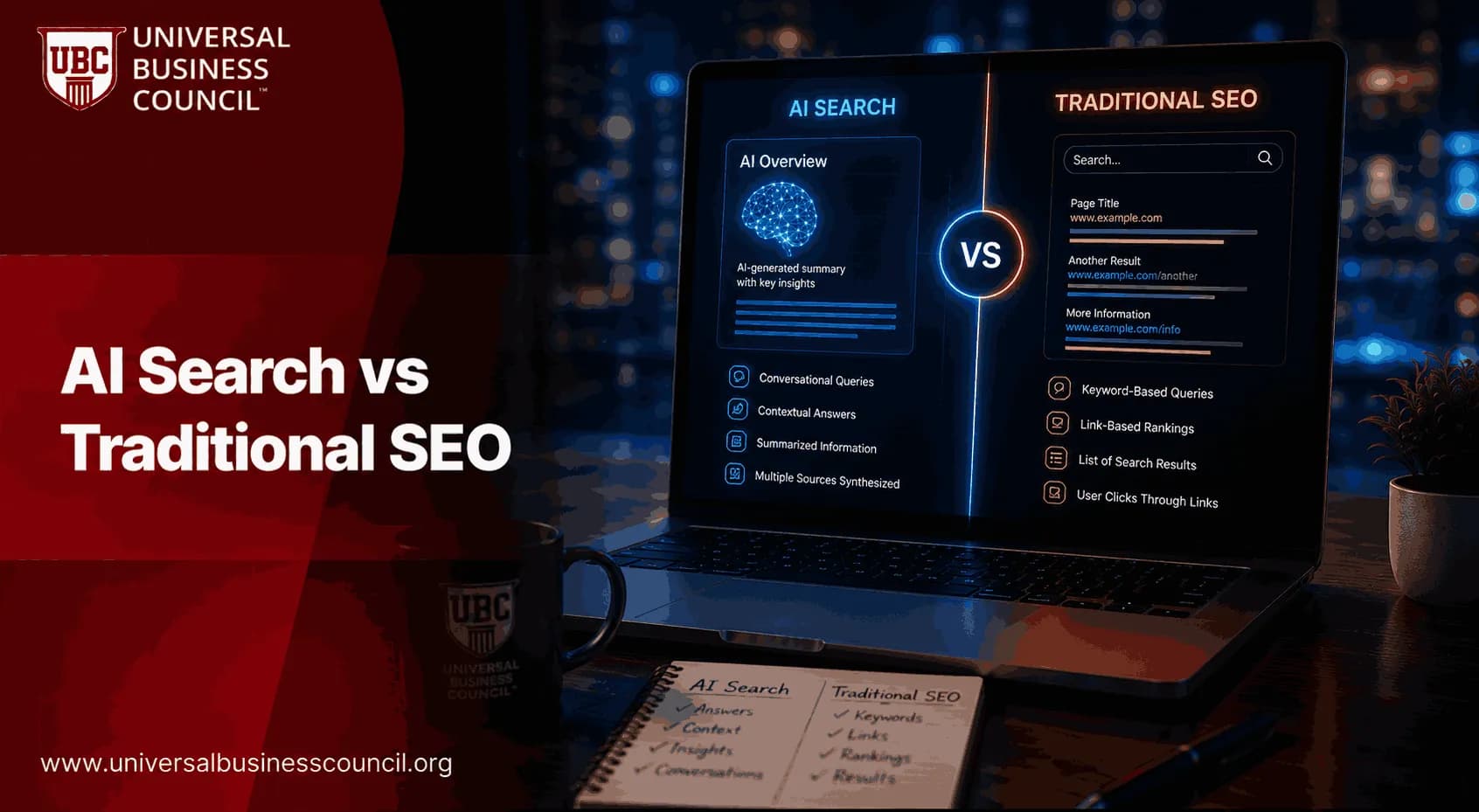
Search behavior is changing faster than ever before. Traditional SEO has been the foundation of digital marketing for years, helping businesses increase website visibility through keywords, backlinks, and technical optimization. However, the rapid rise of artificial intelligence is transforming how people search for and consume information online.
AI-powered platforms such as ChatGPT, Gemini, and AI-enhanced search engines now provide conversational answers instead of only displaying website links. This evolution has created a major shift in the marketing industry, forcing businesses to rethink how online visibility works.

The debate between AI Search vs Traditional SEO is becoming increasingly important for marketers, businesses, publishers, and technology professionals. Companies that understand these changes will be better prepared for the future of digital discovery. Meanwhile, the internet continues its long tradition of making marketers relearn their entire profession every few years. Algorithms apparently thrive on emotional instability.
Professionals adapting to evolving consumer behavior and digital trends often pursue advanced Marketing certification programs to strengthen strategic marketing and leadership expertise.
What Is Traditional SEO?
Traditional SEO refers to optimizing websites to improve rankings on search engine result pages.
Traditional SEO strategies usually focus on:
Keyword optimization
Backlink building
Technical SEO
Meta tags
Website structure
Content optimization
The main objective is to attract organic traffic from search engines like Google.
How Traditional Search Engines Work
Traditional search engines generally:
Crawl websites
Index web pages
Analyze ranking factors
Display search results based on relevance
Users then visit multiple websites to gather information.
This system has shaped digital marketing for decades.
What Is AI Search?
AI search uses artificial intelligence to provide more intelligent and conversational search experiences.
AI-powered systems can:
Understand context
Analyze natural language
Generate summaries
Personalize responses
Deliver direct answers
Instead of showing only links, AI systems often provide complete responses immediately.
Popular AI Search Platforms
Modern AI-powered search tools include:
ChatGPT
Gemini
Perplexity
AI assistants
AI-enhanced search engines
These technologies are changing how users interact with online content.
Professionals interested in intelligent technologies and artificial intelligence systems often pursue the AI Expert certification to strengthen expertise in AI-driven innovation and digital transformation.
The Key Difference Between AI Search and Traditional SEO
The biggest difference lies in how users receive information.
Traditional SEO Experience
Users:
Enter keywords
Browse search results
Open websites
Compare multiple sources
AI Search Experience
Users:
Ask conversational questions
Receive direct responses
Interact naturally with AI systems
Spend less time browsing websites
This changes user behavior significantly.
Search Intent Has Become More Important
Traditional SEO often emphasized exact-match keywords.
AI search prioritizes:
User intent
Semantic meaning
Conversational context
Search relevance
For example:
Traditional query: “best wireless headphones”
AI query: “Which wireless headphones are best for office work and travel?”
AI systems understand context more deeply than conventional search engines.
Conversational Search Is Expanding
Users increasingly search through:
Voice assistants
Smartphones
AI chat platforms
Wearable devices
Searches are becoming:
Longer
More natural
More detailed
More question-focused
Businesses must optimize content for natural language interactions.
Zero-Click Searches Are Increasing
AI search has accelerated the growth of zero-click searches.
Users now receive answers directly through:
AI summaries
Featured snippets
Voice assistants
Instant search previews
without clicking websites.
This changes traditional website traffic patterns significantly.
Brand Visibility Still Matters
Even without clicks, businesses still benefit from:
Online visibility
Brand authority
Customer trust
Industry recognition
Strong digital presence remains essential.
Content Quality Is More Valuable Than Ever
AI systems prioritize content that demonstrates:
Expertise
Accuracy
Reliability
Clarity
User value
Low-quality and repetitive content struggles in AI-driven environments.
Originality Creates Competitive Advantage
The internet contains massive amounts of repetitive AI-generated material.
Businesses should focus on:
Expert insights
Unique perspectives
Real-world examples
Research-backed information
Professionals exploring advanced AI-generated systems often pursue the Generative ai expert course to better understand generative AI technologies and automation.
Technical SEO Still Matters
Despite AI search growth, technical SEO remains important.
Search systems still depend on:
Website speed
Mobile responsiveness
Structured data
Accessibility
Security
Crawlability
Technical optimization supports both AI search and traditional SEO performance.
Structured Data Helps AI Systems
Schema markup improves how AI systems understand:
Products
FAQs
Reviews
Articles
Business details
This improves discoverability and indexing.
Organizations exploring emerging technologies and innovation frequently pursue Deeptech certification programs focused on intelligent systems and advanced digital transformation.
AI Search Is More Personalized
Traditional search often displayed similar results for many users.
AI-powered systems personalize experiences based on:
Search history
User behavior
Preferences
Context
Geographic location
This makes SEO more dynamic and individualized.
Businesses must now focus on broader visibility instead of relying only on universal rankings.
Voice Search Is Accelerating AI Adoption
Voice assistants are changing how people search online.
Users increasingly rely on:
Smart speakers
Mobile assistants
AI-driven applications
Wearable technology
Voice searches are typically:
More conversational
Longer
More detailed
Businesses should optimize content for voice-friendly queries.
User Experience Is Essential
Both AI search and traditional SEO prioritize user experience.
Important factors include:
Fast-loading websites
Easy navigation
Mobile optimization
Accessibility
Readability
Poor user experiences can reduce visibility and engagement.
Core Web Vitals Continue to Matter
Google still evaluates:
Page loading speed
Interactivity
Visual stability
Technical website performance remains an important ranking factor.
Developers improving automation and website optimization often strengthen expertise through the AI Powered coding expert Course to better understand AI-assisted coding and development workflows.
Agentic AI Will Shape Future Search
Agentic AI refers to autonomous systems capable of making decisions independently.
Future AI systems may:
Compare products automatically
Conduct online research
Recommend services
Complete purchases
Automate customer interactions
This could significantly reshape customer journeys and search behavior.
Professionals preparing for intelligent automation ecosystems increasingly explore the Agentic AI course to understand autonomous AI systems and decision-making technologies.
Social Media Is Influencing Search
Users increasingly search directly on:
TikTok
YouTube
Reddit
Instagram
AI systems also analyze:
Creator content
Community discussions
User-generated content
Social engagement
Traditional search engines are no longer the only source of online discovery.
Community Trust Is Becoming Powerful
Authentic discussions strongly influence:
Purchasing decisions
Brand reputation
Customer trust
Online authority
Businesses must build visibility across multiple digital channels.
Traditional SEO Still Offers Major Benefits
Despite AI search growth, traditional SEO remains highly valuable.
Traditional SEO still provides:
Long-term organic traffic
Website discoverability
Brand authority
Scalable growth
Search visibility
Businesses should combine traditional SEO with AI-focused strategies instead of replacing one entirely.
Challenges of AI Search
AI-powered search also introduces several challenges.
Reduced Traffic for Publishers
Direct AI answers may decrease website visits.
AI Hallucinations
AI systems sometimes generate incorrect information.
Attribution Concerns
AI-generated summaries may not always provide traffic referrals.
Increased Online Competition
AI-generated content has increased digital competition significantly.
Businesses must focus on trust and expertise to stand out.
The Future of Search Marketing
The future of digital marketing will likely combine:
Traditional SEO
AI optimization
Conversational search
Technical SEO
Social visibility
Community engagement
Businesses must continuously adapt to changing search behavior.
Skills Modern Marketers Need
Modern marketers increasingly require expertise in:
AI systems
Automation
SEO
Analytics
Consumer psychology
Content strategy
Technology professionals aiming to remain competitive often pursue recognized Tech certification programs to strengthen expertise in evolving digital technologies.
Best Practices for Businesses
Focus on High-Quality Content
Create trustworthy and informative material consistently.
Optimize for Conversational Search
Use natural language and question-based structures.
Improve Technical SEO
Ensure websites are fast, secure, and mobile-friendly.
Build Multi-Platform Visibility
Combine SEO with social media and community engagement.
Understand AI Systems
Businesses should understand how AI technologies influence modern search behavior.
Conclusion
AI search and traditional SEO are not replacing each other completely. Instead, they are evolving together within the modern digital ecosystem.
Traditional SEO still plays a major role in online visibility, while AI-powered search is reshaping how users interact with information. Businesses must adapt by combining:
SEO fundamentals
AI optimization
Technical performance
Conversational content
User experience
Brand authority
The future belongs to organizations that successfully combine human expertise with intelligent technology. Businesses relying entirely on outdated optimization methods may eventually discover that AI-driven search experiences are changing customer behavior faster than traditional SEO strategies can keep up with. The internet remains remarkably committed to reinvention.
FAQs
1. What is AI search?
AI search uses artificial intelligence to provide conversational and context-aware responses to user queries. It delivers direct answers instead of only displaying website links. AI systems also personalize search experiences based on behavior and preferences.
2. How is AI search different from traditional SEO?
Traditional SEO focuses on ranking web pages through keywords and backlinks, while AI search emphasizes context and conversational understanding. AI systems provide more direct and personalized responses. Both approaches influence digital visibility differently.
3. Why is AI search becoming more popular?
Users prefer faster and more convenient search experiences. AI systems simplify information discovery by providing instant answers and conversational interactions. Personalized responses also improve user satisfaction.
4. Does traditional SEO still work?
Yes, traditional SEO remains valuable for long-term website traffic and visibility. Search engines still rely on indexing and ranking systems. Businesses should combine SEO with AI-focused optimization strategies.
5. What are zero-click searches?
Zero-click searches occur when users receive answers directly from search engines or AI systems without visiting websites. Featured snippets and AI summaries are common examples. This trend is changing traffic patterns significantly.
6. Why is conversational search important?
Users increasingly interact with search systems using natural language questions. Conversational search reflects normal human communication patterns. Businesses must optimize content to match these behaviors.
7. How does AI search impact website traffic?
AI systems may reduce direct clicks by providing instant answers. However, businesses still benefit from visibility, authority, and trust. Strong branding remains valuable in AI-driven environments.
8. Why is content quality important in AI search?
AI systems prioritize reliable and expert-driven information sources. Low-quality or repetitive content performs poorly. Original and informative material helps businesses improve credibility and visibility.
9. What role does technical SEO play today?
Technical SEO supports crawlability, indexing, accessibility, and performance across search systems. AI-powered platforms also depend on optimized websites for accurate analysis. Strong technical foundations improve discoverability.
10. What is structured data?
Structured data helps search engines and AI systems understand website content more effectively. It improves visibility for products, reviews, FAQs, and articles. Schema markup also supports indexing performance.
11. How does voice search affect SEO?
Voice searches are more conversational and detailed than typed queries. Businesses must optimize for natural language patterns and question-based searches. Voice-friendly content improves discoverability.
12. What is agentic AI?
Agentic AI refers to autonomous systems capable of independently making decisions and completing tasks. These systems may influence future search and shopping experiences. Businesses are preparing for intelligent automation trends.
13. Why is personalization important in AI search?
AI systems personalize search results based on user preferences, location, and behavior. Different users may receive different responses for similar queries. Personalization improves relevance and user engagement.
14. How are social media platforms influencing search?
Users increasingly search directly on social platforms like TikTok and YouTube. AI systems also analyze creator and community content. Social engagement now contributes to broader online visibility.
15. Can AI-generated content rank well?
AI-generated content can perform successfully if it is accurate, original, and valuable. Generic or repetitive material often struggles in competitive environments. Human editing and expertise remain important.
16. What skills are important for modern marketers?
Modern marketers need expertise in AI systems, automation, analytics, SEO, and content strategy. Understanding user behavior and personalization is also important. Continuous learning is becoming essential.
17. Why is user experience important in SEO?
Search systems prioritize websites that provide smooth and engaging experiences. Fast loading speed and mobile optimization improve customer satisfaction. Poor usability can negatively impact visibility.
18. How can businesses prepare for AI-driven search?
Businesses should combine traditional SEO with conversational optimization and AI-friendly content structures. Strong technical performance and authority are also critical. Multi-platform visibility improves competitiveness.
19. What are the risks of AI search?
AI search may reduce website traffic and increase content competition. AI systems can occasionally generate inaccurate information. Businesses must focus on trust and credibility.
20. What is the future of search marketing?
The future of search marketing will combine AI optimization, conversational search, technical SEO, and personalized experiences. Businesses must continuously adapt to changing technologies and digital behavior.
Related Articles
View All
Seo
SEO After ChatGPT, Gemini & AI Search
ChatGPT, Gemini, and AI search are changing how users find answers, forcing SEO teams to rethink rankings, citations, authority, and content structure.
Seo
From Search Bar to AI Answers: The New SEO Era
AI answers are reshaping how users discover information, forcing brands to rethink visibility beyond traditional search rankings.
Seo
Search Is Changing: Is Your SEO Strategy Ready?
Search behavior is rapidly changing. Discover the strategies businesses need to remain competitive in an AI-driven landscape.
Trending Articles
The Role of Blockchain in Ethical AI Development
How blockchain technology is being used to promote transparency and accountability in artificial intelligence systems.
AWS Career Roadmap
A step-by-step guide to building a successful career in Amazon Web Services cloud computing.
Top 5 DeFi Platforms
Explore the leading decentralized finance platforms and what makes each one unique in the evolving DeFi landscape.