

Six Sigma Control Phase: How to Sustain Process Gains
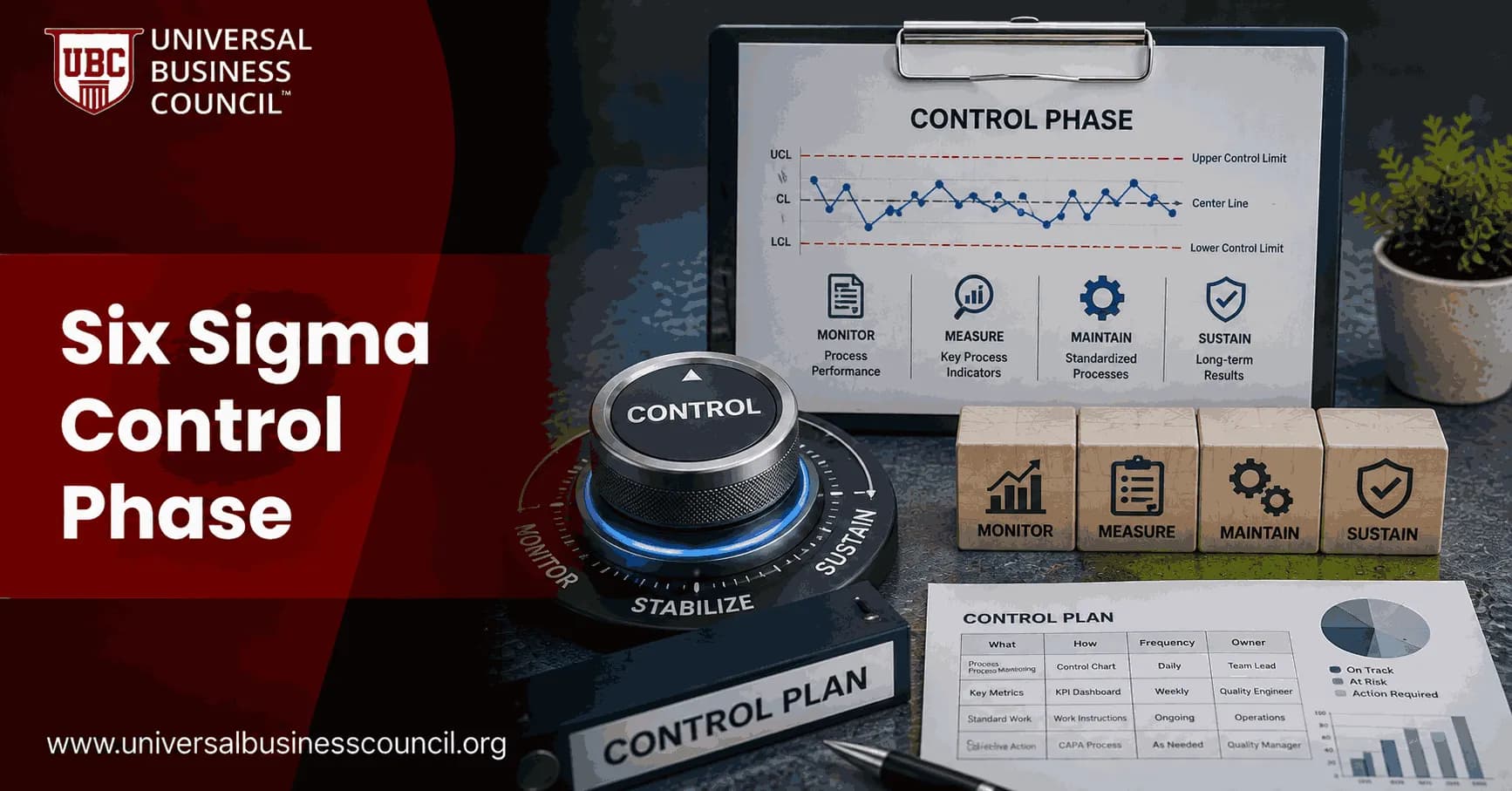
The Six Sigma Control phase is where process improvement either becomes the new operating standard or quietly fades. It is the final stage of DMAIC, after Define, Measure, Analyze, and Improve, and its job is simple: keep the gains from slipping back once the project team leaves. For professionals developing structured process improvement skills, a Certified Six Sigma Expert pathway can help reinforce the practical principles behind control plans, monitoring, and sustained improvement.
That sounds administrative. It is not. Control is where you prove the improved process can survive shift changes, handovers, new hires, busy periods, and the occasional manager who says, we used to do it this way.

What the Six Sigma Control Phase Actually Does
The Control phase verifies that the solution implemented in the Improve phase is still producing the expected result. It also transfers ownership from the project team to the people who run the process every day.
For professionals who also work across teams, workflows, and operational leadership, Management Certifications can complement Six Sigma learning by strengthening broader management and process coordination skills.
In practice, the DMAIC Control phase answers four questions:
Are the improved results real and stable?
Which inputs and outputs must be monitored?
Who reacts when performance moves off target?
How will the new process be documented, audited, and taught?
Control is not a slide deck at the end of a project. It is an operating system for sustaining process gains.
Why Improvements Erode Without Control
Process gains usually erode for ordinary reasons. A team member skips a new checklist because the old method feels faster. A supervisor updates the staffing rota but forgets the revised inspection step. A dashboard gets built, then nobody reviews it on Friday afternoon.
This is where many first-time Six Sigma teams get caught. They celebrate a lower defect rate after the pilot, but they never define the trigger point for action. When defects rise again, people notice too late. Leadership rarely asks for the project charter at that point. They ask one thing: why did the metric move back?
Core Elements of an Effective Control Phase
1. Confirm the Measurement System Still Works
Before you trust a control chart or dashboard, check that the data is reliable. In manufacturing, that may mean a gauge R&R study. In service operations, it may mean confirming that agents classify errors the same way. If the measurement system is noisy, the control plan will create arguments instead of decisions.
Standard Six Sigma training emphasizes long-term capability verification and measurement validation as part of Control. That matters because a process can look improved during a short test and still fail under normal volume.
2. Build a Practical Control Plan
A control plan defines what will be monitored, how often, by whom, and what action follows if performance changes. Keep it usable. A ten-page control plan nobody opens is theater.
A strong Six Sigma control plan usually includes:
Critical inputs: settings, staffing levels, material quality, handoff rules, or system conditions that affect output.
Output metrics: defect rate, cycle time, yield, service level, rework, complaints, or cost per transaction.
Data source: ERP report, CRM field, inspection sheet, Google Looker Studio dashboard, or quality management system.
Review frequency: hourly, daily, weekly, or by batch, depending on risk and process speed.
Owner: the named process owner, not just a department.
Reaction plan: the specific containment, investigation, and escalation steps.
To be blunt, ownership is the part that fails most often. If three people own the chart, nobody owns the chart.
3. Use SPC Where Variation Matters
Statistical process control, or SPC, helps teams separate normal variation from signals that deserve action. ASQ describes control charts as tools for studying how a process changes over time, with a center line and control limits based on process data.
Use SPC when the process runs repeatedly and variation is meaningful. Examples include defect rates on a production line, turnaround time in claims processing, lab result cycle time, or incident resolution time in IT operations.
Do not use a control chart as decoration. If nobody understands the rules for special cause variation, train them first. Otherwise, teams will either overreact to every small movement or ignore a real signal.
4. Standardize the New Way of Working
Standardization turns an improvement into normal work. Update SOPs, process maps, job aids, scripts, inspection forms, system fields, and training materials. Then remove the old versions.
This small detail matters. In audits, I have seen teams follow an outdated work instruction simply because it was still pinned beside the workstation. The process had improved. The wall had not.
Standard work should be clear enough for a trained employee to follow under pressure. If the document needs a project Black Belt to explain it, rewrite it.
Response Plans: The Control Phase Safety Net
A response plan says what happens when the process drifts. It should be written before the drift happens.
Good response plans define:
The threshold that triggers action, such as a control limit breach or missed service level.
The first containment step, such as holding a batch, reviewing a sample, or assigning a supervisor check.
The root cause method to use, such as 5 Whys, fishbone analysis, or FMEA review.
The escalation path if the issue repeats.
The person responsible for confirming recovery.
Modern Six Sigma practice increasingly links FMEA to the control plan. That is the right move. High-risk failure modes should have visible controls, not vague reassurance.
When control systems involve automation, connected equipment, analytics, or digital workflows, technical understanding can also help teams maintain reliable monitoring. A Deep Tech Certification pathway can provide complementary exposure to technology concepts relevant to increasingly digital operating environments.
Handover and Project Closure
Control ends with a formal handover. The process owner accepts the new standard, the monitoring rhythm, and the response plan. Finance or controlling should validate savings where the project claims a financial benefit, especially for reduced scrap, lower rework, improved yield, or shorter cycle time.
Typical Control phase work may take 2 to 3 weeks, though complex regulated environments can take longer. The point is not speed. The point is making sure the operating team can run the improved process without the project team in the room.
Where the Control Phase Applies
Manufacturing: SPC charts, defect tracking, audit checks, and visual management boards.
Service operations: response time monitoring, error classification, updated scripts, and daily performance reviews.
Healthcare administration: turnaround time tracking, protocol audits, and error frequency monitoring.
Technology teams: release checklists, incident metrics, deployment failure rates, and automated alerts.
If you are building Six Sigma capability across a team, connect this topic with related Universal Business Council Six Sigma certification courses, quality management training, and process improvement courses. The Control phase is also a natural bridge to risk management, operations management, and performance measurement.
Next Step: Make Control Visible
Pick one recently improved process. Write down the metric, the owner, the review frequency, and the exact action if performance slips. If you cannot answer those four items in five minutes, the gain is not controlled yet.
For professionals preparing for Six Sigma certification, spend extra time on control plans, SPC interpretation, response plans, and handover. These are not exam trivia. They are the difference between a completed project and a process that keeps delivering.
As organizations connect process control with digital platforms, automation, data systems, and technology teams, broader technical knowledge can also be useful. A Tech Certification pathway can complement process improvement expertise with additional technology-focused learning.
FAQs
1. What is the Control phase in Six Sigma DMAIC?
The Control phase is the fifth and final stage of the Six Sigma DMAIC methodology:
Define → Measure → Analyze → Improve → Control
Its purpose is to ensure that improvements achieved during the project are maintained over time. The team establishes monitoring systems, standard procedures, ownership, response plans, and performance controls so the process does not gradually return to its previous state.
Improvement proves the process can perform better. Control makes sure it continues doing so after the project team leaves and everyone stops behaving unusually well because a Black Belt is watching.
2. Why is the Control phase important in Six Sigma?
The Control phase protects the time, money, and effort invested during DMAIC.
Without effective controls, processes can drift because employees change, equipment wears, suppliers vary, demand changes, procedures are ignored, or old working methods quietly return.
A strong Control phase helps preserve improvements in quality, cost, cycle time, productivity, customer satisfaction, and process capability.
The objective is not merely to finish the project. It is to make improved performance part of normal operations.
3. What are the main objectives of the Control phase?
The Control phase aims to stabilize the improved process, standardize successful changes, monitor important metrics, define ownership, establish reaction procedures, and verify that financial and operational benefits continue.
The basic logic is:
Improved Process → Standardize → Monitor → Detect Change → Respond → Sustain
A process improvement that disappears three months later is not really a sustained improvement. It was more of a temporary statistical holiday.
4. What happens during the Control phase of DMAIC?
During Control, the team confirms that the improved process is stable and establishes mechanisms for maintaining performance.
Typical activities include updating procedures, implementing control plans, establishing SPC monitoring where appropriate, training employees, defining reaction plans, documenting process changes, assigning process ownership, validating final capability, and tracking key metrics.
The project team also prepares to transfer responsibility to the process owner so the improvement no longer depends on the DMAIC team.
5. What is a Six Sigma Control Plan?
A Control Plan is a structured document describing how important process characteristics will be monitored and controlled after improvement.
For each critical characteristic, it typically identifies the requirement, measurement method, frequency, responsibility, control method, and required response when performance deviates.
For example:
Characteristic | Requirement | Method | Frequency | Owner |
|---|---|---|---|---|
Fill weight | 495-505 g | Calibrated scale | Every 30 min | Operator |
Defect rate | < 1% | Inspection | Hourly | Quality |
Temperature | Defined range | Sensor | Continuous | Operator |
The actual plan should also contain explicit reaction procedures.
6. What is a reaction plan in Six Sigma?
A reaction plan defines exactly what employees should do when a process metric or critical variable indicates abnormal performance.
For example, if a control chart detects a special-cause signal, the reaction plan might require the operator to stop the process when appropriate, isolate potentially affected material, verify measurement equipment, investigate the assignable cause, correct the condition, document the event, and notify designated personnel.
The purpose is to replace improvisation with a predefined response.
“Keep running and see whether it fixes itself” rarely deserves formal recognition as a quality strategy.
7. How are control charts used during the Control phase?
Control charts monitor process behavior over time and help distinguish normal common-cause variation from potential special-cause signals.
After an improvement has been implemented and stable performance established, an appropriate control chart can help detect:
Process shifts, unusual points, trends, changes in variation, and other nonrandom patterns.
Examples include X̄-R, X̄-S, I-MR, p, np, c, and u charts, depending on the data structure.
The selected chart and detection rules should match the process and measurement type.
8. What is the difference between control limits and specification limits in the Control phase?
Control limits describe the expected statistical behavior of a stable process.
Specification limits describe what the customer, engineering function, regulation, or business requirement considers acceptable.
Therefore:
Control Limits → What the process is doing
Specification Limits → What the process must do
A process can be statistically stable but still incapable of meeting specifications consistently.
The Control phase should therefore consider both stability and capability, because a predictably bad process remains bad despite its admirable consistency.
9. How is process capability checked after improvement?
After the process has reached a stable condition, capability analysis can determine whether it consistently meets specification requirements.
Depending on the situation, teams may evaluate metrics such as Cp, Cpk, Pp, and Ppk.
For example, if an improvement reduces variation and centers the process more effectively, Cpk may increase substantially.
Capability should be assessed using suitable data and assumptions. A capability index calculated from an unstable process can provide a beautifully precise answer to the wrong question.
10. Why is standard work important in the Control phase?
Standard work documents the best currently approved method for performing a process consistently.
It may define task sequences, process settings, responsibilities, decision rules, inspection methods, safety requirements, and escalation procedures.
Without standardization, employees may gradually develop different methods for performing the same activity, increasing process variation.
Standard work therefore converts a successful improvement from “how the project team did it” into “how the process is now expected to operate.”
11. How does 5S support the Control phase?
5S can help maintain workplace conditions that support stable process performance.
The five elements are:
Sort → Set in Order → Shine → Standardize → Sustain
For example, standardized tool locations can reduce searching and setup errors, while visual identification can make abnormal conditions easier to recognize.
The final two elements, Standardize and Sustain, are particularly relevant to Control because they establish routines that help prevent improvements from deteriorating.
12. What is visual management in the Control phase?
Visual management makes process conditions and performance easier to understand quickly.
Examples include status boards, production indicators, standard-work displays, Kanban signals, equipment-condition indicators, and performance dashboards.
Effective visual controls should help employees recognize:
Normal condition → Abnormal condition → Required response
The objective is not to cover every available wall with charts. If nobody knows what action a red indicator requires, the dashboard is mostly decorative electricity.
13. How should KPIs be selected for the Control phase?
Control-phase KPIs should focus on measures that indicate whether the improved process continues to deliver the intended outcome.
Useful measures may include defect rate, cycle time, yield, on-time delivery, customer complaints, process capability, throughput, cost, or other relevant CTQs.
Teams should distinguish between outcome measures and important process-driver measures.
For example:
Outcome Y: Defect rate
Critical X: Sealing temperature
Monitoring both can provide earlier warning than waiting for defects to increase.
14. What is a process owner in Six Sigma Control?
The process owner is the person accountable for maintaining process performance after the DMAIC project closes.
The process owner typically reviews performance metrics, ensures standard work is followed, responds to abnormal conditions, maintains documentation, coordinates corrective actions, and escalates problems when necessary.
Ownership should be explicit.
If responsibility belongs vaguely to “the team,” there is a reasonable chance it actually belongs to nobody.
15. Why is training important during the Control phase?
Employees need to understand the new process, why it changed, how performance is measured, and what actions are required when problems occur.
Training may cover revised procedures, equipment settings, measurement methods, control charts, visual controls, error-proofing systems, and reaction plans.
Training effectiveness should also be verified rather than assumed.
A signed attendance sheet proves that people occupied chairs at approximately the same time. It does not necessarily prove competence.
16. What documents should be updated during the Control phase?
Documentation should reflect the improved process rather than the process that existed before DMAIC.
Depending on the project, teams may need to update process maps, SOPs, work instructions, Control Plans, inspection procedures, training materials, FMEA documents, maintenance plans, specifications, data-collection procedures, and escalation rules.
Document control is important because obsolete instructions can quietly reintroduce the conditions the project worked to eliminate.
17. What is mistake-proofing in the Control phase?
Mistake-proofing, or Poka Yoke, modifies the process so errors are prevented or detected immediately.
Examples include connectors that fit only one way, barcode validation, required software fields, automatic parameter checks, interlocks, sensors, and physical guides.
Mistake-proofing can be stronger than relying solely on training or inspection because it changes the process itself.
A well-designed control does not repeatedly ask humans to remember never to make mistakes. History has supplied enough data on that hypothesis.
18. How do you create a Control Plan after a DMAIC improvement?
The team should first identify the important CTQs and critical process inputs that must remain within acceptable conditions.
For each measure, define what will be measured, the target or requirement, measurement method, sampling frequency, responsible owner, monitoring technique, records required, and reaction procedure.
The logic becomes:
Critical Characteristic → Requirement → Measurement → Frequency → Owner → Control Method → Reaction
The Control Plan should be practical enough for operations to use routinely rather than requiring the original project team to interpret it.
19. What are common mistakes in the Six Sigma Control phase?
A common mistake is ending the project immediately after the Improve phase because initial results look good. Other problems include failing to assign ownership, creating weak reaction plans, monitoring too many metrics, failing to update procedures, neglecting training, using inappropriate control charts, and failing to verify long-term capability.
Another mistake is creating controls so complicated that employees cannot realistically maintain them.
Control should make correct process behavior easier and abnormal conditions visible. It should not create a second process whose primary purpose is administering the first process.
20. How can Six Sigma teams sustain process gains after DMAIC?
Sustaining gains requires converting project improvements into routine process management.
The transition can be summarized as:
Confirm Improvement
↓
Verify Process Stability
↓
Confirm Capability Against Requirements
↓
Identify CTQs and Critical Inputs
↓
Develop Control Plan
↓
Establish Control Charts Where Appropriate
↓
Create Reaction Plans
↓
Implement Standard Work
↓
Apply Mistake-Proofing
↓
Update Procedures and Documentation
↓
Train Employees
↓
Assign Process Ownership
↓
Monitor Performance
↓
Audit Compliance and Results
↓
Respond to Deterioration
↓
Continue Improvement
Suppose a DMAIC project reduces defect rate from 6.5% to 1.2%. The Control phase should not merely record the 1.2% result and congratulate everyone.
The team needs to determine which variables must remain controlled, who will monitor them, how frequently they will be measured, what statistical or operational signals require intervention, what actions employees should take, and who owns long-term performance.
The distinction is important:
Improve Phase → We achieved better performance.
Control Phase → We built a system that keeps producing better performance.
That is why Control is not administrative cleanup at the end of DMAIC. It is the mechanism that turns a successful project into a sustainable operating condition.
Without it, the organization may eventually rediscover the same problem, create another project charter, conduct another root cause analysis, and proudly solve what it already solved two years earlier.
A surprisingly expensive form of organizational nostalgia.
Related Articles
View All
Six Sigma
Six Sigma vs ISO 9001: Certification, Quality Systems, and Process Control
Compare Six Sigma vs ISO 9001 for certification, QMS governance, DMAIC, audits, and process control. Learn when to use each approach.
Six Sigma
Six Sigma Statistical Process Control: SPC Basics and Best Practices
Learn how Six Sigma Statistical Process Control uses control charts, CTQs, MSA, capability indices, and OCAPs to sustain process stability.
Six Sigma
Six Sigma vs Process Improvement: Is Six Sigma the Same Thing?
Six Sigma is a structured process improvement method, not a synonym for process improvement. Learn when to use Six Sigma, Lean, Kaizen, or simpler workflow fixes.
Trending Articles
The Role of Blockchain in Ethical AI Development
How blockchain technology is being used to promote transparency and accountability in artificial intelligence systems.
AWS Career Roadmap
A step-by-step guide to building a successful career in Amazon Web Services cloud computing.
Top 5 DeFi Platforms
Explore the leading decentralized finance platforms and what makes each one unique in the evolving DeFi landscape.