

Six Sigma vs Business Process Management: How They Work Together
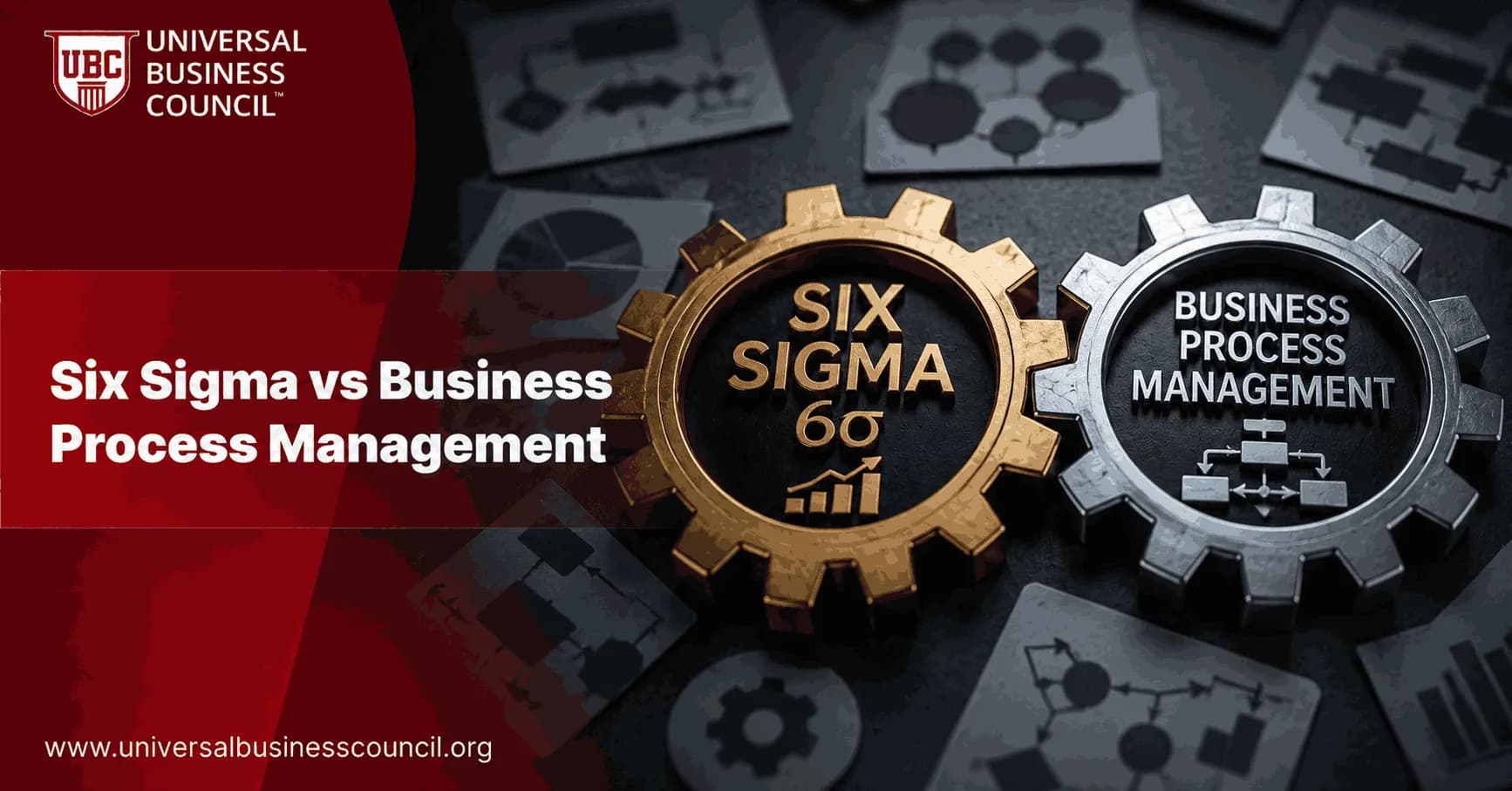
Six Sigma vs Business Process Management is not a choice between two competing methods. Six Sigma gives you the statistical discipline to reduce defects and variation. Business Process Management, or BPM, gives you the process architecture, ownership, workflow technology, and monitoring needed to keep those improvements alive after the project team moves on. Professionals who want to build that statistical discipline often start with a Certified Six Sigma Expert credential, which lays the DMAIC foundation this comparison is built on.
That last part matters. Many improvement projects look excellent in the final presentation, then fade within a quarter because no one owns the process, the dashboard is not trusted, or the workflow still allows the old shortcut. BPM helps close that gap.

Six Sigma vs Business Process Management: The Core Difference
What Six Sigma does best
Six Sigma originated at Motorola and became widely known through General Electric. Its target is famously strict: about 3.4 defects per million opportunities under the conventional Six Sigma quality benchmark. The method is data driven, project based, and usually built around DMAIC: Define, Measure, Analyze, Improve, and Control.
Use Six Sigma when you need to answer hard operational questions with evidence, not opinion. Why are claim approvals reworked? Which input drives call handle time? Is the new picking process statistically better, or did the team just have a good week?
Lean Six Sigma adds Lean's focus on waste reduction. That combination works well when delays, handoffs, queues, and defects all sit in the same process. In service operations, they usually do.
What BPM does best
Gartner defines Business Process Management as a discipline that uses methods to discover, model, analyze, measure, improve, and optimize business processes. BPM looks end to end. It asks who owns the process, how work moves across teams, what systems touch it, and how performance is monitored every day. Process owners who sit at that intersection of governance and workflow design often round out their skills with broader Management Certifications, since running BPM at enterprise scale takes leadership and stakeholder skills that process mapping alone does not cover.
BPM often uses workflow platforms, low code tools, dashboards, process mining, and decision rules. The technology is useful, but it is not the whole discipline. A poorly governed process automated in a BPM suite is still a poorly governed process. Just faster.
Where Six Sigma and BPM Fit Together
The cleanest way to think about the relationship is simple:
BPM is the backbone: it defines, models, assigns, and monitors end to end processes.
Six Sigma is the analytical engine: it finds root causes, quantifies variation, and validates improvements.
BPM is the control layer: it embeds the improved workflow, alerts owners, and keeps the process visible.
Take a procure-to-pay process. BPM may show that supplier onboarding, purchase approval, invoice matching, and payment release sit across four teams and two systems. Six Sigma then narrows the problem: perhaps 62 percent of invoice rework comes from missing purchase order data. The fix might involve a required field, a decision rule, and clearer upstream ownership. BPM makes that fix part of the live workflow, not a PDF on SharePoint.
A Practical Integration Model
If you are trying to combine Six Sigma and BPM, do not start with software. Start with the process and the customer requirement. Then work through these steps.
Map the current process in BPM terms. Identify the trigger, output, customer, systems, handoffs, roles, and process owner.
Select the right Six Sigma project. Pick high-impact problems tied to cost, quality, compliance, cycle time, churn, or customer satisfaction. Avoid vanity projects.
Run DMAIC. Define the defect, measure baseline performance, analyze root causes, improve the process, and set control metrics.
Implement the redesigned workflow. Use BPM tools, business rules, system integrations, or RPA where they genuinely reduce friction.
Monitor continuously. Put control charts, SLA alerts, exception rates, and rework trends into the BPM dashboard.
Feed new issues back into improvement. BPM analytics and process mining can reveal the next Six Sigma candidate.
This is where many teams make the wrong turn. They automate before they understand variation. To be blunt, automation can hide process waste. Six Sigma forces the team to prove what is broken before BPM helps scale the fix. As that automation layer grows more sophisticated, with RPA, AI, and process mining feeding the same dashboards, many practitioners add a Deep Tech Certification to better understand the technology now sitting underneath their process improvements.
Comparison: Six Sigma vs BPM
Aspect | Six Sigma | BPM |
|---|---|---|
Primary focus | Reducing variation, defects, and error rates | Managing end to end processes and governance |
Typical method | DMAIC, root cause analysis, control charts, hypothesis testing | Process modeling, workflow automation, dashboards, process mining |
Scope | Project based and problem specific | Enterprise wide and continuous |
Best use | Solving measurable quality or performance problems | Designing, running, and monitoring processes at scale |
Risk if used alone | Improvements may not sustain | Processes may be automated without deep diagnosis |
Why This Combination Matters Now
BPM adoption is growing because organizations are digitizing workflows, using low code platforms, and connecting BPM with RPA, AI, and process mining. Market researchers put the global BPM market in the tens of billions of US dollars, with strong growth projected through 2030. Cloud based BPM has become especially common because teams need scalable workflow management across locations.
Six Sigma remains active in manufacturing, healthcare, logistics, customer service, and public sector improvement work. The reason is practical: data still wins arguments. When a process owner can show defect rate, cycle time distribution, sigma level, and cost of poor quality, leadership listens differently.
APQC's Process Classification Framework is useful here because it gives organizations a common process language. The broad pattern holds across the practitioner literature: BPM creates the environment for change, Lean removes waste, and Six Sigma identifies and corrects defects with rigor.
Common Mistakes When Combining Six Sigma and BPM
Confusing KPIs with CTQs: certification candidates often mix these up. A KPI tracks performance. A critical-to-quality requirement defines what matters to the customer.
Skipping process ownership: a dashboard without an accountable owner becomes wall art.
Choosing projects from politics, not data: BPM should help expose where the real bottlenecks and defects sit.
Over-automating exceptions: some exceptions should be eliminated, not routed faster.
Ending at implementation: the Control phase should live inside BPM monitoring, not in a static project file.
Which Should You Learn First?
If your role is quality, operations improvement, analytics, or manufacturing excellence, start with Six Sigma or Lean Six Sigma. You need DMAIC, measurement systems, process capability, and root cause analysis.
If your role is enterprise architecture, digital transformation, product operations, compliance, or workflow automation, start with BPM. You need process modeling, governance, ownership, and technology fluency.
If you manage cross-functional operations, learn both. The strongest professionals can move from a BPM process map to a Six Sigma analysis, then back into workflow design and control.
For your next step, review Universal Business Council's Six Sigma and business management certification pathways. Pair statistical improvement skills with process governance knowledge, then apply the combination to one live process with a measurable defect, cycle time, or cost problem. If that process work increasingly overlaps with automation platforms, workflow software, or data systems, a general Tech Certification can help fill in the technical fluency that BPM and Six Sigma alone don't fully cover.
FAQs
1. What is the difference between Six Sigma and Business Process Management?
Six Sigma is a data-driven process improvement methodology focused on reducing defects, controlling variation, and improving measurable performance. Business Process Management (BPM) is a broader discipline for designing, modeling, executing, monitoring, managing, and continuously improving business processes.
A simple distinction is:
BPM → Manages processes across their lifecycle
Six Sigma → Solves specific process-performance problems
Organizations can use both together rather than choosing one over the other.
2. What is Business Process Management?
Business Process Management is a structured approach to understanding and managing how work flows across an organization.
BPM commonly includes:
Discover → Model → Analyze → Design → Implement → Monitor → Improve
It can involve process owners, workflow platforms, automation, governance, process architecture, performance metrics, and continuous improvement.
The objective is to manage processes as business assets rather than as disconnected departmental activities.
3. What is Six Sigma?
Six Sigma is a structured methodology that uses data and analytical techniques to improve process performance.
Its best-known framework is DMAIC:
Define → Measure → Analyze → Improve → Control
Six Sigma is particularly useful when an organization faces recurring defects, errors, excessive variation, rework, poor quality, high costs, or inconsistent process outcomes whose causes are not fully understood.
4. Is BPM the same as Six Sigma?
No.
BPM has a broader process-management scope and can include process design, workflow management, governance, automation, monitoring, and continuous optimization.
Six Sigma focuses more specifically on solving measurable performance problems through disciplined analysis.
Six Sigma can therefore operate within a broader BPM environment when process data identifies a problem requiring deeper investigation.
5. How do BPM and Six Sigma work together?
BPM can provide visibility into process workflows and performance, while Six Sigma can investigate why specific performance gaps occur.
For example:
BPM Monitoring
↓
High Transaction Error Rate Identified
↓
Six Sigma DMAIC Project
↓
Root Cause Validated
↓
Process Redesigned
↓
BPM Workflow Updated
↓
Performance Continuously Monitored
This creates a closed-loop improvement system.
6. What problems is BPM best suited for?
BPM is useful when organizations need to:
Standardize workflows
Clarify process ownership
Manage end-to-end processes
Automate repetitive work
Integrate systems
Monitor process performance
Improve cross-functional workflows
Establish process governance
It is particularly useful when processes span multiple teams, systems, or business units.
7. What problems is Six Sigma best suited for?
Six Sigma is especially useful when:
A measurable performance gap exists.
The problem is recurring.
Defects or variation are significant.
Root causes are unclear.
Reliable data can be collected.
The expected business impact justifies structured analysis.
Examples include high error rates, excessive rework, inconsistent processing times, quality failures, or recurring customer complaints.
8. How does DMAIC fit into BPM?
DMAIC can function as a specialized improvement method within the broader BPM lifecycle.
For example:
BPM identifies the process and performance gap.
Define establishes the Six Sigma problem.
Measure quantifies current performance.
Analyze validates root causes.
Improve develops process changes.
Control helps sustain the improvement.
The redesigned process can then return to normal BPM governance and monitoring.
9. How is process modeling different from Six Sigma process mapping?
BPM process modeling often documents workflows in enough detail to support analysis, governance, system implementation, or automation. Organizations may use standards such as Business Process Model and Notation (BPMN).
Six Sigma process mapping is usually focused on understanding process behavior for improvement.
Tools may include:
SIPOC → High-Level Process Map → Detailed Process Map → Value Stream Map
The methods overlap, but the purpose and required level of detail can differ.
10. How does process mining support BPM and Six Sigma?
Process mining uses system event data to reconstruct how processes actually operate.
It can reveal:
Bottlenecks
Rework loops
Process variants
Waiting time
Compliance deviations
Handoffs
Automation opportunities
BPM teams can use these insights for process management, while Six Sigma teams can use them to identify and investigate measurable performance problems.
This can be considerably more informative than discovering that the official process map describes a workflow nobody has followed since 2019.
11. How do BPM and Six Sigma use process metrics differently?
BPM often uses metrics for continuous operational monitoring.
Examples include:
Cycle Time + Throughput + Backlog + SLA Performance + Cost + Error Rate
Six Sigma uses metrics to establish baseline performance, analyze variation, validate causes, test improvements, and maintain control.
The same KPI can therefore support both ongoing BPM governance and a temporary Six Sigma improvement project.
12. Can Six Sigma improve a BPM workflow?
Yes.
Suppose a BPM-managed loan process has:
Average Cycle Time: 5 days
but individual cases range from:
1 day to 14 days
A Six Sigma project could analyze the sources of variation, such as handoffs, incomplete applications, approval rules, workload patterns, or system issues.
Validated improvements can then be incorporated into the BPM workflow.
13. Can BPM help sustain Six Sigma improvements?
Yes. This is one of the strongest reasons to combine them.
After a Six Sigma project improves a process, BPM mechanisms can help institutionalize the new design through:
Workflow rules
Standard procedures
Process ownership
Dashboards
Automated controls
Alerts
Escalations
Governance reviews
This supports the Six Sigma Control phase and reduces the risk of regression.
14. How do BPM and Six Sigma work with automation?
BPM can identify, redesign, orchestrate, and automate workflows. Six Sigma can help determine whether the underlying process is stable and whether the proposed automation addresses the real cause of poor performance.
A sensible sequence is:
Understand → Measure → Improve → Standardize → Automate → Monitor
Automating first can create:
Bad Process + Automation = Faster Bad Process
Technology remains irritatingly unwilling to compensate for unclear thinking.
15. How do BPM and Six Sigma support digital transformation?
BPM provides an end-to-end view of processes that can guide workflow redesign, integration, and automation.
Six Sigma adds analytical discipline by helping teams determine:
What is performing poorly?
Why is it performing poorly?
Did the proposed change actually improve it?
Together, they can help digital-transformation programs focus technology investment on measurable business problems instead of digitizing unnecessary work.
16. What is the difference between a BPM professional and a Six Sigma Black Belt?
A BPM professional may focus on process architecture, modeling, governance, workflow design, automation, process ownership, and performance management.
A Six Sigma Black Belt typically focuses on complex improvement projects involving DMAIC, root-cause analysis, statistics, process capability, and change implementation.
Both may work on the same process but approach it from different professional perspectives.
17. Which certification is better: BPM or Six Sigma?
The better credential depends on your career goal.
Consider BPM-related education if your target work involves:
Process Architecture + Workflow Management + Automation + Process Governance
Consider Six Sigma if your work involves:
Quality + Defect Reduction + Variation + Root-Cause Analysis + Operational Excellence
Professionals working in business transformation can benefit from knowledge of both.
18. Can BPM, Lean, and Six Sigma be used together?
Yes.
A useful distinction is:
BPM → Manages end-to-end processes
Lean → Eliminates waste and improves flow
Six Sigma → Reduces defects and variation
Together, these methods can provide broad process visibility, efficient flow, and analytical problem solving.
Organizations should still select methods according to the problem rather than forcing every initiative to use all three simultaneously.
19. What career skills are useful for combining BPM and Six Sigma?
A strong combined skill set includes:
Process Modeling + DMAIC + Data Analysis + Root-Cause Analysis + BPMN + Process Mining + Automation + Change Management
Professionals can also benefit from knowledge of:
Business analysis
Project management
Lean
Statistics
Workflow platforms
RPA
AI
Process governance
Financial analysis
This combination can support roles in operational excellence, transformation, process management, and consulting.
20. What is the best framework for integrating Six Sigma and BPM?
Start by treating BPM as the continuous management layer and Six Sigma as a specialized improvement engine.
A practical enterprise model is:
1. Discover
Identify end-to-end business processes.
Examples:
Order-to-Cash
Procure-to-Pay
Hire-to-Retire
Customer Onboarding
Claims Processing
2. Model
Document how the process works.
Capture:
Activities → Decisions → Roles → Systems → Handoffs → Controls
BPMN or other process-modeling methods can be used where appropriate.
3. Establish Ownership
Assign a process owner responsible for end-to-end performance.
This matters because cross-functional processes have a peculiar organizational habit of becoming everyone's responsibility in presentations and nobody's responsibility when performance deteriorates.
4. Measure
Create process KPIs such as:
Cycle Time | Error Rate | Cost | SLA | Throughput | Customer Outcome
Use BPM platforms, operational systems, dashboards, or process-mining tools to monitor performance.
5. Identify Performance Gaps
Suppose monitoring shows:
Customer Onboarding Target: 3 days
Actual Average: 6 days
Variation: 2-15 days
Now determine whether the problem requires simple corrective action or deeper investigation.
6. Launch Six Sigma When Appropriate
If causes are unclear and the business impact is significant, use DMAIC.
Define
Establish the problem, scope, customer impact, and business case.
Measure
Validate data and quantify baseline performance.
Analyze
Identify and validate root causes.
Improve
Develop and test solutions.
Control
Create controls that sustain performance.
7. Update the BPM Process
Once the Six Sigma team validates an improvement, incorporate it into the managed process.
This may involve:
Workflow Redesign → Business Rules → Automation → Roles → Procedures → System Changes
8. Monitor the New Process
Return the improved workflow to normal BPM monitoring.
Track:
Process KPI + Control Limits + Adoption + Exceptions
If performance deteriorates again, the monitoring system should make the problem visible.
The resulting improvement loop is:
BPM Discover
↓
BPM Model
↓
BPM Monitor
↓
Performance Gap
↓
Six Sigma DMAIC
↓
Improved Process
↓
BPM Implementation
↓
Continuous Monitoring
↓
Further Improvement
This relationship is especially powerful when combined with modern technology.
Process Mining can reveal how processes actually behave.
Six Sigma can validate why performance problems occur.
BPM can redesign and govern the workflow.
Automation/RPA can execute repetitive activities.
AI can support prediction, classification, analysis, and decision assistance where appropriate.
The sensible sequence remains:
Understand → Measure → Analyze → Improve → Automate → Monitor
For careers, this creates a valuable combined path:
Business Process Analyst
↓
BPM / Process Modeling Skills
↓
Six Sigma Green or Black Belt Skills
↓
Process Mining + Automation
↓
Operational Excellence / Transformation Leadership
The combined professional profile is:
Process Management + Six Sigma + Data + Technology + Change Management
BPM answers:
“How should we manage this process throughout its lifecycle?”
Six Sigma answers:
“Why is this process failing to achieve the required performance, and how can we prove what improves it?”
Used together, BPM creates the infrastructure for continuous process management while Six Sigma supplies analytical depth when difficult performance problems emerge.
BPM without rigorous improvement can result in beautifully documented underperformance.
Six Sigma without ongoing process management can produce excellent improvements that gradually disappear after the project closes.
Combining them gives organizations a way to manage, diagnose, improve, standardize, automate, and continuously monitor processes as a connected system.
Which, inconveniently, works better than drawing a new flowchart every quarter and declaring the transformation complete.
Related Articles
View All
Six Sigma
Six Sigma Quality Risk Management: Reducing Process and Product Risk
Learn how Six Sigma Quality Risk Management uses DMAIC, FMEA, control charts, and data to reduce process variation, defects, and product risk.

Six Sigma
Six Sigma Business Process Optimization: How to Streamline Operations
Learn how Six Sigma business process optimization uses DMAIC, Lean Six Sigma, and process capability tools to cut defects, cycle time, and cost.
Six Sigma
Six Sigma Change Management: Getting Stakeholder Buy-In for Improvements
Learn how Six Sigma change management improves stakeholder buy-in, reduces resistance, and helps DMAIC projects sustain measurable gains.
Trending Articles
The Role of Blockchain in Ethical AI Development
How blockchain technology is being used to promote transparency and accountability in artificial intelligence systems.
AWS Career Roadmap
A step-by-step guide to building a successful career in Amazon Web Services cloud computing.
Top 5 DeFi Platforms
Explore the leading decentralized finance platforms and what makes each one unique in the evolving DeFi landscape.