

Six Sigma Quality Risk Management: Reducing Process and Product Risk
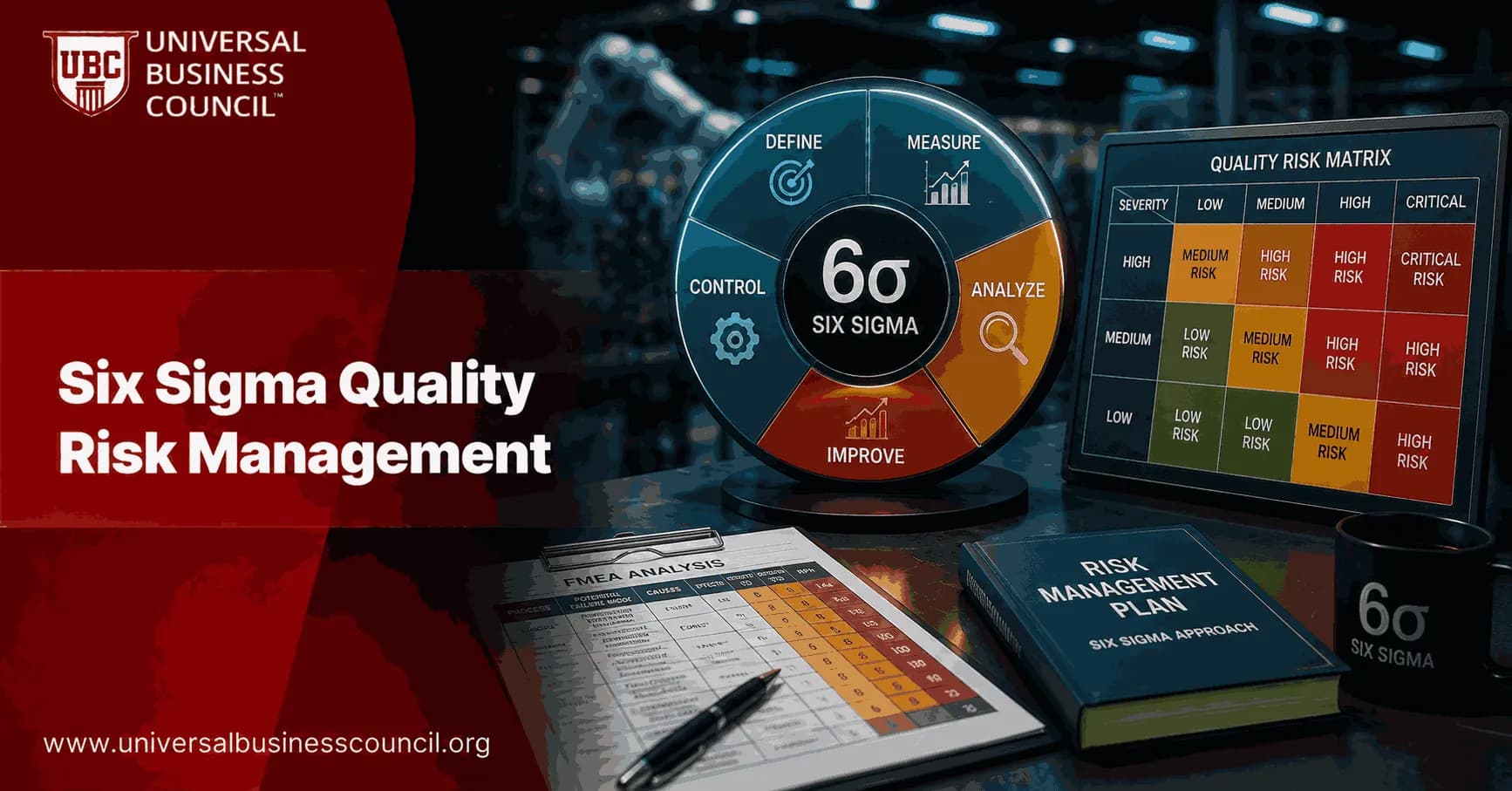
Six Sigma Quality Risk Management gives you a practical way to find, measure, and reduce the risks that create defects, rework, delays, recalls, failed releases, and unhappy customers. The core idea is simple. Variation creates risk. If you can measure variation, find its causes, and hold the process within control limits, you lower the chance that a product or process will fail. For professionals looking to build structured expertise in quality improvement and risk reduction, a Certified Six Sigma Expert pathway can complement this practical approach with focused Six Sigma knowledge.
Six Sigma is often described as a target of 3.4 defects per million opportunities, or roughly 99.99966 percent defect free output. That number gets quoted a lot, sometimes too casually. The real value is not the slogan. It sits in the discipline behind DMAIC, FMEA, control charts, capability studies, and documented controls.

What Six Sigma Quality Risk Management Means
Quality risk management is the structured identification, analysis, control, and review of risks that affect quality. Combine it with Six Sigma and it becomes more than a workshop with sticky notes. You quantify defect rates, process capability, failure modes, and risk priority. Then you act on the biggest drivers.
For professionals who want to connect quality improvement with broader organizational leadership and operational decision-making, Management Certifications can provide complementary knowledge for managing teams, processes, and improvement initiatives.
This matters in manufacturing, healthcare, financial services, software, supply chains, and back office operations. A missed weld, a medication delay, a wrong account posting, a failed software release. They look different on the surface. Underneath, each usually hides a process that varies more than leadership thinks.
How DMAIC Reduces Process and Product Risk
DMAIC is still the working backbone. Used well, it keeps risk work from turning into opinion.
Define: Clarify the customer requirement, the critical to quality characteristics, the defect definition, and the risk you are reducing. Be precise. A vague goal like improve quality will waste weeks.
Measure: Collect baseline data on defects, cycle time, scrap, rework, escapes, complaints, or service errors. Check the measurement system first. If your gauge R and R is poor, your risk numbers are shaky.
Analyze: Use Pareto analysis, cause and effect diagrams, hypothesis tests, regression, and FMEA to isolate the few causes creating most of the risk.
Improve: Test countermeasures. That might mean centre lining equipment, changing process parameters, adding mistake proofing, revising test coverage, or setting a preventive maintenance interval.
Control: Keep the gain. Control charts, layered audits, standard work, response plans, and ownership routines matter far more than a polished final slide deck.
Here is the part beginners miss. The control phase is not administration. It is where risk reduction either survives or dies. I have watched teams celebrate a defect drop, then lose the gain within two months because nobody owned the out of control action plan for the night shift. The chart was there. The response was not.
Key Tools for Six Sigma Risk Management
FMEA for Failure Prioritization
Failure Modes and Effects Analysis helps you list how a process or product can fail, why it might fail, and what the effect would be. Traditional FMEA scores severity, occurrence, and detection. Many teams now pair FMEA with other prioritization methods, such as House of Risk structures, to focus on dominant risk agents instead of chasing every possible issue.
A published cheese manufacturing case used DMAIC with FMEA and House of Risk. The process started at a sigma level of 3.20. The study identified dominant risk agents and a short list of priority mitigation actions, including stronger operator participation in daily meetings, clearer centre lining and marking, better preventive maintenance scheduling, one point lessons, and standardized cleaning, inspection, and lubrication routines. That is what practical risk reduction looks like. Small controls, aimed at real causes.
Control Charts and Capability Analysis
Control charts show whether variation is stable or driven by special causes. Capability analysis shows whether a stable process can meet specification limits. You need both. A process can be stable and still incapable. It can also look capable for a week while hiding special cause variation from tool wear, supplier changes, or a changeover setup.
Simulation and Scenario Analysis
Monte Carlo simulation earns its place when risk depends on uncertainty across many inputs. In software quality risk management, teams have combined DMAIC with simulation to estimate reliability at process completion and update risk estimates as new data arrives. That helps with release decisions, test depth, and resource allocation.
Where Six Sigma Quality Risk Management Works Best
Six Sigma Quality Risk Management works best when defects are measurable and the process repeats often enough to produce data. Good candidates include:
Production lines with scrap, rework, or rejection risk
Supply chain processes with late delivery, variability, or supplier quality issues
Healthcare workflows with waiting time, documentation errors, or handoff failures
Financial operations with transaction errors, compliance exceptions, or reconciliation defects
Software delivery processes with escaped defects, unstable release quality, or incident trends
It is a poor fit when the problem is mostly strategic ambiguity, politics, or a one time crisis with no repeatable process. In those cases, enterprise risk management, scenario planning, or governance redesign will serve you better. To be blunt, not every risk needs a sigma level.
Connecting Six Sigma to Enterprise Risk
Six Sigma has a limitation. It can become too local. A team may cut defects in one process while missing supplier exposure, regulatory risk, cyber risk, or customer experience impact elsewhere. Research on Lean Six Sigma in supply chains finds that these methods sharpen risk awareness and variability control inside focal firms, but a wider supply chain risk culture still needs supplier and customer participation.
The best organizations connect project metrics to enterprise risk indicators. For example:
Defects per million opportunities linked to product recall exposure
Process capability linked to compliance risk
First pass yield linked to cost of poor quality
Escaped defects linked to customer churn, complaints, and service credits
Control chart violations linked to audit findings or operational risk events
This is where formal training pays off. Treat this article as a bridge into relevant Six Sigma, quality management, operations management, and risk management certification pathways. When choosing a course, look for coverage of DMAIC, statistical thinking, FMEA, control planning, and business risk alignment, not just terminology.
For professionals working with increasingly technology-driven risk systems, Deep Tech Certification can also complement Six Sigma knowledge by broadening awareness of emerging technologies and their potential role in modern operational and quality environments.
Practical Steps to Start Reducing Risk
Pick one high cost defect. Choose a defect tied to customer pain, compliance exposure, scrap, rework, or delay.
Define the opportunity. Write the defect definition so two auditors would classify it the same way.
Validate the measurement system. Bad data breeds false confidence.
Build a Pareto chart. Find the few defect types or process steps causing most of the losses.
Run FMEA on the critical path. Prioritize by severity, occurrence, and detection.
Test countermeasures with data. Do not roll out a fix just because the room likes it.
Install controls. Use control charts, response plans, training, audits, and clear process ownership.
Your next step is concrete. Take one recurring quality failure this week and map it through DMAIC. If you want a structured professional path, pair that project work with the appropriate Universal Business Council Six Sigma or quality management programme so you can prove the skill, not just describe it. Broader technical knowledge can also help professionals understand the digital systems increasingly supporting quality monitoring, analytics, and risk management. A Tech Certification pathway can provide complementary technology-focused learning alongside Six Sigma expertise.
FAQs
1. What is Six Sigma quality risk management?
Six Sigma quality risk management is the practice of identifying, analyzing, and reducing risks that can affect process performance, product quality, and customer satisfaction. It combines Six Sigma methods such as DMAIC, statistical analysis, and process control with risk-management techniques to prevent defects before they occur. The goal is to create stable processes with fewer failures and less variation.
2. Why is risk management important in Six Sigma?
Risk management is important in Six Sigma because preventing problems is usually more effective than correcting them after they happen. By identifying potential failure points early, organizations can reduce defects, rework, waste, customer complaints, and operational disruptions. Risk-based Six Sigma helps teams focus improvement efforts where the impact and likelihood of failure are highest.
3. How does Six Sigma reduce quality risks?
Six Sigma reduces quality risks by analyzing process variation, identifying root causes, improving workflows, and establishing control mechanisms. Tools such as Failure Mode and Effects Analysis (FMEA), control charts, process capability analysis, and root cause analysis help teams detect risks and implement preventive actions. This approach shifts quality management from reaction to prevention.
4. What is the role of DMAIC in Six Sigma risk management?
DMAIC provides a structured framework for managing quality risks:
Define: Identify risks, customer requirements, and improvement goals.
Measure: Collect data on current process performance.
Analyze: Find root causes and potential failure points.
Improve: Implement solutions to reduce risk.
Control: Monitor processes to maintain improvements.
DMAIC ensures risk reduction is based on evidence rather than assumptions.
5. What is Failure Mode and Effects Analysis (FMEA) in Six Sigma?
Failure Mode and Effects Analysis (FMEA) is a Six Sigma risk assessment tool used to identify potential failures before they occur. Teams evaluate possible failure modes, their causes, severity, occurrence likelihood, and detection ability. The analysis helps prioritize risks and develop preventive actions. FMEA is widely used in manufacturing, healthcare, aerospace, automotive, and engineering industries.
6. How does FMEA support quality risk management?
FMEA supports quality risk management by providing a systematic method to predict where processes or products may fail. It helps teams rank risks based on impact and likelihood, allowing resources to be focused on the most critical issues. By addressing failures proactively, organizations can reduce defects, recalls, downtime, and customer dissatisfaction.
7. What are the main types of Six Sigma quality risks?
Six Sigma quality risks may include:
Process variation risks
Product defect risks
Equipment failure risks
Supplier quality risks
Compliance risks
Customer satisfaction risks
Data quality risks
Operational risks
Identifying different risk categories helps organizations create targeted improvement strategies.
8. How does Six Sigma reduce product defects?
Six Sigma reduces product defects by identifying sources of variation, improving process capability, and controlling critical quality factors. Teams analyze production data, customer requirements, and failure patterns to determine why defects occur. Improvements may include process redesign, equipment adjustments, employee training, and stronger quality controls.
9. How does Six Sigma manage process variation?
Six Sigma manages process variation by measuring performance, identifying sources of instability, and implementing controls to maintain consistency. Statistical tools help determine whether variation is caused by normal process behavior or specific problems. Reducing unnecessary variation improves reliability, efficiency, and customer outcomes.
10. What is risk priority number (RPN) in Six Sigma FMEA?
Risk Priority Number (RPN) is a scoring method used in FMEA to prioritize potential failures. It is typically calculated using:
RPN = Severity × Occurrence × Detection
A higher RPN indicates a failure mode requiring greater attention. Organizations use RPN scores to decide which risks should be addressed first. While useful, RPN should be combined with expert judgment because numbers alone do not understand business consequences.
11. How does Six Sigma help prevent quality failures?
Six Sigma prevents quality failures by using data analysis, predictive methods, root cause identification, and process controls. Instead of inspecting defects after production, teams improve processes so defects are less likely to occur. Preventive quality management reduces costs and improves customer confidence.
12. How can predictive analytics improve Six Sigma risk management?
Predictive analytics improves Six Sigma risk management by identifying patterns that indicate future failures. Machine learning models can analyze equipment data, process measurements, and historical defects to predict quality risks. This allows organizations to take preventive action before problems affect customers or operations.
13. How does Six Sigma support supplier quality risk management?
Six Sigma helps manage supplier risks by evaluating supplier performance, analyzing defect trends, improving communication, and establishing quality standards. Organizations can use metrics such as defect rates, delivery accuracy, and process capability to monitor suppliers. Strong supplier quality management reduces disruptions and improves overall value-chain performance.
14. How is risk management applied in manufacturing Six Sigma?
In manufacturing, Six Sigma risk management focuses on reducing defects, equipment failures, production variation, and process instability. Organizations use tools such as FMEA, statistical process control, design of experiments, and capability analysis. These methods help manufacturers produce consistent products while reducing waste and operational costs.
15. How does Six Sigma improve compliance risk management?
Six Sigma improves compliance risk management by creating standardized processes, improving documentation, monitoring performance, and reducing process errors. Regulated industries use Six Sigma methods to strengthen quality systems and maintain consistent operations. Better process control makes it easier to meet regulatory requirements and demonstrate operational reliability.
16. What role does root cause analysis play in Six Sigma risk reduction?
Root cause analysis helps Six Sigma teams identify the fundamental reasons behind failures instead of treating symptoms. Techniques such as the 5 Whys, Fishbone diagrams, and data analysis help uncover underlying causes. Addressing root causes creates long-term improvements and prevents the same issues from recurring.
17. How can Six Sigma risk management improve customer satisfaction?
Six Sigma risk management improves customer satisfaction by reducing defects, improving reliability, shortening delivery times, and creating consistent product quality. When organizations identify and eliminate process risks, customers experience fewer failures and better service outcomes. Quality improvement becomes visible through better customer experiences.
18. What challenges exist in Six Sigma quality risk management?
Common challenges include:
Incomplete or inaccurate data
Poor risk identification
Lack of employee involvement
Resistance to process changes
Overreliance on metrics
Limited leadership support
Successful risk management requires both analytical tools and organizational commitment. A perfect risk model is not very useful if nobody follows the resulting improvement plan.
19. How can companies build a Six Sigma risk management culture?
Companies can build a risk-management culture by training employees, encouraging data-driven decisions, integrating risk assessment into daily operations, and rewarding prevention rather than crisis response. Leadership support is essential because quality culture develops through repeated behavior, not through posters on office walls.
20. What is the future of Six Sigma quality risk management?
The future of Six Sigma risk management will increasingly involve artificial intelligence, predictive analytics, automation, real-time monitoring, and digital quality platforms. Organizations will move from identifying failures after they occur toward predicting and preventing risks earlier. Six Sigma will continue evolving as a proactive approach for managing process reliability, product quality, and operational resilience.
Related Articles
View All
Six Sigma
Six Sigma vs Quality Management: Where Six Sigma Fits
Six Sigma vs Quality Management explained: learn how Six Sigma fits within quality systems as a data-driven method for reducing defects and variation.
Six Sigma
How Six Sigma Complements Total Quality Management in Enterprise Quality Programs
Learn how Six Sigma complements Total Quality Management by adding DMAIC, analytics, and project discipline to enterprise quality programs.
Six Sigma
Six Sigma vs Business Process Management: How They Work Together
Learn how Six Sigma and Business Process Management work together to reduce variation, improve workflows, and sustain process performance.
Trending Articles
The Role of Blockchain in Ethical AI Development
How blockchain technology is being used to promote transparency and accountability in artificial intelligence systems.
AWS Career Roadmap
A step-by-step guide to building a successful career in Amazon Web Services cloud computing.
Top 5 DeFi Platforms
Explore the leading decentralized finance platforms and what makes each one unique in the evolving DeFi landscape.