

How Six Sigma Complements Total Quality Management in Enterprise Quality Programs
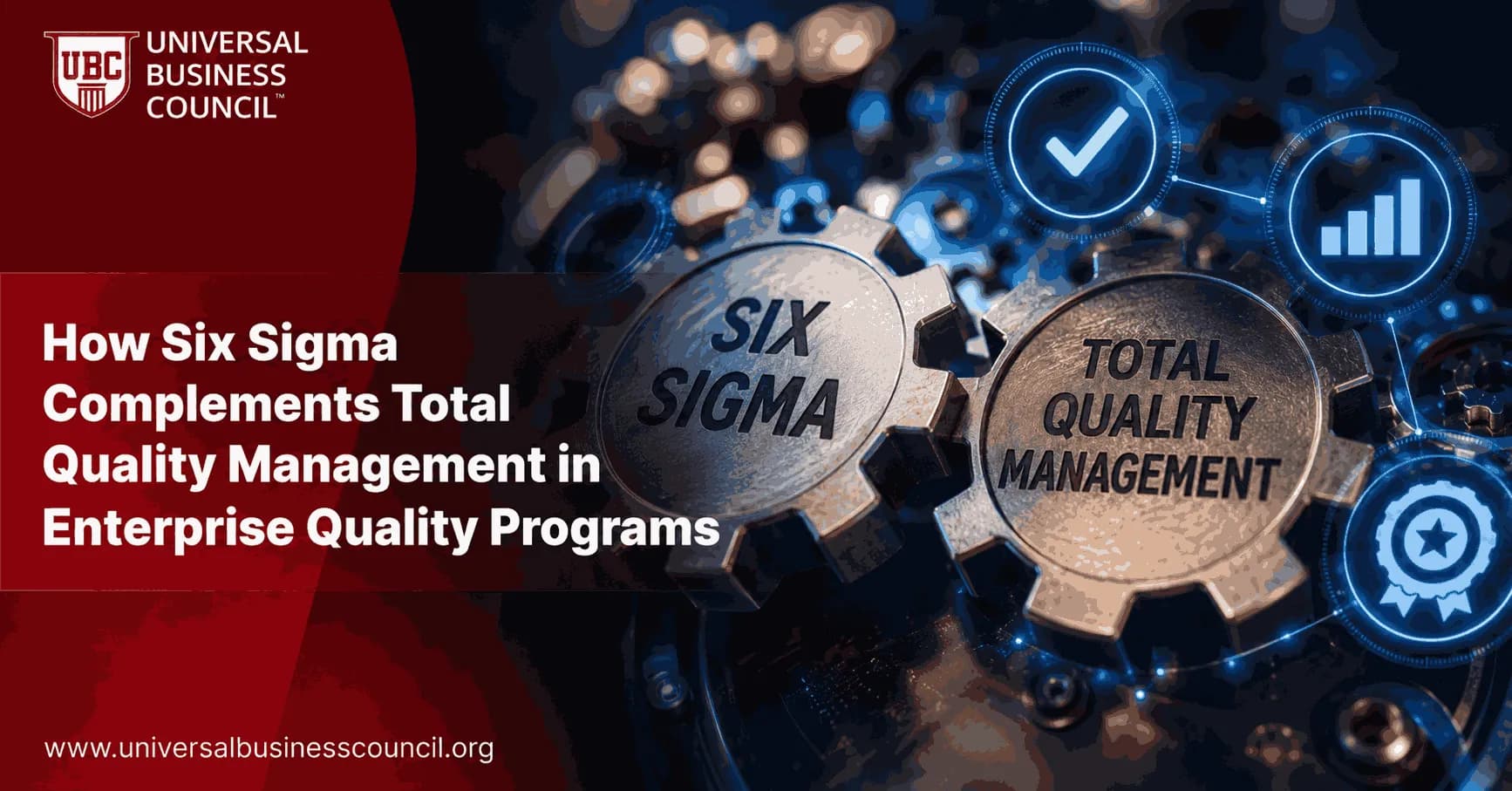
Six Sigma complements Total Quality Management by giving TQM the project discipline, statistical depth, and measurable control it often lacks in day-to-day execution. TQM sets the quality culture. Six Sigma turns selected problems into scoped DMAIC projects with owners, baselines, root-cause evidence, and control plans. Quality professionals looking to build that project discipline often start with a Certified Six Sigma Expert credential, which lays the DMAIC and statistical foundation this kind of integration depends on.
That distinction matters in enterprise quality programs. Treat TQM and Six Sigma as rival methods and you split attention and create competing language. Integrate them well and TQM becomes the management system while Six Sigma becomes the improvement engine inside it.

TQM Sets the Quality System, Six Sigma Sharpens the Work
Total Quality Management is a broad management philosophy built around customer focus, process ownership, employee involvement, continuous improvement, and leadership commitment. It sits comfortably beside ISO 9001 principles, especially the process approach, evidence-based decision-making, and continual improvement described in ISO 9001:2015. Leaders responsible for building that culture often pair their technical training with broader Management Certifications, since running an enterprise quality system takes governance and people skills that DMAIC alone does not teach.
Six Sigma is narrower and more operational. It uses structured phases, most commonly DMAIC: Define, Measure, Analyze, Improve, Control. It also relies on tools such as measurement system analysis, process capability, control charts, hypothesis testing, cause-and-effect diagrams, and failure mode and effects analysis.
Quality researchers, including Bo Bergman and Bengt Klefsjo, have argued that Six Sigma is best understood as a methodology within TQM, not a replacement for it. That view is practical. TQM tells an enterprise what kind of organization it wants to be. Six Sigma tells a trained team how to reduce variation in a stubborn process.
Where Six Sigma Complements Total Quality Management
1. Culture becomes funded projects
TQM encourages everyone to improve quality. Good. But broad encouragement can fade into posters, slogans, and monthly meetings with no hard savings attached. Six Sigma forces a sharper question: which process, which defect, which customer pain, and what financial impact?
Take a packaging line. A TQM team may know that customer complaints are rising. A Six Sigma project would define the critical defect, validate the measurement method, stratify defects by line, shift, material lot, and machine setting, then test which factor actually drives the issue. The difference is not theory. It is the difference between talking about quality and changing the process window.
2. Continuous improvement gains statistical discipline
TQM often uses PDCA, quality circles, standard work, and basic problem-solving. Those tools are useful. They are not always enough when the process has hidden variation or when leaders need proof before approving capital or policy changes.
Six Sigma adds statistical rigor. It asks whether the measurement system is reliable before the team argues about root causes. That step gets skipped more often than people admit. A classic mistake is letting three inspectors record the same defect differently, then building a Pareto chart from bad data. If one operator logs cap defects as cap skew while another writes closure angle, your top defect category may be an artifact of wording, not a process truth.
3. Strategy connects to defects and cost of quality
TQM works best when quality objectives are tied to enterprise strategy. Six Sigma strengthens that link through project selection. A strong project charter connects the problem to cost of poor quality, warranty exposure, cycle time, rework, customer satisfaction, or regulatory risk.
Senior leaders rarely track sigma level alone. They look at scrap cost, yield, complaints per million units, service-level misses, productivity, churn, warranty claims, and margin leakage. Six Sigma helps quality teams translate TQM priorities into metrics executives already review.
4. Breakthrough improvement joins daily improvement
TQM supports steady, incremental gains. Six Sigma is better suited to high-impact problems where the answer is not obvious. Think medication errors in a hospital pharmacy workflow, fill-level variation in beverage manufacturing, or first-pass yield loss in a precision assembly process.
Academic and practitioner reviews since the mid 2010s increasingly recommend integrated TQM and Six Sigma architectures for exactly this reason. TQM sustains the daily habits. Six Sigma attacks the cross-functional problems that need formal analysis, trained facilitators, and management sponsorship. As more of that formal analysis draws on automated sensors, connected equipment, and system-generated data, some practitioners also pursue a Deep Tech Certification to better understand the technology feeding their measurement systems.
How Lean Fits Into the Same Enterprise Quality Program
Many mature enterprises do not stop at TQM and Six Sigma. They also use Lean. The cleanest division of labor is simple:
TQM: Quality philosophy, leadership system, customer focus, and culture.
Lean: Flow, waste reduction, visual management, and shorter cycle time.
Six Sigma: Variation reduction, defect analysis, process capability, and statistical control.
Do not force every issue into Six Sigma. If a process has obvious waiting, excess motion, or overproduction, Lean may solve it faster. If the defect pattern is variable, expensive, and poorly understood, use Six Sigma. If the organization lacks ownership and customer focus, fix the TQM foundation first.
Building an Integrated TQM and Six Sigma Architecture
For enterprise quality leaders, the integration work is not complicated, but it does require discipline. Use this structure:
Set TQM principles first. Define customer requirements, process ownership, quality governance, escalation rules, and improvement expectations.
Create a project funnel. Prioritize Six Sigma projects by strategic fit, customer impact, cost of poor quality, and data availability.
Train people by role. Executives need sponsor skills. Managers need project selection and control-plan literacy. Analysts and engineers need DMAIC and statistical tools.
Standardize the language. A defect, opportunity, CTQ, baseline, and control metric should mean the same thing across business units.
Hold the gains. Every Six Sigma project should end with process controls, owner handoff, visual monitoring, and audit checkpoints.
This is also where professional development matters. Readers can connect this topic with Universal Business Council certification pages covering Six Sigma, quality management, operations management, and project management. The best candidates are not just tool users. They understand how quality systems, people, data, and strategy fit together.
Common Mistakes When Combining TQM and Six Sigma
Running Six Sigma as a side program. If projects are not tied to TQM priorities, they become isolated analytics exercises.
Certifying people without sponsor support. Green Belts and Black Belts fail when managers will not remove barriers or approve data access.
Skipping measurement validation. Bad gauges, unclear defect codes, and inconsistent inspection rules can wreck the analysis.
Using DMAIC for every problem. Some fixes need standard work or visual control, not a three-month project.
Ignoring control plans. Improvement that is not controlled is usually temporary.
The Practical Takeaway
Six Sigma complements Total Quality Management because it makes TQM measurable, project-based, and analytically stronger. TQM gives the enterprise a quality culture and management system. Six Sigma gives teams a disciplined way to solve the problems that matter most.
If you are refreshing an enterprise quality program, start by mapping your TQM principles to active business goals. Then select three to five high-value defects or process gaps for DMAIC projects. Train the sponsors before you train the project teams. That single step prevents a surprising amount of wasted effort. And as quality data increasingly lives in digital systems rather than paper checksheets, a general Tech Certification can help sponsors and analysts alike keep pace with the technology behind the metrics they are trying to control.
FAQs
1. How does Six Sigma complement Total Quality Management?
Six Sigma complements Total Quality Management (TQM) by adding structured, data-driven problem solving to a broader organization-wide quality philosophy. TQM emphasizes customer focus, leadership, employee involvement, process management, and continuous improvement. Six Sigma provides methodologies such as DMAIC and analytical tools that teams can use to solve specific quality and performance problems.
A simple relationship is:
TQM → Builds the quality culture and management system
Six Sigma → Provides structured methods for targeted improvement
2. What is Total Quality Management?
Total Quality Management is an organization-wide approach to improving the quality of products, services, processes, and customer outcomes.
TQM commonly emphasizes:
Customer focus
Leadership commitment
Employee participation
Process orientation
Continuous improvement
Evidence-based decisions
Cross-functional collaboration
Supplier quality
Rather than treating quality as the responsibility of one department, TQM makes it part of how the organization operates.
3. What is Six Sigma in quality management?
Six Sigma is a structured methodology for improving measurable process performance by reducing defects and variation.
Its best-known improvement framework is DMAIC:
Define → Measure → Analyze → Improve → Control
Six Sigma can operate within an enterprise quality program to address problems such as excessive defects, rework, customer complaints, inconsistent cycle times, process variation, or high Cost of Poor Quality.
4. Is Six Sigma part of TQM?
Six Sigma is not inherently a required component of TQM, but organizations can use it as a powerful improvement methodology within a TQM-oriented quality system.
TQM establishes broad principles and organizational commitment to quality. Six Sigma can provide teams with a repeatable framework for turning those principles into measurable improvement projects.
The precise relationship depends on how the organization designs its quality program.
5. What is the difference between Six Sigma and TQM?
The main difference is their emphasis and structure.
TQM is a broad management philosophy centered on organization-wide quality and continuous improvement.
Six Sigma is a more structured, project-oriented methodology emphasizing measurable problems, root-cause analysis, statistical evidence, and controlled improvements.
TQM asks the organization to make quality everyone's responsibility.
Six Sigma gives selected teams a rigorous method for solving difficult quality problems.
6. What principles do TQM and Six Sigma share?
Both approaches emphasize several common ideas:
Customer Focus
Quality should reflect requirements that matter to customers.
Process Thinking
Performance is produced by processes that can be understood and improved.
Evidence-Based Decisions
Decisions should rely on credible information rather than assumptions.
Continuous Improvement
Organizations should continually seek better performance.
Leadership
Management support is essential for sustained quality improvement.
These shared principles make Six Sigma and TQM naturally compatible.
7. How does DMAIC strengthen a TQM program?
DMAIC gives teams a structured sequence for solving specific process problems.
Define: Clarify the problem and customer requirements.
Measure: Establish baseline performance.
Analyze: Identify and validate root causes.
Improve: Develop and implement solutions.
Control: Sustain the improved performance.
Within TQM, this structure can prevent improvement teams from jumping directly from a complaint to someone's favorite solution without establishing what actually caused the problem.
8. How does Six Sigma support TQM's customer focus?
Six Sigma tools such as Voice of the Customer and Critical-to-Quality analysis help translate customer expectations into measurable process requirements.
For example:
Customer Need: Reliable delivery
↓
CTQ: Delivery within two business days
↓
Metric: Percentage of orders delivered within target
↓
Six Sigma Project: Reduce variation in fulfillment cycle time
This connects TQM's customer-focus principle with measurable operational performance.
9. How does Six Sigma improve decision-making in TQM?
Six Sigma strengthens evidence-based decision-making through measurement and analytical tools.
Teams can use process data, Pareto analysis, control charts, capability analysis, hypothesis testing, regression, or Design of Experiments to evaluate causes and solutions.
The required statistical depth depends on the problem.
The objective is not to make every quality meeting resemble a statistics examination. It is to reduce decisions based solely on hierarchy, instinct, or whichever anecdote was delivered most confidently.
10. How does TQM help Six Sigma projects succeed?
TQM can provide the organizational culture that makes Six Sigma easier to implement.
A company with strong customer focus, employee participation, process ownership, leadership commitment, and continuous-improvement habits may be more receptive to structured improvement projects.
Without that environment, Six Sigma teams can identify technically valid solutions but struggle with stakeholder resistance, adoption, and long-term sustainability.
11. How does employee involvement differ between TQM and Six Sigma?
TQM generally emphasizes broad employee participation in quality and continuous improvement.
Six Sigma often uses more defined project roles such as:
Sponsor → Champion → Master Black Belt → Black Belt → Green Belt → Team Members
The approaches can complement each other.
Employees across the organization can participate in everyday improvement, while trained Six Sigma practitioners address more complex problems requiring structured analysis.
12. How does Six Sigma help reduce the Cost of Poor Quality in a TQM program?
Six Sigma can quantify and reduce costs associated with failures such as:
Scrap + Rework + Downtime + Returns + Warranty + Complaints + Service Recovery
Teams can establish baseline Cost of Poor Quality, identify the processes responsible for major losses, validate root causes, implement improvements, and measure financial benefits.
This gives enterprise quality programs a clearer connection between quality performance and financial performance.
13. How can TQM and Six Sigma improve supplier quality?
TQM can establish supplier-quality expectations, partnerships, standards, and continuous-improvement practices.
Six Sigma can address specific supplier-related performance problems using data.
For example:
Supplier Defect Problem
↓
Measure Incoming Defects
↓
Analyze Variation and Root Causes
↓
Improve Supplier Process
↓
Control Future Performance
Organizations can also use process capability, FMEA, control charts, and supplier scorecards where appropriate.
14. How do TQM and Six Sigma support continuous improvement?
TQM provides the broad expectation that improvement should occur continuously across the organization.
Six Sigma provides a more rigorous approach for selected problems.
A practical enterprise model might be:
Everyday Improvement → TQM/Kaizen Practices
Complex Variation or Defect Problems → Six Sigma DMAIC
Not every problem needs a Black Belt project. Some improvements require only a straightforward process change, which is fortunate because otherwise changing the printer location would apparently require hypothesis testing.
15. How do leadership roles differ in TQM and Six Sigma?
In TQM, senior leaders establish quality values, priorities, customer focus, resources, and accountability across the organization.
In Six Sigma, leadership also supports project selection, sponsorship, resource allocation, barrier removal, and benefit realization.
Master Black Belts, Black Belts, and Green Belts then provide specialized improvement capability.
Leadership therefore connects enterprise quality strategy with project-level execution.
16. Can Six Sigma and TQM be used with ISO 9001?
Yes.
An organization can use an ISO 9001-based Quality Management System, apply TQM principles to strengthen quality culture, and use Six Sigma to solve selected process-performance problems.
A simplified model is:
ISO 9001/QMS → Management framework
TQM → Quality philosophy and culture
Six Sigma → Structured improvement methodology
These concepts overlap, but they do not perform exactly the same function.
17. What Six Sigma tools are useful in a TQM environment?
Useful tools can include:
Voice of the Customer
SIPOC
Process mapping
Pareto analysis
Fishbone diagrams
5 Whys
FMEA
Control charts
Process capability analysis
Measurement System Analysis
Hypothesis testing
Regression
Design of Experiments
Control plans
Tool selection should depend on the business problem and available evidence rather than a desire to demonstrate possession of an unusually large quality toolbox.
18. What are the risks of combining TQM and Six Sigma poorly?
Problems can arise when organizations create excessive bureaucracy, duplicate improvement programs, overuse statistical tools, fail to define ownership, or treat certification numbers as evidence of business results.
Another risk is running Six Sigma as an isolated specialist program disconnected from everyday quality management.
The methodologies should reinforce a common set of customer, process, financial, and strategic objectives.
19. How should an enterprise decide which problems need Six Sigma?
A Six Sigma project is particularly suitable when:
The problem is important.
Performance can be measured.
The issue is recurring.
Variation or defects are significant.
Root causes are unclear.
The expected benefit justifies structured analysis.
Simpler quality problems can often be addressed through standard corrective action, Kaizen, process redesign, or routine management.
Methodology should match problem complexity.
20. What is the best way to integrate Six Sigma and TQM in an enterprise quality program?
A practical enterprise model begins with quality strategy, not certification.
Start with organizational objectives:
Business Strategy
↓
Customer Requirements
↓
Quality Objectives
↓
Process Performance
↓
Improvement Priorities
TQM provides the broad operating philosophy.
Leadership establishes principles such as:
Customer Focus + Employee Involvement + Process Ownership + Continuous Improvement + Evidence-Based Decisions
The organization then creates mechanisms for identifying quality problems.
These may include:
Customer complaints
Quality dashboards
Audit findings
Process KPIs
Cost of Poor Quality
Supplier performance
Employee improvement ideas
Risk assessments
Not every issue should become a Six Sigma project.
Create an improvement funnel:
Simple Problem
→ Local corrective action or Kaizen
Waste/Flow Problem
→ Lean improvement
Recurring Defect or Variation with Unknown Causes
→ Six Sigma DMAIC
Fundamentally Broken Process
→ Process redesign or reengineering
For problems selected for Six Sigma, establish a project charter linking improvement directly to business goals.
For example:
Enterprise Goal: Improve customer retention
↓
Quality Problem: High order-error rate
↓
Current Performance: 6.5% errors
↓
Target: Below 2%
↓
Financial Impact: $750,000 annual Cost of Poor Quality
↓
Method: Six Sigma DMAIC
The Six Sigma team then follows:
Define
Connect the project to customer and business priorities.
Measure
Establish reliable baseline performance.
Analyze
Validate the causes of poor quality.
Improve
Develop and test solutions.
Control
Integrate the improved process into normal quality management.
That final step is especially important.
After a Six Sigma project ends, responsibility should return to the operating system through:
Process Owner + Standard Work + KPI + Control Plan + Audit/Review + Corrective Action
This creates a continuous loop:
TQM identifies and reinforces quality priorities
↓
Six Sigma solves selected complex problems
↓
Improved processes return to normal management
↓
TQM monitors and continuously improves performance
Organizations should measure the effectiveness of the combined program through business outcomes rather than activity counts.
Useful measures include:
Customer Satisfaction
Defect Reduction
Cost of Poor Quality
First-Pass Yield
Cycle Time
Process Capability
Validated Financial Benefits
Sustained Improvement
Avoid making the primary success metric:
“Number of employees certified.”
Training 500 people is an activity.
Reducing customer defects by 40% is an outcome.
For professionals, the complementary skill stack can be expressed as:
Quality Management + TQM + Lean + Six Sigma + Data Analysis + Change Management
At leadership level, add:
Strategy + Financial Management + Coaching + Portfolio Management
The relationship is ultimately straightforward:
TQM creates the environment in which quality becomes everyone's responsibility.
Six Sigma provides specialized analytical discipline for problems that require deeper investigation.
Together, they can connect enterprise quality culture with measurable process improvement.
TQM without rigorous problem solving can become a collection of admirable intentions.
Six Sigma without a broader quality culture can become a collection of isolated projects.
The useful enterprise model combines the cultural reach of TQM with the analytical discipline of Six Sigma, then measures success by whether customers, processes, and financial results actually improve.
Which is less glamorous than accumulating belts, committees, dashboards, and motivational posters, but considerably more useful.
Related Articles
View All
Six Sigma
Six Sigma vs Quality Management: Where Six Sigma Fits
Six Sigma vs Quality Management explained: learn how Six Sigma fits within quality systems as a data-driven method for reducing defects and variation.
Six Sigma
Six Sigma in Project Management: Better Scope, Schedule, and Quality Control
Learn how Six Sigma in project management improves scope control, schedule reliability, and quality using DMAIC, CTQs, control charts, and change governance.
Six Sigma
Six Sigma AI-Powered Quality Management: Opportunities and Risks
AI is changing DMAIC with predictive quality, computer vision, and generative AI, but results depend on clean data, governance, and skilled Six Sigma judgment.
Trending Articles
The Role of Blockchain in Ethical AI Development
How blockchain technology is being used to promote transparency and accountability in artificial intelligence systems.
AWS Career Roadmap
A step-by-step guide to building a successful career in Amazon Web Services cloud computing.
Top 5 DeFi Platforms
Explore the leading decentralized finance platforms and what makes each one unique in the evolving DeFi landscape.