

Six Sigma Predictive Quality Management: From Reactive to Proactive Quality
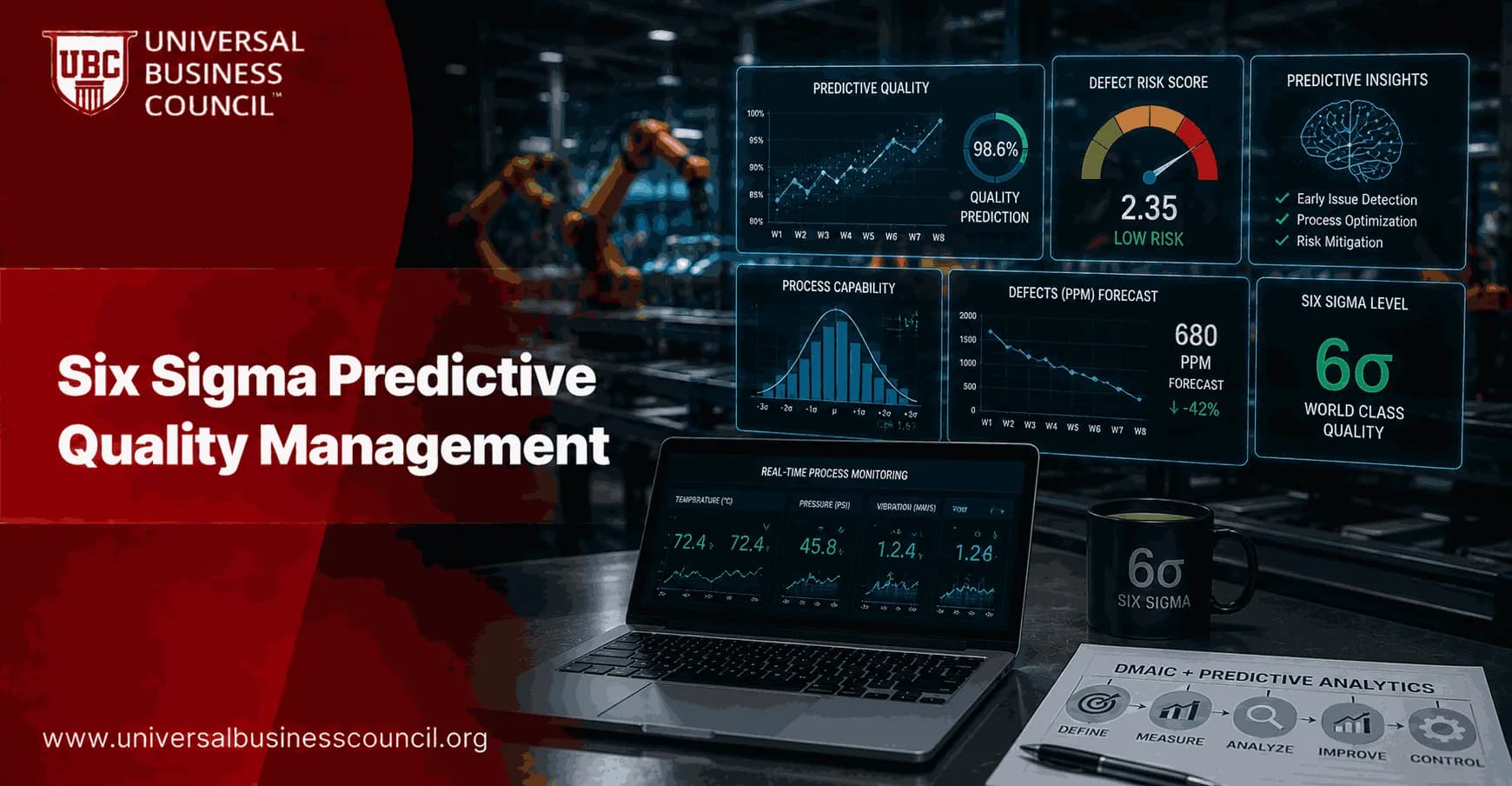
Six Sigma predictive quality management takes DMAIC beyond after-the-fact defect analysis. Instead of waiting for scrap reports, warranty claims, or failed inspections, you use process data, machine signals, and quality history to predict where defects are likely to appear and act before the loss is locked in. Quality professionals building this capability often start with a focused credential like the Certified Six Sigma Expert program, since predictive quality is still built on DMAIC discipline, just extended with better data.
That shift matters. ASQ has long noted that quality-related costs can consume 15 to 20 percent of sales in many manufacturers. Other industry benchmarks put the cost of poor quality at 10 to 30 percent of revenue for typical manufacturers, while world-class operations keep it below 5 percent. Predictive quality is not a technology fashion. It is a practical response to expensive variation.

What Six Sigma Predictive Quality Management Means
Six Sigma is formally described in ISO 13053 through the DMAIC cycle: Define, Measure, Analyze, Improve, and Control. Traditional Six Sigma uses tools such as statistical process control, process capability analysis, measurement system analysis, design of experiments, and hypothesis testing to reduce variation.
Predictive quality management adds advanced analytics and machine learning to that structure. The goal is simple. You estimate product quality during production from process, product, equipment, supplier, and environment data.
In a reactive model, a team finds nonconforming units through sampling inspection, end-of-line testing, or customer complaints. In a predictive model, the process is scored while it is still running. If a press temperature, spindle vibration, humidity reading, material batch, and cycle-time pattern resemble a known defect condition, the system flags the risk before the part is completed.
To be blunt, this is where many SPC-only systems struggle. A single control chart may show each parameter within limits, while the combination of parameters is already risky. Machine learning models such as random forests, support vector machines, neural networks, and gradient boosting can detect multivariate patterns that a wall of charts misses. Rolling out this kind of predictive program across a plant is as much a change-management effort as a modeling one, which is why quality leaders often pair Six Sigma training with broader Management Certifications, covering the leadership and cross-functional alignment skills needed to get operators, engineers, and data teams working from the same playbook.
How Predictive Quality Strengthens DMAIC
Define
Start with the business pain, not the algorithm. Define the critical-to-quality characteristics, the defect opportunity, and the financial exposure. Use the cost-of-quality categories from the ASQ model: prevention, appraisal, internal failure, and external failure.
Measure
You need trustworthy data from PLCs, IoT sensors, MES, ERP, inspection systems, supplier records, and maintenance logs. This is where projects often slow down. Time stamps do not match. Operators rename defect codes. A sensor gets replaced and its calibration history disappears. Fix that first. When these integration failures run deep, spanning PLCs, MES, and ERP systems that were never designed to share data cleanly, a Deep Tech Certification from Blockchain Council can help teams understand how reliable, auditable data pipelines are actually built, since a predictive model is only as trustworthy as the data feeding it.
Analyze
Use DMAIC discipline to separate correlation from useful prediction. Build models that connect process variables to quality outcomes, then test them against holdout data. If the model cannot explain enough risk to guide action, do not deploy it. A pretty dashboard that operators ignore is just appraisal cost with better graphics.
Improve
Turn predictions into interventions. That might mean adjusting feed speed, changing inspection frequency, holding a suspect material lot, or scheduling maintenance before the machine starts producing borderline output. On one high-mix line, the most useful signal was not the average temperature. It was a short temperature recovery lag after tool changeover, visible only when cycle data and defect labels were joined correctly.
Control
Predictive control means monitoring model drift. Materials change. Tooling wears. New operators join. If the model was trained on last year's stable process and the process is now different, its predictions will decay. Build recalibration into the control plan.
What the Evidence Says
Research on predictive quality in manufacturing shows broad use of machine learning and deep learning to estimate product quality from production data. RWTH Aachen University's maturity work describes predictive quality as a method that combines process, product, and environment data to detect irregularities before they become critical failures.
Reported results are strong when predictive quality is integrated with maintenance and operations. Manufacturing 4.0 research has found that linking predictive maintenance with quality control can reduce quality-related defects by 42.7 percent, cut unplanned production stoppages by 38.5 percent, and improve first-pass yield by 29.4 percent. The same study reported prediction of quality issues with 94.1 percent accuracy roughly 12 to 15 hours before they appeared.
Market data also shows why this topic is moving quickly. One industry estimate values the predictive quality analytics market at 3.2 billion US dollars in 2025, with a forecast of 11.8 billion US dollars by 2034. Manufacturing accounts for the largest share of that market.
Where Predictive Quality Works Best
Predictive quality management is strongest where defects are costly, variables are measurable, and production history is deep enough to train models. Good candidates include:
Automotive and aerospace production, where scrap, rework, and traceability costs are high.
Electronics manufacturing, where small parameter shifts can create latent failures.
Process industries, where temperature, pressure, flow, and chemistry interact in non-obvious ways.
Paint, coating, molding, and machining operations, where machine health and quality outcomes are tightly connected.
Supplier quality programs, where incoming material data can predict downstream failures.
It is the wrong first move when the basics are broken. If measurement systems fail repeatability and reproducibility checks, or if defect definitions change every shift, fix the quality system before training a model.
Implementation Steps for Practitioners
Pick one high-value defect family. Do not try to solve everything at once. Start with a defect tied to scrap, rework, downtime, or warranty exposure.
Map the data trail. Connect process parameters, machine states, inspection results, material lots, and operator events.
Validate the measurement system. Poor labels create poor models. Measurement system analysis still matters.
Build a baseline. Compare predictive models against current SPC, inspection, and first-pass yield performance.
Deploy with human decision rules. Define who responds, how fast, and what action is allowed when risk crosses a threshold.
Track cost of poor quality. Leadership will watch scrap, rework, downtime, first-pass yield, customer escapes, and cost avoidance.
Skills You Need Next
Six Sigma professionals do not need to become full-time data scientists, but you do need enough analytics fluency to challenge a model, question a data pipeline, and translate prediction into process control. Developers and technology teams need the reverse: enough DMAIC, SPC, and process capability knowledge to avoid building models that solve the wrong problem.
For structured learning, consider Universal Business Council's Certified Six Sigma Expert programme, which covers DMAIC, statistical process control, design of experiments, measurement system analysis, AI-powered quality analytics, predictive process optimization, and enterprise governance. Related Six Sigma and quality management courses can support teams building a common language between operations, analytics, and leadership.
From Inspection to Prevention
The future of quality is not less Six Sigma. It is better Six Sigma, supported by real-time data and predictive models that make variation visible earlier. Keep the DMAIC discipline. Add machine learning where it improves decisions. Start with one expensive defect, prove the control plan, then scale the method to the next process. Pick that defect this week and map its data trail. If the sensors, PLCs, and MES systems along that trail cannot reliably share data with each other, a Tech Certification from Global Tech Council is worth adding to the plan, since some predictive quality projects stall on systems integration long before they reach a model.
FAQs
1. What is Six Sigma predictive quality management?
Six Sigma predictive quality management combines traditional Six Sigma methods with predictive analytics, machine learning, and real-time process data to anticipate quality problems before they occur. Instead of relying mainly on inspection and corrective action, organizations analyze patterns that indicate future defects or failures. This helps teams intervene earlier, reduce variation, and shift quality management from reactive problem-solving toward proactive prevention.
2. How does predictive quality management differ from traditional quality management?
Traditional quality management often detects defects during inspection or responds after a problem has occurred. Predictive quality management uses historical and real-time data to estimate what is likely to happen next. Combined with Six Sigma, it allows teams to identify emerging risks, understand their causes, and take preventive action. The goal is to stop producing defects rather than becoming exceptionally efficient at documenting them afterward.
3. How does Six Sigma support proactive quality management?
Six Sigma provides structured methods for understanding processes, measuring variation, identifying root causes, and controlling improvements. Predictive analytics adds forecasting capabilities to this framework. Teams can use Six Sigma to determine which variables matter and predictive models to estimate when those variables are likely to produce undesirable outcomes. Together, they create a systematic approach to preventing quality failures.
4. What is the role of predictive analytics in Six Sigma?
Predictive analytics uses historical and current data to estimate future process outcomes. In Six Sigma, it can help forecast defect probability, equipment failure, process deviations, customer complaints, and other quality events. Predictive insights allow improvement teams to prioritize interventions based on risk instead of waiting for conventional performance indicators to confirm that something has already gone wrong.
5. How does predictive quality fit into the DMAIC methodology?
Predictive quality can strengthen every DMAIC phase. During Define, teams identify critical quality risks. Measure establishes reliable data and baselines. Analyze develops an understanding of variables associated with failures. Improve uses predictive insights to select preventive actions. Control can then use real-time models and alerts to identify emerging deviations. DMAIC remains the improvement framework, while predictive technology adds earlier visibility into process behavior.
6. Can predictive quality management prevent defects before they occur?
Predictive quality management can reduce the likelihood of defects by identifying conditions associated with future failures. For example, a model might detect that particular combinations of temperature, pressure, material characteristics, and equipment settings significantly increase defect probability. Operators can then adjust the process before production moves outside acceptable conditions. Prediction does not guarantee prevention, but it gives teams valuable time to act.
7. What data is needed for Six Sigma predictive quality management?
Useful data can include:
Process measurements and parameters
Quality inspection results
Historical defect records
Equipment and sensor data
Maintenance history
Supplier and material information
Environmental conditions
Customer complaints and returns
Data must be accurate, sufficiently representative, and relevant to the quality outcome being predicted. Feeding unreliable measurements into an advanced model merely produces sophisticated nonsense faster.
8. How does machine learning improve predictive quality?
Machine learning can identify complex relationships between process variables and quality outcomes that may be difficult to detect using simpler analytical methods. Classification models can estimate whether products will pass or fail, while regression models can predict continuous quality measurements. Other techniques can detect anomalies or group unusual process behaviors, giving Six Sigma teams additional tools for identifying emerging risks.
9. How can predictive quality reduce manufacturing defects?
Manufacturers can analyze production data to identify operating conditions associated with defects. Predictive models may continuously evaluate machine settings, sensor readings, raw materials, and environmental conditions to calculate defect risk. When risk rises beyond an acceptable threshold, operators can investigate or adjust the process. This reduces scrap, rework, warranty claims, and the cherished industrial tradition of discovering a problem after producing several thousand units.
10. How does predictive quality management improve root cause analysis?
Predictive models can reveal which process variables are strongly associated with quality outcomes and how combinations of variables influence failure risk. Six Sigma teams can use these insights alongside techniques such as Fishbone diagrams, hypothesis testing, regression, and Design of Experiments. Predictive models should support root cause investigation rather than automatically be treated as proof of causation.
11. How does predictive quality work with Statistical Process Control?
Statistical Process Control (SPC) monitors process stability and detects unusual variation, while predictive quality models estimate future outcomes using broader patterns in data. Combining the two can provide stronger process monitoring. SPC can identify statistically significant changes, while predictive models can detect complex or nonlinear patterns that indicate increasing defect risk before conventional control limits are crossed.
12. How does predictive quality management support predictive maintenance?
Equipment condition often directly affects product quality. Predictive maintenance analyzes vibration, temperature, pressure, runtime, and other equipment information to estimate failure or degradation risk. Six Sigma teams can connect these predictions with quality metrics to determine how machine condition influences defects. Maintenance can then occur before equipment deterioration causes significant production problems.
13. Can AI automate predictive quality management?
AI can automate activities such as anomaly detection, defect-risk scoring, image inspection, alerts, and performance monitoring. Computer vision can identify visual defects, while machine learning can analyze process variables continuously. Human oversight remains important for validating models, investigating causes, and deciding corrective actions. Automatically generating an alert is easy; determining whether stopping a production line is justified requires considerably more context.
14. What KPIs are used in predictive quality management?
Important predictive quality KPIs can include defect probability, predicted yield, First Pass Yield, DPMO, process capability, scrap rate, rework rate, anomaly frequency, false-positive rate, model accuracy, and Cost of Poor Quality. Organizations should combine traditional Six Sigma measures with predictive-model metrics so they can evaluate both process performance and whether the forecasting system itself remains reliable.
15. What are the business benefits of predictive quality management?
Potential benefits include lower defect rates, reduced scrap and rework, fewer warranty claims, improved equipment reliability, better process stability, and faster quality decisions. Predictive quality can also reduce inspection costs and improve customer satisfaction by preventing problems from reaching customers. Financial benefits become particularly significant when defects are expensive to correct after production or delivery.
16. What industries can use Six Sigma predictive quality management?
Predictive quality can be applied in manufacturing, automotive, aerospace, electronics, pharmaceuticals, healthcare, logistics, energy, food production, and other data-rich environments. Service organizations can also predict transaction errors, delays, customer complaints, or operational failures. The essential requirements are measurable processes, meaningful quality outcomes, and sufficient reliable data.
17. What are the challenges of implementing predictive quality?
Common challenges include poor data quality, disconnected systems, insufficient historical data, model bias, false alerts, lack of analytics expertise, and difficulty integrating predictions into operational workflows. Organizations may also build accurate models without defining what employees should do when risk is detected. A prediction without an actionable response process is mostly an expensive notification.
18. How can companies implement Six Sigma predictive quality management?
Organizations should begin with a clearly defined quality problem and measurable business objective. They can then establish reliable data collection, identify critical process variables, analyze historical patterns, build and validate predictive models, and integrate alerts into operational workflows. Six Sigma methods should be used to validate improvements, while ongoing monitoring ensures models remain accurate as processes change.
19. How can organizations measure the ROI of predictive quality?
ROI can be measured by comparing implementation costs with financial benefits such as reduced scrap, rework, warranty expenses, downtime, inspection costs, and customer returns. Organizations should establish baseline performance before deployment and track improvements afterward. Model accuracy alone is not a sufficient ROI measure; a mathematically impressive prediction system that saves no money or improves no quality is mainly an academic achievement.
20. What is the future of Six Sigma predictive quality management?
The future of predictive quality management will increasingly combine Six Sigma with AI, machine learning, IoT sensors, digital twins, computer vision, and real-time analytics. Quality systems will move beyond detecting defects toward continuously forecasting process risk and recommending preventive actions. Six Sigma provides the disciplined methodology for validating these improvements, while predictive technologies provide earlier intelligence. The result is a shift from asking “Why did this defect happen?” to “What is likely to fail next, why, and what should we change before it does?”
Related Articles
View All
Six Sigma
Six Sigma vs Quality Management: Where Six Sigma Fits
Six Sigma vs Quality Management explained: learn how Six Sigma fits within quality systems as a data-driven method for reducing defects and variation.
Six Sigma
How Six Sigma Complements Total Quality Management in Enterprise Quality Programs
Learn how Six Sigma complements Total Quality Management by adding DMAIC, analytics, and project discipline to enterprise quality programs.

Six Sigma
Six Sigma in Project Management: Better Scope, Schedule, and Quality Control
Learn how Six Sigma in project management improves scope control, schedule reliability, and quality using DMAIC, CTQs, control charts, and change governance.
Trending Articles
The Role of Blockchain in Ethical AI Development
How blockchain technology is being used to promote transparency and accountability in artificial intelligence systems.
AWS Career Roadmap
A step-by-step guide to building a successful career in Amazon Web Services cloud computing.
Top 5 DeFi Platforms
Explore the leading decentralized finance platforms and what makes each one unique in the evolving DeFi landscape.