

Six Sigma vs ISO 9001: Certification, Quality Systems, and Process Control
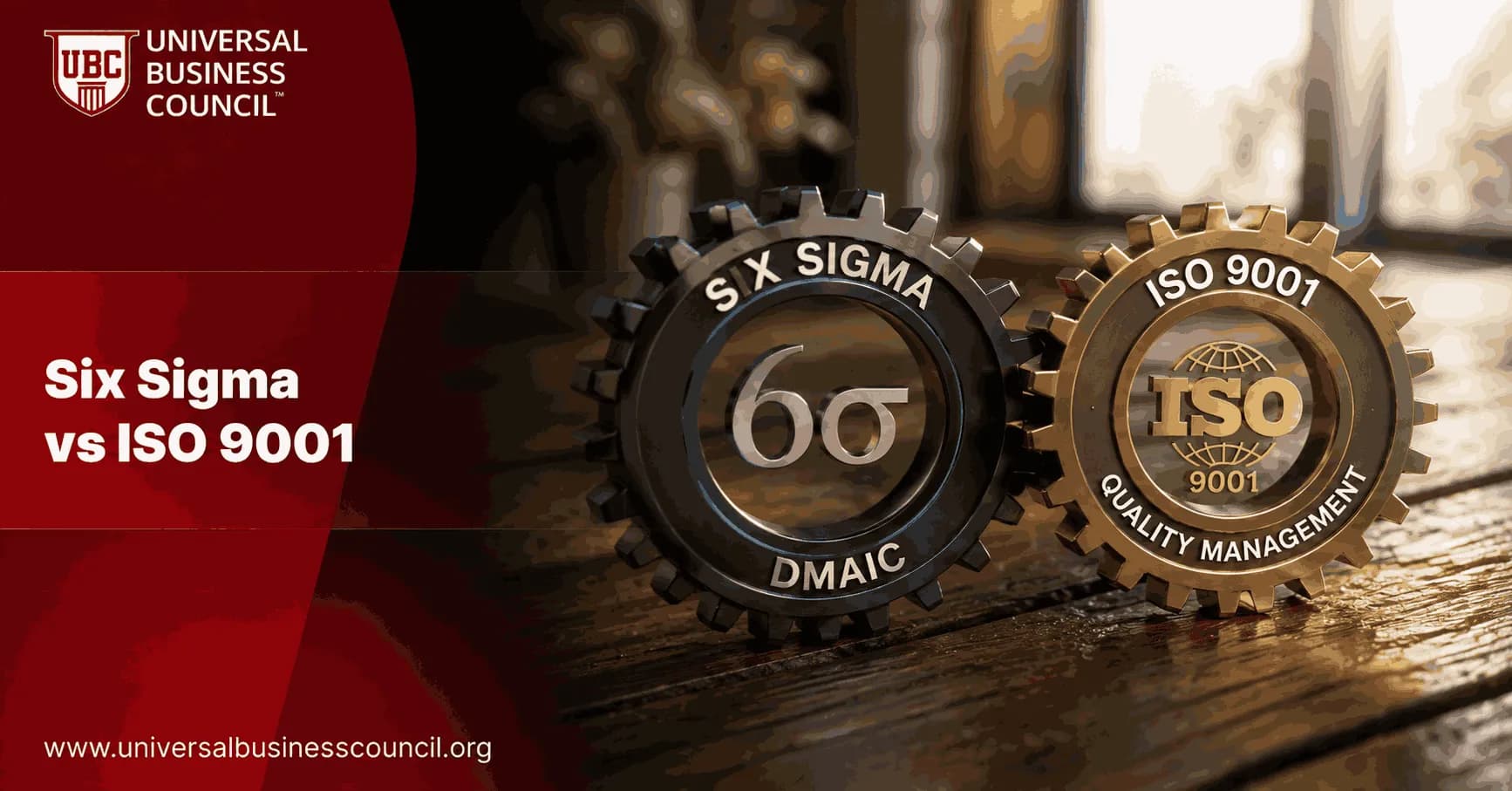
Six Sigma vs ISO 9001 is not a choice between two versions of the same thing. ISO 9001 is a certifiable quality management system standard for organizations. Six Sigma is a project-based method for reducing variation, defects, and the cost of poor quality in specific processes. Use ISO 9001 to govern the system. Use Six Sigma to fix the process. Professionals who want to build that process-fixing skill set often start with a Certified Six Sigma Expert credential, which builds the DMAIC and statistical foundation this comparison relies on.
That distinction matters. I have watched teams pass an ISO audit with clean procedures and tidy records, while one filling line still produced avoidable scrap every Friday afternoon after a changeover. The system was controlled. The process was not capable enough. That is where Six Sigma earns its keep.

What ISO 9001 Is Built to Do
ISO 9001 is issued by the International Organization for Standardization, and the current widely used reference is ISO 9001:2015. It defines requirements for a quality management system, often called a QMS, across the organization.
In plain terms, ISO 9001 asks whether your organization has a consistent way to manage quality. It covers areas such as:
Process ownership and process interactions
Documented information and traceability
Customer requirements and customer satisfaction
Risk-based planning
Internal audits and management reviews
Nonconformity handling and corrective action
Continual improvement
ISO 9001 certification is awarded to an organization after an independent audit by a certification body. The certificate normally applies to defined sites, products, services, and activities. Individuals can train as internal auditors, lead auditors, or implementation specialists, but the formal ISO 9001 certificate belongs to the organization. Auditors and quality leaders who work across both governance and improvement often pair that specialist training with broader Management Certifications, since running a QMS well takes leadership and stakeholder skills beyond the audit checklist itself.
What Six Sigma Is Built to Do
Six Sigma is a data-driven process improvement methodology. It is usually applied through the DMAIC cycle: Define, Measure, Analyze, Improve, and Control.
Six Sigma does not provide an organization-wide management system certificate like ISO 9001. Instead, Six Sigma certification is normally individual. Professionals earn belt-level credentials such as Yellow Belt, Green Belt, Black Belt, or Master Black Belt through training providers and professional bodies.
The work is narrower and deeper than ISO 9001. A Six Sigma project may target a high defect rate, slow claims handling, unstable machine output, excess rework, poor first-pass yield, or inconsistent service response time. The tools often include:
Control charts and statistical process control
Measurement system analysis
Capability analysis such as Cp and Cpk
Root cause analysis
Hypothesis testing
Regression analysis
Designed experiments
The famous Six Sigma benchmark is 3.4 defects per million opportunities. Do not treat that number as a slogan. In many service processes, the more useful question is simpler: what defect definition matters to the customer, and can you measure it without arguing over the spreadsheet?
Six Sigma vs ISO 9001 Certification
The certification model is the easiest way to separate the two.
ISO 9001 certification
ISO 9001 certification confirms that an organization has implemented a QMS that conforms to ISO 9001 requirements. Auditors look for evidence, not intent. Procedures must be followed. Records must match reality. Corrective actions must close actual causes, not just symptoms.
ISO 9001 is often required in manufacturing, engineering, public procurement, and regulated supply chains. According to the ISO Survey 2023, there were roughly 835,000 ISO 9001 certificates worldwide, making it the dominant global QMS certification.
Six Sigma certification
Six Sigma certification confirms that an individual understands and can apply improvement methods at a defined level. A Green Belt is commonly expected to support or lead smaller DMAIC projects. A Black Belt is expected to lead complex projects, coach teams, and use more advanced statistical analysis.
There is no single global registry of Six Sigma organizations equivalent to ISO 9001 certification. That trips up certification candidates. The exam-style question often asks, which one certifies the organization? The answer is ISO 9001.
Quality Management System vs Process Control
ISO 9001 creates the management framework. It makes sure processes are defined, controlled, audited, and improved. It also forces leadership to review performance instead of leaving quality to the quality department.
Six Sigma strengthens process control inside that framework. It asks whether the process is statistically stable, whether variation is understood, and whether improvements can be sustained after the project team moves on.
A blunt rule works well:
Use ISO 9001 when you need governance, auditability, customer assurance, and consistent operating rules.
Use Six Sigma when you have a measurable performance problem and enough data to investigate it properly.
Use both when improvements must survive audits, staff changes, supplier shifts, and quarter-end pressure.
How They Work Together in Real Organizations
The best quality teams do not run ISO 9001 and Six Sigma in separate corners. They connect them.
Say an ISO 9001 corrective action process reveals repeated nonconformities in a packaging operation. A Six Sigma Green Belt project can then measure the baseline defect rate, test root causes, improve settings or changeover steps, and create a control plan. The new standard work, inspection frequency, and monitoring chart are then added back into the ISO-controlled QMS.
That last step is where many teams fail. They improve the process, celebrate the savings, and forget to update the procedure, training record, control plan, or audit checklist. Six months later, the old defect pattern returns. This is increasingly true as more of that monitoring shifts onto digital platforms and automated sensors, which is why some quality professionals also pursue a Deep Tech Certification to better understand the systems generating the data their control plans depend on.
Which Should You Choose First?
Choose based on the problem in front of you.
Start with ISO 9001 if customers, tenders, or regulators expect a recognized quality management certificate.
Start with Six Sigma if you already have basic process discipline but are losing money through defects, cycle time, rework, or variation.
Build both capabilities if you work in operations, quality, supply chain, product delivery, or technical management.
For professionals, this combination is practical. ISO 9001 competence shows that you understand systems, audits, risk, and governance. Six Sigma competence shows that you can measure a process, find causes, and control improvement. If you are planning your development path, look at Universal Business Council learning pathways in Six Sigma, quality management, operations management, and project management as internal next steps.
The Practical Takeaway
Six Sigma vs ISO 9001 should be framed as system plus method, not winner plus loser. ISO 9001 gives your organization the quality management system. Six Sigma gives your team the statistical discipline to improve high-impact processes inside it.
If you manage quality or operations, map one painful process this week. Check whether it is documented in your QMS. Then ask whether the data is good enough for DMAIC. That single check will show whether your next move is ISO discipline, Six Sigma analysis, or both. And as quality systems lean further into digital records and automated monitoring, a general Tech Certification can help round out that skill set with the technical fluency modern QMS work increasingly demands.
FAQs
1. What is the difference between Six Sigma and ISO 9001?
Six Sigma is a data-driven methodology for improving processes, reducing defects, and controlling variation. ISO 9001 is an international standard that specifies requirements for an organization's Quality Management System (QMS).
A simple distinction is:
Six Sigma → Improves process performance
ISO 9001 → Establishes requirements for managing quality systematically
Organizations can use both together because they address different but complementary aspects of quality management.
2. What is ISO 9001?
ISO 9001 is an international Quality Management System standard published by the International Organization for Standardization (ISO).
It provides requirements for areas such as organizational context, leadership, planning, support, operations, performance evaluation, and improvement.
Its purpose is to help organizations consistently provide products and services that meet applicable customer and regulatory requirements while continually improving their QMS.
3. What is Six Sigma?
Six Sigma is a structured process-improvement methodology that uses data and analytical tools to understand process performance and reduce defects and variation.
Its best-known framework is DMAIC:
Define → Measure → Analyze → Improve → Control
Six Sigma can be applied to manufacturing, services, healthcare, finance, logistics, technology, and other environments with measurable processes.
4. Is ISO 9001 the same as Six Sigma?
No.
ISO 9001 addresses how an organization establishes and maintains a Quality Management System.
Six Sigma addresses how teams can systematically improve specific processes.
An ISO 9001-certified organization does not automatically operate at Six Sigma performance levels, and a company using Six Sigma is not automatically ISO 9001 certified.
The concepts overlap, but the credentials and objectives are different.
5. What is the difference between ISO 9001 certification and Six Sigma certification?
ISO 9001 certification generally applies to an organization's Quality Management System and is issued through an independent certification process.
Six Sigma certification generally applies to an individual practitioner and may be offered at levels such as Yellow Belt, Green Belt, Black Belt, or Master Black Belt.
Six Sigma certification requirements vary by provider.
So:
ISO 9001 Certification → Organization/QMS
Six Sigma Certification → Individual skills
That distinction saves a surprising amount of confusion.
6. Can an individual become ISO 9001 certified?
ISO 9001 certification itself is generally associated with organizations and their Quality Management Systems rather than individual professionals.
Individuals can complete ISO 9001-related training, such as awareness, implementation, internal auditor, or lead auditor courses.
Those training credentials should not be confused with an organization's ISO 9001 certification.
7. Can a company become Six Sigma certified?
Six Sigma certification is most commonly associated with individual practitioners, although organizations can adopt Six Sigma programs, deployment models, and internal belt structures.
Unlike ISO 9001, Six Sigma does not function as the same type of standardized organizational QMS certification.
A company can therefore “use Six Sigma” without that phrase meaning the same thing as being independently certified to ISO 9001.
8. How does ISO 9001 support process control?
ISO 9001 requires organizations to determine and manage processes needed for their Quality Management System.
Organizations may establish:
Process Criteria → Responsibilities → Resources → Controls → Monitoring → Measurement → Corrective Actions
The specific controls depend on the organization's products, services, risks, and processes.
ISO 9001 provides the management framework, while individual organizations determine suitable operational controls.
9. How does Six Sigma support process control?
Six Sigma uses measurement and statistical methods to understand and control process performance.
Common tools include:
Control charts
Process capability analysis
Measurement System Analysis
Statistical Process Control
Control plans
Process monitoring
Standard work
Response plans
During the Control phase of DMAIC, teams establish mechanisms intended to prevent the improved process from returning to previous performance.
10. What is the difference between ISO 9001 corrective action and Six Sigma DMAIC?
Corrective action addresses causes of nonconformities to prevent recurrence.
DMAIC is a broader structured methodology for improving an existing process when a measurable performance problem exists and its causes require investigation.
A relatively straightforward nonconformity may be addressed through the organization's corrective-action process.
A complex, recurring, high-impact problem may justify a Six Sigma DMAIC project.
Not every corrective action needs several months of statistical analysis. Civilization can survive some problems being solved efficiently.
11. How does Six Sigma complement an ISO 9001 Quality Management System?
ISO 9001 can provide the organizational framework for quality management, while Six Sigma provides a structured improvement methodology.
For example:
QMS Performance Monitoring
↓
Recurring Quality Problem Identified
↓
Six Sigma DMAIC Project
↓
Root Causes Validated
↓
Process Improved
↓
Controls and Documentation Updated
↓
QMS Continues Monitoring
This creates a connection between systematic quality management and data-driven process improvement.
12. Does ISO 9001 require Six Sigma?
No.
An organization can conform to ISO 9001 without using Six Sigma.
ISO 9001 does not require organizations to adopt a particular branded process-improvement methodology.
Organizations may use Six Sigma, Lean, Kaizen, root-cause analysis, corrective action, process redesign, or other appropriate methods to support improvement.
13. Does Six Sigma require ISO 9001?
No.
Organizations can implement Six Sigma without having an ISO 9001-certified Quality Management System.
However, a mature QMS can provide useful foundations such as documented processes, performance metrics, process ownership, corrective-action systems, and management reviews.
These can help identify and sustain Six Sigma improvement opportunities.
14. How do ISO 9001 and Six Sigma approach risk?
ISO 9001 incorporates risk-based thinking into the Quality Management System so organizations consider risks and opportunities when planning and managing processes.
Six Sigma projects may use tools such as FMEA to identify potential failure modes and prioritize risks.
A simplified distinction is:
ISO 9001 → Risk within the broader QMS
Six Sigma → Risk analysis within specific improvement efforts
The two approaches can reinforce each other.
15. How do ISO 9001 and Six Sigma use data?
ISO 9001 requires organizations to monitor, measure, analyze, and evaluate relevant QMS performance as appropriate.
Six Sigma often goes deeper into quantitative analysis for selected process problems.
Depending on the project, Six Sigma practitioners may use:
Descriptive Statistics → Control Charts → Capability Analysis → Hypothesis Testing → Regression → Design of Experiments
The goal is to use enough analytical depth to make reliable decisions.
16. How do ISO 9001 audits differ from Six Sigma projects?
An ISO 9001 audit evaluates whether the Quality Management System conforms to applicable requirements and whether it is effectively implemented and maintained.
A Six Sigma project focuses on improving measurable process performance.
An audit may identify a recurring issue that becomes an improvement opportunity, but the audit itself is not a Six Sigma project.
In simplified terms:
Audit → Evaluate
DMAIC → Improve
17. Which is better for a quality career: Six Sigma or ISO 9001?
Both can be useful, depending on the role.
ISO 9001 knowledge can be valuable for:
Quality Management + QMS Implementation + Auditing + Compliance + Supplier Quality
Six Sigma can be valuable for:
Process Improvement + Operational Excellence + Quality Engineering + Analytics + Continuous Improvement
Quality professionals who understand both systems and improvement methodology can develop a broader career profile.
18. Should a Quality Manager learn both ISO 9001 and Six Sigma?
Often, yes.
A Quality Manager may need to maintain a Quality Management System while also improving processes that fail to meet performance objectives.
A useful skill combination is:
ISO 9001 + Quality Auditing + Root-Cause Analysis + Six Sigma + Lean + Risk Management
The appropriate depth in each area depends on the organization's industry, regulatory environment, and quality strategy.
19. Can ISO 9001, Lean, and Six Sigma be used together?
Yes.
A practical distinction is:
ISO 9001 → Quality Management System
Lean → Waste reduction and flow improvement
Six Sigma → Defect and variation reduction
An organization might use ISO 9001 to establish quality governance, Lean to streamline workflows, and Six Sigma to solve complex process-performance problems.
These approaches should support common business and customer objectives rather than become competing internal programs.
20. What is the best way to integrate ISO 9001 and Six Sigma?
Treat ISO 9001 as the quality-management framework and Six Sigma as one of the organization's structured improvement methods.
A practical model begins with the QMS:
Customer Requirements
↓
Quality Objectives
↓
Business Processes
↓
Operational Controls
↓
Monitoring and Measurement
↓
Performance Evaluation
Suppose monitoring identifies:
Customer Return Rate: 7.5%
while the organization's target is:
Below 3%
The QMS makes the performance gap visible.
The organization then determines how to address it.
If the problem is straightforward and its cause is known, normal corrective action may be sufficient.
If the issue is complex, recurring, financially significant, and has unclear causes, it may become a Six Sigma project.
The DMAIC sequence can then be applied.
Define
Establish:
Problem + Business Impact + Customer Impact + Scope + Goal
Measure
Validate the measurement system and establish baseline performance.
For example:
Current Return Rate = 7.5%
Annual Return Cost = $850,000
Analyze
Investigate and validate the causes of returns using appropriate methods such as:
Pareto analysis
Fishbone diagrams
Process mapping
Hypothesis testing
Regression
FMEA
Improve
Develop and test solutions that address validated root causes.
Control
Establish mechanisms such as:
Control Plan + KPI + Process Owner + Standard Work + Monitoring + Response Plan
Then integrate the improved process back into the QMS.
This might require updates to:
Procedures
Work instructions
Risk assessments
Training
Process metrics
Operational controls
Relevant documented information
The organization then continues monitoring the process through its normal quality-management system.
The complete loop becomes:
ISO 9001 QMS
↓
Monitor Process
↓
Identify Performance Gap
↓
Select Improvement Method
↓
Six Sigma DMAIC
↓
Improve Process
↓
Update Controls
↓
Return to QMS Monitoring
This illustrates why the two approaches are complementary.
ISO 9001 helps answer:
“Do we have an effective system for consistently managing quality?”
Six Sigma helps answer:
“Why is this particular process failing to achieve the performance we need, and how can we improve it using evidence?”
For professionals, the combined skill stack can be particularly useful:
QMS Knowledge + ISO 9001 + Auditing + Six Sigma + Lean + Data Analysis + Risk Management
For leadership roles, add:
Financial Analysis + Change Management + Strategy + Coaching
The key is to avoid confusing certification types.
ISO 9001 certification concerns an organization's QMS.
Six Sigma belt certification generally concerns an individual's process-improvement knowledge and capability.
One does not replace the other.
An organization can maintain beautifully controlled documentation and still have poor process performance.
It can also run excellent Six Sigma projects while lacking a coherent enterprise quality system.
Combining a disciplined QMS with rigorous improvement methods gives organizations a better chance of achieving both consistency and continuous improvement.
Which is rather more useful than passing an audit while everyone privately knows the process is still held together by spreadsheets, tribal knowledge, and one employee named Susan.
Related Articles
View All
Six Sigma
Six Sigma in Procurement: Improving Supplier Quality and Cost Control
Learn how Six Sigma in procurement improves supplier quality, reduces defects, controls cost, and strengthens purchase-to-pay performance with DMAIC.
Six Sigma
Six Sigma in Project Management: Better Scope, Schedule, and Quality Control
Learn how Six Sigma in project management improves scope control, schedule reliability, and quality using DMAIC, CTQs, control charts, and change governance.
Six Sigma
Six Sigma Digital Quality Management: Tools, Systems, and Best Practices
Learn how Six Sigma digital quality management combines DMAIC, AI, process mining, IoT, and digital QMS platforms to improve quality.
Trending Articles
The Role of Blockchain in Ethical AI Development
How blockchain technology is being used to promote transparency and accountability in artificial intelligence systems.
AWS Career Roadmap
A step-by-step guide to building a successful career in Amazon Web Services cloud computing.
Top 5 DeFi Platforms
Explore the leading decentralized finance platforms and what makes each one unique in the evolving DeFi landscape.