

Six Sigma Process Optimization: Improving Speed, Quality, and Cost
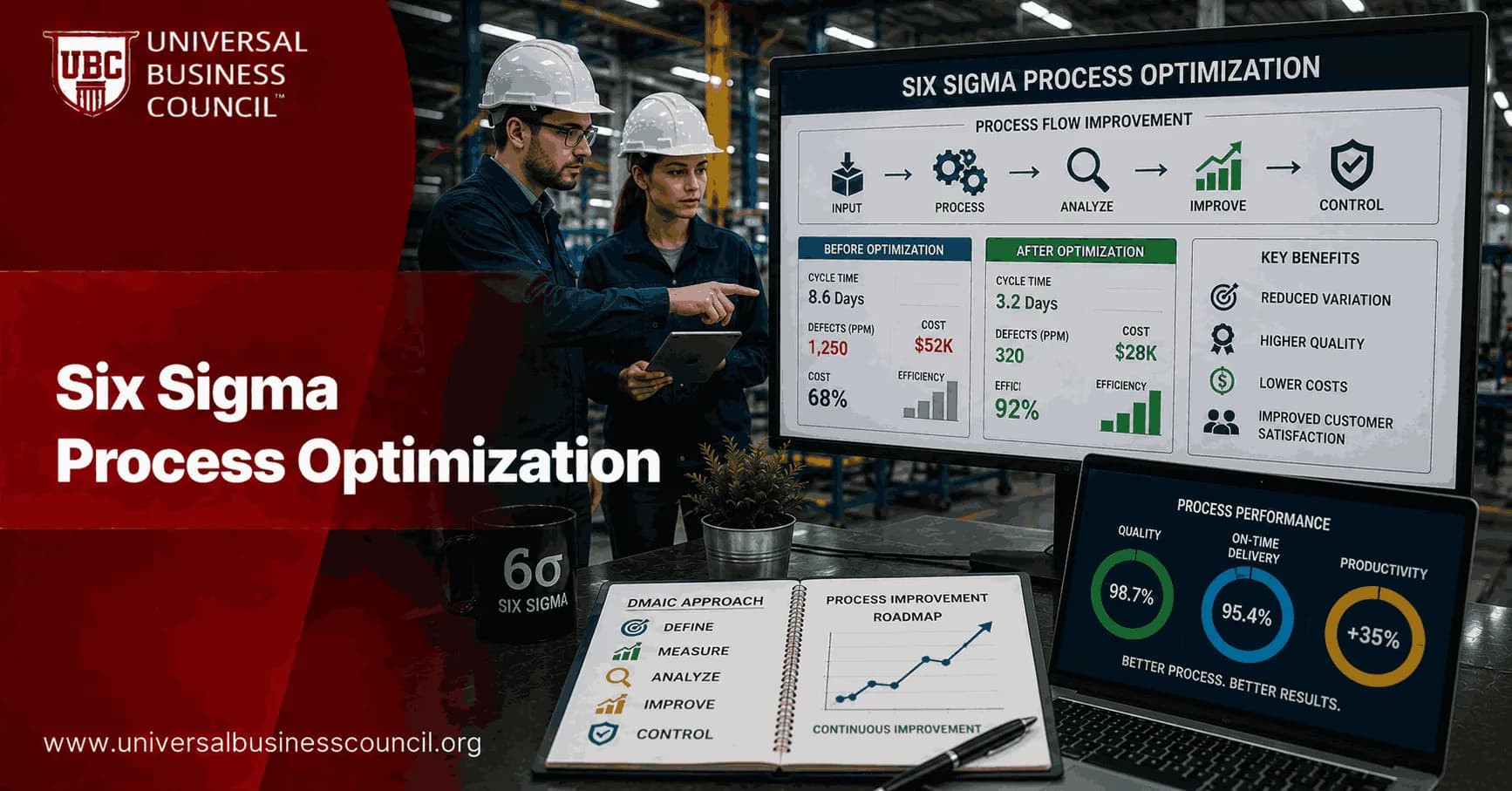
Six Sigma process optimization works because it forces teams to prove what is slowing the process, where defects enter, and which fixes actually reduce cost. Not opinions. Data. That is why the method still matters in 2026, even as organizations add automation, analytics, and agile operating models. Professionals who want to lead this kind of work rather than just support it often start with the Certified Six Sigma Expert credential, which covers the DMAIC discipline this article is built around.
At its best, Six Sigma is not a wall of charts. It is a practical operating discipline: define the problem, measure the current state, analyze root causes, improve the process, then control it so the gains do not fade after the project team leaves.

What Six Sigma Process Optimization Means
Six Sigma is a data-based method for reducing variation and defects. At the Six Sigma performance level, the target is commonly stated as 3.4 defects per million opportunities. That is an ambitious standard, but the bigger point is simpler: reduce variation and the process becomes faster, cheaper, and more predictable. Because these gains usually depend on coordinating operations, quality, and frontline leadership together, project sponsors often pair Six Sigma training with broader Management Certifications, since driving optimization across that many functions is as much a leadership skill as a statistical one.
Most improvement teams use three related approaches:
DMAIC: Define, Measure, Analyze, Improve, and Control. Best for improving an existing process.
Lean Six Sigma: Combines Six Sigma analytics with Lean waste reduction, flow improvement, and cycle time reduction.
Design for Six Sigma (DFSS): Applies Six Sigma thinking while designing a new product, service, or process.
If you are choosing between them, start with DMAIC for a broken process, Lean Six Sigma for a slow or bloated process, and DFSS when the process has not been built yet. Retrofitting quality later is always more expensive.
Why Speed, Quality, and Cost Improve Together
Managers often treat speed, quality, and cost as trade-offs. In many processes, they are connected. A loan file that is missing documents creates rework. Rework increases labor hours. Labor queues slow approval time. Customers call for updates, which creates more workload. One defect multiplies.
This is where Six Sigma process optimization earns its keep. It separates visible symptoms from root causes. A backlog may look like a staffing problem, but the actual cause might be unclear handoffs, poor input quality, or a system field that lets people submit incomplete forms.
Speed: Reducing Cycle Time and Bottlenecks
Some Design for Six Sigma studies report large cycle time reductions, and reviews of Lean Six Sigma in small and medium manufacturing firms frequently show cuts in both cycle time and defect rates. Treat these figures as ranges, not guarantees. Results depend heavily on the process and the discipline of the team running it.
In practice, the breakthrough often comes from measuring queue time, not work time. I have seen process maps where the actual task took 12 minutes, but the item waited 3 days between approvals. That is the sort of detail a stopwatch misses and a value stream map exposes.
Quality: Reducing Defects and Variation
Quality gains come from narrowing process variation. When a process reaches the Six Sigma level, defect performance can approach 99.9997 percent, though few real projects sit there for long without active control. The point is direction, not a trophy number.
Do not start with the prettiest chart. Start with the defect definition. Certification candidates often get this wrong too. If the team cannot agree on what counts as a defect, the Pareto chart is just decoration.
Cost: Cutting Scrap, Rework, and Hidden Labor
Cost reduction is usually the executive hook. The strongest cost cases do not rely only on headcount reduction. Better measures include scrap, rework hours, expedited freight, warranty claims, inventory carrying cost, missed service-level penalties, and capacity released for revenue work.
A word of caution. Savings that only exist on a slide tend to vanish by the next budget cycle. Tie every claimed gain to a metric finance already tracks, and get the number signed off by the process owner before you present it.
Where Six Sigma Is Being Used Now
Six Sigma began in manufacturing, but its current use is much broader. That matters for professionals outside the factory floor.
Manufacturing: Teams use DMAIC to stabilize critical process parameters, reduce defects, and improve throughput.
Supply chain: Lean Six Sigma supports demand management, inventory control, warehouse flow, and order fulfillment reliability.
Healthcare: Projects target medication errors, patient flow, surgical setup time, and communication failures.
Banking: Process teams reduce loan approval delays by removing duplicate checks and improving document quality at intake.
Government: Agencies apply Lean Six Sigma to permit processing, backlog reduction, and service transparency.
Hospitality: Teams standardize check-in, housekeeping, and room readiness processes to reduce service defects.
The pattern is consistent: where work moves through steps, queues, handoffs, decisions, and rework loops, Six Sigma can help. As more of this queue and cycle-time data comes from automated tracking, sensors, and connected systems rather than manual logs, some optimization teams also pair Six Sigma work with a Deep Tech Certification to build a stronger footing in the emerging technology now generating this measurement data.
How to Run a Practical DMAIC Project
Use DMAIC when you already have a process and performance is below target. Keep it narrow. A project scoped as "improve customer experience" will drift for months. A project scoped as "cut loan approval cycle time from 9 days to 5" gives the team a finish line.
Move through the five phases in order. Define the problem and the customer requirement. Measure the current state with real data, not memory. Analyze to find root causes rather than the loudest complaint. Improve by testing changes on a small scale first. Control by locking in the gain with a checklist, a chart, or a system rule, so the process does not slide back once attention moves on.
If you want to build this skill formally, pursue a recognized Lean Six Sigma Green Belt or Black Belt certification and run a live project alongside the training. Reading about DMAIC teaches the vocabulary. Running one project end to end teaches the judgment. If your own role also touches the systems and platforms generating that process data, a general Tech Certification can help round out that technical side of the work.
FAQs
1. What is Six Sigma process optimization?
Six Sigma process optimization is a data-driven approach to improving how a process performs by reducing defects, variation, delays, and unnecessary costs. It uses structured methods such as DMAIC, statistical analysis, process mapping, and control techniques to improve quality while increasing speed and efficiency.
2. What are the main goals of Six Sigma process optimization?
The main goals are to improve three interconnected areas: speed, quality, and cost. Organizations seek shorter cycle times, fewer defects, lower operating expenses, better resource utilization, and more consistent customer outcomes. The trick is improving them together rather than reducing cost today and discovering next quarter that quality has collapsed.
3. How does DMAIC optimize a process?
DMAIC provides five structured phases:
Define: Identify the problem, scope, customer requirements, and objectives.
Measure: Establish baseline performance using reliable data.
Analyze: Determine the root causes of poor performance.
Improve: Develop, test, and implement solutions.
Control: Monitor the improved process and sustain results.
This keeps optimization focused on evidence rather than whatever solution happens to be fashionable.
4. How does Six Sigma improve process speed?
Six Sigma improves speed by identifying factors responsible for excessive cycle and lead times. Teams analyze queues, handoffs, approvals, rework loops, capacity constraints, and process variation. Improvements may include removing unnecessary activities, simplifying decisions, balancing workloads, standardizing procedures, or automating repetitive work.
5. How does Six Sigma improve process quality?
Six Sigma improves quality by identifying the causes of defects and unwanted variation. Teams define Critical-to-Quality (CTQ) requirements, measure process performance, analyze failures, and control important process inputs. The objective is prevention rather than relying primarily on inspection to catch defective outputs afterward.
6. How does Six Sigma reduce process costs?
Six Sigma can reduce costs associated with scrap, rework, downtime, excess inventory, delays, returns, warranty claims, manual processing, and inefficient resource use. Cost of Poor Quality (COPQ) is often used to quantify these losses. Financial measurement helps ensure an optimization project creates business value rather than merely producing aesthetically pleasing flowcharts.
7. What tools are used for Six Sigma process optimization?
Common tools include:
SIPOC diagrams
Process maps
Value stream mapping
Pareto charts
Fishbone diagrams
5 Whys
FMEA
Control charts
Process capability analysis
Regression analysis
Design of Experiments (DOE)
The appropriate combination depends on the process and problem being investigated.
8. How does process mapping support optimization?
Process mapping shows how work actually moves through activities, decisions, handoffs, and systems. It helps identify duplicate tasks, unnecessary approvals, delays, rework loops, unclear responsibilities, and other inefficiencies. Current-state and future-state maps allow teams to compare existing operations with a redesigned workflow.
9. How does Six Sigma identify bottlenecks?
Teams can analyze processing time, waiting time, queue length, capacity, utilization, throughput, and work-in-progress at each process stage. Bottlenecks are points where limited capacity restricts overall flow. Improving a non-bottleneck may accomplish remarkably little, even if that department's dashboard becomes much greener.
10. How does Lean complement Six Sigma process optimization?
Lean focuses primarily on eliminating waste and improving flow, while Six Sigma focuses on reducing defects and variation. Lean Six Sigma combines both approaches. Lean tools can remove unnecessary activities and delays, while Six Sigma analysis determines why performance varies and how to make improvements statistically reliable.
11. What KPIs should be tracked during process optimization?
Useful KPIs include:
Cycle time
Lead time
Throughput
First Pass Yield
Defect rate and DPMO
Cp and Cpk
Rework and scrap rates
Cost per transaction or unit
Cost of Poor Quality
On-time delivery
Customer satisfaction
Metrics should reflect both process performance and business outcomes.
12. How does Six Sigma balance speed and quality?
Increasing speed without controlling quality can increase defects, while excessive controls can create unnecessary delays. Six Sigma uses data to determine which activities actually protect quality and which merely add processing time. The goal is a capable process that produces acceptable outputs efficiently, not simply the fastest possible process.
13. How does Six Sigma balance quality and cost?
Quality improvements can reduce total costs by preventing scrap, rework, complaints, returns, and failures. However, additional controls also have costs. Six Sigma helps organizations identify an appropriate balance by evaluating process capability, customer requirements, risk, and COPQ. More inspection is not automatically better quality.
14. How can Design of Experiments optimize processes?
Design of Experiments systematically tests combinations of process inputs to determine how they affect outputs. DOE can identify critical factors, interactions, and optimal operating conditions. It is especially valuable when several variables influence speed, quality, or cost simultaneously and simple one-variable-at-a-time experiments would miss important interactions.
15. How can automation improve optimized processes?
Automation can accelerate repetitive tasks, enforce business rules, reduce manual errors, collect data automatically, and improve process consistency. Workflow systems and robotic process automation can be particularly valuable for transactional processes. However, the process should be simplified first. Automating ten unnecessary steps merely allows the organization to perform nonsense more efficiently.
16. How can AI support Six Sigma process optimization?
AI and machine learning can analyze large datasets, predict defects, identify anomalies, forecast delays, and recommend operating adjustments. Process mining can reveal actual workflow behavior, while predictive models can identify emerging performance problems. These technologies expand Six Sigma's analytical capabilities but still require reliable data and process expertise.
17. How should process optimization improvements be tested?
Teams should test proposed changes through pilots, controlled trials, simulations, or DOE where appropriate. Results should be compared with baseline performance using predefined success measures. Testing allows teams to identify unintended effects before full implementation. A solution that improves cycle time but doubles customer complaints has not discovered optimization; it has discovered a trade-off.
18. How can organizations sustain optimized processes?
The Control phase can use standardized work, SOPs, control plans, dashboards, control charts, training, automated alerts, preventive maintenance, and process audits. Clear process ownership and response procedures are also essential. Sustaining improvements ensures performance does not gradually drift back after the project team leaves.
19. What are common mistakes in Six Sigma process optimization?
Common mistakes include optimizing the wrong process, using unreliable data, ignoring customer requirements, confusing correlation with causation, automating before simplifying, focusing on departmental rather than end-to-end performance, and failing to establish controls. Another common mistake is measuring dozens of KPIs while nobody is clearly accountable for improving any of them.
20. What is the best roadmap for Six Sigma process optimization?
A practical roadmap is:
Define customer and business requirements → map the current process → establish speed, quality, and cost baselines → identify bottlenecks and root causes → prioritize opportunities → test improvements → validate financial and operational results → standardize the new process → establish ongoing controls.
Successful optimization does not maximize speed, quality, or cost independently. It designs a process that delivers the right quality, at the required speed, with the lowest sustainable total cost. That balance is where Six Sigma earns its keep.
Related Articles
View All
Six Sigma
Six Sigma in Procurement: Improving Supplier Quality and Cost Control
Learn how Six Sigma in procurement improves supplier quality, reduces defects, controls cost, and strengthens purchase-to-pay performance with DMAIC.
Six Sigma
Six Sigma Cost of Poor Quality: Finding Hidden Losses
Six Sigma Cost of Poor Quality explains how defects, rework, downtime, and lost customers hide real financial losses inside everyday operations.
Six Sigma
Six Sigma vs ISO 9001: Certification, Quality Systems, and Process Control
Compare Six Sigma vs ISO 9001 for certification, QMS governance, DMAIC, audits, and process control. Learn when to use each approach.
Trending Articles
The Role of Blockchain in Ethical AI Development
How blockchain technology is being used to promote transparency and accountability in artificial intelligence systems.
AWS Career Roadmap
A step-by-step guide to building a successful career in Amazon Web Services cloud computing.
Top 5 DeFi Platforms
Explore the leading decentralized finance platforms and what makes each one unique in the evolving DeFi landscape.