

Six Sigma Business Process Optimization: How to Streamline Operations
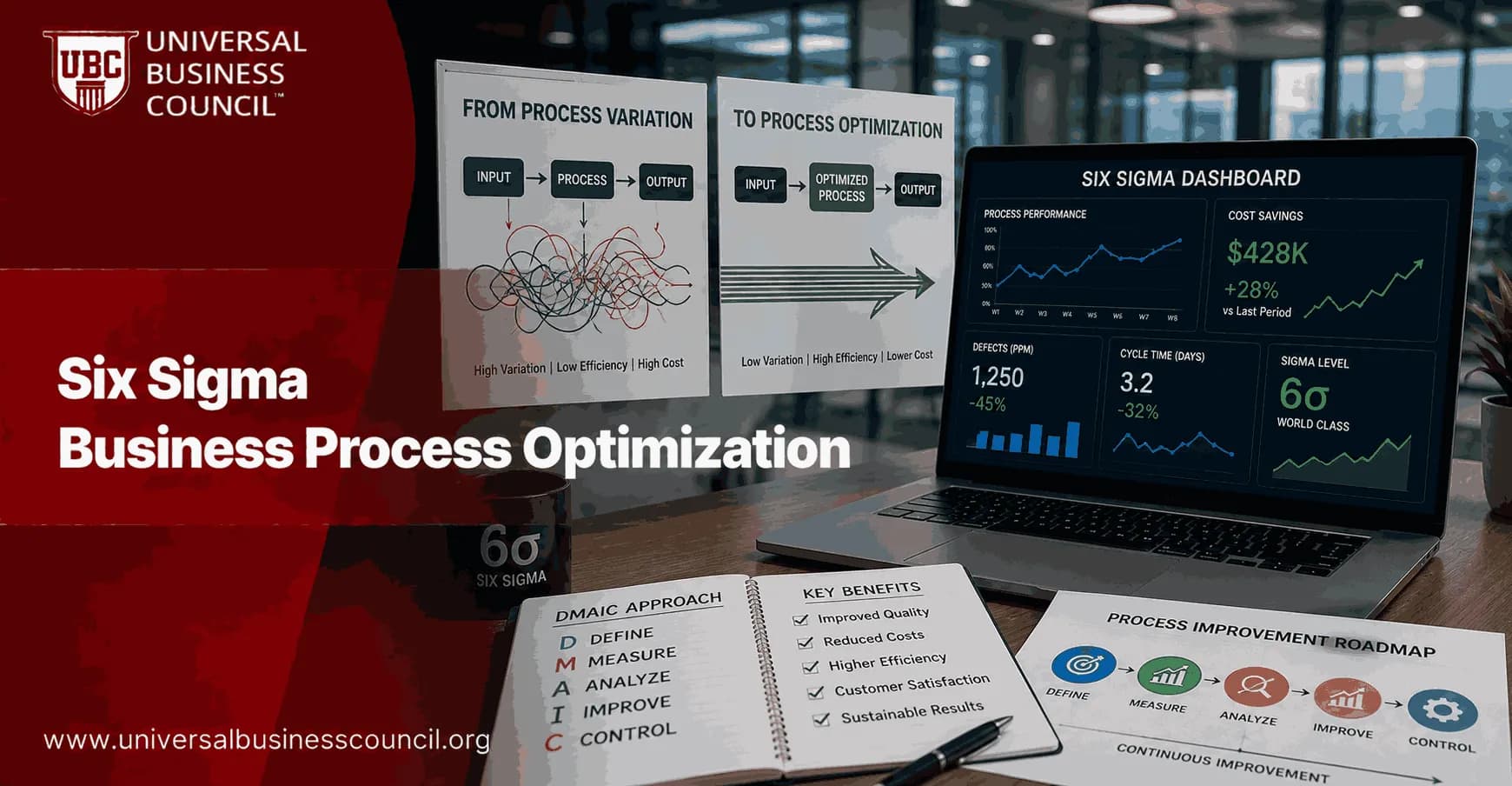
Six Sigma business process optimization works because it forces you to stop guessing. You define the process, measure the gap, find the root cause, improve the flow, and control the result. That sounds simple. It is not. The discipline comes from using real data instead of opinions in the meeting room. Professionals building this discipline often start with a focused credential like the Certified Six Sigma Expert program, since DMAIC fluency is what turns a vague "improve efficiency" goal into a project you can actually measure.
Six Sigma is now used well beyond factory quality teams. Manufacturing, healthcare, logistics, construction, shared services, and digital operations all use it to reduce defects, shorten cycle time, and improve throughput. A 2024 systematic review of Lean Six Sigma in small and medium-sized manufacturers found that most studied projects reduced cycle time and defect rates, and a majority reported cost reductions.

What Six Sigma Business Process Optimization Actually Means
Six Sigma business process optimization is the structured improvement of a process using statistical thinking, customer requirements, and controlled experimentation. The goal is not to make a process look tidy on a flowchart. The goal is measurable performance improvement.
In practical terms, you are usually trying to improve one or more of these metrics:
Cycle time: How long the process takes from start to finish.
Defect rate: How often the output fails to meet requirements.
First pass yield: The percentage completed correctly without rework.
Throughput: How much work the process can complete in a given period.
Cost of poor quality: Scrap, rework, warranty claims, delays, and avoidable labor.
Leadership usually cares less about the tool name and more about whether the project improves margin, service level, risk, or customer retention. Keep that in mind when you write a project charter. Getting leadership to actually sponsor a project on those terms is a stakeholder-management skill as much as a statistical one, which is why process owners often pair Six Sigma training with broader Management Certifications, covering the sponsorship and governance habits that keep a project charter from being ignored the moment priorities shift.
Use DMAIC to Streamline Operations
The core Six Sigma method for existing processes is DMAIC: Define, Measure, Analyze, Improve, and Control. It keeps teams from jumping straight to solutions, which is where many failed improvement projects begin.
1. Define the problem in customer terms
Start with the critical to quality requirements, often called CTQs. A CTQ might be order accuracy, laboratory turnaround time, invoice error rate, software uptime, or delivery reliability. Avoid vague goals like "improve efficiency." Write the business pain clearly.
A better charter statement is: "Reduce average invoice correction time from 6.2 days to under 2 days by the end of Q3." Now you can measure it.
2. Measure the current process
Map the process as it really operates, not how the procedure manual says it works. Then collect baseline data. Use defect counts, lead time, queue time, handoff frequency, and process capability where appropriate.
One detail that trips up certification candidates: Cp and Cpk are not the same. Cp tells you potential capability if the process is centered. Cpk tells you actual capability relative to specification limits. If the process mean drifts toward one limit, Cpk exposes the risk.
3. Analyze root causes
Use tools such as cause and effect diagrams, Pareto analysis, regression analysis, value stream mapping, and hypothesis testing. Do not stop at the first convenient answer.
In warehouse and service processes, a quiet budget killer is internal travel. People often optimize labor schedules while ignoring walking distance, search time, and repeated system lookups. That is not cosmetic. Cut the wasted motion and you change real capacity, not just a spreadsheet number. When that wasted motion traces back to fragmented systems that force repeated lookups across disconnected tools, a Deep Tech Certification from Blockchain Council can help teams understand how integrated, traceable data systems eliminate that kind of redundant work, since the fix is sometimes architectural rather than procedural.
4. Improve the process
Improvement can mean redesigning the sequence, removing non-value-added steps, balancing workloads, using error proofing, changing layout, automating data entry, or standardizing decision rules. Lean Six Sigma adds a strong waste-removal lens, which is why it works well for end-to-end process optimization.
Published galvanizing and metal-finishing case studies have shown large gains in process cycle efficiency and lead time after Lean Six Sigma analysis and targeted changes. That type of result usually comes from fixing flow, not from asking people to "work harder."
5. Control the gains
This is where many teams get lazy. They celebrate the result, close the project, and watch performance slide back within three months.
Use control plans, statistical process control charts, visual management, audit checks, and named process owners. If nobody owns the metric after the project, the improvement is temporary.
Where Lean Six Sigma Fits Best
Lean Six Sigma is the stronger choice when your process has both waste and variation. Use it for order fulfillment, patient flow, production scheduling, claims processing, software support, procurement, and field service.
Classic Six Sigma is especially useful when variation, defects, and process capability are the central problem. Lean tools are better when the process is clogged with queues, excess motion, waiting, and rework loops. In real operations, you often need both.
One warning: do not run a full DMAIC project for every small annoyance. If the fix is obvious, low risk, and reversible, implement it and measure the result. Save DMAIC for problems where the cause is unclear, the cost is material, or the process crosses functions.
New Trends: Digital, Sustainable, and Enterprise-Wide
Modern Six Sigma is moving into real-time data, Industry 4.0 systems, predictive analytics, and digital twins. Recent sustainable Lean Six Sigma research shows growing use of mathematical optimization and multi-criteria decision methods to balance cost, quality, speed, and environmental impact.
This matters because many organizations now need process improvement to support ESG targets as well as financial performance. Energy use, scrap, water consumption, carbon intensity, and resource waste can be added to Six Sigma project scorecards. The hard part is data quality. If sustainability data is collected manually once a quarter, it will not guide daily process control.
How to Build Six Sigma Capability in Your Organization
If you want Six Sigma business process optimization to stick, treat it as a management system, not a workshop topic.
Pick projects tied to business outcomes. Link them to cost, customer experience, compliance, or growth capacity.
Train the right people. Analysts need statistics. Managers need sponsorship skills. Process owners need control discipline.
Use a common project language. DMAIC, CTQs, SIPOC, control charts, and capability analysis should mean the same thing across teams.
Review benefits honestly. Separate hard savings from soft savings. Finance should validate material claims.
Build governance. Track project selection, stage gates, control plans, and post-project performance.
For professionals building formal competence, Universal Business Council's Certified Six Sigma Expert is a relevant learning path. It covers statistical quality management, DMAIC, process capability analysis, risk management, and enterprise process optimization. You can also pair Six Sigma study with related Universal Business Council courses in operations management, analytics, and business management to strengthen cross-functional decision-making.
Next Step: Start With One Process That Hurts
Choose one process with visible pain: late orders, repeated customer complaints, long approvals, lab delays, high rework, or missed service levels. Write a tight problem statement. Measure the baseline for two to four weeks. Then run DMAIC with a small team that actually touches the work.
If you want to lead larger optimization projects, build your statistical and change management skills next. Start with the Certified Six Sigma Expert path, then apply the tools to a real process where the numbers matter. If that process keeps stalling because the systems behind it will not share data reliably, a Tech Certification from Global Tech Council is worth adding to your plan, since some optimization problems need better systems integration, not another DMAIC cycle.
FAQs
1. What is Six Sigma business process optimization?
Six Sigma business process optimization is a data-driven approach to improving workflows by reducing defects, variation, delays, waste, and unnecessary costs. It uses structured methods such as DMAIC to understand how a process currently performs, identify root causes of poor performance, implement improvements, and maintain the results over time.
2. How does Six Sigma help streamline operations?
Six Sigma streamlines operations by identifying activities that create delays, errors, rework, bottlenecks, or little customer value. Teams measure process performance and use data to determine where improvement will have the greatest impact. The objective is not merely to make employees work faster, humanity's traditional answer to everything, but to redesign the process so less unnecessary work exists.
3. What is the role of DMAIC in business process optimization?
DMAIC provides a five-stage framework:
Define: Identify the business problem, customers, scope, and objectives.
Measure: Establish baseline performance and collect reliable data.
Analyze: Determine the root causes of inefficiency and variation.
Improve: Design, test, and implement better processes.
Control: Monitor performance and sustain the improvements.
This structure prevents teams from jumping directly from “we have a problem” to somebody's favorite solution.
4. What processes can be optimized with Six Sigma?
Six Sigma can optimize processes across manufacturing and service organizations, including order fulfillment, procurement, billing, customer onboarding, claims processing, inventory management, production, logistics, customer support, finance, healthcare administration, and IT operations. Any repeatable process with measurable outputs can potentially benefit.
5. How does Six Sigma identify inefficient processes?
Six Sigma teams use process maps, operational data, customer feedback, interviews, observations, and performance metrics to identify inefficiencies. Indicators can include excessive cycle times, high defect rates, repeated approvals, unnecessary handoffs, customer complaints, rework, and inconsistent outputs. Process mining can also reveal how workflows actually operate rather than how procedure documents claim they operate.
6. What Six Sigma tools are used for process optimization?
Common tools include:
SIPOC diagrams
Process maps and flowcharts
Value stream mapping
Pareto charts
Fishbone diagrams
5 Whys analysis
Control charts
Process capability analysis
Failure Mode and Effects Analysis (FMEA)
Design of Experiments (DOE)
The appropriate tool depends on the problem. Deploying every Six Sigma diagram at once does not make a project more scientific.
7. How does process mapping help streamline operations?
Process mapping shows the sequence of activities, decisions, handoffs, inputs, and outputs within a workflow. It helps teams identify duplication, unnecessary approvals, waiting periods, unclear responsibilities, and process loops. A future-state map can then define a simpler workflow with fewer non-value-added activities.
8. How does Six Sigma reduce process cycle time?
Six Sigma reduces cycle time by identifying the causes of waiting, rework, unnecessary movement, inefficient approvals, and inconsistent processing. Teams analyze which steps add customer value and which create delays. Improvements may involve simplifying workflows, removing redundant steps, balancing workloads, standardizing procedures, or introducing automation.
9. How does Six Sigma reduce operational costs?
Six Sigma reduces costs by decreasing defects, rework, scrap, delays, excess inventory, manual processing, and other forms of operational waste. Organizations can measure financial benefits through metrics such as Cost of Poor Quality (COPQ), labor productivity, processing costs, and cost per transaction. Improvements should ultimately produce measurable business value rather than merely prettier process maps.
10. What is the difference between Six Sigma and Lean process optimization?
Six Sigma primarily focuses on reducing defects and process variation, while Lean focuses on eliminating waste and improving flow. Lean Six Sigma combines both approaches. For example, Lean may identify unnecessary waiting and movement, while Six Sigma investigates the statistical causes of inconsistent process performance. Together, they provide a broader optimization framework.
11. How does Six Sigma improve workflow efficiency?
Six Sigma improves workflow efficiency by reducing unnecessary steps, clarifying responsibilities, standardizing work, improving handoffs, and eliminating recurring errors. Better workflow design reduces the amount of effort required to produce the desired output. Organizations can then handle more work without automatically assuming the answer is hiring more people or scheduling more meetings.
12. How does Six Sigma identify process bottlenecks?
Teams can identify bottlenecks by measuring queue lengths, processing times, capacity, utilization, work-in-progress, and waiting times at different stages. Process maps and value stream maps help visualize where work accumulates. Once the constraint is identified, teams can investigate its causes and redesign capacity, sequencing, staffing, or process rules.
13. What KPIs should be used for business process optimization?
Useful KPIs may include:
Cycle time
Lead time
First Pass Yield (FPY)
Defect rate
DPMO
Cost per transaction
Rework rate
Throughput
On-time completion
Customer satisfaction
Process capability
Cost of Poor Quality
The best KPIs connect operational performance with customer and business outcomes.
14. How does Six Sigma improve customer experience?
Process optimization improves customer experience by reducing errors, delays, inconsistent service, and unnecessary customer effort. Voice of the Customer (VOC) analysis helps teams identify what customers actually value. Critical-to-Quality (CTQ) requirements can then translate those expectations into measurable process standards.
15. How can automation support Six Sigma process optimization?
Automation can handle repetitive activities, validate information, route work, trigger alerts, and integrate systems. Robotic process automation, workflow platforms, and AI can improve speed and consistency. However, teams should optimize a process before automating it. Automating unnecessary steps merely allows the organization to perform pointless work faster and with greater technological confidence.
16. How can process mining support Six Sigma optimization?
Process mining uses system event logs to reconstruct actual workflows and identify bottlenecks, deviations, rework loops, and compliance problems. Six Sigma teams can use these insights during the Measure and Analyze phases of DMAIC. Process mining is especially useful for complex digital workflows involving ERP, CRM, financial, or service-management systems.
17. How can AI improve Six Sigma business process optimization?
AI can analyze large datasets, predict process failures, detect anomalies, classify customer issues, and recommend potential improvements. Machine learning can identify complex relationships between process variables and outcomes. Generative AI can also assist with documentation and analysis. AI should support evidence-based improvement rather than become a decorative layer attached to an inefficient process because somebody demanded an “AI strategy.”
18. What are common challenges in Six Sigma process optimization?
Common challenges include poor data quality, unclear process ownership, resistance to change, weak leadership support, excessive project scope, insufficient employee involvement, and failure to sustain improvements. Another frequent problem is optimizing one department while making another department's work worse. End-to-end performance matters more than isolated local efficiency.
19. How can organizations sustain optimized processes?
Organizations can sustain improvements through standardized work, control plans, dashboards, process ownership, employee training, audits, control charts, and regular performance reviews. Teams should define clear response procedures when KPIs move outside acceptable ranges. The Control phase ensures that improvements become normal operations rather than gradually disappearing once the project team moves elsewhere.
20. What is the future of Six Sigma business process optimization?
The future of Six Sigma process optimization will increasingly combine DMAIC with process mining, AI, predictive analytics, automation, digital twins, and real-time performance monitoring. Organizations will move from periodically analyzing inefficient processes toward continuously detecting and correcting performance problems. The underlying principle remains stubbornly sensible: measure how work actually happens, remove what does not create value, reduce harmful variation, and control the improved process so the old problems do not quietly return.
Related Articles
View All
Six Sigma
Six Sigma vs Business Process Management: How They Work Together
Learn how Six Sigma and Business Process Management work together to reduce variation, improve workflows, and sustain process performance.
Six Sigma
Six Sigma in Business Operations: Streamlining Everyday Processes
Learn how Six Sigma in business operations reduces defects, cycle time, and rework in finance, healthcare, service, inventory, and daily workflows.

Six Sigma
Six Sigma Process Optimization: Improving Speed, Quality, and Cost
Learn how Six Sigma process optimization improves cycle time, defect reduction, and cost control across manufacturing, services, healthcare, and government.
Trending Articles
The Role of Blockchain in Ethical AI Development
How blockchain technology is being used to promote transparency and accountability in artificial intelligence systems.
AWS Career Roadmap
A step-by-step guide to building a successful career in Amazon Web Services cloud computing.
Top 5 DeFi Platforms
Explore the leading decentralized finance platforms and what makes each one unique in the evolving DeFi landscape.