

Six Sigma in Software Development: Reducing Defects and Rework
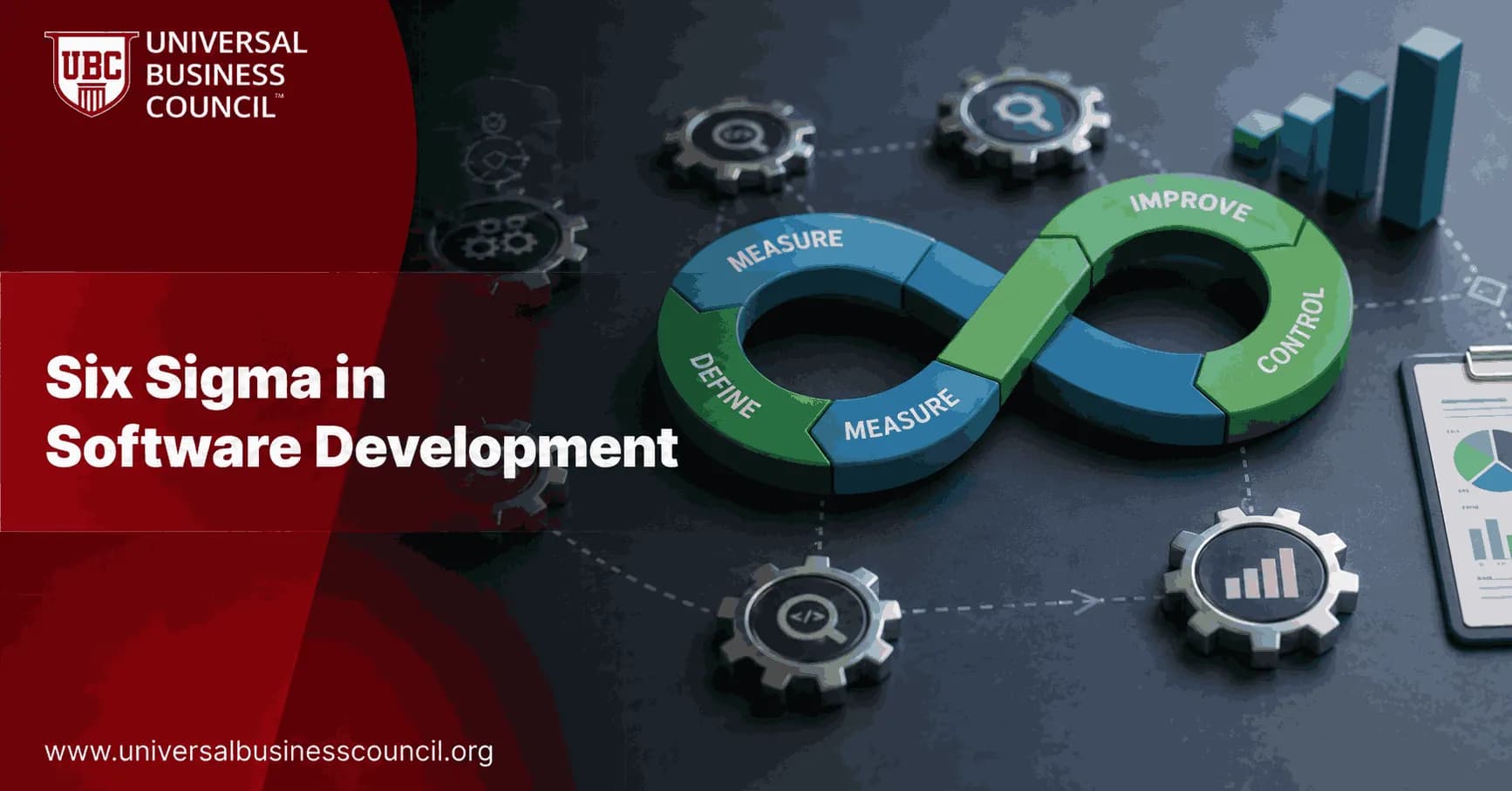
Six Sigma in software development gives teams a practical way to reduce defects, rework, and avoidable support cost without turning engineering into paperwork. The best use is not a heavy quality office sitting outside delivery. It is a measured improvement loop inside the way you already plan, code, test, release, and support software. Engineers and quality leads who want to run this loop properly, rather than just borrow the vocabulary, often start with the Certified Six Sigma Expert credential, which covers the DMAIC discipline this article is built around.
The method matters because software defects are rarely random. They cluster around unclear requirements, fragile interfaces, weak test data, rushed code reviews, and handoffs nobody owns. Six Sigma helps you prove where the waste sits before you ask developers to change how they work.

What Six Sigma Means for Software Teams
Six Sigma is a data-driven quality method aimed at reducing variation and defects. The commonly cited target is about 3.4 defects per million opportunities, or 99.99966 percent accuracy. In software, the point is not to pretend every sprint can hit a manufacturing-style sigma level. The point is to measure defects consistently, find root causes, and prevent repeat failures. Because that effort spans engineering, QA, product, and support all at once, engineering leaders often pair Six Sigma training with broader Management Certifications, since coordinating a quality program across that many functions is as much a leadership skill as a statistical one.
The two most useful approaches are:
DMAIC: Define, Measure, Analyze, Improve, Control. Use it when an existing process is producing too many bugs, slow fixes, or recurring incidents.
Lean Six Sigma: Combine defect reduction with waste removal. This fits software well because rework, waiting, duplicate documentation, and unclear approvals are common sources of delay.
Design for Six Sigma can also help when you are building a new product or service workflow, but for most engineering teams, DMAIC is the better starting point. It is specific. It forces you to measure before acting.
Defects, Rework, and the Cost of Poor Quality
Rework is where software quality problems become expensive. A requirement defect found during backlog refinement may take minutes to correct. The same defect found after release can involve a hotfix, customer communication, regression testing, incident review, and sometimes SLA credits.
Case studies of Lean Six Sigma in software and IT settings report meaningful gains. Teams that moved defect discovery earlier and removed repeated causes have cut rework cost, shortened change request turnaround, and raised early bug detection rates. The pattern is consistent: the sooner you catch a defect, the cheaper it is to fix.
Those results are not magic. They come from moving defect discovery earlier and stopping repeated causes.
Software Metrics That Make Six Sigma Work
You cannot improve what your team records badly. Start with a small metric set that developers will trust.
Core defect metrics
Defect density: Defects per thousand lines of code, often written as defects per KLOC. Useful for comparing modules, not for judging individual developers.
Escaped defects: Bugs found after the phase where they should have been caught, especially after release.
Reopened defect rate: A quiet but revealing metric. If more than about 10 to 15 percent of closed bugs reopen in a sprint, acceptance criteria or fix validation is probably weak.
Mean time to resolve: How long it takes to fix and verify a bug once accepted.
Cost of poor quality: Rework hours, incident response, retesting, support escalations, and missed delivery cost tied to defects.
A practical warning: clean the Jira or Azure DevOps data before you analyze it. I have seen closed issues with blank resolution fields, bugs logged as tasks, and production incidents hidden under generic support tickets. Your Pareto chart will lie if the input data is messy.
How DMAIC Reduces Software Defects
1. Define the real problem
Do not define the project as "improve quality." That is too broad. Define a defect problem in business terms: checkout payment failures, API timeout defects, mobile crash rate, late-cycle requirement changes, or excessive reopened bugs.
2. Measure the baseline
Collect defect counts, severity, source phase, escaped phase, cycle time, and rework effort. For Agile teams, pull data from Jira, GitHub, GitLab, CI pipelines, incident tools, and test automation reports. Keep the measurement period consistent, such as the last six sprints or last quarter.
3. Analyze root causes
Use Pareto analysis first. It usually exposes the few defect categories causing most of the pain. Then use cause-and-effect diagrams, 5 Whys, correlation analysis, or regression where the data supports it. In practice, a Pareto chart on defect type will often point you at two or three categories worth fixing before anything else.
4. Improve upstream controls
The most effective fixes usually happen before system testing. Examples include mandatory code inspection for risky modules, a clearer definition of ready, API contract tests, automated unit and integration tests, better test data, and stricter pull request review for security-sensitive code.
In a typical e-commerce DMAIC project, teams cut system errors and improved checkout response by addressing payment failures, slow response times, application logic issues, thin automated testing, and gaps in real-time monitoring. The wins came upstream, not from testing harder at the end.
5. Control the gains
Control is where many software Six Sigma efforts fail. A dashboard is not enough. Put quality checks into the workflow: CI quality gates, escaped defect reviews, release readiness criteria, and monthly defect trend reviews. If the process depends on one quality manager chasing people, it will fade.
Using Six Sigma with Agile and DevOps
Six Sigma should not replace Agile. Used badly, it slows teams with forms and approval gates. Used well, it strengthens retrospectives and DevOps pipelines with better evidence.
Apply it to the parts of Agile delivery that benefit from stability:
Defect triage and severity classification
Build and deployment failure analysis
Production incident reduction
Backlog refinement quality
Regression testing coverage
Change request turnaround time
Lean Six Sigma also fits ITIL-based software support. Incident and problem management already depend on classification, root cause analysis, service levels, and prevention. Six Sigma adds sharper measurement and a stronger bias toward removing repeat causes. As more of this measurement runs through CI/CD pipelines, automated monitoring, and emerging data platforms, some engineering-quality teams also pair this work with a Deep Tech Certification to build a stronger footing in the technology layer generating that evidence.
When Six Sigma Is the Wrong Tool
Be blunt about the trade-off. Six Sigma is not ideal for a brand-new product team that has not found product-market fit. If requirements change daily and the main risk is building the wrong thing, use discovery practices, user research, and rapid prototyping first.
Six Sigma is strongest when the process repeats often enough to measure: release defects, support tickets, failed deployments, test escapes, onboarding errors, data quality issues, or checkout failures. Repetition gives you the data needed to separate noise from root cause.
Skills Professionals Should Build
If you want to apply Six Sigma in software development, build skills in both quality methods and engineering context. Learn DMAIC, Lean waste analysis, Pareto charts, control charts, root cause analysis, defect density, DPMO, and cost of poor quality. Also learn how teams use Git, CI/CD, automated testing, issue trackers, and monitoring platforms.
Professionals who can translate Six Sigma into software delivery language are far more useful than people who only know the terminology. Pair the quality method with real engineering fluency and you become the person leadership trusts to fix a recurring incident, not just to name it.
Next Step
Pick one defect stream this week. Export the last 90 days of data, classify defects by source and escape point, and build a simple Pareto chart. If one or two categories dominate, you have a DMAIC project worth pursuing. Then strengthen your method through the appropriate Universal Business Council Six Sigma or Lean Six Sigma certification pathway. If your own gap sits more on the engineering side, a general Tech Certification can help round out the CI/CD, testing, and platform skills this kind of DMAIC work depends on.
FAQs
1. How is Six Sigma used in software development?
Six Sigma is used in software development to reduce defects, rework, escaped bugs, process variation, release failures, and avoidable delays. It applies structured methods such as DMAIC, root-cause analysis, process mapping, Pareto analysis, Measurement System Analysis, and statistical techniques to recurring software quality problems.
A typical improvement flow is:
Requirements → Design → Development → Testing → Deployment → Production Support
Six Sigma helps teams determine where defects enter this lifecycle, why they occur, and which changes measurably reduce them.
2. What software development problems can Six Sigma solve?
Six Sigma is particularly useful for recurring and measurable problems such as high defect rates, excessive rework, repeated production incidents, inconsistent testing outcomes, long defect-resolution times, unstable releases, requirement errors, and excessive variation in development cycle time.
It is less useful when teams simply need to explore an uncertain product idea. In those situations, Agile experimentation or product discovery may be more appropriate.
3. How does DMAIC apply to software development?
DMAIC provides a structured framework for improving an existing software-development process.
Define → Measure → Analyze → Improve → Control
During Define, the team identifies the problem and desired outcome. Measure establishes baseline performance. Analyze identifies and validates root causes. Improve introduces solutions. Control ensures that performance remains improved.
For example, a software organization could use DMAIC to reduce production defects from 8% of releases to below 3%.
4. How can Six Sigma reduce software defects?
Six Sigma reduces defects by examining where bugs originate and which factors contribute most strongly to them.
The team might classify defects according to:
Requirements → Architecture → Coding → Integration → Testing → Deployment
Suppose analysis shows that 55% of production defects originate from incomplete requirements and interface-related problems.
Improvement efforts can then focus on those causes rather than simply increasing the amount of testing performed at the end of development.
5. How can Six Sigma reduce software rework?
Rework occurs when completed or partially completed software must be corrected, redesigned, rewritten, or retested.
Six Sigma can quantify the amount of rework and identify its causes.
A useful model is:
Requirements Error → Development → Testing Failure → Rework → Retesting → Release Delay
Preventing the original requirement error can eliminate several downstream activities.
This is generally more efficient than becoming exceptionally good at fixing preventable mistakes.
6. What is a software defect in Six Sigma?
A defect is an outcome that fails to meet a defined customer, technical, security, business, or operational requirement.
Examples include incorrect calculations, broken functionality, failed integrations, security weaknesses, data errors, performance failures, or unsuccessful deployments.
The defect definition should be specific and measurable so teams can consistently determine whether a failure has occurred.
7. What is Defects Per Million Opportunities in software development?
Defects Per Million Opportunities, or DPMO, is a Six Sigma metric used to normalize defect performance against the number of opportunities for defects.
Conceptually:
DPMO = Defects ÷ Total Defect Opportunities × 1,000,000
In software environments, defining a meaningful and consistent “opportunity” can be difficult. Teams should therefore avoid using DPMO mechanically when metrics such as escaped defects, defect density, failure rate, or change failure rate provide a clearer picture of performance.
8. How can Pareto analysis improve software quality?
Pareto analysis helps teams identify the defect categories responsible for the greatest share of failures.
For example, defects might be grouped as:
Requirements 32%
Integration 27%
Coding Logic 18%
Configuration 13%
Other 10%
The team can prioritize requirements and integration problems because together they account for most defects.
This is more useful than distributing improvement effort equally across every possible problem merely in the interests of mathematical democracy.
9. How can root-cause analysis reduce recurring software bugs?
Root-cause analysis investigates why defects repeatedly occur instead of treating each bug as an isolated event.
Methods such as 5 Whys, Fishbone analysis, process mapping, and data analysis can reveal causes involving unclear requirements, architectural weaknesses, insufficient automated testing, configuration differences, poor deployment controls, or inadequate code-review practices.
The objective is to remove systemic causes so the same category of bug becomes less likely to return.
10. How can Six Sigma improve requirements quality?
Requirement defects can create expensive downstream rework because errors discovered late may affect design, development, testing, documentation, and deployment.
Teams can measure requirement-related problems such as ambiguity, incompleteness, conflicting requirements, acceptance-criteria failures, and requirement changes.
Improvements may include clearer acceptance criteria, structured reviews, better stakeholder validation, improved traceability, and earlier technical involvement.
11. How can Six Sigma improve software testing?
Six Sigma can analyze testing effectiveness using measures such as defect detection, escaped defects, test failure patterns, retesting, and defect-removal effectiveness.
Teams can determine which defect categories frequently escape into production and why existing tests fail to detect them.
Validated improvements might include stronger automated tests, improved integration testing, risk-based testing, better test data, earlier testing, or redesigned quality gates.
12. How can Six Sigma reduce escaped defects?
Escaped defects are problems discovered after they pass through earlier development and testing controls.
A team can map:
Defect Introduced → Review → Testing → Release → Production Detection
The investigation should determine both why the defect was introduced and why existing controls failed to detect it.
This distinction matters because merely adding another testing layer may detect more defects without addressing why the development process keeps producing them.
13. How can Six Sigma improve software release quality?
Release quality can be measured using indicators such as production defects, deployment failures, rollback frequency, incidents, recovery time, and customer-reported issues.
Teams can analyze release performance by application, component, team, change type, deployment method, or other relevant factors.
The resulting improvements might involve automated testing, deployment validation, better configuration management, smaller changes, improved observability, or stronger release controls.
14. How can Six Sigma reduce software development cycle time?
Development cycle time can be broken into:
Active Development Time + Waiting + Review + Testing + Rework + Deployment Delay
This decomposition often reveals that actual coding represents only part of total elapsed time.
Teams can then investigate bottlenecks involving approvals, dependencies, test environments, handoffs, queues, or rework.
Reducing these delays can improve delivery speed without simply demanding that developers type code faster, an approach management occasionally rediscovers with surprising confidence.
15. How does Six Sigma work with Agile software development?
Six Sigma and Agile can complement each other.
Agile supports iterative delivery, frequent feedback, and adaptation. Six Sigma provides deeper analysis when recurring process-performance problems cannot be resolved through normal team improvement activities.
A useful model is:
Agile Delivery → Measure Performance → Identify Recurring Problem → DMAIC Analysis → Improvement → Agile Implementation
For example, an Agile team experiencing persistent production defects can use Six Sigma to investigate the causes and then implement validated improvements through its regular backlog.
16. How does Six Sigma work with DevOps?
DevOps emphasizes collaboration, automation, continuous integration, continuous delivery, observability, and operational feedback.
Six Sigma can complement DevOps by analyzing recurring failures across the delivery pipeline.
The combined process can examine:
Code → Build → Test → Deploy → Operate → Monitor
Six Sigma methods can help determine why build failures, deployment problems, incidents, or recovery times vary and which interventions measurably improve performance.
17. What software metrics are useful for Six Sigma projects?
Useful metrics depend on the problem being investigated.
Common measures include defect density, escaped defects, rework percentage, cycle time, lead time, change failure rate, deployment success rate, production incidents, Mean Time to Restore, test effectiveness, and Cost of Poor Quality.
Customer-oriented measures may also include availability, response time, error rates, support contacts, and customer satisfaction.
A project should select metrics connected directly to the improvement goal rather than measuring everything because a dashboard has unused space.
18. How can Six Sigma reduce the Cost of Poor Quality in software?
Software Cost of Poor Quality can include developer rework, repeated testing, production incidents, customer support, refunds, SLA penalties, emergency releases, downtime, and lost productivity.
A simplified model is:
COPQ = Rework + Testing Failures + Incident Costs + Support Costs + Service Failure Costs
Six Sigma can quantify these losses and identify the defect categories responsible for the greatest financial and customer impact.
19. What skills do software professionals need to use Six Sigma?
Software professionals using Six Sigma benefit from knowledge of DMAIC, process mapping, root-cause analysis, measurement, statistical thinking, process capability, FMEA, and change management.
These capabilities become more useful when combined with software engineering, Agile, DevOps, automated testing, CI/CD, observability, data analytics, and secure development practices.
A Six Sigma practitioner does not need to replace software engineers. The methodology works better when analytical improvement expertise and technical domain knowledge are combined.
20. What is the best Six Sigma framework for reducing software defects and rework?
A practical approach starts by identifying a recurring quality problem rather than declaring that the entire software-development lifecycle needs “optimization,” a phrase broad enough to keep consultants occupied until retirement.
Suppose a software organization currently has:
Production Defect Rate: 8.5%
Rework: 21% of Development Capacity
Change Failure Rate: 14%
Average Defect Resolution Time: 3.8 Days
Annual Estimated Cost of Poor Quality: $1.1 Million
The organization identifies escaped production defects as the highest-impact problem.
The team can apply DMAIC.
Define
Establish the problem, customer impact, scope, and improvement objective.
A goal statement might be:
“Reduce escaped production defects by 60% within nine months while maintaining or improving deployment frequency.”
This is important because quality improvement should not automatically require slower delivery.
Measure
Map the development process:
Requirement
↓
Design
↓
Development
↓
Code Review
↓
Testing
↓
Deployment
↓
Production
Collect data on defect origin, detection point, severity, component, development stage, release, and rework.
The team should also establish consistent defect definitions so measurements remain comparable.
Suppose the data shows:
Requirements Defects: 31%
Integration Defects: 29%
Coding Defects: 22%
Configuration Defects: 12%
Other: 6%
Requirements and integration problems therefore account for 60% of defects.
Analyze
The team can investigate these categories using:
Process Mapping → Pareto Analysis → Fishbone → 5 Whys → Statistical Analysis
Suppose deeper analysis identifies three important causes:
Incomplete Acceptance Criteria
Insufficient Integration-Test Coverage
Environment Configuration Differences
The team should validate these relationships with evidence rather than treating workshop hypotheses as established causes.
Improve
The organization can then design targeted changes.
For requirement defects, the improvement may involve clearer acceptance criteria and earlier technical review.
For integration defects, it may involve automated integration testing and improved test environments.
For configuration problems, it may involve infrastructure automation and stronger configuration consistency.
The improvement flow becomes:
Validated Root Cause
↓
Improvement Proposal
↓
Pilot
↓
Measure Results
↓
Scale Successful Change
Suppose the pilot produces:
Production Defect Rate: 8.5% → 3.2%
Rework: 21% → 11%
Change Failure Rate: 14% → 7%
Defect Resolution Time: 3.8 → 2.1 Days
The team now has evidence that the interventions improved performance.
Control
The final stage is preventing regression.
Establish ongoing monitoring for:
Escaped Defects | Rework | Change Failure Rate | Production Incidents | Resolution Time
Integrate the controls into normal engineering workflows rather than creating a parallel quality bureaucracy.
Automated dashboards, CI/CD quality checks, test coverage monitoring, incident reviews, and periodic defect trend analysis can help maintain the gains.
The broader software quality model becomes:
Customer Requirements
↓
Software Development
↓
Automated Quality Controls
↓
Deployment
↓
Production Monitoring
↓
Performance Data
↓
Six Sigma Analysis
↓
Process Improvement
↓
Continuous Delivery
Six Sigma can also be combined with modern software approaches:
Agile + Six Sigma + DevOps + Automated Testing + Observability + Data Analytics
Agile provides iterative delivery and feedback.
DevOps strengthens delivery and operational integration.
Automated testing detects defects earlier.
Observability provides production evidence.
Six Sigma provides structured analysis for persistent performance problems.
The central principle is:
Do not confuse defect detection with defect prevention.
Finding a bug during testing is better than finding it in production.
Preventing the conditions that created the bug is better still.
The objective of Six Sigma in software development is therefore not to create a software factory obsessed with statistical terminology.
It is to help teams understand where defects originate, why rework occurs, which process changes actually improve quality, and whether those gains persist over time.
For software organizations, the ideal outcome is:
Fewer Defects → Less Rework → More Stable Releases → Faster Recovery → Better Customer Experience
That is considerably more useful than celebrating an increasing bug-closure rate while quietly ignoring why the organization keeps producing so many bugs to close.
Related Articles
View All
Six Sigma
Six Sigma in Construction: Reducing Rework and Project Variability
Learn how Six Sigma in construction reduces rework, controls project variability, and improves quality through DMAIC, Lean tools, and site-level data.

Six Sigma
Six Sigma in Manufacturing: Reducing Defects on the Production Floor
Learn how Six Sigma in manufacturing reduces defects, cuts rework, improves DPMO, and strengthens production floor quality through DMAIC and Lean Six Sigma.

Six Sigma
Six Sigma in Customer Service: Reducing Complaints and Response Times
Learn how Six Sigma in Customer Service reduces complaints, wait times, callbacks, and response delays using DMAIC, Lean tools, and measurable CTQ metrics.
Trending Articles
The Role of Blockchain in Ethical AI Development
How blockchain technology is being used to promote transparency and accountability in artificial intelligence systems.
AWS Career Roadmap
A step-by-step guide to building a successful career in Amazon Web Services cloud computing.
Top 5 DeFi Platforms
Explore the leading decentralized finance platforms and what makes each one unique in the evolving DeFi landscape.