

Six Sigma vs Kaizen: Continuous Improvement Approaches Compared
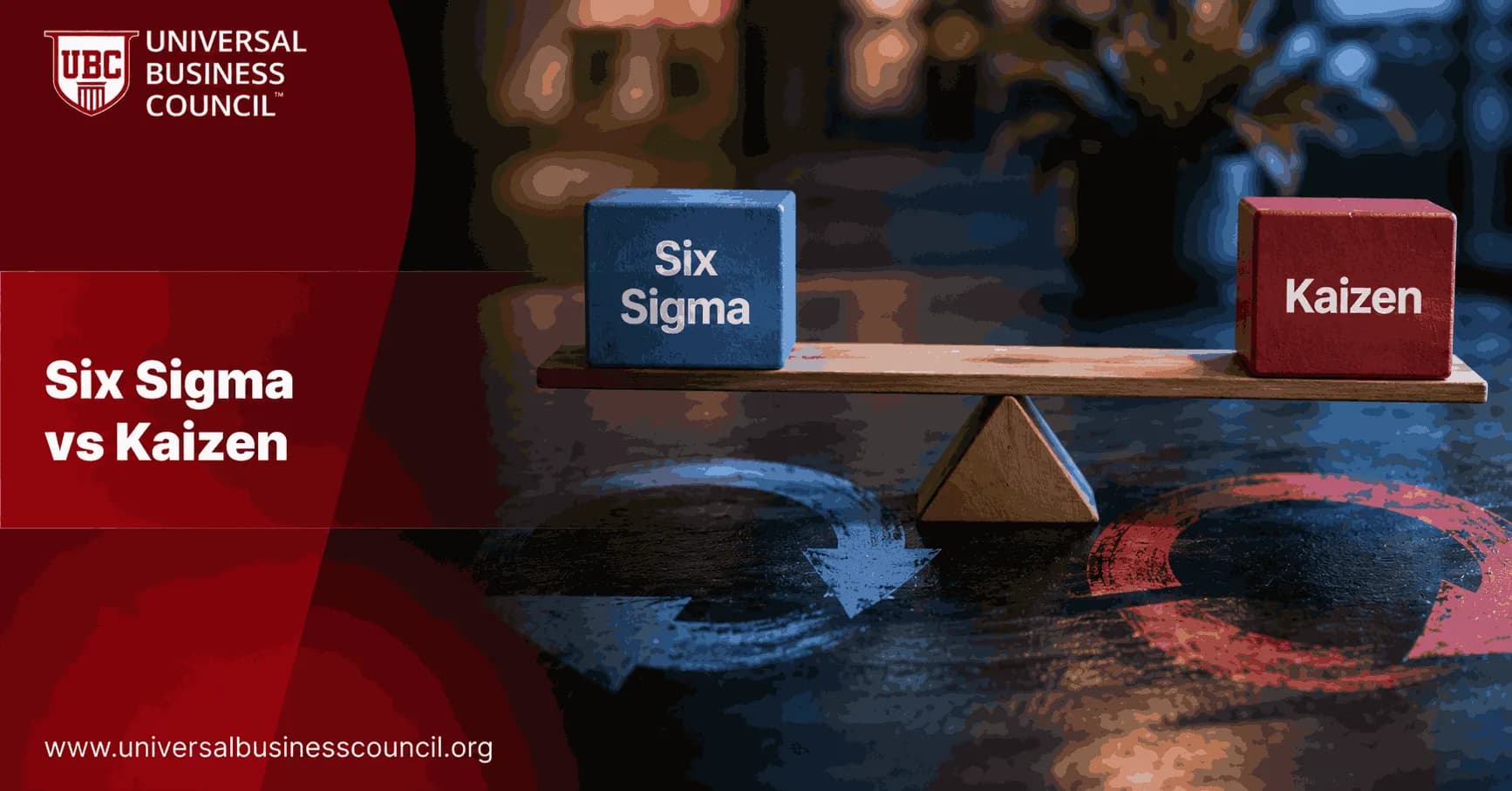
Six Sigma vs Kaizen is not a question of which method is better. It is a question of fit. Use Six Sigma when variation, defects, and measurable risk are hurting performance. Use Kaizen when everyday waste, slow handoffs, and weak improvement habits are holding teams back. Professionals deciding where to build their first skill often start with a focused credential like the Certified Six Sigma Expert program, since it builds the measurement discipline that makes it obvious which of these two problems you are actually looking at.
Both approaches sit at the center of continuous improvement. They share a practical aim: better work, better quality, and fewer headaches for customers and employees. The difference is how they get there.

What Six Sigma Does Best
Six Sigma is a data-driven quality improvement method made famous by Motorola and General Electric. Its core target is often described as about 3.4 defects per million opportunities, a benchmark linked to very high process capability.
The standard Six Sigma framework is DMAIC:
Define the problem, customer requirement, and project scope.
Measure the current process and validate the data.
Analyze root causes of defects or variation.
Improve the process with tested countermeasures.
Control the gains so the process does not drift back.
Six Sigma is strong when the process is measurable and the cost of error is high. Think medication errors, warranty claims, billing defects, loan processing mistakes, or a production line with unstable yield.
Its tools include control charts, hypothesis testing, process capability indices, Pareto analysis, failure mode and effects analysis, and measurement system analysis. That last one catches people out. In many Six Sigma projects, the Measure phase looks clean until someone checks whether two inspectors classify the same defect the same way. Bad data ruins good statistics.
What Kaizen Does Best
Kaizen means "change for better." It became widely known through Toyota and the Toyota Production System, where daily improvement is treated as part of the job rather than a special project.
Kaizen is less about advanced analytics and more about disciplined observation. Go to the place where the work happens. Watch the handoffs. Ask why a form gets retyped into three systems. Fix small irritants before they become accepted waste.
Common Kaizen tools include:
5S for workplace organization and visual order
Gemba walks to observe real work at the source
Kanban to manage flow and work-in-progress
Standard work to make the best known method visible
Visual management so problems can be seen quickly
Kaizen works well in offices, warehouses, clinics, call centers, and production areas where employees can see delays and waste directly. A five-day Kaizen event can remove redundant approvals faster than a formal statistical project ever would. Sometimes the answer is not a regression model. Sometimes it is moving the printer, changing the form, or stopping a pointless status meeting. Getting frontline staff and supervisors to actually own this kind of daily improvement is a leadership skill in its own right, which is why professionals leading Kaizen programs often pair it with broader Management Certifications, covering the coaching and team-leadership habits that keep improvement culture alive after the first Gemba walk.
Six Sigma vs Kaizen: The Core Differences
The practical differences become clear once you look at scope, training, metrics, and culture.
Focus
Six Sigma targets defect reduction, variation control, and measurable quality performance. Kaizen targets continuous incremental improvement and waste removal in daily work.
Style of Change
Six Sigma usually addresses bigger, more complex problems through formal projects. Kaizen favors smaller changes made often, sometimes through short improvement workshops and sometimes through daily team routines.
Who Leads It
Six Sigma is often led by trained Green Belt and Black Belt practitioners, with sponsors and process owners supporting the work. Kaizen is broader. Frontline staff, supervisors, managers, and executives all have a role.
Tools and Data
Six Sigma relies on statistical evidence. Kaizen relies on observation, standardization, and employee involvement. That does not make Kaizen soft. It makes it practical. If a nurse walks 200 extra steps per patient discharge because supplies sit in the wrong area, a Gemba walk may reveal the issue faster than a dashboard.
Time and Cost
Six Sigma projects often run for months and require formal training, project governance, and reliable data systems. Kaizen can start with modest training and leadership commitment. The trade-off is depth. Kaizen is fast, but it may not solve chronic process variation in a regulated or high-risk workflow. When that data infrastructure itself is the bottleneck, teams sometimes need more than statistical training, and a Deep Tech Certification from Blockchain Council can help staff understand how reliable, auditable data systems are actually built, since a Six Sigma project is only as good as the data feeding it.
When to Use Six Sigma
Choose Six Sigma when you can answer yes to most of these questions:
Is the problem costly, recurring, and measurable?
Do you need to reduce defects, errors, or variation?
Is there enough process data to analyze causes properly?
Would a wrong fix create safety, compliance, or customer risk?
Does leadership support a project that may take several months?
Six Sigma is the better fit for warranty reduction, lab turnaround accuracy, payment processing errors, claims defects, and manufacturing yield issues. For professionals building this capability, connect this topic to Universal Business Council resources in the Six Sigma category and related process improvement certification pathways.
When to Use Kaizen
Choose Kaizen when the problem is visible, local, and tied to daily work. It is ideal when teams are frustrated by waiting, rework, clutter, unclear responsibilities, or needless movement.
Kaizen is also the better starting point when an organization has a weak improvement culture. To be blunt, a Black Belt project will struggle if employees think improvement is something done to them. Kaizen builds ownership first.
Use Kaizen for:
Reducing handoffs in administrative workflows
Improving patient or customer flow
Organizing work areas with 5S
Shortening meeting-heavy approval processes
Creating standard work for repeated tasks
Can You Combine Six Sigma and Kaizen?
Yes, and many organizations should. Lean Six Sigma programs often use Kaizen to build daily improvement habits while reserving DMAIC for the hard problems that need statistical analysis.
A useful rule is simple: use Kaizen to improve the work people can see, and use Six Sigma to solve the variation people cannot explain without data.
Take a call center. It might use Kaizen to simplify after-call documentation and cut wasted clicks. If first-call resolution still varies sharply by queue, customer type, or agent group, a Six Sigma project can test the drivers with better data.
Common Mistakes to Avoid
Using Six Sigma for everything: Not every problem deserves a full DMAIC project.
Treating Kaizen as a suggestion box: Ideas need follow-through, standards, and leader coaching.
Skipping measurement: Even Kaizen needs baseline and follow-up metrics such as cycle time, lead time, rework, and employee participation.
Ignoring control: Improvements fade when no one owns the new standard.
The Practical Verdict
Six Sigma vs Kaizen should be decided by the problem, not by preference. If defects, variation, and risk dominate, use Six Sigma. If waste, engagement, and daily flow are the issue, use Kaizen. If you lead operations, quality, service delivery, or transformation work, learn both.
Your next step: map one current problem. If it needs statistical proof, build DMAIC skills through a Six Sigma learning path. If it needs team ownership and faster daily fixes, start with Kaizen routines, Gemba walks, and standard work. And if the recurring waste or delay keeps tracing back to clunky systems or manual data handling rather than habits alone, a Tech Certification from Global Tech Council is worth adding to the plan, since some daily friction needs a systems fix, not another Gemba walk.
FAQs
1. What is the difference between Six Sigma and Kaizen?
Six Sigma is a structured, data-driven methodology used to reduce defects, control variation, and improve measurable process performance. Kaizen is a continuous improvement philosophy focused on making frequent, incremental improvements involving employees across the organization.
A simple distinction is:
Six Sigma → Structured improvement projects
Kaizen → Continuous everyday improvement
Both aim to improve quality, efficiency, cost, and customer value, but they operate differently.
2. What is Six Sigma?
Six Sigma is a process improvement methodology that uses data, root-cause analysis, statistical methods, and structured project management to improve performance.
Its best-known framework is DMAIC:
Define → Measure → Analyze → Improve → Control
Six Sigma is particularly useful when organizations face recurring defects, excessive variation, high Cost of Poor Quality, inconsistent cycle times, or other complex problems whose causes are not immediately clear.
3. What is Kaizen?
Kaizen is a Japanese management philosophy centered on continuous improvement through many small, ongoing changes.
Rather than waiting for a major transformation project, Kaizen encourages employees to identify waste, simplify work, improve safety, reduce delays, and make processes better as part of everyday operations.
The emphasis is on participation, discipline, learning, and sustained improvement over time.
4. Is Kaizen the same as Six Sigma?
No.
Both are process improvement approaches, but their methods differ.
Kaizen emphasizes frequent incremental improvements and broad employee participation.
Six Sigma typically uses trained practitioners, defined projects, measurable goals, deeper data analysis, and structured methods such as DMAIC.
An organization can use Kaizen for everyday improvements and Six Sigma for more complex performance problems.
5. Which is better: Six Sigma or Kaizen?
Neither is universally better.
Choose Kaizen when the organization needs frequent, low-risk improvements that employees can identify and implement relatively quickly.
Choose Six Sigma when the problem is important, recurring, measurable, and complex enough to require deeper analysis.
The best organizations often use both.
The question is not which method wins. It is which method matches the problem without requiring a committee to debate methodology for longer than the problem has existed.
6. What kinds of problems are best suited for Kaizen?
Kaizen is well suited to problems such as:
Unnecessary movement
Small delays
Workplace organization issues
Repetitive inefficiencies
Simple quality problems
Poor visual management
Minor workflow bottlenecks
Standardization opportunities
These issues often have relatively visible causes and can be improved through employee participation and rapid experimentation.
7. What kinds of problems are best suited for Six Sigma?
Six Sigma is particularly useful when:
The problem is recurring.
The business impact is significant.
Performance can be measured.
Root causes are unclear.
Variation or defects are substantial.
Examples include high defect rates, inconsistent delivery performance, excessive rework, recurring transaction failures, or quality problems involving several interacting variables.
8. How does Kaizen differ from DMAIC?
Kaizen usually focuses on continuous incremental improvement without requiring a formal five-phase analytical structure.
Six Sigma DMAIC follows:
Define → Measure → Analyze → Improve → Control
DMAIC is more structured and generally involves deeper measurement and validation.
Kaizen may solve a visible workflow problem quickly, while DMAIC is better suited to situations where the process problem is measurable but the actual cause remains uncertain.
9. Does Kaizen use data like Six Sigma?
Yes, but usually with less statistical depth.
Kaizen teams may use:
Check sheets
Visual boards
Process measures
Pareto charts
Before-and-after comparisons
Cycle-time data
Defect counts
Six Sigma may add advanced methods such as:
Process capability analysis
Hypothesis testing
Regression
Measurement System Analysis
Design of Experiments
The amount of analysis should match the complexity of the problem.
10. How does employee involvement differ between Kaizen and Six Sigma?
Kaizen emphasizes broad employee participation.
Frontline workers are encouraged to identify and implement improvements because they often understand day-to-day process problems best.
Six Sigma uses more formal roles such as Green Belts, Black Belts, Master Black Belts, Champions, and project teams.
Employees can participate in both approaches, but Kaizen generally places stronger emphasis on continuous organization-wide involvement.
11. What is a Kaizen event?
A Kaizen event is a focused, short-duration improvement effort in which a cross-functional team analyzes a process and implements changes rapidly.
A typical event may involve:
Understand Current State → Identify Waste → Design Improvement → Test → Standardize
Kaizen events can produce faster improvements than a full Six Sigma project when the problem is sufficiently understood and does not require extensive statistical investigation.
12. What is the difference between a Kaizen event and a Six Sigma project?
A Kaizen event is typically shorter and focused on rapid improvement of a defined process.
A Six Sigma project generally lasts longer and may require data collection, measurement validation, root-cause analysis, statistical testing, pilot improvements, and control planning.
A useful distinction is:
Known problem + visible causes → Kaizen may work well
Complex problem + uncertain causes → Six Sigma may be stronger
13. How do Six Sigma and Kaizen approach waste?
Kaizen often focuses directly on removing waste from everyday work.
Common forms of waste may include waiting, unnecessary movement, excess inventory, rework, overprocessing, and unused employee capability.
Six Sigma focuses more heavily on defects and variation, although it can also reduce waste.
When waste is the dominant problem, Kaizen or Lean methods may provide a faster path.
14. How do Six Sigma and Kaizen approach standardization?
Both value standardization, but in different ways.
Kaizen often follows the idea that an improvement should become the new standard before further improvement occurs.
Six Sigma uses the Control phase to stabilize improved performance through standard work, control plans, monitoring, and ownership.
In both methods:
Improvement without standardization = temporary improvement
Which is how organizations end up solving the same problem every eighteen months with suspiciously familiar slides.
15. Can Six Sigma and Kaizen be used together?
Yes.
A practical model is:
Daily Problems → Kaizen
Complex Performance Problems → Six Sigma
For example, employees may use Kaizen to reorganize tools and eliminate unnecessary movement.
If defect rates remain high despite these changes, a Six Sigma project can investigate deeper process variables.
This allows organizations to combine broad participation with rigorous analysis.
16. Is Kaizen part of Lean Six Sigma?
Kaizen is commonly associated with Lean thinking and continuous improvement and can be used within a Lean Six Sigma environment.
Lean Six Sigma combines waste reduction with variation and defect reduction.
A typical improvement system may use:
Kaizen → Small, rapid improvements
Lean → Flow and waste reduction
Six Sigma → Variation and defect reduction
These approaches can reinforce one another when applied appropriately.
17. Which certification is better for a career: Six Sigma or Kaizen?
Six Sigma generally has a more established professional certification structure through Yellow Belt, Green Belt, Black Belt, and Master Black Belt levels.
Kaizen education and certifications also exist, but career requirements vary widely by industry and provider.
Professionals in operations, manufacturing, quality, supply chain, and operational excellence can benefit from understanding both approaches rather than treating them as competing credentials.
18. Which is better for manufacturing: Six Sigma or Kaizen?
Both are highly relevant.
Kaizen works well for frequent shop-floor improvements, standardization, visual management, waste reduction, and employee participation.
Six Sigma is stronger when manufacturers face complex problems involving defects, yield, variation, process capability, or high Cost of Poor Quality.
Manufacturing organizations often combine Kaizen, Lean, and Six Sigma within one continuous improvement system.
19. Which is better for service industries: Six Sigma or Kaizen?
Both can work effectively in service environments.
Kaizen can improve office workflows, customer service, healthcare processes, banking operations, logistics, and administrative work through frequent small improvements.
Six Sigma can address larger measurable problems such as transaction errors, claims-processing variation, long customer wait times, or inconsistent service quality.
The method should fit the problem rather than the industry label.
20. How should an organization choose between Six Sigma and Kaizen?
Start with the nature of the problem.
If the problem is small, visible, and relatively easy to understand, Kaizen may be the more efficient approach.
For example:
Problem: Employees walk repeatedly between two workstations.
Cause: Poor workstation layout.
Action: Redesign the layout.
A full Six Sigma project would probably be unnecessary.
Now consider another problem:
Problem: Product defect rate is 7.5%.
Target: Below 2%.
Possible Causes: Machine settings, supplier variation, operator methods, material quality, temperature, measurement error.
The root cause is unclear.
This is a stronger candidate for Six Sigma DMAIC.
The team can follow:
Define
Establish the problem, scope, customer impact, and business objective.
Measure
Validate data and establish baseline performance.
Analyze
Determine which factors actually drive defects.
Improve
Test and implement validated solutions.
Control
Monitor the improved process and prevent regression.
A practical decision framework is:
Situation | Kaizen | Six Sigma |
|---|---|---|
Small improvement | Strong fit | Usually unnecessary |
Visible root cause | Strong fit | May be excessive |
Employee-led improvement | Strong fit | Can support |
Rapid implementation | Strong fit | Moderate |
Complex defect problem | Limited | Strong fit |
Statistical analysis | Limited | Strong fit |
Process variation | Moderate | Strong fit |
Daily continuous improvement | Strong fit | Limited |
Cross-functional project | Can support | Strong fit |
Formal control plan | Can support | Strong fit |
The strongest enterprise model often looks like:
Kaizen Culture
↓
Daily Small Improvements
↓
Performance Monitoring
↓
Complex Problem Identified
↓
Six Sigma DMAIC
↓
Validated Improvement
↓
New Standard
↓
Continue Kaizen
This creates a useful cycle.
Kaizen prevents employees from waiting for formal projects before improving obvious problems.
Six Sigma prevents teams from guessing their way through difficult problems that require evidence.
For professionals, a strong improvement skill stack can be:
Kaizen + Lean + Six Sigma + Data Analysis + Change Management
At leadership level, add:
Strategy + Financial Analysis + Coaching + Portfolio Management
The clearest distinction remains:
Kaizen asks: “What small improvement can we make now?”
Six Sigma asks: “Why is this important process failing, and what evidence proves how to improve it?”
Use Kaizen for continuous everyday improvement.
Use Six Sigma for complex measurable problems requiring deeper analysis.
Use both when the goal is to build an organization capable of improving constantly while still knowing when a problem deserves more than sticky notes and optimism.
That combination is usually more useful than insisting every improvement initiative wear the same methodological uniform.
Related Articles
View All
Six Sigma
Six Sigma vs Scrum: Quality Improvement and Iterative Delivery Compared
Six Sigma vs Scrum explained for professionals comparing quality improvement, defect reduction, Agile delivery, certification paths, and hybrid use cases.
Six Sigma
Six Sigma vs Process Improvement: Is Six Sigma the Same Thing?
Six Sigma is a structured process improvement method, not a synonym for process improvement. Learn when to use Six Sigma, Lean, Kaizen, or simpler workflow fixes.
Six Sigma
Six Sigma vs Agile: Which Improvement Method Fits Your Team?
A practical guide to Six Sigma vs Agile, showing when to use each method, when to combine them, and how to choose based on your team's work.
Trending Articles
The Role of Blockchain in Ethical AI Development
How blockchain technology is being used to promote transparency and accountability in artificial intelligence systems.
AWS Career Roadmap
A step-by-step guide to building a successful career in Amazon Web Services cloud computing.
Top 5 DeFi Platforms
Explore the leading decentralized finance platforms and what makes each one unique in the evolving DeFi landscape.