

Six Sigma vs Agile: Which Improvement Method Fits Your Team?
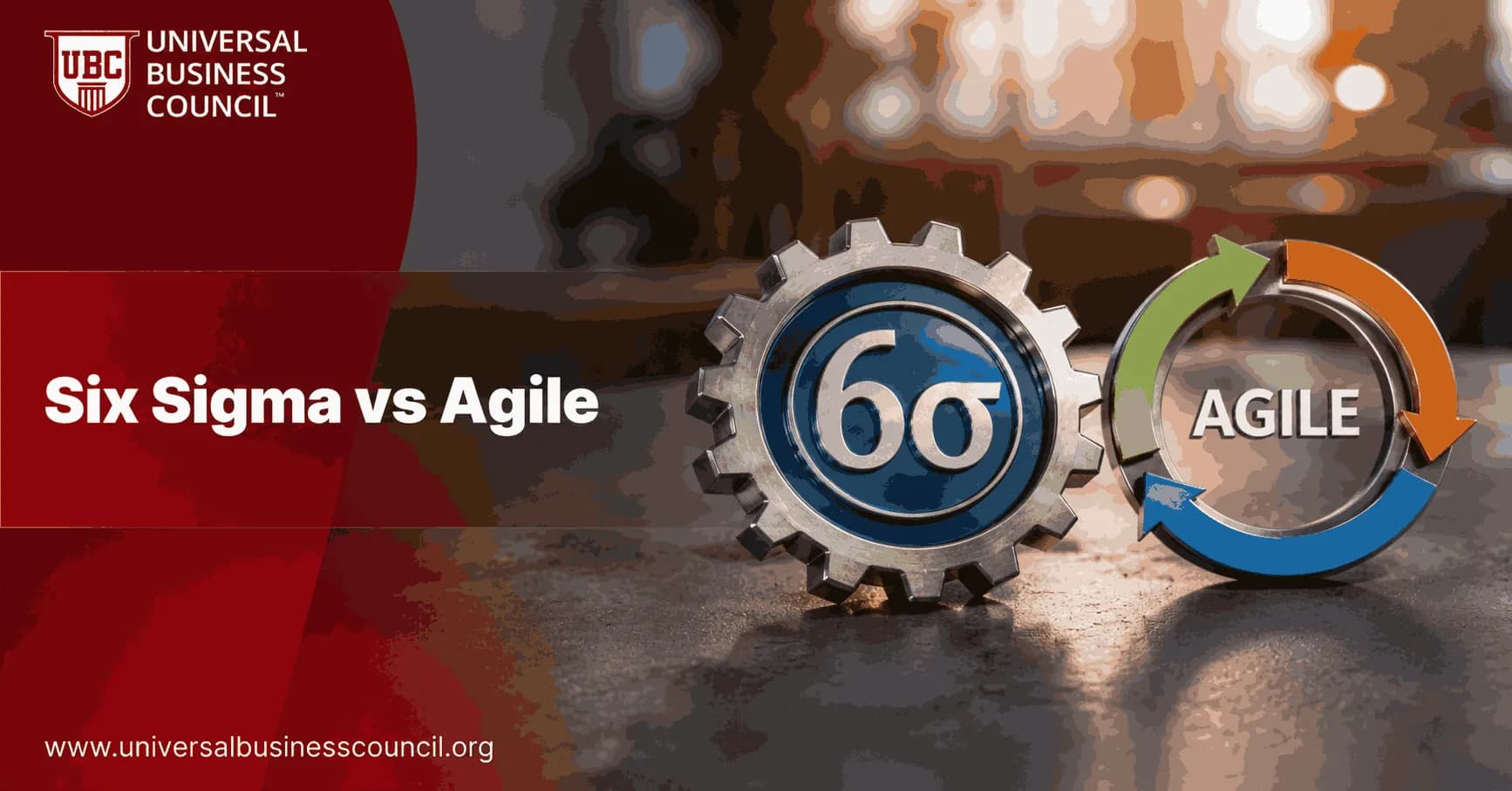
Six Sigma vs Agile is not a contest between old and new management thinking. It is a choice about the work in front of you. If your team is building something under changing requirements, Agile usually fits. If your team is fixing a repeatable process that keeps producing defects, delays, or rework, Six Sigma is the sharper tool. Professionals sorting out which discipline to invest in first often start with a focused credential like the Certified Six Sigma Expert program, since knowing how to measure and diagnose a process is what makes the Agile-versus-Six-Sigma choice easy to make correctly.
The practical answer for many teams is a hybrid. Use Agile to deliver and learn quickly. Use Six Sigma when recurring problems need measurement, root-cause analysis, and control.

What Six Sigma Does Best
Six Sigma is a data-driven process improvement method built around DMAIC: Define, Measure, Analyze, Improve, and Control. The American Society for Quality describes Six Sigma as a method for reducing variation and defects through disciplined statistical analysis.
That matters when the cost of inconsistency is high. Think manufacturing scrap, billing errors, claim rework, order delays, compliance failures, or customer support queues with unpredictable response times.
Use Six Sigma when you need control
The process already exists: You can map it, measure it, and identify where it breaks.
Defects are measurable: Error rates, cycle time, first-contact resolution, rework, and cost of poor quality can be tracked.
Variation is the enemy: The goal is not creativity. The goal is repeatability.
Compliance matters: Documentation, validation, and audit trails are part of the work.
A common mistake is starting a Six Sigma project before the team has a clean operational definition of the defect. If one manager counts a reopened ticket as a defect and another counts only a customer escalation, your baseline is already contaminated. Fix that first.
What Agile Does Best
Agile is an iterative delivery approach rooted in the Agile Manifesto, which values working solutions, customer collaboration, and response to change. Scrum teams often work in 1-4 week sprints. Kanban teams manage flow continuously through visible work queues.
Agile fits when the team cannot know the final answer upfront. Product features, software releases, digital services, and internal technology projects often need short feedback loops because users change their minds once they see a working version. That is normal. Plan for it.
Use Agile when you need learning speed
Requirements change often: Stakeholders are still discovering what they need.
Customer feedback is frequent: Reviews, demos, prototypes, and usability tests shape the work.
Delivery can be incremental: You can ship useful pieces rather than wait for a perfect final release.
Team autonomy is real: Agile fails when every decision waits for a steering committee.
To be blunt, Agile is often overused. A daily stand-up does not make a team Agile. Neither does a board full of tickets. If your team ships fast but repeats the same production incident every month, you do not have an Agile problem. You have a quality problem. Leading either style of team well is ultimately a management skill, not just a framework choice, which is why professionals rounding out this side of their capability often look at broader Management Certifications, covering the leadership and team-operating skills that decide whether Agile or Six Sigma actually sticks.
Six Sigma vs Agile: The Core Difference
The cleanest way to decide is this: Agile helps you find and deliver the right solution. Six Sigma helps you stop a known process from failing.
Dimension | Agile | Six Sigma |
Primary goal | Adapt and deliver quickly | Reduce defects and variation |
Best work type | Exploratory product or software work | Repeatable operational processes |
Cadence | Short sprints or continuous flow | Structured projects, often over months |
Evidence style | Customer feedback, team insight, delivery metrics | Baseline data, statistical analysis, control charts |
Documentation | Lightweight and useful | Detailed enough to sustain control |
Where a Hybrid Works Better
Most modern organizations should stop asking whether Agile or Six Sigma is better in general. Ask where each one belongs in the operating system of the team.
For example, a software support team might use Kanban to manage incoming work, limit work in progress, and improve flow. If the same defect category keeps appearing after every release, the team can run a focused DMAIC effort inside its existing cadence. Define the defect. Measure its frequency. Analyze the root cause. Test a fix during a sprint. Add a control, such as a release checklist, dashboard, or automated test.
This avoids the classic failure mode: a separate improvement program that no one has time to attend. When the recurring defect turns out to live in the underlying platform, such as an unreliable deployment pipeline or a fragile integration layer, a Deep Tech Certification from Blockchain Council can help teams understand the distributed systems and architecture patterns behind that kind of failure, since a control chart alone will not fix a structurally weak system.
Practical hybrid pattern
Start with a real business problem: Use a SIPOC diagram or project charter to define scope, customers, inputs, outputs, and success metrics.
Measure the baseline: Track cycle time, escaped defects, queue length, rework, NPS, or cost of poor quality.
Put improvement work on the board: Treat root-cause analysis and experiments as visible work, not side tasks.
Use retrospectives for evidence: Discuss both team observations and quantitative results.
Control what works: Update working agreements, standard operating procedures, dashboards, or automated checks.
How to Choose for Your Team
Use this decision guide before you choose a method, train a team, or sponsor a project.
Choose Agile if:
You are building a new product, feature, platform, or service.
User needs are uncertain or changing.
Fast feedback is more valuable than full upfront specification.
Your main metrics are lead time, deployment frequency, customer adoption, and sprint goals.
Choose Six Sigma if:
The process is already running and produces measurable defects.
You need lower variation, fewer errors, or reduced cost.
Leadership cares about defect rate, yield, SLA performance, rework, or compliance evidence.
The fix must last after the project team moves on.
Choose a hybrid if:
You deliver in Agile cycles but recurring quality problems slow the team down.
You run operations where demand changes daily but the workflow still needs standardization.
You need both speed and proof, especially in regulated digital environments.
Skills Professionals Should Build Next
If you manage delivery teams, learn Agile practices deeply enough to run planning, reviews, retrospectives, and flow metrics without turning them into theater. If you manage operations, build Six Sigma capability around DMAIC, process mapping, voice of customer analysis, and control plans.
Universal Business Council readers can connect this topic to related Six Sigma certification courses, Agile project management training, business analysis programmes, and management certification pathways. The strongest professionals are not loyal to one method. They are precise about the problem.
Your next step: take one recurring issue from your team this week. If the question is what should we build next, run it through Agile discovery and delivery. If the question is why does this keep failing, frame it as a Six Sigma DMAIC project and start measuring the baseline. If the baseline keeps pointing back to tooling, infrastructure, or platform limits rather than process discipline, a Tech Certification from Global Tech Council is worth adding to your plan, since some recurring failures need an engineering fix, not another retrospective.
FAQs
1. What is the difference between Six Sigma and Agile?
Six Sigma is a structured, data-driven methodology focused on improving process performance, reducing defects, and controlling variation. Agile is a broader set of principles and practices designed to help teams deliver value iteratively, respond to change, and learn through frequent feedback.
A simple distinction is:
Six Sigma → Improve process capability and consistency
Agile → Adapt and deliver incrementally
They solve different kinds of problems and can be used together.
2. What is Six Sigma?
Six Sigma is a process-improvement methodology that uses data, root-cause analysis, and statistical tools to improve measurable outcomes.
Its best-known framework is DMAIC:
Define → Measure → Analyze → Improve → Control
Six Sigma is especially useful when organizations face recurring defects, excessive variation, rework, high Cost of Poor Quality, inconsistent cycle times, or other performance gaps whose causes are not obvious.
3. What is Agile?
Agile is an umbrella term for approaches that emphasize customer value, collaboration, iterative delivery, feedback, and responsiveness to change.
Agile principles are commonly applied in software and product development, but adaptive ways of working are also used in marketing, operations, innovation, and other knowledge-intensive environments.
Frameworks and methods associated with Agile include Scrum, Kanban, and Extreme Programming.
4. Is Agile a process improvement methodology like Six Sigma?
Not in exactly the same sense.
Agile supports continuous learning and adaptation, which can improve how teams work, but it is not primarily a statistical process-improvement methodology.
Six Sigma is specifically designed to investigate measurable process problems and reduce variation or defects.
Agile helps teams adapt their product and working methods.
Six Sigma helps teams prove why a process performs poorly and what change improves it.
5. Which is better: Six Sigma or Agile?
Neither is universally better.
Use Six Sigma when the main challenge is:
Recurring defects
Process variation
Quality problems
Rework
High costs
Unknown root causes
Process capability
Use Agile when the main challenge is:
Changing requirements
Product uncertainty
Rapid feedback
Incremental delivery
Customer learning
Cross-functional collaboration
The correct choice depends on the problem rather than which methodology appears more fashionable on conference slides.
6. What is the difference between DMAIC and Agile iterations?
DMAIC structures a process-improvement investigation:
Define → Measure → Analyze → Improve → Control
Agile iterations or delivery cycles typically involve:
Plan → Build → Review → Learn → Adapt
DMAIC emphasizes understanding causes and validating improvements.
Agile emphasizes short feedback loops and adapting based on what teams learn.
A Six Sigma project may use iterative experiments during Improve, while an Agile team may use analytical tools when recurring process problems emerge.
7. Can Six Sigma and Agile be used together?
Yes.
An Agile team may identify a recurring performance problem that ordinary retrospectives do not resolve. Six Sigma can then provide deeper root-cause analysis.
The validated improvement can be introduced through Agile iterations.
A practical model is:
Agile Delivery → Performance Problem → Six Sigma Analysis → Improvement Work → Agile Implementation → Measurement
This allows organizations to combine adaptability with analytical rigor.
8. How do Six Sigma and Agile approach customer needs?
Both are customer-oriented, but their mechanisms differ.
Six Sigma can use Voice of the Customer and Critical-to-Quality requirements to translate customer expectations into measurable process metrics.
Agile uses frequent customer or stakeholder feedback, incremental delivery, and prioritization to refine what teams build.
Six Sigma asks, “What measurable quality requirement matters?”
Agile asks, “What should we learn and deliver next?”
9. How do Six Sigma and Agile use data differently?
Six Sigma typically relies heavily on quantitative process data.
Practitioners may analyze:
Defect rates
Variation
Cycle time
Process capability
Control charts
Hypothesis tests
Regression
Experimental data
Agile teams may use delivery and product metrics such as lead time, cycle time, usage, outcomes, feedback, and throughput.
The statistical depth is usually greater in Six Sigma.
10. Which is better for software teams: Agile or Six Sigma?
Agile is generally more directly suited to software and product development because requirements can change and learning occurs throughout delivery.
Six Sigma can still be valuable for recurring operational or engineering problems such as:
Escaped Defects → Incident Resolution → Deployment Failures → Test Process Variation → Support Delays
The better method depends on whether the problem is primarily about product uncertainty or process performance.
11. Which is better for manufacturing: Six Sigma or Agile?
Six Sigma is usually more directly applicable to repeatable manufacturing processes involving quality, defects, yield, scrap, process capability, and variation.
Agile can still help in product development, engineering, innovation, and digital initiatives within manufacturing organizations.
A manufacturer may therefore use Six Sigma on the factory floor and Agile in software or product-development teams without causing a methodological constitutional crisis.
12. How do Agile and Six Sigma handle change differently?
Agile assumes that change is normal and builds frequent adaptation into the delivery model.
Six Sigma treats change as an improvement intervention that should be supported by evidence and measured against baseline performance.
Agile emphasizes flexibility under uncertainty.
Six Sigma emphasizes validated change under measurable process conditions.
Both approaches value learning, but they structure it differently.
13. What roles are common in Agile and Six Sigma?
Agile roles vary by framework. Scrum, for example, defines a Product Owner, Scrum Master, and Developers.
Six Sigma commonly uses roles such as:
Champion → Master Black Belt → Black Belt → Green Belt → Team Members
Agile roles tend to focus on product value, team effectiveness, and delivery.
Six Sigma roles tend to focus on improvement expertise, project leadership, and statistical problem solving.
14. What tools are used in Six Sigma compared with Agile?
Six Sigma tools may include:
SIPOC
Process mapping
Pareto analysis
Fishbone diagrams
FMEA
Control charts
Process capability analysis
Hypothesis testing
Regression
Design of Experiments
Agile teams may use:
Product backlogs
User stories
Kanban boards
Iteration planning
Reviews
Retrospectives
Delivery metrics
Continuous integration practices
The tools reflect different objectives.
15. Can Agile replace Six Sigma?
No.
Agile may help teams continuously improve through frequent reflection and adaptation, but it does not replace Six Sigma's deeper analytical methods for process variation and defect reduction.
If an Agile team has a recurring production defect problem with unclear causes, a retrospective may identify hypotheses. Six Sigma can provide a more rigorous method for validating them.
16. Can Six Sigma replace Agile?
No.
Six Sigma does not provide a complete framework for adaptive product development under changing requirements.
A team building a new digital product may need rapid experimentation, frequent releases, and customer feedback rather than a large process-improvement project.
Trying to use full DMAIC for every uncertain product decision would produce impressive documentation and possibly very little product.
17. Which certification is better for a career: Agile or Six Sigma?
It depends on the career path.
Agile-related credentials can be relevant for:
Product Development + Software + Delivery + Scrum + Agile Coaching
Six Sigma credentials may be more relevant for:
Operations + Manufacturing + Quality + Supply Chain + Continuous Improvement + Operational Excellence
Professionals working in digital transformation may benefit from knowledge of both because transformation often involves both iterative delivery and process redesign.
18. Can Agile teams benefit from Six Sigma skills?
Yes.
Six Sigma can help Agile teams investigate recurring issues involving defects, lead time, rework, support performance, or release reliability.
Useful skills include:
Root-Cause Analysis + Process Mapping + Measurement + Statistical Thinking + Control
These techniques can supplement retrospectives when a problem requires more evidence than team intuition alone can provide.
19. Can Six Sigma teams benefit from Agile practices?
Yes.
Agile practices can help Six Sigma teams test improvements incrementally, gather feedback quickly, and adapt implementation plans.
For example, instead of deploying a redesigned process across an entire enterprise at once, the team may test smaller changes with selected users or locations.
The Six Sigma team still validates results, while iterative delivery reduces implementation risk.
20. How should a team choose between Six Sigma and Agile?
Start by identifying the type of uncertainty your team faces.
If the main question is:
“Why does this repeatable process keep producing inconsistent results?”
Six Sigma may be the stronger choice.
If the main question is:
“What should we build next, and how do we adapt as we learn?”
Agile may fit better.
A useful decision framework is:
Need | Six Sigma | Agile |
|---|---|---|
Reduce defects | Strong fit | Can support |
Reduce variation | Strong fit | Limited focus |
Root-cause validation | Strong fit | Moderate |
Statistical analysis | Strong fit | Not core |
Changing requirements | Limited focus | Strong fit |
Iterative delivery | Can support | Strong fit |
Product discovery | Limited | Strong fit |
Process capability | Strong fit | Not core |
Continuous feedback | Moderate | Strong fit |
Process control | Strong fit | Not core |
Consider a software team releasing updates every two weeks.
The team is good at delivering quickly, but production defects remain high.
Agile practices help them inspect and adapt, yet the defect rate stays at 8%.
This is a sign that a deeper process investigation may be useful.
A Six Sigma project can define the problem, measure defect patterns, analyze root causes, and identify validated improvements.
Those changes can then be implemented through the team's normal Agile delivery cycles.
The integrated model becomes:
Agile Delivery
↓
Observe Results
↓
Recurring Performance Problem
↓
Six Sigma DMAIC
↓
Validated Root Causes
↓
Improvement Backlog
↓
Agile Iterations
↓
Measure Impact
↓
Control and Continue Learning
The deeper distinction is:
Agile is strongest when uncertainty is about the solution.
Six Sigma is strongest when uncertainty is about the cause of poor process performance.
For careers, a useful combined skill set is:
Agile + Six Sigma + Data Analytics + Change Management + Domain Expertise
This can be particularly valuable in digital transformation, operations technology, healthcare, financial services, manufacturing, and enterprise process redesign.
The best team does not ask:
“Are we an Agile team or a Six Sigma team?”
It asks:
“What kind of problem are we trying to solve, and which method gives us the best evidence and fastest learning?”
Use Agile when adaptation matters most.
Use Six Sigma when variation and root-cause discipline matter most.
Use both when the organization needs to learn quickly and improve rigorously.
Frameworks become substantially more useful once teams stop treating them like sports teams requiring lifelong loyalty.
Related Articles
View All
Six Sigma
Six Sigma vs Process Improvement: Is Six Sigma the Same Thing?
Six Sigma is a structured process improvement method, not a synonym for process improvement. Learn when to use Six Sigma, Lean, Kaizen, or simpler workflow fixes.
Six Sigma
Six Sigma vs Quality Management: Where Six Sigma Fits
Six Sigma vs Quality Management explained: learn how Six Sigma fits within quality systems as a data-driven method for reducing defects and variation.
Six Sigma
Six Sigma Certification vs PMP: Which Credential Fits Your Career?
Compare Six Sigma Certification vs PMP by career focus, skills, costs, industries, salary ranges, and role fit so you can choose the right credential.
Trending Articles
The Role of Blockchain in Ethical AI Development
How blockchain technology is being used to promote transparency and accountability in artificial intelligence systems.
AWS Career Roadmap
A step-by-step guide to building a successful career in Amazon Web Services cloud computing.
Top 5 DeFi Platforms
Explore the leading decentralized finance platforms and what makes each one unique in the evolving DeFi landscape.