

Six Sigma Certification vs PMP: Which Credential Fits Your Career?
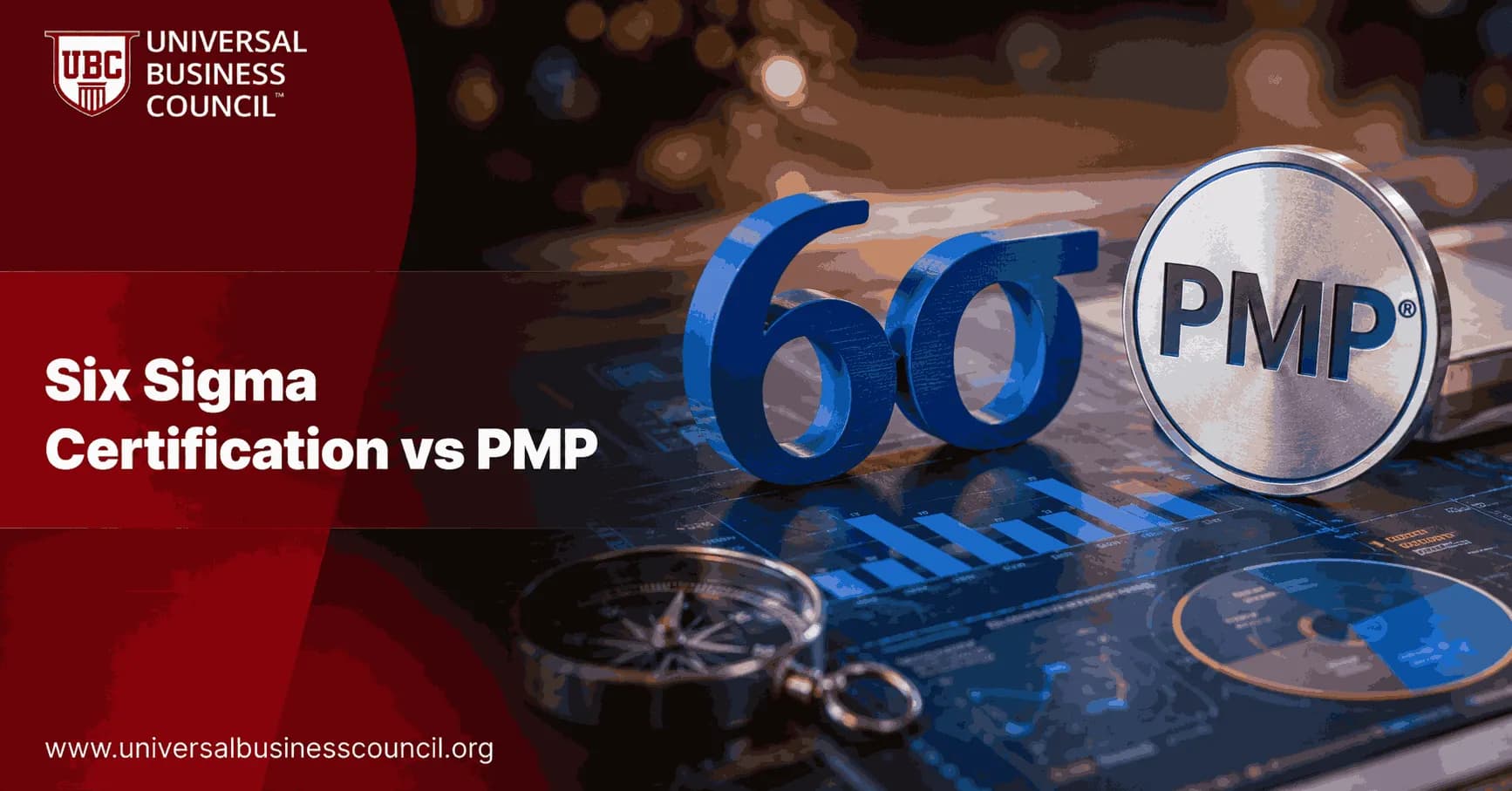
Six Sigma Certification vs PMP comes down to one practical question: do you want to improve processes with data, or do you want to lead projects from start to finish? Both credentials are respected. They solve different career problems. If you are leaning toward the process side of that question, a Certified Six Sigma Expert credential is a solid place to start, since it builds the DMAIC and root-cause foundation this whole comparison rests on.
If your work is full of defect rates, rework queues, cycle time, root cause analysis, and operational waste, Six Sigma is usually the better first move. If your calendar is packed with status meetings, stakeholder escalations, scope changes, budgets, and delivery dates, PMP is usually the clearer signal.

What PMP Represents
The Project Management Professional, or PMP, is governed by the Project Management Institute. PMI defines PMP as a credential for professionals who lead projects, manage teams, and deliver business outcomes across predictive, agile, and hybrid environments.
PMP is not tied to one industry. You see it in IT, construction, healthcare, finance, government, consulting, and engineering. The common thread is project delivery: scope, schedule, cost, quality, risk, procurement, communication, and stakeholder management. Professionals aiming for the leadership side of this work, rather than a single credential, sometimes look at broader Management Certifications that cover governance, stakeholder alignment, and decision-making across both project and process disciplines.
One PMP exam pattern catches many candidates. The technically correct answer is not always the best answer. If a sponsor asks for a late scope change after the baseline is approved, the exam usually wants you to follow change control, not simply say yes because the sponsor is senior. That is real project governance.
What Six Sigma Certification Represents
Six Sigma certification focuses on reducing variation, improving quality, and removing defects from processes. Lean Six Sigma adds waste reduction and flow improvement. The main roadmap is DMAIC: Define, Measure, Analyze, Improve, and Control.
Six Sigma is commonly structured by belt level:
Yellow Belt: basic concepts and team participation.
Green Belt: project support and moderate analysis.
Black Belt: leading improvement projects and using deeper statistical tools.
Master Black Belt: coaching, program leadership, and enterprise improvement strategy.
Unlike PMP, Six Sigma is not controlled by one global body. Providers vary in exam depth, project requirements, renewal rules, and pricing. That matters. A Black Belt that requires a completed project and a serious exam carries more weight than a certificate earned after a short quiz.
Six Sigma Certification vs PMP: The Core Difference
PMP is a project delivery credential. Six Sigma is a process improvement credential. Simple. Useful.
PMP helps you run a temporary initiative with a defined beginning and end. A cloud migration, ERP implementation, office move, hospital system upgrade, or product launch fits the PMP world.
Six Sigma helps you improve an ongoing process. Think order fulfillment, claims processing, production yield, lab turnaround time, customer onboarding, or invoice accuracy.
Here is the difference I use with teams. PMP asks, "Are we delivering the agreed outcome on time and within constraints?" Six Sigma asks, "Why does this process keep producing errors, delays, or waste?"
Skills You Build in Each Credential
PMP Skills
Work Breakdown Structures and scheduling
Critical path thinking
Risk registers and issue management
Stakeholder analysis
Budget tracking and change control
Team leadership across functions
Six Sigma Skills
Process mapping
Control charts
Root cause analysis
Hypothesis testing
Defect measurement
Process capability and control planning
To be blunt, Six Sigma is the better fit if you enjoy evidence over opinion. A common beginner mistake is jumping straight to solutions. Good Six Sigma work starts by measuring the current process. Skip that step and you may just automate a bad workflow. As more of that measurement work involves connected systems, IoT sensors, and automated data pipelines, some practitioners add a Deep Tech Certification to better understand the technology generating the data behind their process improvements.
Cost, Time, and Difficulty
PMP usually requires documented project experience, 35 hours of project management education, a formal exam, and renewal every three years through 60 professional development units. PMI lists different eligibility paths based on education and experience.
Exam fees vary by PMI membership status and country. Many 2025 and 2026 training guides place PMP exam costs in the range of about USD 405 to USD 675.
Six Sigma costs vary more because there are multiple providers. Green Belt and Black Belt exams often fall between roughly USD 200 and USD 700, although full training packages can cost more. Some providers require renewal. Others do not.
Study time is not trivial for either path. PMP often takes three to six months of focused preparation. Six Sigma may take two to six months depending on belt level and your comfort with statistics.
Salary and Career Direction
Recent career guides place PMP holders commonly around USD 95,000 to USD 120,000 in average salary ranges, depending on geography, seniority, and industry. Six Sigma professionals are often reported around USD 70,000 to USD 110,000, with Black Belts and operational excellence leaders at the higher end.
Do not choose only by salary. The better credential is the one your target role actually values.
Choose PMP for Project Manager, Program Manager, IT Project Lead, Implementation Manager, or PMO roles.
Choose Six Sigma for Quality Manager, Process Improvement Specialist, Operational Excellence Lead, Business Analyst, or Continuous Improvement Manager roles.
Which Industries Prefer Which Credential?
PMP has strong recognition in project-heavy environments: IT services, consulting, construction, engineering, finance, and government programs. When leadership cares about milestones, budget variance, RAID logs, and executive reporting, PMP fits.
Six Sigma is especially useful in operations-heavy settings such as manufacturing, supply chain, healthcare, logistics, shared services, insurance, and banking operations. When leadership watches first-pass yield, defect rate, turnaround time, scrap, rework, and customer complaints, Six Sigma is the sharper tool.
A quiet budget burner I have seen more than once is a project that finishes "on time" but leaves the old broken process untouched. The new system goes live, then teams keep exporting spreadsheets to fix exceptions by hand. PMP got the project delivered. Six Sigma would have challenged the process design before go-live.
Should You Get Both?
For senior transformation roles, yes, eventually. The combination is strong because organizations need people who can manage change and prove that the change improved performance.
Start with the credential closest to your current work:
If you manage deadlines, vendors, stakeholders, and budgets: start with PMP.
If you analyze defects, delays, handoffs, and quality problems: start with Six Sigma.
If you lead operational transformation: plan for both, but do not study both at the same time unless your schedule is unusually light.
Universal Business Council learners can treat this as a development path. Begin with the Six Sigma category if your role is quality, operations, analytics, or process improvement. Explore related project management courses if your next move is delivery leadership, PMO work, or enterprise transformation.
Final Recommendation
If you want the broadest project leadership credential, choose PMP. It has a single governing body, strong employer recognition, and clear value in cross-functional delivery roles.
If you want to become the person who finds why work breaks, proves it with data, and fixes the process permanently, choose Six Sigma certification. For operations and quality careers, it is often the more practical first credential.
Your next step is simple. Pull three job descriptions for the role you want next. Count how often they mention PMP, Six Sigma, Lean Six Sigma, DMAIC, project governance, process improvement, and quality metrics. Let the market answer, then choose the credential that appears in the work you actually want to do. And if those job descriptions increasingly mention automation, digital systems, or data platforms alongside process and delivery skills, a general Tech Certification can help you close that gap without abandoning the project or quality path you have already chosen.
FAQs
1. What is the difference between Six Sigma certification and PMP?
Six Sigma certification focuses on process improvement, defect reduction, variation control, data analysis, and operational excellence. The Project Management Professional (PMP) credential focuses on managing projects, including scope, schedule, stakeholders, risk, resources, quality, and delivery.
A simple distinction is:
Six Sigma → Improve how a process performs
PMP → Develop expertise in managing and delivering projects
The better credential depends on your current role and career goals.
2. What is a Six Sigma certification?
Six Sigma certification demonstrates knowledge of structured process-improvement methods and tools.
Common certification levels include:
White Belt → Yellow Belt → Green Belt → Black Belt → Master Black Belt
Green and Black Belt programs commonly cover DMAIC, process mapping, root-cause analysis, data analysis, process capability, control methods, and other quality-improvement techniques.
Requirements vary by certification provider.
3. What is PMP certification?
PMP, or Project Management Professional, is a project-management credential offered by the Project Management Institute (PMI).
It is designed for professionals with project leadership experience and assesses knowledge and skills relevant to managing projects and teams across different delivery environments.
Candidates should verify PMI's current education, experience, application, examination, and renewal requirements before applying because certification requirements can change.
4. Which is better: Six Sigma or PMP?
Neither credential is universally better.
Six Sigma may be more relevant for careers in:
Process improvement
Quality
Manufacturing
Operations
Supply chain
Operational excellence
Continuous improvement
PMP may be more relevant for:
Project management
Program delivery
Technology implementation
Construction
Consulting
Transformation
Cross-functional project leadership
Choose according to the work you want to perform.
5. Is PMP harder than Six Sigma certification?
There is no useful universal comparison because Six Sigma certification requirements vary considerably between providers and belt levels.
A Black Belt program involving statistics and project work is very different from an introductory Yellow Belt course.
PMP has defined eligibility and examination requirements established by PMI.
Instead of asking which credential is harder, compare the knowledge, experience, preparation, and assessment requirements of the specific certifications you are considering.
6. Which certification costs more: PMP or Six Sigma?
Costs vary.
PMP expenses can include examination fees, preparation courses, study materials, renewal requirements, and potentially PMI membership.
Six Sigma costs vary dramatically by provider, belt level, training format, examination structure, and project requirements.
Candidates should calculate:
Training + Exam + Materials + Renewal + Time
Current prices should be checked directly with the credential provider before enrolling.
7. Which certification takes longer to complete?
Six Sigma training can take anywhere from a short introductory course to several months of advanced study and project work.
PMP preparation time depends on the candidate's existing project-management knowledge and experience, while eligibility itself requires meeting PMI's current requirements.
A meaningful comparison should therefore consider the entire qualification process rather than merely the length of an online course.
8. Which is better for Project Managers: Six Sigma or PMP?
PMP is generally more directly aligned with a dedicated Project Manager career because it focuses on project leadership and delivery.
Six Sigma can be an excellent complementary credential for Project Managers working on process improvement, operational transformation, quality, manufacturing, healthcare, or supply-chain initiatives.
The combination can help a Project Manager understand both how to deliver change and how to determine whether a process actually improved.
9. Which is better for quality professionals: Six Sigma or PMP?
Six Sigma is generally more directly aligned with quality and continuous-improvement careers.
Quality professionals often need skills in DMAIC, process capability, defect reduction, root-cause analysis, control charts, FMEA, and statistical analysis.
PMP can become valuable when those professionals progress into larger transformation programs or roles requiring extensive project coordination, budgets, schedules, vendors, and stakeholders.
10. Which is better for operations professionals?
Six Sigma can be particularly valuable for operations professionals responsible for productivity, defects, cycle time, quality, cost, and process consistency.
PMP may be valuable when the same professional also leads implementations, facility projects, technology deployments, or major transformation initiatives.
Operations leaders frequently benefit from understanding both disciplines.
11. Which is better for manufacturing careers?
Six Sigma is often highly relevant in manufacturing because it addresses variation, defects, yield, process capability, waste, and quality.
Useful career paths include:
Manufacturing Engineer → Green Belt → Improvement Leader → Black Belt → Operational Excellence Manager
PMP can add value for professionals leading plant expansions, equipment installations, product introductions, automation programs, or other large manufacturing projects.
12. Which is better for IT and technology careers?
PMP can be more directly relevant for professionals managing software, infrastructure, cloud, cybersecurity, enterprise-system, or digital-transformation projects.
Six Sigma may be useful for technology professionals improving recurring operational processes such as incident management, service delivery, support workflows, defect handling, or transaction processing.
The appropriate credential depends on whether the job emphasizes project delivery or process performance.
13. Which is better for consulting careers?
Both can be useful.
PMP can support consulting work involving implementations, transformation programs, PMO services, and complex project delivery.
Six Sigma can support operational-improvement, quality, process redesign, and performance-transformation consulting.
Consultants working across both implementation and operational improvement may benefit from combining the disciplines with strong industry expertise.
14. Does Six Sigma certification increase salary more than PMP?
There is no reliable universal answer.
Compensation depends on the underlying role, experience, geography, employer, industry, leadership responsibility, and scarcity of skills.
A credential may contribute to higher earnings when it helps a professional qualify for a more valuable role, but neither PMP nor Six Sigma guarantees a salary increase.
Compare compensation for the actual target jobs rather than generic certification salary claims.
15. Which certification has better global recognition?
PMP has standardized branding and requirements through PMI and is widely used in project-management job markets internationally.
Six Sigma is also recognized globally, but certification standards can vary among providers.
When evaluating Six Sigma programs, examine the provider, curriculum, examination rigor, project requirements, and recognition among employers in your target industry and location.
16. Can a Six Sigma professional become a Project Manager?
Yes.
Green Belts and Black Belts often develop project leadership, stakeholder management, communication, business-case development, risk management, and change-management experience.
To move into broader Project Manager positions, they may need additional skills in scheduling, budgeting, procurement, resource management, contracts, governance, and different project-delivery approaches.
17. Can a PMP-certified Project Manager benefit from Six Sigma?
Yes.
Six Sigma can strengthen a Project Manager's ability to analyze process problems, validate root causes, measure variation, and evaluate whether implemented changes produce measurable improvement.
This can be particularly useful in operational transformation, healthcare, manufacturing, supply chain, financial services, and quality-related projects.
18. Should I get Six Sigma or PMP first?
Choose the credential most relevant to your current responsibilities and next career move.
Consider Six Sigma first if you currently work in:
Quality → Operations → Manufacturing → Continuous Improvement → Process Excellence
Consider PMP when your experience and goals center on:
Project Delivery → Implementation → PMO → Transformation → Program Management
Eligibility requirements also matter. Candidates should confirm current PMP requirements directly with PMI before planning the sequence.
19. Is it worth having both Six Sigma and PMP?
It can be, particularly for professionals working in operational transformation, consulting, manufacturing, healthcare, supply chain, financial services, or large-scale process improvement.
Together they can create a complementary skill set:
PMP → Project Delivery
Six Sigma → Process Improvement
However, having both credentials is most valuable when supported by real experience using both disciplines.
20. How should I choose between Six Sigma certification and PMP?
Start with the role you want rather than the certificate you want.
Use this framework:
Choose Six Sigma when your target problem is:
“This process performs poorly. How do we improve it?”
Choose PMP when your target problem is:
“This initiative must be successfully planned and delivered. How do we manage it?”
For Six Sigma, a typical career progression could be:
Operations/Quality Role
↓
Green Belt
↓
Process Improvement Projects
↓
Black Belt
↓
Continuous Improvement Manager
↓
Operational Excellence Leader
For project management, a career progression could be:
Project Coordinator
↓
Project Manager
↓
PMP
↓
Senior Project Manager
↓
Program Manager
↓
PMO/Portfolio Leadership
Now compare the underlying skill sets.
Six Sigma Skills
DMAIC
Root-cause analysis
Process mapping
Statistics
Process capability
FMEA
Control charts
Continuous improvement
Cost of Poor Quality
Change management
PMP-Aligned Skills
Scope management
Scheduling
Cost and resource management
Risk management
Stakeholder engagement
Team leadership
Governance
Project delivery
Communication
Benefits awareness
There is significant overlap in:
Leadership + Stakeholders + Risk + Communication + Change
The difference is where the analytical emphasis sits.
Consider a company with a customer-order process producing an 8% error rate.
A Six Sigma professional may use:
Define → Measure → Analyze → Improve → Control
to identify why the errors occur and reduce them.
Suppose the solution requires implementing a new enterprise platform across 20 locations.
That implementation may require:
Scope → Schedule → Budget → Resources → Vendors → Risks → Stakeholders → Deployment
This is where formal project-management capability becomes particularly important.
In practice:
Six Sigma identifies and validates process improvement.
Project management organizes and delivers the change.
For professionals who want to work in business transformation, the combined profile can be powerful:
Domain Expertise + Six Sigma + Project Management + Data Analytics + Change Management
Before paying for either credential, review actual vacancies for your target job.
Count how frequently employers request:
Six Sigma / Lean Six Sigma
versus
PMP / Project Management
Then examine experience requirements.
This gives you a far better indication of career value than generic claims that one certification is “better.”
The simplest decision rule is:
Want to improve processes? → Six Sigma
Want to lead projects? → PMP
Want to lead complex operational transformation? → Consider both
Credentials should follow the career strategy, not become the career strategy.
Otherwise, one can spend an impressive amount of money becoming exceptionally qualified at collecting certificates.
Related Articles
View All
Six Sigma
Six Sigma Certification vs MBA: Cost, ROI, and Career Value
Compare Six Sigma certification vs MBA by cost, ROI, time commitment, salary impact, and career outcomes so you can choose the right path.
Six Sigma
Six Sigma Career Path: Certifications, Roles, Salaries, and Skills
A practical guide to the Six Sigma career path, including belt levels, roles, salary ranges, required skills, and next steps for professionals.
Six Sigma
Six Sigma vs Quality Management: Where Six Sigma Fits
Six Sigma vs Quality Management explained: learn how Six Sigma fits within quality systems as a data-driven method for reducing defects and variation.
Trending Articles
The Role of Blockchain in Ethical AI Development
How blockchain technology is being used to promote transparency and accountability in artificial intelligence systems.
AWS Career Roadmap
A step-by-step guide to building a successful career in Amazon Web Services cloud computing.
Top 5 DeFi Platforms
Explore the leading decentralized finance platforms and what makes each one unique in the evolving DeFi landscape.