

Six Sigma Certification vs MBA: Cost, ROI, and Career Value
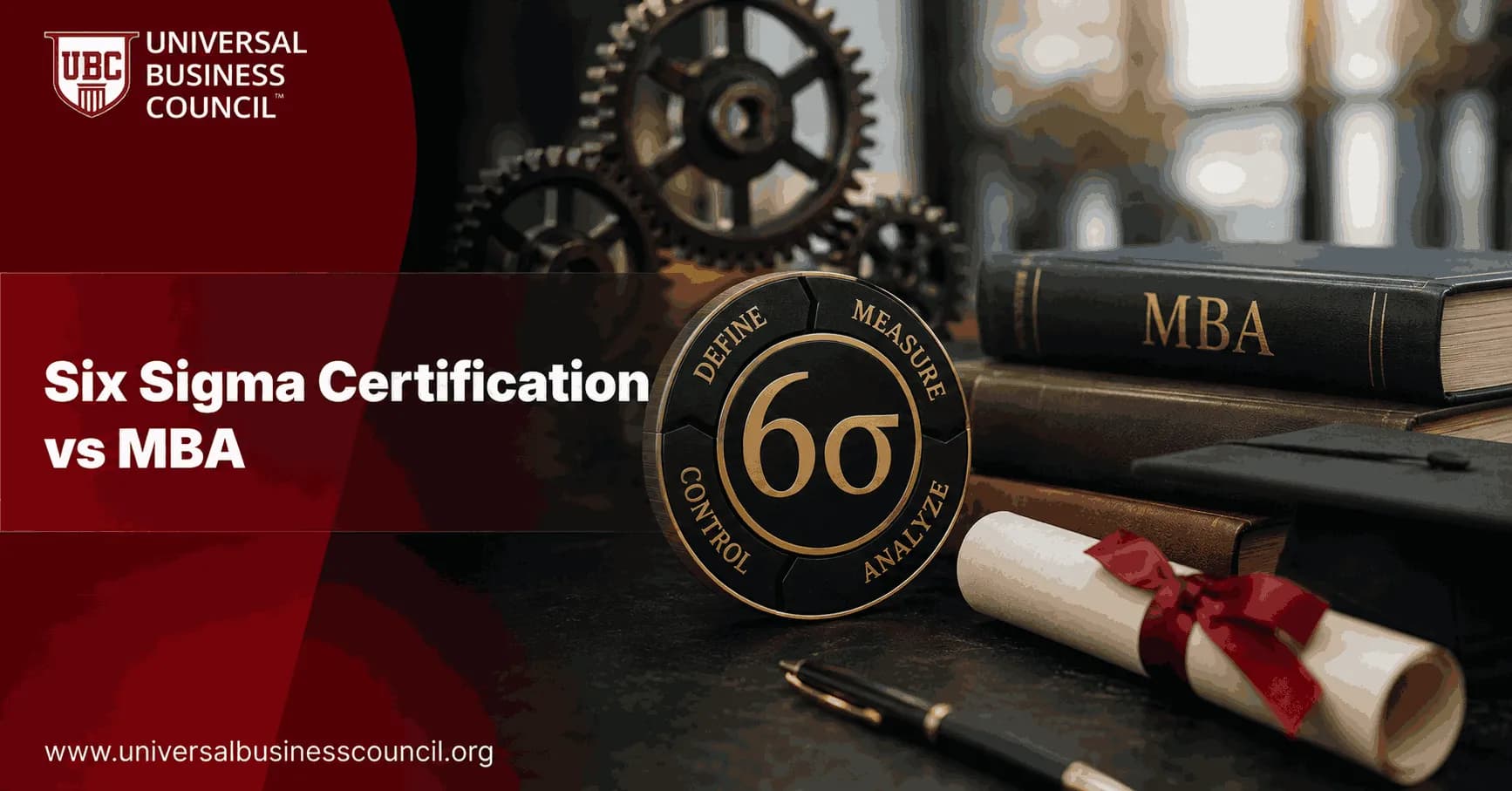
Six Sigma Certification vs MBA is not a prestige contest. It is a timing and career-goal decision. If you need measurable process wins this quarter, Six Sigma usually pays back faster. If you want a broad move into strategy, finance, consulting, or general management, a reputable MBA still carries more long-term signaling power. For readers leaning toward the process-improvement route, a Certified Six Sigma Expert credential is often the fastest way to turn that interest into a workplace-ready skill set.
Six Sigma Certification vs MBA: the quick answer
Choose Six Sigma certification if your work sits close to operations, quality, supply chain, healthcare processes, IT service delivery, logistics, or shared services. The value is practical. You learn how to reduce defects, cut variation, improve cycle time, and prove savings with data.

Choose an MBA if you need a wider business platform: finance, marketing, strategy, leadership, organizational behavior, and P&L thinking. An MBA is usually better for career pivots, senior leadership tracks, consulting, and roles where the employer wants a general management credential. Professionals weighing this decision sometimes look at broader Management Certifications as a middle path, one that builds leadership and governance skills without the full time and cost commitment of a traditional MBA.
To be blunt, a Green Belt will not replace a strong MBA for investment banking. An MBA will not teach you the hands-on discipline of a control chart, a root cause analysis workshop, or a DMAIC project review. They solve different problems.
Learning focus: what you actually walk away with
What an MBA teaches
An MBA gives you broad business literacy. You study strategy, accounting, corporate finance, marketing, operations, leadership, and organizational management. Many programs also include electives in analytics, entrepreneurship, technology management, and international business.
The outcome is career mobility. You are not just learning a toolset. You are building the language used in boardrooms, business cases, budget reviews, market-entry decisions, and executive hiring conversations.
What Six Sigma teaches
Six Sigma and Lean Six Sigma focus on process improvement. Common belt levels include Yellow Belt, Green Belt, and Black Belt. Green Belt candidates usually learn DMAIC, process mapping, cause-and-effect analysis, basic statistics, measurement systems, and control planning. Black Belt training goes deeper into project leadership, hypothesis testing, regression, design of experiments, and financial validation.
Here is the detail that trips many candidates up. They memorize sigma levels but confuse Cp and Cpk. Cp tells you potential capability if the process is centered. Cpk tells you how the process is actually performing against specification limits. In real projects, that distinction matters. A process can look capable on paper and still disappoint customers because it has drifted toward one limit.
Cost and time commitment
The cost gap is large.
MBA tuition: top 50 programs are often reported in the range of 60,000 to 200,000 USD, before lost income, travel, housing, and fees.
Six Sigma Black Belt cost: many programs fall around 2,000 to 5,000 USD, while some intensive in-person options can reach roughly 16,000 USD.
Lower belt levels: Yellow Belt and Green Belt programs can cost far less, with some market surveys placing Six Sigma certification cost from about 150 USD to more than 3,000 USD depending on provider and format.
Time is just as different. A full-time MBA commonly takes 18 to 24 months. Part-time and executive formats can run longer. A Six Sigma Black Belt may take 1 to 6 months, and some classroom-based programs estimate a little over 20 training days. Green Belt can often be completed in weeks.
That shorter path is why Six Sigma often wins on near-term ROI. You can train while working, run a project, and show results before an MBA student finishes the first year. As more of that project work involves automated reporting, sensor data, or digital process tracking, some Black Belts also pick up a Deep Tech Certification to better understand the systems generating the data behind their improvement projects.
Salary impact and payback period
Reported MBA salary increases vary by school, industry, geography, and pre-MBA income. Comparative career analyses commonly place the post-MBA salary uplift from reputable programs around 50 to 100 percent, especially when graduates move into consulting, finance, product leadership, or senior management. The payback period is often estimated at 3 to 6 years after graduation.
Six Sigma has a smaller salary jump, but a faster recovery of cost. Black Belt holders are often associated with 10 to 20 percent salary gains, or roughly 10,000 to 15,000 USD more per year for many mid-career professionals. Payback can happen in 6 to 12 months because the training cost is lower.
PayScale data cited by the University of South Florida has placed average Lean Six Sigma Black Belt salaries at about 135,000 USD in the United States. Treat that as a directional figure, not a promise. Industry, responsibility level, and whether you own financial outcomes will move the number.
Employer perception: credential versus proof
Employers read an MBA as a broad leadership signal, especially when it comes from a well-ranked or accredited university. MBA programs may be regulated through national higher education systems and often seek recognition from bodies such as AACSB, AMBA, or EQUIS.
Six Sigma certification is different. There is no single global regulator for all providers, so rigor varies. Employers care about the belt level, the provider, the exam, and the project evidence. A Black Belt without a completed project is weaker than a Green Belt who can show a verified 8 percent scrap reduction, a shorter claim cycle, or fewer repeat service tickets.
In operations-heavy settings, Six Sigma can carry surprising weight. A 2025 manufacturing-focused professional poll reported that 42 percent of respondents preferred Six Sigma Black Belt for leadership development, compared with 6 percent who chose an MBA. That does not make the MBA weak. It means the factory floor, the warehouse, the hospital unit, and the service center reward people who can fix broken processes.
When you should choose each path
Choose Six Sigma certification if you want fast operational impact
You work in quality, operations, engineering, supply chain, healthcare administration, IT service management, or logistics.
You need a practical method for reducing defects, waste, rework, delays, and cost.
You want a credential you can complete while employed.
Your manager tracks metrics such as cycle time, first-pass yield, SLA performance, cost per claim, on-time delivery, churn, NPS, or rework rate.
Choose an MBA if you need broader mobility
You want to move from a technical role into corporate strategy, finance, consulting, product management, or general management.
You need a recognized academic credential for promotion or international mobility.
You want access to alumni networks, internships, executive recruiters, and structured career services.
The strongest profile may be both
The MBA plus Six Sigma combination is powerful for operations leadership, transformation, and COO-track roles. The MBA helps you frame the business case. Six Sigma helps you prove the improvement. That combination matters when leadership asks the hard question: Did this project actually improve margin, or did it just move work to another department?
If you are reviewing professional development options, compare the Six Sigma programs in the Universal Business Council course catalog with related business, management, and project-focused learning paths. That comparison helps if you are building a stackable credential plan rather than picking one certificate in isolation.
Your next step
If you need results within the next 6 months, start with Six Sigma Green Belt or Black Belt training and pick a real workplace project before you enroll. Choose one metric, one process owner, and one financial sponsor. If your goal is a major career pivot or senior general management, shortlist accredited MBA programs and ask for employment outcomes by industry, not just average salary. If you are aiming for operations leadership, do both in sequence: Six Sigma first for proof, MBA later for scope. And if your career path is pulling you toward digital transformation work alongside process improvement, a general Tech Certification can help bridge that gap between operational expertise and the technical fluency employers increasingly expect.
FAQs
1. What is the difference between Six Sigma certification and an MBA?
A Six Sigma certification focuses on process improvement, quality, data analysis, defect reduction, and operational excellence. An MBA provides broader business education across areas such as finance, strategy, marketing, operations, leadership, economics, and management.
Six Sigma is generally narrower, faster, and less expensive. An MBA requires substantially more time and investment but can support a wider range of management and leadership careers.
2. Which is better: Six Sigma certification or an MBA?
Neither is universally better.
Choose Six Sigma when your career goals center on process improvement, quality, manufacturing, operations, supply chain, or operational excellence.
Consider an MBA when you want broader business knowledge, management development, career switching, leadership opportunities, or access to recruiting and professional networks associated with a particular business school.
The right choice depends on the career outcome you are trying to achieve.
3. How much does Six Sigma certification cost compared with an MBA?
Six Sigma certification costs vary widely by belt level, provider, training format, exam structure, and whether project mentoring is included. Programs can range from relatively inexpensive online training to several thousand dollars for advanced instructor-led certification.
MBA costs vary even more dramatically. Tuition can range from comparatively affordable online or public-university programs to well over $100,000 for some full-time programs, before living expenses and lost earnings are considered.
Always compare current provider-specific costs.
4. How long does Six Sigma certification take compared with an MBA?
Six Sigma training can often be completed in weeks or months, depending on belt level, study intensity, assessment requirements, and project work.
A traditional full-time MBA commonly takes around two years, while accelerated, part-time, executive, and online programs follow different schedules.
The larger time commitment of an MBA creates an additional economic consideration: opportunity cost.
5. Which has a better ROI: Six Sigma or an MBA?
ROI depends on cost, career outcome, salary growth, and opportunity cost.
A relatively inexpensive Six Sigma certification can produce a strong percentage return when it helps a professional earn a promotion or move into process-improvement responsibilities.
An MBA can produce a larger absolute career impact when it enables a significant career switch, leadership progression, or access to higher-paying employers.
Neither credential guarantees a positive return.
6. How do you calculate ROI for Six Sigma certification?
A simple model is:
ROI = (Financial Benefit − Total Cost) ÷ Total Cost × 100
Suppose certification, training, and exam fees cost $2,000 and contribute to a role change that increases annual compensation by $8,000.
A simplified first-year calculation would be:
($8,000 − $2,000) ÷ $2,000 × 100 = 300%
However, attributing an entire salary increase to certification alone may overstate its impact. Experience, performance, market conditions, and other skills also matter.
7. How do you calculate MBA ROI?
MBA ROI should include more than tuition.
Consider:
Tuition + Fees + Living-Cost Difference + Financing Cost + Lost Earnings
Then compare those costs with expected post-MBA compensation and longer-term career benefits.
For example, leaving a $90,000 job for two years creates substantial opportunity cost before tuition is even counted.
Part-time or online programs can produce a different ROI because students may continue earning while studying.
8. Does Six Sigma certification increase salary?
It can strengthen a professional's qualifications, particularly in roles involving quality, operations, manufacturing, supply chain, healthcare, or continuous improvement.
However, certification alone does not guarantee higher compensation.
The strongest salary impact generally comes when professionals combine certification with measurable project results, industry experience, analytical ability, and increased responsibility.
9. Does an MBA increase salary?
An MBA can contribute to higher earnings for some graduates, but outcomes vary considerably by school, prior experience, industry, geography, specialization, and post-MBA role.
A highly selective MBA with strong recruiting pipelines can produce a very different career outcome from a program with limited employer connections.
Candidates should examine current employment reports for the specific programs they are considering rather than relying on generic MBA salary claims.
10. Is Six Sigma better than an MBA for operations careers?
Six Sigma may provide more directly applicable skills for professionals focused specifically on process improvement, quality, manufacturing, operational excellence, or continuous improvement.
An MBA can be more useful when the goal is broader operations leadership involving finance, strategy, organizational management, and executive decision-making.
For some professionals, the strongest combination is technical process-improvement expertise followed by broader management education.
11. Is an MBA better for management and leadership roles?
An MBA can provide broader preparation for general management because it typically covers finance, strategy, marketing, operations, economics, organizational behavior, and leadership.
However, an MBA does not automatically create leadership ability.
Professional experience, decision-making, communication, team management, and demonstrated results remain critical.
Six Sigma can complement leadership development by providing a rigorous method for improving operational performance.
12. Is Six Sigma certification useful for MBA graduates?
Yes.
An MBA graduate working in operations, consulting, manufacturing, supply chain, healthcare, or transformation can use Six Sigma to add deeper process-improvement and analytical skills.
A useful combination is:
MBA → Broad Business Management
Six Sigma → Structured Process Improvement
The two credentials address different dimensions of professional development.
13. Do I need an MBA if I already have Six Sigma certification?
Not necessarily.
If your career goals can be achieved through experience, technical specialization, process-improvement expertise, and leadership progression, an MBA may not be required.
Consider an MBA when the broader business education, recruiting opportunities, professional network, brand value, or career-switching potential justifies the investment.
A second credential should solve a career problem, not merely occupy another line on LinkedIn.
14. Do I need Six Sigma if I already have an MBA?
Not necessarily.
An MBA may already provide some exposure to operations and process management. However, Six Sigma can be useful if your work requires deeper knowledge of DMAIC, process capability, root-cause analysis, statistical methods, quality improvement, or operational excellence.
Its value depends on the requirements of your target roles.
15. Which option is better for a career change?
It depends on the size and direction of the change.
Six Sigma can support transitions into adjacent roles such as quality, continuous improvement, process analysis, operations, or operational excellence.
An MBA may be better suited to larger transitions between functions or industries, particularly when the business school provides strong recruiting access.
Candidates should examine whether employers in their target field actually recruit from the credential or program being considered.
16. Which has better networking opportunities: Six Sigma or an MBA?
MBA programs, particularly cohort-based programs, generally provide substantially broader networking opportunities through classmates, alumni, faculty, employers, clubs, and recruiting events.
Six Sigma programs tend to focus more heavily on technical and professional skill development.
Networking value can therefore be an important part of MBA ROI, especially for professionals pursuing career changes or leadership roles.
17. Which is better for entrepreneurs: Six Sigma or an MBA?
The answer depends on the entrepreneur's needs.
Six Sigma can help founders improve operations, reduce waste, standardize processes, and build scalable workflows.
An MBA can provide broader knowledge of finance, marketing, strategy, operations, organizational design, and entrepreneurship.
Neither is required to start a business. The more useful option is the one addressing the founder's actual knowledge gaps.
18. Can I complete Six Sigma before pursuing an MBA?
Yes. This can be a practical sequence for professionals in operations, engineering, manufacturing, quality, or supply chain.
A possible progression is:
Professional Experience → Green Belt → Improvement Projects → Management Responsibility → MBA
This allows professionals to develop measurable operational achievements before pursuing broader management education.
An MBA can then help expand from process-level improvement toward business-level decision-making.
19. Should I choose Six Sigma, an MBA, or both?
Choose based on the career gap you need to close.
Choose Six Sigma when you need:
Process improvement, quality, analytical problem solving, Lean/Six Sigma methodology, or operational-excellence skills.
Choose an MBA when you need:
Broad management education, career switching, strategic knowledge, leadership development, recruiting access, or professional networking.
Consider both when you need:
Deep operational expertise combined with broader business and leadership capability.
Sequence them according to your career stage and financial circumstances.
20. How should I compare the cost, ROI, and career value of Six Sigma certification and an MBA?
Use a structured decision framework rather than asking which credential is universally “better.”
Start with your target outcome.
If your goal is: Process Improvement
Six Sigma usually has the more direct alignment.
If your goal is: General Management
An MBA may provide broader value.
If your goal is: Operational Excellence Leadership
Both may eventually be useful.
If your goal is: Major Career Switching
An MBA with strong recruiting access may offer advantages that a certification cannot replicate.
Next, calculate the true cost.
For Six Sigma:
Training + Exam + Materials + Project Costs + Study Time
For an MBA:
Tuition + Fees + Financing + Living-Cost Difference + Lost Earnings + Time
Opportunity cost can fundamentally change the comparison.
Consider a simplified example.
A professional earns $80,000 annually.
Option A: Six Sigma Green Belt
Certification cost: $2,000
Lost earnings: $0
Total direct cost: $2,000
If the credential and resulting experience contribute to a promotion paying an additional $8,000 annually, the investment may be recovered relatively quickly.
Option B: Full-Time MBA
Tuition and fees: $100,000
Approximate lost earnings over two years: $160,000
Simplified economic cost before other expenses: $260,000
If post-MBA compensation rises substantially and the degree changes the person's long-term career trajectory, that larger investment may still make sense.
But the hurdle is obviously much higher.
This is why percentage ROI and absolute career value should both be considered.
Next, compare career breadth.
Six Sigma provides specialized depth:
Quality → Operations → Process Improvement → Operational Excellence
An MBA provides broader exposure:
Finance → Strategy → Marketing → Operations → Leadership → General Management
Then examine employer recognition.
For Six Sigma, investigate:
Certification Provider + Belt Level + Assessment + Project Requirements + Employer Demand
For an MBA, examine:
School Reputation + Accreditation + Employment Outcomes + Alumni Network + Recruiting Access
Next, consider career stage.
An early-career operations professional may obtain greater immediate value from a Green Belt and real project experience.
A mid-career professional seeking a major management transition may benefit more from an MBA.
An experienced operational-excellence professional moving toward executive leadership might eventually benefit from both.
A useful comparison is:
Factor | Six Sigma Certification | MBA |
|---|---|---|
Primary Focus | Process improvement | Broad business management |
Typical Commitment | Weeks to months | Months to years |
Relative Cost | Low to moderate | Moderate to very high |
Statistical Depth | Moderate to advanced | Usually limited |
Management Breadth | Limited | High |
Networking | Usually limited | Potentially substantial |
Career Switching | Moderate | Potentially strong |
Operations Value | High | Moderate to high |
Best ROI | Role-specific improvement | Broader career transformation |
The strongest decision rule is:
Career Goal → Skill Gap → Employer Demand → Total Cost → Expected Benefit → ROI
Do not begin with the credential.
Begin with the job you want.
Then examine people already doing that job. Determine what qualifications, experience, skills, and credentials employers actually request.
If Six Sigma closes the gap, pursue Six Sigma.
If an MBA provides the management breadth, recruiting access, or career transition you need, evaluate an MBA.
If both contribute meaningfully, build them in a sensible sequence.
A Six Sigma certification is usually a targeted skills investment.
An MBA is usually a broader career investment.
The cheaper option is not automatically the better investment, and the more expensive option is certainly not automatically the more valuable one.
Educational ROI becomes much easier to evaluate once we stop assuming tuition is a proxy for usefulness.
Related Articles
View All
Six Sigma
Six Sigma Certification vs PMP: Which Credential Fits Your Career?
Compare Six Sigma Certification vs PMP by career focus, skills, costs, industries, salary ranges, and role fit so you can choose the right credential.
Six Sigma
Six Sigma Career Path: Certifications, Roles, Salaries, and Skills
A practical guide to the Six Sigma career path, including belt levels, roles, salary ranges, required skills, and next steps for professionals.
Six Sigma
Six Sigma Cost of Poor Quality: Finding Hidden Losses
Six Sigma Cost of Poor Quality explains how defects, rework, downtime, and lost customers hide real financial losses inside everyday operations.
Trending Articles
The Role of Blockchain in Ethical AI Development
How blockchain technology is being used to promote transparency and accountability in artificial intelligence systems.
AWS Career Roadmap
A step-by-step guide to building a successful career in Amazon Web Services cloud computing.
Top 5 DeFi Platforms
Explore the leading decentralized finance platforms and what makes each one unique in the evolving DeFi landscape.