

Six Sigma Career Path: Certifications, Roles, Salaries, and Skills
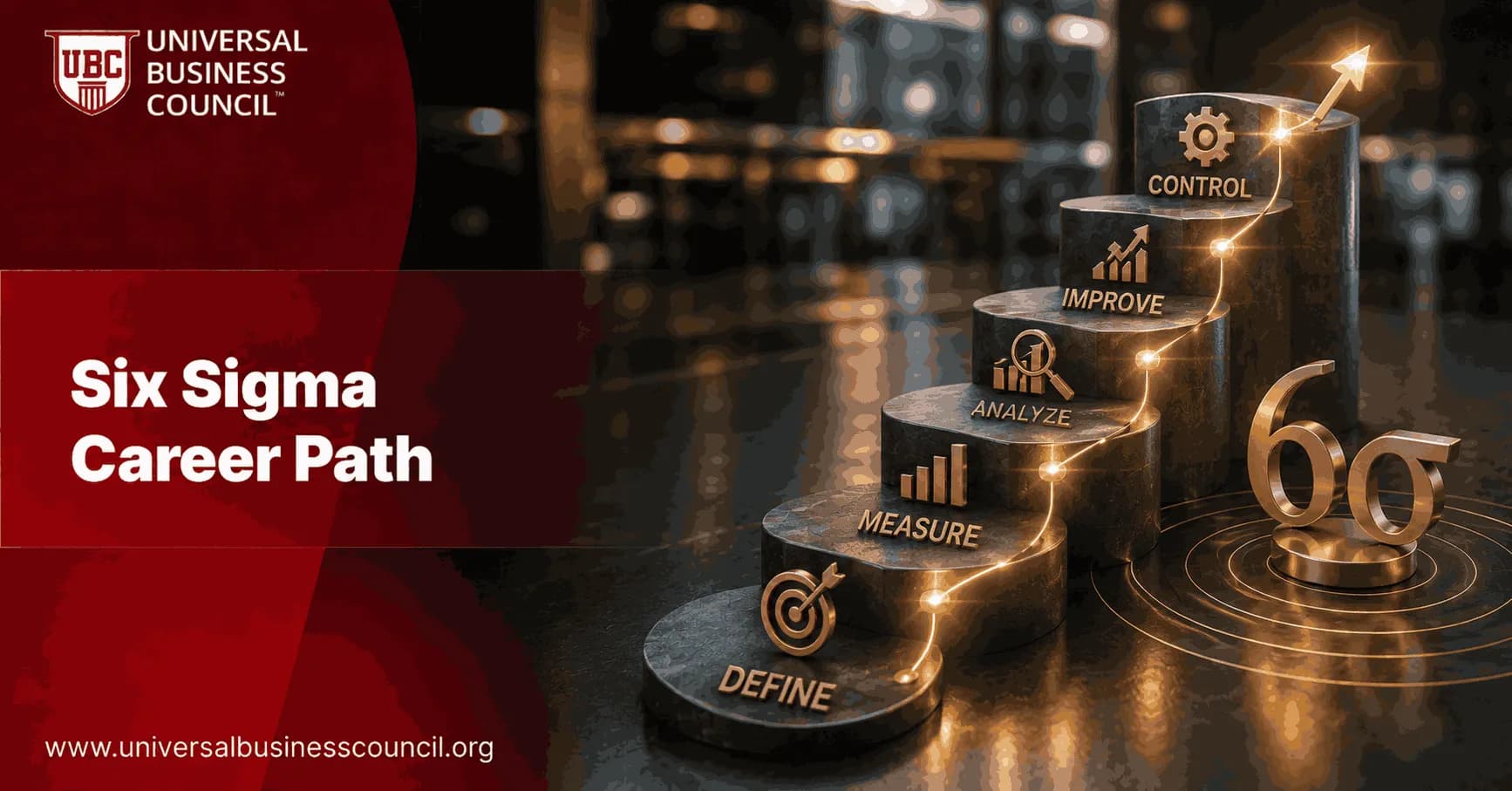
The Six Sigma career path is one of the clearest routes into quality, operations, process improvement, and business transformation work. You move through belt levels, build proof through projects, and take on larger problems as your statistical and leadership skills improve. Professionals who want to move faster often pair their belt training with a broader credential such as the Certified Six Sigma Expert designation, which signals mastery across the full DMAIC toolkit rather than a single belt level alone.
That structure matters. In a market where many certifications are vague, Six Sigma still ties learning to measurable outcomes: fewer defects, shorter cycle time, lower rework, better customer experience, and cleaner management reporting.

How the Six Sigma Career Path Works
Most Six Sigma certifications follow a belt model. The names are familiar, but the work changes sharply at each level.
White Belt: Basic awareness of Six Sigma terms and improvement thinking. Best for team members who need a shared vocabulary.
Yellow Belt: Supports data collection, documentation, and DMAIC project work. A good fit if you join improvement teams but do not lead them yet.
Green Belt: Leads smaller departmental projects while often keeping a full-time functional role. This is where your resume starts to change.
Black Belt: Leads cross-functional projects, uses deeper statistical tools, and works with senior stakeholders.
Master Black Belt: Designs the improvement program, coaches belts, governs project selection, and connects Six Sigma work to strategy.
ASQ describes this progression as a move from project participation to project leadership, then to program-level governance. That matches what you see inside mature operations teams. Green Belts fix local problems. Black Belts remove cross-functional friction. Master Black Belts decide which problems are worth fixing first. As you move toward that governance layer, it also helps to look outside pure statistics and into how programs are actually run; browsing Management Certifications is a useful way to see what a Master Black Belt track typically expects from you on the leadership side.
Six Sigma Salaries by Belt Level
Six Sigma salaries vary by region, sector, and job title, but the certification premium is well documented. ASQ salary survey data has found that US professionals with Six Sigma training earn a meaningful annual premium over those without it, often in the region of $15,000 or more. Black Belt holders tend to see an even larger gap.
Typical salary ranges
Yellow Belt: Often around $65,000 to $76,000 in the US, with wider ranges from about $55,000 to $95,000 depending on role.
Green Belt: Commonly $70,000 to $95,000, with several career sources placing averages near $85,000 to $95,000.
Black Belt: Often $90,000 to $130,000, with higher pay in operations leadership, consulting, and regulated manufacturing.
Master Black Belt: Frequently $120,000 to $170,000, especially where the role owns enterprise improvement governance.
Regional differences are real. Global salary analyses generally report the highest Black Belt averages in North America, followed by parts of Europe and Asia-Pacific, with lower averages in markets such as India. Master Black Belt averages sit higher in every region.
Do not read these numbers as a guarantee. A Green Belt in a high-margin medical device plant may out-earn a Black Belt in a smaller service business. Industry matters. So does whether you can show project results.
Common Six Sigma Roles
Six Sigma roles rarely sit in one department. You will find certified practitioners in plants, hospitals, banks, logistics networks, software teams, and public-sector operations.
Continuous Improvement Specialist or Manager: Runs improvement projects, tracks savings, and supports Lean initiatives.
Quality Engineer or Quality Manager: Reduces defects, manages control plans, and protects compliance metrics.
Process Engineer: Maps process flow, studies variation, and improves throughput.
Operations Manager: Uses Six Sigma to connect daily performance to KPIs such as cost, service level, yield, and cycle time.
IT Project Manager or Service Improvement Lead: Applies DMAIC to incident management, change failure rates, release quality, and service desk queues.
Lean Six Sigma Consultant: Advises teams, trains belts, and helps leadership select projects that are financially meaningful.
For technology professionals, the practical entry point is often service reliability. If your team tracks mean time to resolve, reopened tickets, failed changes, or defect escape rate, you already have Six Sigma project material.
Skills You Need to Progress
The best Six Sigma professionals are not just statistics people. They are translators. They can explain variation to a finance director, challenge a weak measurement system, and still get a tired operations team to test a new process on Thursday afternoon.
Core technical skills
DMAIC: Define, Measure, Analyze, Improve, Control.
Process mapping, SIPOC, and value stream mapping.
Root cause analysis using 5 Whys, fishbone diagrams, and FMEA.
Statistical tools such as hypothesis testing, regression, control charts, and capability analysis.
Measurement system analysis and control plans.
Leadership skills
Stakeholder management, especially with managers who own the process but not the project.
Clear problem statements and business cases.
Facilitation skills for cross-functional workshops.
Change management, coaching, and resistance handling.
A small exam tip: candidates often confuse common cause and special cause variation on control chart questions. Slow down there. If you treat every data point as a crisis, you will over-adjust a stable process and make it worse.
Where Six Sigma Is Heading in 2025 and 2026
The method is not frozen in 1990s manufacturing. Current quality trends point to closer links with analytics platforms, ESG reporting, digital twins, and remote operating models.
That does not mean every Six Sigma professional needs to become a data scientist. You should, however, be comfortable with tools such as Excel, Minitab, Power BI, Tableau, Google Analytics 4, Salesforce reports, or cloud dashboards, depending on your sector. The work is moving closer to live data, and in some industries, closer to distributed and blockchain-based systems as well. Quality professionals working near supply chain traceability, digital twins, or asset verification are increasingly finding it worthwhile to understand that layer through a Deep Tech Certification, since control and audit logic in these systems still follows the same measurable, defect-driven thinking Six Sigma is built on.
ESG is another growth area. Six Sigma logic fits energy use, scrap reduction, water consumption, emissions-related process controls, and supplier quality. The wrong move is treating ESG as a slogan. The right move is to define a measurable defect, baseline it, improve it, and hold the gain.
How to Choose Your Next Six Sigma Certification
Start with your current responsibility. Choose Yellow Belt if you contribute to projects. Choose Green Belt if you can lead a contained improvement project. Choose Black Belt if you are ready to lead across departments.
Pick a real project before you study. Certification is easier when you can connect tools to a live problem, such as rework, wait time, order errors, or late releases.
Pair Six Sigma with a second skill. Project management, data analytics, Lean, Agile, and operations strategy all strengthen the credential.
Track before-and-after results. Hiring managers want numbers: cycle time reduced, defects lowered, cost avoided, NPS improved, or capacity gained.
If you are building a broader professional development plan, consider linking your Six Sigma training with related Universal Business Council certification courses in project management, business management, leadership, and analytics. That combination is useful if your target role sits between operations and strategy.
Best Next Step
If you are new to improvement work, start with Yellow Belt or Green Belt and document one measurable project. If you already manage cross-functional problems, Black Belt is the better target. For senior leaders, Master Black Belt only makes sense if you will govern a portfolio of projects, coach others, and defend the improvement agenda with hard business metrics.
Choose the belt that matches the problems you are trusted to solve now, then use your next project to earn trust for the next level. And if your role keeps pulling you toward software, automation, or platform work alongside process improvement, it's worth exploring a general Tech Certification to round out your profile, so your quality credentials and your technical credentials tell one consistent career story.
FAQs
1. What is a Six Sigma career path?
A Six Sigma career path focuses on improving processes, reducing defects, controlling variation, and using data to improve business performance. Professionals commonly progress through White Belt, Yellow Belt, Green Belt, Black Belt, and Master Black Belt levels. Career opportunities include quality, operations, process improvement, manufacturing, healthcare, supply chain, finance, consulting, and operational excellence.
2. What are the different Six Sigma certification levels?
The commonly recognized Six Sigma levels are:
White Belt: Basic awareness of Six Sigma concepts
Yellow Belt: Foundational participation in improvement projects
Green Belt: Leads or supports data-driven improvement projects
Black Belt: Leads complex cross-functional Six Sigma projects
Master Black Belt: Coaches Black Belts and leads enterprise-level improvement
Some organizations also combine Six Sigma with Lean methodology.
3. What is Lean Six Sigma?
Lean Six Sigma combines two improvement approaches. Lean focuses on reducing waste, improving flow, and increasing customer value, while Six Sigma focuses on reducing process variation and defects using data and statistical analysis.
Together, Lean Six Sigma is widely applied to manufacturing, healthcare, logistics, financial services, technology, and other process-intensive industries.
4. Which Six Sigma certification should a beginner choose?
Beginners can start with a Yellow Belt to learn Six Sigma terminology, process improvement, problem identification, and basic analytical tools.
Professionals who already manage processes or improvement initiatives may consider moving directly toward Green Belt training if they meet the program's prerequisites. The appropriate starting level depends on experience, role, and the certification provider's requirements.
5. What is a Six Sigma Green Belt?
A Six Sigma Green Belt is typically a professional who understands the DMAIC methodology and can participate in or lead improvement projects of moderate complexity.
Green Belts commonly use process mapping, root-cause analysis, basic statistics, measurement techniques, control charts, and other quality tools. Many perform Six Sigma responsibilities alongside their primary operational or functional role.
6. What is a Six Sigma Black Belt?
A Six Sigma Black Belt typically leads complex process-improvement projects and applies more advanced analytical techniques.
Black Belts may manage cross-functional teams, analyze process performance, identify root causes, implement improvements, quantify financial benefits, and establish controls to sustain results. They may work full-time in continuous improvement, quality, operational excellence, or transformation roles.
7. What is a Six Sigma Master Black Belt?
A Master Black Belt is generally an advanced Six Sigma practitioner who provides strategic leadership, mentoring, methodology expertise, and organizational guidance.
Master Black Belts may train Green and Black Belts, oversee project portfolios, establish standards, advise executives, validate project benefits, and connect continuous-improvement initiatives with broader business strategy.
8. What is DMAIC in Six Sigma?
DMAIC stands for:
Define → Measure → Analyze → Improve → Control
In the Define phase, teams clarify the problem and customer requirements.
Measure establishes current process performance.
Analyze identifies root causes.
Improve develops and implements solutions.
Control establishes mechanisms to sustain the improvement.
DMAIC is one of the central frameworks professionals should understand for Six Sigma careers.
9. What skills do Six Sigma professionals need?
Important skills include:
Process Mapping + Root-Cause Analysis + Statistics + Data Analysis + Problem Solving + Project Management + Communication
More advanced practitioners may need hypothesis testing, regression, statistical process control, experiment design, risk analysis, change management, financial analysis, and leadership.
Technical ability matters, but professionals also need to persuade teams to change established processes, which can occasionally prove harder than the mathematics.
10. What tools should Six Sigma professionals learn?
Common tools and techniques include:
SIPOC diagrams
Process maps
Pareto charts
Fishbone diagrams
5 Whys
Control charts
Process capability analysis
Failure Mode and Effects Analysis (FMEA)
Hypothesis testing
Regression analysis
Measurement System Analysis
Design of Experiments
Professionals may use Excel and specialized statistical or business-intelligence software depending on their organization.
11. What jobs can you get with Six Sigma certification?
Six Sigma skills can support roles such as:
Process Improvement Analyst
Quality Engineer
Quality Manager
Continuous Improvement Specialist
Operational Excellence Manager
Manufacturing Engineer
Business Process Analyst
Operations Manager
Supply Chain Analyst
Process Engineer
Lean Six Sigma Consultant
Transformation Manager
Job titles vary substantially by industry and employer.
12. Which industries hire Six Sigma professionals?
Six Sigma originated in manufacturing environments but is now applied across many industries.
Potential sectors include manufacturing, automotive, aerospace, healthcare, pharmaceuticals, logistics, supply chain, financial services, telecommunications, technology, energy, government, and consulting.
Any organization with repeatable processes, measurable outcomes, defects, delays, waste, or quality problems can potentially apply Lean Six Sigma principles. Humanity has ensured this produces a fairly large addressable market.
13. What is the average Six Sigma salary?
There is no single Six Sigma salary because certification is usually combined with another professional role.
As broad illustrative US ranges rather than guaranteed compensation:
Process/Quality Analyst: $60,000-$100,000+
Quality or Process Engineer: $70,000-$120,000+
Green Belt-level improvement roles: $75,000-$125,000+
Black Belt/Continuous Improvement Manager: $95,000-$160,000+
Operational Excellence Manager: $110,000-$180,000+
Master Black Belt/Senior Transformation roles: $130,000-$200,000+
Actual compensation varies considerably by location, industry, experience, employer, and responsibility.
14. Does Six Sigma certification increase salary?
It can strengthen a professional's qualifications, particularly when Six Sigma skills are directly relevant to the employer's operations. However, certification alone does not guarantee higher compensation.
Salary growth is more likely when certification is combined with measurable project experience, leadership responsibilities, industry knowledge, analytical skills, and documented improvements in cost, quality, productivity, cycle time, or customer outcomes.
15. Is Six Sigma useful outside manufacturing?
Yes. Six Sigma can be applied wherever processes can be measured and improved.
In healthcare, it can address patient flow or errors.
In banking, it can improve transaction and operational processes.
In logistics, it can reduce delays and defects.
In technology, it can improve service operations and delivery workflows.
The specific statistical tools and implementation methods should be adapted to the problem rather than mechanically copied from a factory environment.
16. Do I need statistics for a Six Sigma career?
Yes, particularly at Green Belt and Black Belt levels, but the required depth varies.
Professionals should understand descriptive statistics, variation, probability concepts, sampling, process capability, control charts, and hypothesis testing. Advanced roles may use regression, Design of Experiments, and more sophisticated statistical analysis.
The goal is not mathematical performance for its own sake. Statistics should help professionals make better process decisions using evidence.
17. Which is better: Six Sigma Green Belt or Black Belt?
Neither is universally better because they represent different levels of responsibility.
A Green Belt is appropriate for professionals who support or lead moderate improvement projects while often retaining another primary role.
A Black Belt is better suited to professionals who want deeper expertise and responsibility for complex cross-functional improvement initiatives.
Candidates should progress according to experience rather than collecting higher belts purely for decorative résumé purposes.
18. Is Six Sigma certification worth it?
Six Sigma certification can be worthwhile for professionals working in operations, quality, manufacturing, supply chain, healthcare, process improvement, consulting, or business transformation.
Its value depends on provider credibility, curriculum, assessment rigor, practical project requirements, and employer recognition. The strongest return usually comes when candidates apply the methodology to real problems and can demonstrate measurable results.
19. How do I choose a Six Sigma certification provider?
Compare providers based on curriculum depth, instructor expertise, assessment standards, project requirements, recognition among target employers, learning support, and cost.
Also determine whether the program teaches Lean alongside Six Sigma and whether certification requires only passing an exam or demonstrating practical project experience.
Employer recognition should matter more than impressive-looking certificate graphics.
20. What is the best Six Sigma career roadmap?
A practical Six Sigma career roadmap begins with process knowledge and measurable problem-solving experience.
For a beginner, a progression might look like:
Yellow Belt → Green Belt → Black Belt → Master Black Belt
However, certification should follow growing responsibility rather than simply accumulating belts.
Stage 1: Learn the Fundamentals
Understand:
Process Thinking → Customer Requirements → Variation → Waste → Quality → DMAIC
Learn basic tools such as SIPOC, process mapping, Pareto analysis, Fishbone diagrams, and the 5 Whys.
Stage 2: Develop Data Skills
Build competence in:
Excel → Descriptive Statistics → Control Charts → Process Capability → Hypothesis Testing
Learn to distinguish genuine process evidence from convenient assumptions.
Stage 3: Earn a Green Belt
At Green Belt level, develop practical ability in:
DMAIC + Root-Cause Analysis + Data Analysis + Process Improvement + Project Management
Apply these skills to a real improvement project whenever possible.
Stage 4: Build Measurable Results
Document outcomes such as:
Cost Reduction → Defect Reduction → Faster Cycle Time → Higher Productivity → Improved Customer Satisfaction
A project that reduced annual operating costs by $250,000 usually tells an employer more than merely writing “Six Sigma Green Belt” beneath your name.
Stage 5: Progress to Black Belt
Develop deeper skills in:
Statistical analysis
Regression
Hypothesis testing
Measurement System Analysis
FMEA
Design of Experiments
Change management
Financial benefit validation
Cross-functional leadership
Black Belt professionals should be capable of leading complex improvement initiatives rather than merely applying isolated tools.
Stage 6: Move Toward Leadership
Experienced practitioners can progress toward roles such as:
Continuous Improvement Manager → Operational Excellence Leader → Transformation Director → Master Black Belt
At this stage, leadership, portfolio management, coaching, strategy, and organizational change become increasingly important.
Professionals should also build complementary skills in:
Project Management + Data Analytics + Business Intelligence + Automation + AI + Change Management
Modern process improvement increasingly combines Lean Six Sigma with digital tools rather than treating them as separate disciplines.
The strongest career formula is:
Domain Expertise + Six Sigma + Data Skills + Project Experience + Leadership
Certification provides the methodology.
Projects provide evidence.
Industry knowledge provides context.
Leadership allows improvements to survive contact with an actual organization.
That last part matters because finding a broken process is often easy. Convincing an organization to stop lovingly repeating it is where the career skill begins.
Related Articles
View All
Six Sigma
Six Sigma vs Project Management: Methods, Tools, and Career Paths
Compare Six Sigma vs Project Management across methods, tools, salaries, and career paths. Learn when to use DMAIC, Agile, Waterfall, or both.

Six Sigma
Six Sigma Certification vs MBA: Cost, ROI, and Career Value
Compare Six Sigma certification vs MBA by cost, ROI, time commitment, salary impact, and career outcomes so you can choose the right path.
Six Sigma
Six Sigma Certification vs PMP: Which Credential Fits Your Career?
Compare Six Sigma Certification vs PMP by career focus, skills, costs, industries, salary ranges, and role fit so you can choose the right credential.
Trending Articles
The Role of Blockchain in Ethical AI Development
How blockchain technology is being used to promote transparency and accountability in artificial intelligence systems.
AWS Career Roadmap
A step-by-step guide to building a successful career in Amazon Web Services cloud computing.
Top 5 DeFi Platforms
Explore the leading decentralized finance platforms and what makes each one unique in the evolving DeFi landscape.