

Six Sigma vs Project Management: Methods, Tools, and Career Paths
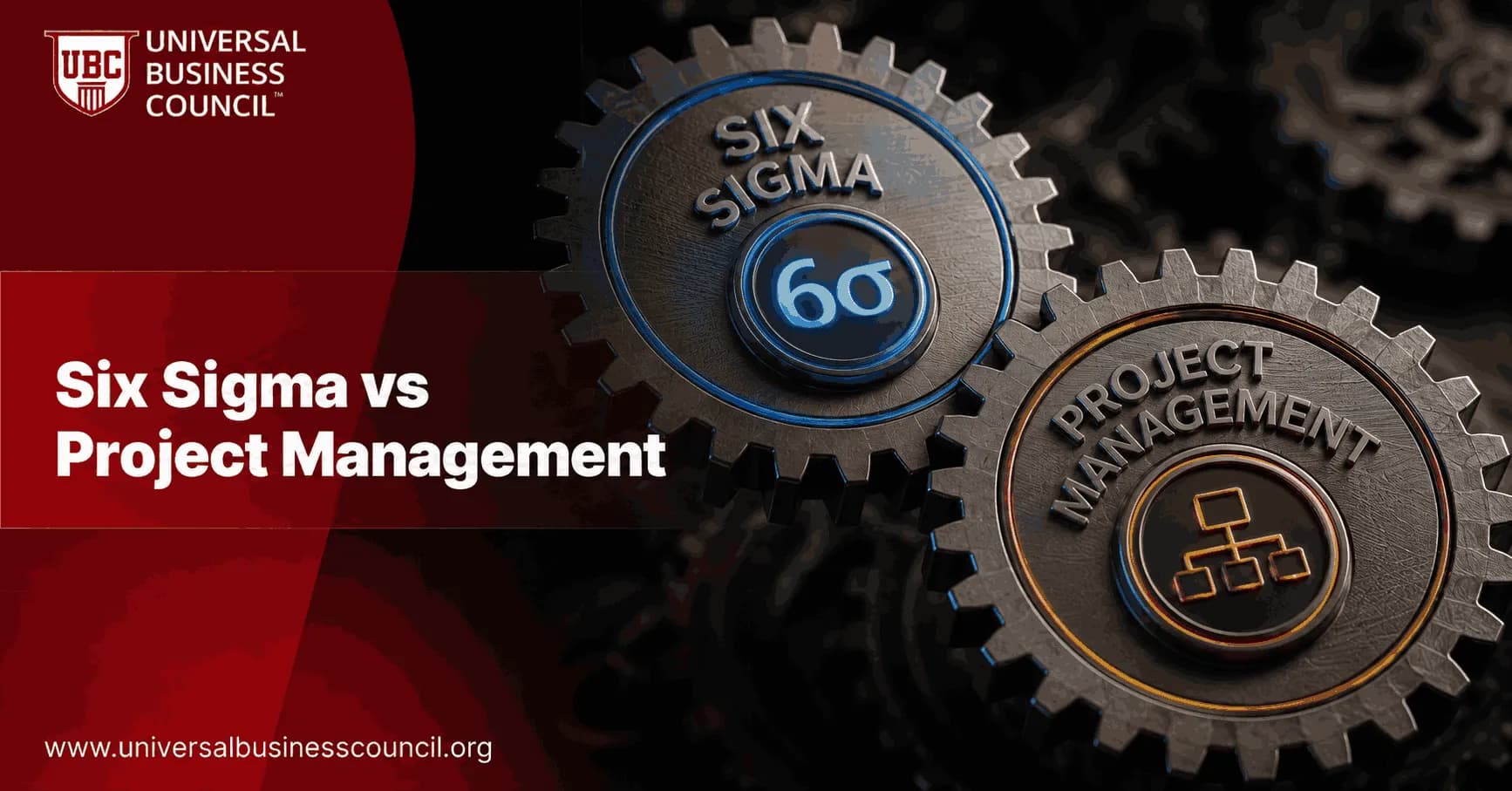
Six Sigma vs Project Management is not a choice between quality and delivery. It is a choice of primary lens. Six Sigma improves repeatable processes by reducing variation and defects. Project management plans and controls temporary work so teams can deliver scope, cost, schedule, risk, and stakeholder outcomes. Professionals who want to build credibility in the process-improvement side of this equation often start with a Certified Six Sigma Expert credential, which lays the statistical and root-cause foundation this comparison depends on.
The best operators know where the line sits. If customer invoices keep going out with errors, use Six Sigma. If you are implementing a new billing platform, use project management. If the platform rollout must also cut billing defects, use both.

Six Sigma vs Project Management: The Core Difference
Six Sigma is a data-driven process improvement discipline. It uses statistics, root cause analysis, and control methods to improve quality. Six Sigma performance is often described as 99.99966 percent defect-free output, commonly linked to 3.4 defects per million opportunities under the long-term convention used in quality management.
Project management, as defined by the Project Management Institute, applies knowledge, skills, tools, and techniques to project activities to meet requirements. The emphasis is not only technical delivery. It includes governance, stakeholder alignment, budget control, schedule control, and change management.
Here is the blunt version: Six Sigma asks, why does this process keep failing? Project management asks, how do we deliver this defined outcome?
Methods: DMAIC Compared With Project Delivery Frameworks
Leaders who move between these two disciplines, or manage teams that do, often round out their skills with broader Management Certifications that cover governance, stakeholder alignment, and decision rights, the softer skills that neither DMAIC nor a delivery framework fully teaches on its own.
How Six Sigma Works
Most Six Sigma projects follow DMAIC:
Define: Clarify the problem, customer requirements, project scope, and critical-to-quality measures.
Measure: Collect baseline data and check whether the measurement system can be trusted.
Analyze: Identify root causes using statistical and practical evidence.
Improve: Test and implement changes that reduce variation or waste.
Control: Put monitoring, ownership, and response plans in place so gains do not fade.
A detail that trips people up in exams and in real projects: control limits are not specification limits. Control limits come from process behavior. Specification limits come from customer or engineering requirements. Mix those up and you make bad calls, especially when a process is stable but still fails what the customer actually expects.
Lean Six Sigma adds waste reduction through tools such as value stream mapping, standard work, and flow analysis. That is why it fits manufacturing, healthcare, logistics, finance operations, and service workflows where defects, waiting, rework, and handoff delays are visible in the data.
How Project Management Works
Project management uses different methods depending on the work:
Waterfall: Best for predictable work with defined requirements, formal approvals, and compliance gates.
Agile: Useful when requirements change, customer feedback matters, and iterative delivery is possible.
Hybrid: Often the most practical model. Agile teams build in sprints while leadership still needs milestones, budgets, risk logs, and governance reviews.
Scaled Agile: Frameworks such as SAFe are used by large organizations coordinating many teams across portfolios.
Hybrid project management is not a buzzword. In regulated healthcare technology, for example, teams may run product discovery in sprints but still pass through validation, privacy, procurement, and legal checkpoints. Pure Agile would be naive there. Pure Waterfall may be too slow.
Tools: What You Actually Use
Common Six Sigma Tools
Six Sigma tools are built to expose variation, prove causes, and sustain improvement:
SIPOC diagrams for supplier, input, process, output, and customer clarity
Process maps and value stream maps to identify waste and handoff delays
Cause and effect diagrams for structured root cause thinking
Control charts to separate normal variation from special cause variation
Capability analysis to compare process performance with customer requirements
Measurement System Analysis to check whether data collection is reliable
Design of Experiments for testing multiple factors without guesswork
Digital Lean Six Sigma now adds machine learning, IoT data, robotic process automation, and predictive analytics. The point is not to decorate DMAIC with technology. The point is faster detection, better root cause evidence, and tighter control. As these tools lean more on connected systems and automated data pipelines, some practitioners pair their Six Sigma skills with a Deep Tech Certification to better understand the underlying technology generating the data they act on.
Common Project Management Tools
Project managers work with planning and coordination tools:
Work breakdown structures for scope decomposition
Gantt charts and critical path analysis for schedule planning
Risk registers for threat tracking and response ownership
Stakeholder maps and communication plans
Product backlogs, sprint boards, Kanban boards, and burndown charts
Platforms such as Jira, Microsoft Project, ClickUp, Asana, Power BI, Salesforce, and ServiceNow
The hidden budget burner is not always a bad vendor or a missed task. It is often unclear decision rights. A project can lose three weeks while five directors debate a scope change that should have had one accountable owner.
Career Paths and Salary Outlook
Six Sigma Careers
Six Sigma career paths commonly follow belt levels. Yellow Belts support projects. Green Belts lead smaller improvements. Black Belts lead complex, cross-functional initiatives. Master Black Belts coach, govern portfolios, and build organizational capability.
Roles include process improvement manager, quality manager, operational excellence leader, continuous improvement consultant, healthcare quality analyst, manufacturing quality engineer, and transformation lead. Salary surveys from training providers and labor market sources often place United States Green Belt and Black Belt roles in strong six-figure ranges, with Master Black Belt roles higher in senior operational settings.
Universal Business Council's Certified Six Sigma Expert gives readers structured coverage of DMAIC, Statistical Process Control, process capability, Measurement System Analysis, AI powered quality analytics, and enterprise process optimization.
Project Management Careers
Project management careers include project manager, program manager, portfolio manager, PMO director, delivery manager, Scrum Master, and transformation program lead. The US Bureau of Labor Statistics reported a median annual wage of $100,750 for project management specialists in May 2024.
PMP certification is widely associated with a salary premium. PMI's salary research has reported that PMP holders earn materially higher median salaries than non-certified peers across many countries. Agile credentials can also help, especially in product, software, and digital transformation environments.
Which Path Should You Choose?
Choose Six Sigma if you like data, process behavior, root cause analysis, and measurable quality improvement. It is the better path when the business problem keeps coming back: defects, cycle time, rework, scrap, customer complaints, claim denials, missed service levels.
Choose project management if you prefer leading temporary initiatives with defined outcomes. It fits technology rollouts, construction, compliance programs, product launches, migrations, and strategic change.
Combine them if you want to lead transformation. This is the strongest option for operations leaders, consultants, product operations managers, and business improvement professionals. A Six Sigma practitioner who cannot manage stakeholders will struggle. A project manager who cannot read process data may deliver a project that fixes the wrong problem.
Next Step
If your work involves quality, operations, or process improvement, start with the Universal Business Council Certified Six Sigma Expert. If your role is broader leadership, pair it with related Universal Business Council management certifications or courses to build governance, stakeholder, and decision-making skills. For professionals whose process improvement work increasingly overlaps with software, data systems, or digital transformation, a general Tech Certification can help connect these operational skills with the technical foundation behind them. Then apply both methods to one real problem: define the metric, map the process, assign an owner, and track whether the change holds after 30 days.
FAQs
1. What is the difference between Six Sigma and project management?
Six Sigma is a data-driven methodology for improving processes, reducing defects, and controlling variation. Project management is the discipline of planning, organizing, executing, and controlling temporary initiatives to achieve defined objectives.
A Six Sigma initiative may be managed as a project, but not every project is a Six Sigma project.
2. What is Six Sigma?
Six Sigma is a structured process-improvement methodology that uses data to understand process performance, identify root causes, implement improvements, and sustain results.
Its best-known framework is:
DMAIC: Define → Measure → Analyze → Improve → Control
Six Sigma is particularly useful for recurring problems involving defects, errors, variation, quality, cost, or inconsistent performance.
3. What is project management?
Project management is the structured management of temporary work intended to create a defined product, service, result, or organizational change.
Project Managers typically coordinate:
Scope + Schedule + Cost + Resources + Risk + Quality + Stakeholders
Projects can include software implementations, construction, product launches, business transformations, system migrations, and process improvements.
4. Is Six Sigma a project management methodology?
Not primarily.
Six Sigma is fundamentally a process-improvement methodology, although Six Sigma improvements are frequently organized as projects.
Project management techniques can therefore support a Six Sigma initiative by managing schedules, resources, risks, communication, dependencies, and stakeholders.
The two disciplines are complementary rather than interchangeable.
5. What is the main difference between DMAIC and project management?
DMAIC structures the analytical journey required to improve an existing process:
Define → Measure → Analyze → Improve → Control
Project management structures how work is organized and delivered.
A Project Manager may focus on questions such as:
What must be delivered?
When must it be completed?
Who is responsible?
What resources are required?
A Six Sigma practitioner focuses more heavily on:
What is causing poor process performance, and what evidence supports the solution?
6. What tools are used in Six Sigma?
Common Six Sigma tools include:
SIPOC
Voice of the Customer
Critical-to-Quality analysis
Process mapping
Pareto charts
Fishbone diagrams
5 Whys
FMEA
Control charts
Process capability analysis
Measurement System Analysis
Hypothesis testing
Regression
Design of Experiments
These tools help practitioners measure and improve process performance.
7. What tools are used in project management?
Common project-management tools and techniques include:
Project charters
Work Breakdown Structures
Project schedules
Gantt charts
Critical path analysis
Resource plans
Budget tracking
RAID logs
Risk registers
RACI matrices
Status reports
Change-control processes
Stakeholder plans
Digital tools may include project-management, collaboration, reporting, and portfolio-management platforms.
8. What skills do Six Sigma professionals need?
Important skills include:
Process Analysis + Statistics + Root-Cause Analysis + Problem Solving + Data Analysis + Change Management
Green Belts and Black Belts may also need process capability analysis, hypothesis testing, FMEA, financial-benefit analysis, stakeholder management, and project leadership.
The emphasis is on improving measurable process outcomes.
9. What skills do Project Managers need?
Project Managers need skills in planning, scheduling, budgeting, risk management, stakeholder communication, leadership, resource coordination, problem solving, negotiation, and change control.
Depending on the industry, they may also need technical or domain expertise.
Their job is generally less about performing advanced statistical analysis and more about ensuring that complex work reaches a defined outcome within agreed constraints.
10. Where do Six Sigma and project management overlap?
Both disciplines can involve:
Project charters
Goal setting
Stakeholder management
Risk management
Team leadership
Communication
Milestone tracking
Business cases
Change management
Benefits measurement
The difference lies largely in emphasis.
Six Sigma adds deeper process and statistical analysis, while project management provides broader delivery and coordination disciplines.
11. Can a Project Manager use Six Sigma?
Yes.
Six Sigma can help Project Managers solve recurring process problems using data rather than assumptions.
For example, a Project Manager implementing a new customer-service platform may discover high variation in ticket-resolution times. Six Sigma techniques could help identify the underlying causes and determine which process changes actually improve performance.
12. Can a Six Sigma Black Belt work as a Project Manager?
Potentially.
Black Belts already develop skills in project leadership, stakeholder management, risk, communication, business cases, and cross-functional coordination.
However, broader Project Manager roles may require deeper knowledge of scheduling, budgeting, procurement, resource management, contracts, governance, and delivery methodologies.
Additional project-management training or experience may therefore be useful.
13. Which is better for operations careers: Six Sigma or project management?
Six Sigma can be particularly valuable for careers involving operations, manufacturing, quality, supply chain, continuous improvement, and operational excellence.
Project management is useful when professionals frequently lead implementations, transformations, launches, or other temporary initiatives.
Many operations professionals benefit from both because they need to improve existing processes and deliver changes to those processes.
14. Which is better for a career: Six Sigma or PMP?
Neither is universally better.
Six Sigma certifications emphasize process improvement and analytical problem solving.
PMP certification is associated with professional project-management knowledge and experience.
A professional targeting Operational Excellence or Continuous Improvement may benefit more directly from Six Sigma. Someone targeting dedicated Project or Program Manager positions may find project-management credentials more aligned.
Professionals whose work involves both can benefit from combining them.
15. What careers are available with Six Sigma certification?
Relevant roles can include:
Process Improvement Analyst
Quality Engineer
Process Engineer
Continuous Improvement Specialist
Operational Excellence Manager
Six Sigma Black Belt
Operations Manager
Quality Manager
Business Process Analyst
Lean Six Sigma Consultant
Transformation Manager
Six Sigma skills are particularly relevant where measurable process performance matters.
16. What careers are available in project management?
Project-management career paths can include:
Project Coordinator
Project Manager
Senior Project Manager
Program Manager
Portfolio Manager
PMO Manager
Transformation Manager
Implementation Manager
Delivery Manager
Project Director
Opportunities exist across technology, construction, finance, healthcare, manufacturing, consulting, government, and many other industries.
17. Should a Project Manager get Six Sigma certified?
It can be useful when the Project Manager works in operations, quality, manufacturing, healthcare, supply chain, financial services, or transformation environments where process improvement is important.
A Six Sigma certification can add structured analytical and root-cause skills to a Project Manager's delivery toolkit.
However, certification should align with actual career requirements rather than becoming another badge collected because LinkedIn had space available.
18. Should a Six Sigma professional learn project management?
Yes, particularly when leading complex cross-functional improvement initiatives.
Project-management skills can help Six Sigma professionals manage schedules, resources, dependencies, stakeholders, budgets, risks, and implementation activities.
Technical analysis may identify the correct improvement, but project-management discipline helps ensure that the improvement is actually delivered.
19. Can Six Sigma and project management be used together?
Yes.
A Six Sigma improvement can use DMAIC for problem solving while project-management methods govern execution.
For example:
DMAIC: Determines what needs to change and validates why.
Project Management: Coordinates who will make the change, when activities will occur, what resources are needed, and how delivery risks will be controlled.
This combination can be particularly effective for complex organizational improvements.
20. What is the best career path for combining Six Sigma and project management?
The strongest career strategy depends on whether you want to specialize in process performance, project delivery, or both.
For a Six Sigma-focused career, a typical path might be:
Operations/Quality Role → Green Belt → Improvement Projects → Black Belt → Continuous Improvement Manager → Operational Excellence Leader
The professional develops deeper expertise in:
DMAIC + Statistics + Process Capability + Root-Cause Analysis + Change Management
For a project-management-focused career, the progression may look more like:
Project Coordinator → Project Manager → Senior Project Manager → Program Manager → Portfolio/PMO Leadership
The professional develops deeper expertise in:
Planning + Scheduling + Budgeting + Risk + Resources + Stakeholders + Governance
For professionals who want both, the combined skill stack is particularly useful:
Project Management + Six Sigma + Data Analytics + Change Management + Domain Expertise
Consider a manufacturing company experiencing high order-fulfillment errors.
A Six Sigma practitioner may use DMAIC:
Define: Establish the defect problem.
Measure: Determine baseline error rates.
Analyze: Identify root causes.
Improve: Develop validated process changes.
Control: Sustain performance.
But suppose the solution requires:
New software
Employee training
Equipment changes
Vendor coordination
Process documentation
Multiple departmental rollouts
Now project-management capabilities become essential.
The delivery team needs:
Schedule → Budget → Resources → Dependencies → Risks → Communication → Implementation
The relationship can therefore be summarized as:
Six Sigma asks: “How do we improve this process?”
Project Management asks: “How do we successfully deliver this initiative?”
A useful career decision framework is:
Choose Six Sigma if you enjoy:
Data analysis, root-cause investigation, process optimization, quality, operational performance, and continuous improvement.
Choose Project Management if you enjoy:
Planning, coordination, leadership, stakeholder communication, resource management, and delivering complex initiatives.
Combine both if you want to lead business transformation.
Professionals who can diagnose process problems and deliver the resulting organizational changes can be valuable in operational excellence, transformation, consulting, manufacturing, healthcare, financial services, and technology.
The important distinction is that successful delivery does not automatically mean the underlying process improved, and excellent process analysis does not automatically mean the solution was successfully delivered.
Six Sigma without delivery discipline can produce a beautifully validated recommendation that never gets implemented.
Project management without process analysis can deliver a new version of the same broken process precisely on schedule.
Combining the two reduces the odds of either particularly human achievement.
Related Articles
View All
Six Sigma
Six Sigma in Project Management: Better Scope, Schedule, and Quality Control
Learn how Six Sigma in project management improves scope control, schedule reliability, and quality using DMAIC, CTQs, control charts, and change governance.
Six Sigma
Six Sigma Digital Quality Management: Tools, Systems, and Best Practices
Learn how Six Sigma digital quality management combines DMAIC, AI, process mining, IoT, and digital QMS platforms to improve quality.
Six Sigma
Six Sigma Career Path: Certifications, Roles, Salaries, and Skills
A practical guide to the Six Sigma career path, including belt levels, roles, salary ranges, required skills, and next steps for professionals.
Trending Articles
The Role of Blockchain in Ethical AI Development
How blockchain technology is being used to promote transparency and accountability in artificial intelligence systems.
AWS Career Roadmap
A step-by-step guide to building a successful career in Amazon Web Services cloud computing.
Top 5 DeFi Platforms
Explore the leading decentralized finance platforms and what makes each one unique in the evolving DeFi landscape.