

Six Sigma vs TQM: Which Quality Approach Fits Your Goal?
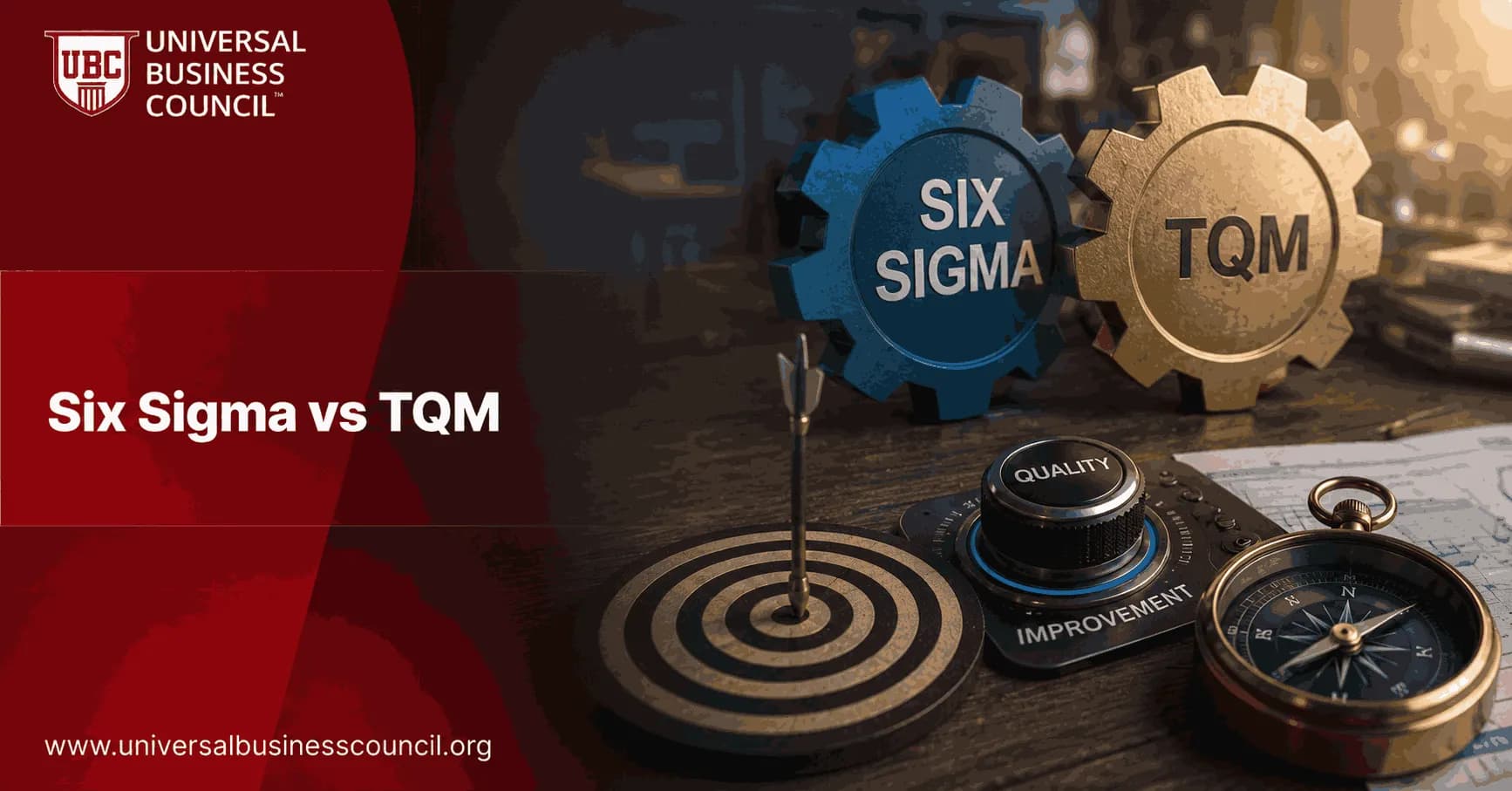
Six Sigma vs TQM is not a choice between data and culture. It is a choice about where to start. Six Sigma gives you a project method for reducing defects and variation. Total Quality Management, or TQM, gives you the management philosophy needed to make quality part of daily work. Professionals deciding where to invest their learning time often start with a focused credential like the Certified Six Sigma Expert program, since it builds the project discipline that makes the rest of this comparison easier to apply on the job.
Used well, they fit together. Used badly, either one becomes theater: charts nobody trusts, meetings nobody wants, and improvement boards that quietly die after the first quarter.

What Six Sigma Means
Six Sigma is a structured, data-driven quality method developed at Motorola in the 1980s and later made famous by General Electric in the 1990s. Its best-known benchmark is 3.4 defects per million opportunities, based on the common 1.5 sigma shift assumption used in Six Sigma teaching.
The standard roadmap is DMAIC:
Define the problem, customer need, and project scope.
Measure the current process with reliable data.
Analyze root causes, not symptoms.
Improve the process through tested changes.
Control the gains so the old problem does not return.
Six Sigma works best when defects are measurable. Think invoice errors, claim denials, late deliveries, software incident recurrence, lab turnaround time, or manufacturing scrap. If you cannot define a defect clearly, Six Sigma gets messy fast.
What TQM Means
Total Quality Management is broader. It grew from the work of quality thinkers such as W. Edwards Deming and Joseph Juran, and it focuses on customer satisfaction, leadership commitment, employee involvement, and continuous improvement across the full organization.
TQM is less about running a single project and more about how the organization behaves. Do managers ask for root cause or hunt for someone to blame? Are frontline employees allowed to stop a bad process? Are customer complaints treated as data or as noise? That is TQM territory.
Common TQM tools include quality circles, Pareto charts, fishbone diagrams, audits, benchmarking, standard work, and statistical process control. ISO 9001:2015 also reflects several TQM ideas, including customer focus, process control, evidence-based decisions, and continual improvement. Because TQM sits closer to how an organization is run day to day than to any single project, professionals building this side of their skill set often look at broader Management Certifications, which cover the leadership, process ownership, and organizational habits that a quality culture actually depends on.
Six Sigma vs TQM: Key Differences
Focus
Six Sigma targets variation and defect reduction in selected processes. TQM targets a long-term quality culture across the organization.
Structure
Six Sigma uses formal projects, roles, tollgates, and trained practitioners such as Green Belts and Black Belts. TQM spreads responsibility more widely, often through managers, teams, and frontline staff.
Metrics
Six Sigma favors hard measures: DPMO, sigma level, process capability, cost of poor quality, yield, cycle time, and defect rate. TQM may use those too, but it also tracks customer satisfaction, complaint trends, employee participation, audit findings, and service consistency.
Tools
Six Sigma uses statistical tools more heavily, including hypothesis testing, regression, control charts, measurement system analysis, and design of experiments. TQM uses a wider set of practical quality tools. To be blunt, many TQM teams never need advanced statistics. They need cleaner process ownership first.
Where Six Sigma Is the Better Fit
Choose Six Sigma when the problem is expensive, repeatable, and measurable. A claims team with a 9 percent rework rate is a good candidate. So is a warehouse with recurring picking errors, or a SaaS support team where escalations spike after each release.
One detail that trips up first-time project teams: the Measure phase is not just collecting whatever data is nearby. You need operational definitions. If one analyst counts a delayed order after 24 hours and another after 48 hours, your baseline is junk. I have seen teams lose weeks because the defect code named other hid half the real issue. When that kind of data quality problem comes from disconnected systems rather than sloppy definitions, the fix is often technical rather than procedural, and a Deep Tech Certification from Blockchain Council can help quality teams understand how tamper-evident, auditable data pipelines are built so a baseline stays trustworthy in the first place.
Six Sigma is also useful for professionals who want a clear skill path. If you are exploring Universal Business Council programs, look for related training in quality management, operations management, business analytics, and process improvement.
Where TQM Is the Better Fit
Choose TQM when the bigger issue is leadership behavior, inconsistent standards, weak customer focus, or low employee involvement. A Black Belt project cannot fix a culture where supervisors reward speed while asking for quality.
TQM is also the better starting point for smaller organizations that do not yet have clean process documentation. Before you run regression analysis, make sure the team agrees on the process steps, the customer requirement, and who owns the handoff.
Why the Best Organizations Combine Them
The practical answer to Six Sigma vs TQM is usually both. TQM sets the climate. Six Sigma supplies the project discipline.
Use TQM to build customer focus and shared quality habits.
Use Six Sigma for high-value defects where data can guide action.
Use ISO 9001, Lean, Agile, or DevOps practices where they fit the operating model.
Use dashboards carefully. If leaders only track savings, teams will avoid problems that matter but are hard to price.
Motorola, GE, Toyota, and Tata Steel come up often in quality management literature because they did not treat improvement as a single tool. They combined methods, governance, training, and leadership routines. That is the lesson worth copying.
Common Mistakes to Avoid
Running Six Sigma without sponsorship: Projects stall when process owners do not have authority to change the work.
Using TQM as a slogan: Posters about quality do not change queue time, defect rates, or customer complaints.
Overtraining specialists: A room full of certified people does not matter if no one selects the right projects.
Ignoring control plans: Many improvements fade because nobody audits the new process after 30, 60, and 90 days.
How to Choose Your Next Step
If your organization has clear process data and a costly defect, start with a Six Sigma DMAIC project. If your teams lack shared standards or managers treat quality as someone else's job, start with TQM principles and basic process discipline.
For your own development, pair a quality management foundation with practical analytics and project skills. Review Universal Business Council learning options in business management, operations, analytics, and process improvement, then apply one tool this week: define a defect, build a Pareto chart, and ask whether the top category is specific enough to act on. If your defects trace back to fragmented systems or unreliable data handoffs rather than process discipline alone, it is also worth looking at a Tech Certification from Global Tech Council, since fixing the underlying data and systems layer is sometimes the real prerequisite for any quality program to stick.
FAQs
1. What is the difference between Six Sigma and TQM?
Six Sigma and Total Quality Management (TQM) both aim to improve quality, but they differ in scope and approach.
Six Sigma uses structured methods, data, and statistical analysis to improve specific processes, reduce defects, and control variation.
TQM is a broader management philosophy that promotes customer focus, employee involvement, process quality, leadership commitment, and continuous improvement across an organization.
In simple terms:
Six Sigma → Structured process improvement
TQM → Organization-wide quality culture
2. What is Six Sigma?
Six Sigma is a data-driven methodology for improving measurable process performance.
Its best-known framework is DMAIC:
Define → Measure → Analyze → Improve → Control
Six Sigma practitioners use process analysis, root-cause methods, statistical tools, risk analysis, and process controls to address problems involving defects, variation, rework, cost, cycle time, and customer outcomes.
3. What is Total Quality Management?
Total Quality Management is an organization-wide approach to continuously improving products, services, processes, and customer satisfaction.
TQM commonly emphasizes:
Customer focus
Leadership commitment
Employee participation
Process management
Continuous improvement
Evidence-based decisions
Cross-functional collaboration
TQM treats quality as an organizational responsibility rather than something delegated exclusively to a quality department.
4. Is Six Sigma the same as TQM?
No.
Both share principles such as customer focus, process thinking, measurement, leadership, and continuous improvement, but their structures differ.
TQM is primarily a broad quality-management philosophy.
Six Sigma provides more explicitly structured improvement methodologies, specialized practitioner roles, project selection processes, and analytical techniques.
An organization can use both simultaneously.
5. Which is better: Six Sigma or TQM?
Neither is universally better.
Choose based on the problem.
TQM may fit when the goal is:
Building an enterprise-wide quality culture, increasing employee participation, strengthening customer focus, and embedding continuous improvement.
Six Sigma may fit when the goal is:
Solving measurable process problems, reducing defects, controlling variation, and validating root causes.
Organizations often benefit from combining the two.
6. How do Six Sigma and TQM differ in their approach to quality?
TQM generally takes an organization-wide, continuous approach to quality.
Six Sigma frequently uses defined projects to address specific performance gaps.
For example, TQM may encourage every department to continuously improve customer service.
A Six Sigma project might specifically target reducing customer-service resolution time from 48 hours to 24 hours while maintaining quality.
TQM establishes the broader expectation; Six Sigma provides a structured route to a defined result.
7. How does customer focus differ in Six Sigma and TQM?
Customer focus is central to both.
TQM emphasizes understanding and satisfying customers as a broad organizational principle.
Six Sigma often translates customer expectations into measurable Critical-to-Quality requirements.
For example:
Customer Need: Reliable delivery
↓
CTQ: Delivery within two business days
↓
Metric: On-time delivery percentage
↓
Improvement Target: Increase from 88% to 97%
This makes customer expectations measurable at the process level.
8. How does employee involvement differ between Six Sigma and TQM?
TQM typically encourages broad employee participation in quality and continuous improvement.
Six Sigma commonly uses more specialized roles, such as:
Champion → Master Black Belt → Black Belt → Green Belt → Team Members
Employees outside formal belt roles can still participate in Six Sigma projects.
The key difference is that TQM emphasizes widespread participation, while Six Sigma often adds trained specialists to lead more complex analytical improvements.
9. Which approach uses more statistical analysis?
Six Sigma generally places greater emphasis on statistical analysis.
Depending on the project, tools can include:
Control charts
Process capability analysis
Measurement System Analysis
Hypothesis testing
Regression
Design of Experiments
TQM can also use quantitative quality tools, but advanced statistical analysis is not necessarily central to every TQM initiative.
Statistics should serve the problem, naturally, rather than becoming ceremonial spreadsheet decoration.
10. How does leadership differ between TQM and Six Sigma?
TQM requires senior leadership to establish and sustain an organization-wide commitment to quality.
Six Sigma also requires leadership support, particularly for selecting projects, providing resources, removing barriers, and validating business benefits.
Six Sigma may additionally use defined roles such as Champions and Master Black Belts to connect improvement initiatives with business priorities.
Both approaches become considerably weaker when leadership treats quality as somebody else's department.
11. What is the difference between TQM continuous improvement and Six Sigma DMAIC?
TQM promotes continuous improvement as an ongoing organizational behavior.
Six Sigma's DMAIC provides a specific sequence for improving an existing process:
Define: Clarify the problem.
Measure: Establish baseline performance.
Analyze: Identify root causes.
Improve: Implement validated solutions.
Control: Sustain the improvement.
DMAIC can therefore operate as one structured improvement mechanism inside a broader continuous-quality culture.
12. Which approach is better for reducing defects?
Six Sigma is particularly well suited to complex defect problems where performance can be measured and root causes are unclear.
A team can quantify defects, analyze variation, identify causal factors, test solutions, and establish controls.
TQM can also reduce defects through quality culture, standardization, employee involvement, and continuous improvement.
For a specific high-impact defect problem, Six Sigma may provide greater analytical depth.
13. Which is better for building a quality culture?
TQM is more directly oriented toward building an organization-wide culture of quality.
It emphasizes that quality should be integrated into leadership, employee behavior, customer relationships, processes, and decision-making.
Six Sigma can reinforce that culture by creating trained improvement leaders and measurable success stories.
A technically sophisticated Six Sigma program without broad organizational participation can struggle to sustain improvements.
14. How do Six Sigma and TQM approach Cost of Poor Quality?
Both can address Cost of Poor Quality (COPQ).
Six Sigma frequently quantifies losses such as:
Scrap + Rework + Downtime + Returns + Warranty + Complaints
Teams can then use DMAIC to identify and reduce the causes of those losses.
TQM addresses COPQ more broadly by promoting prevention, customer focus, process discipline, employee involvement, and continuous improvement throughout the organization.
15. Can Six Sigma and TQM be used in service industries?
Yes.
Both approaches can be applied beyond manufacturing.
Potential applications include:
Healthcare: Patient waiting times and administrative errors.
Banking: Transaction errors and loan-processing delays.
Insurance: Claims accuracy and processing time.
Logistics: Delivery reliability.
Technology: Service incidents and support performance.
Government: Service delivery and administrative processes.
The relevant metrics simply need to reflect the service process.
16. Can TQM and Six Sigma be used together?
Yes, and their strengths can complement each other.
A useful model is:
TQM → Quality Culture
↓
Performance Monitoring
↓
Complex Quality Problem
↓
Six Sigma DMAIC
↓
Validated Improvement
↓
Standardized Process
↓
Continuous TQM Monitoring
TQM creates broad commitment to quality, while Six Sigma provides analytical depth for selected problems.
17. What are the limitations of Six Sigma compared with TQM?
Six Sigma can become overly project-focused if it is disconnected from broader organizational culture.
Other potential limitations include excessive bureaucracy, inappropriate use of statistical methods, poor project selection, or overemphasis on belt certifications.
Six Sigma is most effective when projects support customer and business priorities rather than existing merely to demonstrate that the organization owns several DMAIC templates.
18. What are the limitations of TQM compared with Six Sigma?
TQM initiatives can become too broad or difficult to measure when objectives are not translated into specific performance targets.
Organizations may strongly endorse “continuous quality improvement” without defining which processes need improvement, who owns them, or what measurable results are expected.
Six Sigma can strengthen TQM by introducing clearer project selection, metrics, analytical methods, roles, and financial accountability.
19. Which approach is better for a quality career: Six Sigma or TQM?
Six Sigma certification can provide a more defined professional credential and structured skill path through Green Belt, Black Belt, and Master Black Belt levels.
TQM knowledge remains valuable for understanding enterprise quality culture, customer focus, leadership, and continuous improvement.
A broader quality-career skill set may include:
TQM + Six Sigma + Lean + QMS/ISO 9001 + Data Analysis + Risk Management + Change Management
Real project experience remains particularly important.
20. How should an organization choose between Six Sigma and TQM?
Begin with the organization's goal.
If the primary goal is:
Build an organization-wide quality culture
→ TQM principles may provide the broader foundation.
If the goal is:
Reduce a recurring defect rate
→ Six Sigma DMAIC may be appropriate.
If the goal is:
Reduce process variation
→ Six Sigma may provide the required analytical depth.
If the goal is:
Increase employee participation in continuous improvement
→ TQM can provide the broader philosophy.
If the organization needs both cultural transformation and rigorous problem solving:
→ Combine TQM and Six Sigma.
Consider a manufacturer facing inconsistent product quality.
At the enterprise level, TQM can establish:
Customer Focus
↓
Leadership Commitment
↓
Employee Participation
↓
Process Ownership
↓
Continuous Improvement
Performance monitoring then reveals:
Defect Rate = 7%
Target = Below 2%
Annual Cost of Poor Quality = $1.2 million
This specific performance gap can become a Six Sigma project.
The team follows:
Define
Establish the problem, customer impact, business case, scope, and goal.
Measure
Validate data and determine baseline defect performance.
Analyze
Identify and validate the causes of defects.
Improve
Test and implement solutions.
Control
Standardize the improved process and monitor future performance.
The improved process then returns to the broader quality-management environment.
This produces a continuous cycle:
TQM Culture
→ identifies and supports improvement
Six Sigma DMAIC
→ solves complex measurable problems
Standardization
→ embeds improvements
TQM Continuous Improvement
→ monitors and improves further
The choice can therefore be summarized as:
Factor | Six Sigma | TQM |
|---|---|---|
Primary Focus | Process performance | Organization-wide quality |
Approach | Structured projects | Management philosophy |
Main Framework | DMAIC/DMADV | Continuous improvement principles |
Statistics | Strong emphasis | Varies |
Employee Involvement | Defined project roles | Broad participation |
Customer Focus | CTQs and metrics | Organization-wide principle |
Project Structure | High | Less prescriptive |
Best Fit | Complex measurable problems | Quality culture |
Financial Measurement | Often explicit | Varies |
Certification Path | Common | Less standardized |
The strongest enterprise model is often not Six Sigma versus TQM, but:
TQM + Six Sigma
TQM provides the cultural foundation.
Six Sigma provides the analytical improvement engine.
TQM helps ensure quality is everyone's responsibility.
Six Sigma helps ensure difficult quality problems are solved using evidence rather than opinion.
Used poorly, TQM can become a collection of admirable slogans, while Six Sigma can become a collection of belts and statistical presentations.
Used together, they can connect quality culture, customer requirements, process performance, employee participation, and measurable business results.
That is a considerably more useful goal than spending six meetings deciding which quality acronym gets to own the problem.
Related Articles
View All
Six Sigma
Six Sigma vs Quality Management: Where Six Sigma Fits
Six Sigma vs Quality Management explained: learn how Six Sigma fits within quality systems as a data-driven method for reducing defects and variation.
Six Sigma
Six Sigma vs Lean Six Sigma: Which Approach Fits Your Goals?
Compare Six Sigma vs Lean Six Sigma by goals, tools, metrics, culture, and use cases so you can choose the right improvement path.
Six Sigma
Six Sigma Cost of Poor Quality: Finding Hidden Losses
Six Sigma Cost of Poor Quality explains how defects, rework, downtime, and lost customers hide real financial losses inside everyday operations.
Trending Articles
The Role of Blockchain in Ethical AI Development
How blockchain technology is being used to promote transparency and accountability in artificial intelligence systems.
AWS Career Roadmap
A step-by-step guide to building a successful career in Amazon Web Services cloud computing.
Top 5 DeFi Platforms
Explore the leading decentralized finance platforms and what makes each one unique in the evolving DeFi landscape.