

Six Sigma vs Scrum: Quality Improvement and Iterative Delivery Compared
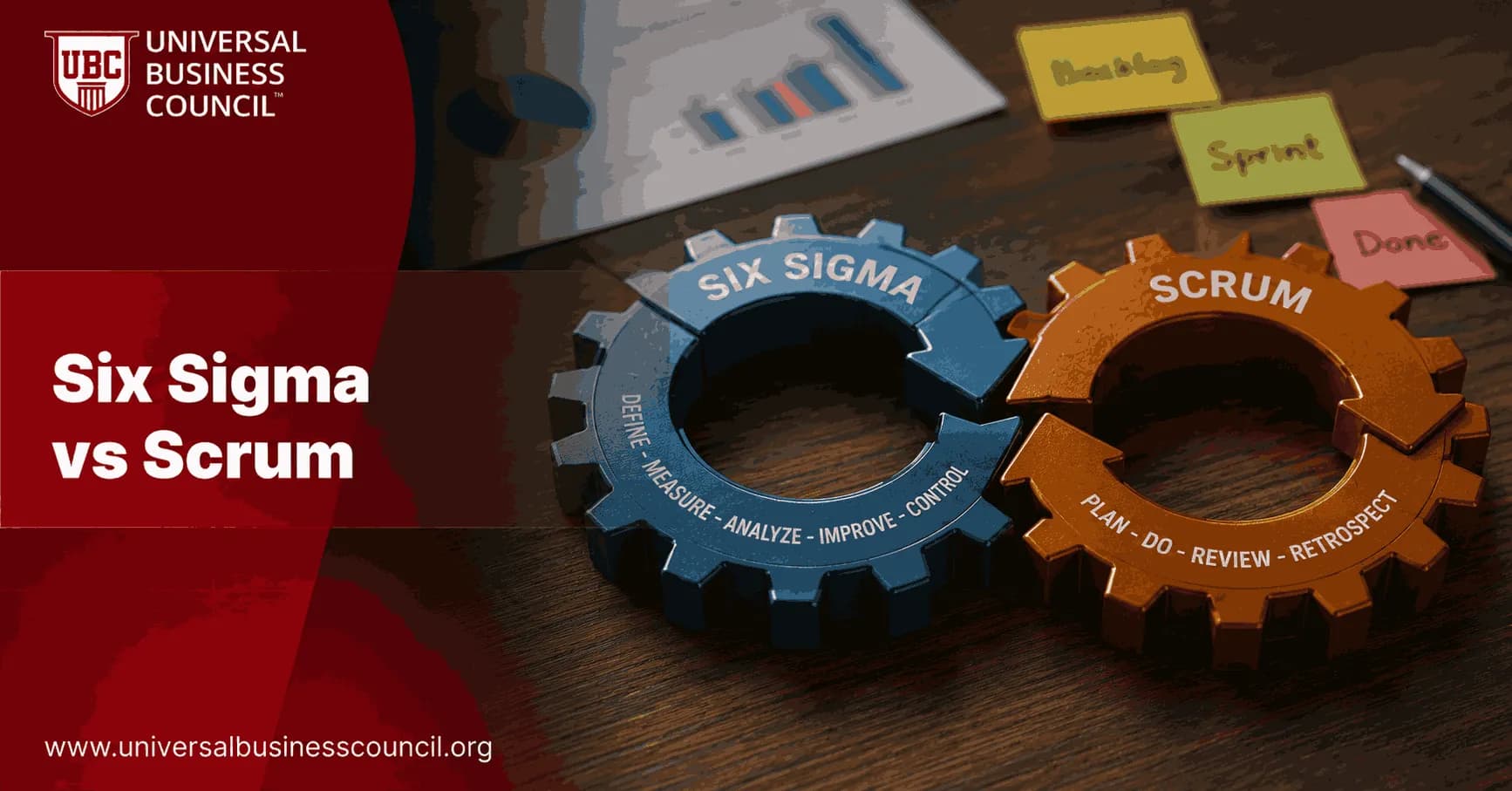
Six Sigma vs Scrum is not a contest between old and new management thinking. It is a choice between two different kinds of improvement. Six Sigma reduces variation in repeatable processes. Scrum helps teams deliver useful work in short cycles when requirements are still moving. Professionals mapping out which skill to build first often start with a focused credential like the Certified Six Sigma Expert program, since it gives you the measurement discipline to recognize which of these two problems you are actually facing.
Pick the wrong one and you will feel it quickly. A Scrum team can ship every two weeks and still keep producing the same defect pattern. A Six Sigma team can build a careful DMAIC project and still move too slowly for a product market that changes every month.

What Six Sigma Is Built to Do
Six Sigma is a data-driven method for reducing defects and process variation. Motorola developed it in the mid-1980s, and it later spread into manufacturing, operations, healthcare, logistics, financial services, and IT operations.
The core improvement cycle is DMAIC:
Define the business problem and critical-to-quality requirements.
Measure the current process and baseline performance.
Analyze root causes using data, not opinion.
Improve the process through tested changes.
Control the new process so performance does not drift back.
For new process design, teams often use DMADV: Define, Measure, Analyze, Design, Verify. The work is usually led by trained Green Belts or Black Belts who understand statistics, process capability, control charts, defect analysis, and root cause methods such as fishbone diagrams and 5 Whys.
This is why Six Sigma fits stable processes. If your team processes 40,000 invoices per month, manufactures components, runs claims approvals, or manages service desk tickets, you can measure defects and variation with discipline. That is Six Sigma territory.
What Scrum Is Built to Do
Scrum is an Agile framework for complex work, especially product and software development. The Scrum Guide describes it as a lightweight framework built on transparency, inspection, and adaptation.
Scrum teams work in short cycles called sprints, commonly two to four weeks. Work is pulled from a product backlog. Each sprint aims to produce a usable increment, then the team inspects the result with stakeholders and adapts the next plan.
Scrum has three accountabilities:
Product Owner: orders the backlog and focuses the team on value.
Scrum Master: coaches the team and removes delivery barriers.
Developers: create the increment and manage the technical work.
Scrum works well when discovery matters. Think SaaS features, mobile apps, digital customer journeys, marketing experiments, internal platforms, and innovation projects. If nobody can define the final answer on day one, Scrum gives you a practical cadence for learning. Since Scrum leadership leans as much on facilitation and stakeholder management as it does on ceremonies, professionals building this side of their profile often look at broader Management Certifications, which cover the leadership and delivery-management skills that keep a Scrum team functional beyond the mechanics of sprints.
Six Sigma vs Scrum: The Core Differences
The simplest split is this: Six Sigma improves how work performs. Scrum improves how work is delivered.
Aspect | Six Sigma | Scrum |
|---|---|---|
Main goal | Reduce defects, waste, and variation | Deliver value in short cycles |
Best environment | Stable, repeatable processes | Complex work with changing needs |
Time rhythm | Often 3 to 6 month projects | Usually 2 to 4 week sprints |
Evidence used | Statistical analysis and process data | Customer feedback, sprint results, team inspection |
Success metrics | DPMO, defect rate, process capability, CTQ performance | Sprint goal achievement, increment quality, cycle time, stakeholder value |
Leadership model | Certified Belts lead structured improvement work | Self-managing teams work through defined Scrum accountabilities |
Here is a practical warning. In Six Sigma training, candidates often mix up defects per unit with defects per million opportunities. In Scrum workshops, the common mistake is different: leaders treat velocity as a performance target. That backfires. The moment velocity becomes a KPI for appraisal, estimates get inflated and trust drops.
Quality Improvement vs Iterative Delivery
How Six Sigma Creates Quality
Six Sigma quality comes from control. You define CTQ measures, collect reliable data, find root causes, test improvements, and lock the gains into the process. It is not quick tinkering. It is disciplined improvement.
Use Six Sigma when the cost of variation is high. A hospital discharge process, a loan approval workflow, or an aerospace part inspection process should not depend on creative interpretation every week. You want consistency.
How Scrum Creates Quality
Scrum quality comes from frequent inspection. The team builds, reviews, tests, and adapts. Defects surface earlier because work is sliced smaller. Feedback arrives before months of effort are spent in the wrong direction.
That said, Scrum does not automatically create high quality. Weak engineering practices, vague acceptance criteria, and skipped retrospectives will damage any Scrum implementation. To be blunt, daily stand-ups do not fix poor product thinking. When the weak engineering practices trace back to the underlying tech stack, especially in teams working with distributed systems or blockchain-based products, a Deep Tech Certification from Blockchain Council can help close that gap, since sprint discipline alone will not fix quality problems rooted in unfamiliar architecture.
When to Choose Six Sigma
Choose Six Sigma when you need measurable improvement in a process that already exists.
You have enough data to study variation.
The process is repeated often.
The cost of defects is visible.
Requirements are reasonably stable.
Leadership wants audited, controlled improvement.
Six Sigma is a strong fit for operations managers, quality analysts, process improvement specialists, supply chain professionals, and service leaders. If this is your path, look at Universal Business Council learning routes tied to Six Sigma, quality management, operations management, and business analysis.
When to Choose Scrum
Choose Scrum when the work involves uncertainty and customer feedback should shape the next move.
You are building a product or digital service.
Priorities change based on evidence.
Stakeholders need regular visibility.
The team can deliver usable increments.
Learning speed matters more than fixed upfront planning.
Scrum is a better fit for product managers, Scrum Masters, software teams, delivery managers, UX teams, and technology leaders. Universal Business Council courses in project management, Agile delivery, leadership, and digital business support this career direction.
Can You Combine Six Sigma and Scrum?
Yes. In many enterprises, the best answer is not Six Sigma or Scrum. It is both, used in the right place.
A useful hybrid pattern looks like this:
Use Scrum to deliver product increments and expose workflow problems.
Use sprint retrospectives to spot recurring defects, delays, or rework.
Apply DMAIC to one serious process issue, such as escaped defects or long approval queues.
Implement the improvement through future sprints.
Track whether cycle time, defect rate, or customer satisfaction actually improves.
This works especially well in IT and digital operations. For example, a Scrum team may find that release delays are not caused by coding speed. The real issue might be environment instability, test data access, or approval batching. Scrum reveals the pain. Six Sigma can analyze and reduce it.
Six Sigma vs Scrum Certification: Which Should You Pursue?
If your career goal is operational excellence, process improvement, or quality leadership, start with Six Sigma. You will need comfort with measurement, statistical thinking, and structured problem solving.
If your goal is Agile delivery, product development, or technology leadership, start with Scrum. You will need facilitation skill, backlog discipline, stakeholder management, and a clear grasp of empirical delivery.
If you work in an enterprise where product teams depend on operational performance, pursue both over time. That combination is valuable. You can talk to engineers about sprints and to executives about defect cost, cycle time, and control plans.
Next Step
Map your current work before choosing a framework. If the problem is variation in a repeatable process, study Six Sigma. If the problem is uncertain delivery with changing requirements, study Scrum. If both problems exist, build a dual skill plan through Universal Business Council certification and course options in Six Sigma, project management, Agile practices, and business management. And if the recurring delivery issues you uncover keep tracing back to infrastructure, tooling, or platform gaps rather than process or ceremony, a Tech Certification from Global Tech Council is worth adding to that plan, since some delivery problems need a technical fix, not another retrospective.
FAQs
1. What is the difference between Six Sigma and Scrum?
Six Sigma is a data-driven process-improvement methodology focused on reducing defects, controlling variation, and improving measurable process performance. Scrum is a lightweight framework for helping teams address complex problems through iterative, incremental delivery and frequent inspection and adaptation.
A simple distinction is:
Six Sigma → Improve process performance
Scrum → Deliver and adapt complex work iteratively
They can complement each other when an organization needs both disciplined quality improvement and rapid learning.
2. What is Six Sigma?
Six Sigma is a structured methodology for improving existing processes using data, root-cause analysis, and statistical techniques.
Its best-known framework is DMAIC:
Define → Measure → Analyze → Improve → Control
Six Sigma can address problems involving defects, rework, process variation, cycle time, cost, quality, and customer outcomes.
It is used across manufacturing, healthcare, financial services, supply chain, technology, and other industries.
3. What is Scrum?
Scrum is a framework for developing and sustaining complex products through short, iterative cycles called Sprints.
Scrum includes three accountabilities:
Product Owner
Scrum Master
Developers
It also uses events such as Sprint Planning, the Daily Scrum, Sprint Review, and Sprint Retrospective.
The goal is to create usable increments, inspect results frequently, and adapt based on what teams learn.
4. Is Scrum a quality-improvement methodology like Six Sigma?
Not in the same sense.
Scrum can support better quality through frequent feedback, clear quality expectations, iterative delivery, inspection, and adaptation.
However, Six Sigma is specifically designed for structured process improvement and often provides deeper analytical methods for identifying and reducing variation and defects.
Scrum helps teams learn and deliver iteratively. Six Sigma helps teams diagnose and improve process performance.
5. What is the difference between DMAIC and Scrum Sprints?
DMAIC structures a process-improvement investigation:
Define → Measure → Analyze → Improve → Control
A Scrum Sprint is a fixed-length period during which a team works toward a Sprint Goal and creates a usable Increment.
DMAIC phases answer different analytical questions.
Sprints create repeated cycles of:
Plan → Build → Inspect → Adapt
A Six Sigma project may last weeks or months, while Scrum uses recurring Sprints throughout product development.
6. Which is better: Six Sigma or Scrum?
Neither is universally better because they address different needs.
Use Six Sigma when you need to:
Reduce defects
Analyze process variation
Identify unknown root causes
Improve process capability
Reduce Cost of Poor Quality
Stabilize recurring processes
Use Scrum when you need to:
Develop complex products
Deliver incrementally
Respond to changing requirements
Obtain frequent stakeholder feedback
Learn through short delivery cycles
Choose according to the problem, not the popularity of the framework.
7. Can Six Sigma and Scrum be used together?
Yes.
For example, a Scrum team developing a digital product may repeatedly experience high production defect rates.
Six Sigma techniques can investigate why those defects occur.
The resulting improvements can then be implemented incrementally through Scrum.
A combined loop might look like:
Scrum Delivery → Performance Problem → Six Sigma Analysis → Improvement Backlog → Scrum Implementation → Measurement
The two approaches can therefore reinforce each other.
8. How do Six Sigma and Scrum approach customer needs?
Both value customer outcomes, but they approach them differently.
Six Sigma may use:
Voice of the Customer → Critical-to-Quality Requirements → Process Metrics
Scrum uses the Product Goal, Product Backlog, stakeholder feedback, Sprint Reviews, and incremental delivery to help teams adapt toward valuable outcomes.
Six Sigma translates requirements into measurable quality characteristics.
Scrum supports repeated learning about what stakeholders and users need.
9. How do Six Sigma and Scrum approach data?
Six Sigma typically emphasizes quantitative process data.
Practitioners may analyze:
Defect rates
Cycle times
Variation
Process capability
Control charts
Hypothesis tests
Regression
Experimental results
Scrum teams use evidence about product outcomes and delivery to inspect progress and adapt.
The statistical depth is generally much greater in Six Sigma.
10. How does quality work in Scrum?
Scrum expects each Increment to meet the team's Definition of Done.
Quality can be supported through practices such as:
Automated Testing + Code Review + Continuous Integration + Security Testing + Acceptance Criteria
Many of these engineering practices are complementary to Scrum rather than prescribed by the Scrum framework itself.
Scrum creates frequent opportunities to inspect the product and working approach, while technical practices help teams build quality into each Increment.
11. How does quality work in Six Sigma?
Six Sigma focuses on measurable process quality.
A typical sequence is:
Customer Requirement
↓
Critical-to-Quality Metric
↓
Baseline Performance
↓
Root-Cause Analysis
↓
Validated Improvement
↓
Process Control
The objective is not merely to detect defects but to understand and reduce the process conditions producing them.
12. Which is better for software development: Scrum or Six Sigma?
Scrum is generally more directly aligned with iterative software and product development.
Six Sigma can add value when software organizations need to improve recurring processes such as:
Defect management
Incident resolution
Release reliability
Support operations
Testing processes
Deployment failures
A software organization can therefore use Scrum for product delivery and Six Sigma selectively for complex process-performance problems.
13. Which is better for manufacturing: Six Sigma or Scrum?
Six Sigma is generally more directly applicable to manufacturing processes involving defects, yield, variation, scrap, rework, and process capability.
Scrum can still be useful for certain product-development, engineering, innovation, or digital initiatives within manufacturing organizations.
The appropriate approach depends on whether the work involves optimizing a repeatable process or managing complex iterative development.
14. How do Six Sigma and Scrum handle change?
Scrum expects learning and adaptation throughout product development. Teams inspect outcomes frequently and adjust the Product Backlog and plans as needed.
Six Sigma handles change through structured problem solving and validated process improvement.
A Six Sigma team generally seeks evidence that a proposed change addresses verified causes and improves the target metric.
Scrum emphasizes adaptability.
Six Sigma emphasizes validated improvement.
15. How do Six Sigma and Scrum approach team roles?
Six Sigma commonly uses roles such as:
Champion → Master Black Belt → Black Belt → Green Belt → Project Team
Scrum defines:
Product Owner → Scrum Master → Developers
Six Sigma roles often reflect improvement expertise and project responsibility.
Scrum accountabilities support product value, team effectiveness, and creation of usable product Increments.
Organizations should avoid casually renaming one framework's roles to fit another. Acronym fusion rarely improves governance.
16. What is the difference between a Scrum Master and a Six Sigma Black Belt?
A Scrum Master helps establish Scrum, improve team effectiveness, remove or address impediments, and support productive interactions within the organization.
A Six Sigma Black Belt typically leads complex process-improvement projects using DMAIC, analytical methods, and change-management skills.
A simplified distinction is:
Scrum Master → Scrum effectiveness and team enablement
Black Belt → Data-driven process improvement leadership
Both require facilitation and influence, but their technical responsibilities differ.
17. Which certification is better for a career: Scrum or Six Sigma?
It depends on the target career.
Scrum-related credentials may align more directly with:
Product Development + Agile Delivery + Technology + Scrum Master Roles
Six Sigma credentials may align with:
Quality + Operations + Manufacturing + Supply Chain + Continuous Improvement + Operational Excellence
Professionals working in digital transformation or operational technology may benefit from understanding both.
18. Can Six Sigma slow down Scrum teams?
It can if organizations force full DMAIC analysis onto every small product decision or defect.
Not every issue requires a formal Six Sigma project.
Six Sigma is most appropriate when a problem is recurring, measurable, important, and has unclear causes.
Teams should use the lightest method that provides sufficient evidence.
Adding twelve statistical analyses to a problem with an obvious solution is not rigor. It is paperwork wearing safety goggles.
19. Can Scrum improve Six Sigma implementation?
Yes.
Scrum-inspired iterative delivery practices can help improvement teams test and deploy solutions incrementally where the context allows it.
Instead of implementing a large process redesign all at once, teams may test smaller changes, gather evidence, and adapt.
However, the approaches should be integrated thoughtfully rather than forcing DMAIC phases into artificial Sprints simply so two framework diagrams fit on the same presentation slide.
20. What is the best way to combine Six Sigma and Scrum?
Use each approach for the problem it handles best.
Consider a software company with a Scrum team delivering updates every two weeks.
The team observes:
Production Defect Rate = 9%
Target = Below 3%
Defects continue despite ordinary retrospectives and engineering improvements.
This creates a candidate for deeper analysis.
A Six Sigma improvement effort can begin.
Define
Establish:
Problem → Customer Impact → Business Impact → Scope → Goal
For example:
“Reduce production defects from 9% to below 3% within six months without reducing deployment frequency.”
Measure
Collect reliable data on:
Defect types
Release characteristics
Development stages
Test coverage
Rework
Escaped defects
Cycle time
Analyze
Identify and validate root causes.
Potential causes might include:
Requirement Ambiguity → Testing Gaps → Integration Failures → Environment Differences
The team should validate these causes rather than assuming them.
Improve
Convert validated improvements into actionable work.
For example:
Improvement Opportunity
↓
Product Backlog Items
↓
Sprint Planning
↓
Implementation During Sprints
↓
Usable Increment
Scrum becomes a delivery mechanism for implementing appropriate changes.
Control
Monitor whether performance remains improved.
Track measures such as:
Defect Rate | Escaped Defects | Rework | Deployment Frequency | Lead Time
The organization can then use Scrum's recurring inspection and adaptation cycles to reinforce ongoing learning.
The integrated model becomes:
Scrum Delivery
↓
Observe Performance
↓
Complex Recurring Problem
↓
Six Sigma DMAIC
↓
Validated Root Causes
↓
Improvement Backlog
↓
Scrum Sprints
↓
Incremental Implementation
↓
Measure Results
↓
Control and Adapt
This combination becomes especially useful when organizations distinguish between two kinds of uncertainty.
Product Uncertainty
“What should we build, and what will users value?”
Scrum can support iterative learning.
Process Uncertainty
“Why does this process keep producing inconsistent results?”
Six Sigma can provide deeper analytical investigation.
A practical selection framework is:
Need | Six Sigma | Scrum |
|---|---|---|
Reduce defects | Strong fit | Can support |
Reduce variation | Strong fit | Limited focus |
Root-cause analysis | Strong fit | Retrospectives can help |
Statistical analysis | Strong fit | Not core |
Iterative delivery | Not core | Strong fit |
Changing requirements | Limited focus | Strong fit |
Product development | Can support | Strong fit |
Process capability | Strong fit | Not core |
Frequent feedback | Can support | Strong fit |
Process control | Strong fit | Not core |
For professionals, the two paths also develop different capabilities.
A Six Sigma-oriented path might be:
Green Belt → Black Belt → Continuous Improvement → Operational Excellence
A Scrum-oriented path might involve:
Product/Delivery Team Experience → Scrum Expertise → Agile/Product/Delivery Leadership
A combined skill profile can be valuable in transformation environments:
Scrum + Six Sigma + Data Analytics + Product Thinking + Change Management
The simplest distinction remains:
Scrum helps teams deliver, inspect, learn, and adapt.
Six Sigma helps teams measure, analyze, improve, and control process performance.
Use Scrum when uncertainty requires frequent learning and iterative delivery.
Use Six Sigma when a recurring measurable problem requires disciplined root-cause analysis.
Use both when a team needs to discover the right process improvement through evidence and implement that improvement incrementally.
Frameworks work rather well together once organizations stop demanding that one of them be declared the winner.
Related Articles
View All
Six Sigma
Six Sigma vs Kaizen: Continuous Improvement Approaches Compared
Compare Six Sigma vs Kaizen by focus, tools, cost, metrics, and use cases. Learn when to use each approach and how they work together.

Six Sigma
Six Sigma in Automotive: Quality Improvement Across the Value Chain
Learn how Six Sigma in Automotive improves design, manufacturing, supply chain, warranty, and service using DMAIC, Lean, Industry 4.0, and AI analytics.

Six Sigma
Six Sigma and Artificial Intelligence: The Future of Quality Improvement
Six Sigma and artificial intelligence are reshaping quality improvement with predictive analytics, real-time control, and stronger AI governance practices.
Trending Articles
The Role of Blockchain in Ethical AI Development
How blockchain technology is being used to promote transparency and accountability in artificial intelligence systems.
AWS Career Roadmap
A step-by-step guide to building a successful career in Amazon Web Services cloud computing.
Top 5 DeFi Platforms
Explore the leading decentralized finance platforms and what makes each one unique in the evolving DeFi landscape.