

Six Sigma Quality Improvement: A Roadmap for Measurable Results
Six Sigma quality improvement works when you treat it as a management discipline, not a statistics exercise. The useful question is not whether your team can draw a control chart. It is whether you can reduce defects, waiting time, rework, complaints, or cost in a way finance and customers can see. Professionals building this discipline often start with a focused credential like the Certified Six Sigma Expert program, since DMAIC fluency is what turns a statistics exercise into a management discipline finance can actually trust.
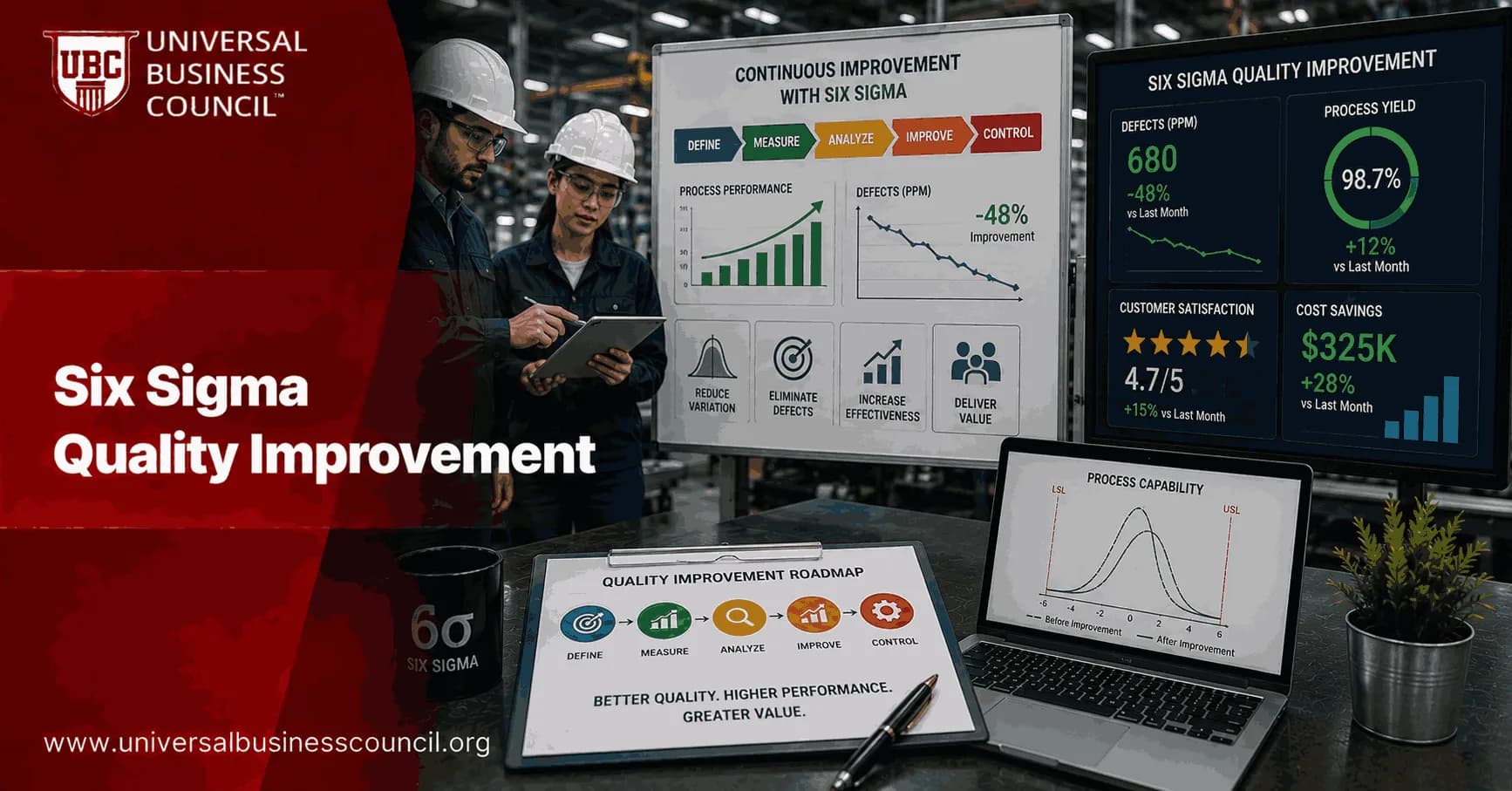
The method still matters. DMAIC, which stands for Define, Measure, Analyze, Improve, and Control, remains the backbone. What has changed is the operating environment. Teams now pull data from scanners, sensors, ERP systems, service desks, online forms, and dashboards. That makes Six Sigma quality improvement faster, but only if the data is trusted.

What Six Sigma Quality Improvement Means Now
Six Sigma began in manufacturing, with Motorola and later General Electric making it famous through defect reduction and cost savings. Today you will find it in hospitals, banks, logistics hubs, IT operations, public services, and shared service centers.
The American Society for Quality describes Six Sigma as a method for reducing variation and improving processes through data. That definition still holds. But modern practice usually blends Six Sigma with Lean tools such as value stream mapping, 5S, standard work, and mistake-proofing. In software and digital operations, teams often pair it with Agile routines so improvements can be tested in short cycles.
Here is the trade-off. DMAIC is excellent for fixing an existing process with measurable waste or variation. If you are designing a new service from scratch, DMADV, sometimes called Design for Six Sigma, may fit better. And if the problem is a one-off leadership decision, do not bury it in a 14-week project. Just fix it. Knowing which of these calls to make is a judgment skill that grows with leadership experience, which is why many practitioners pair Six Sigma training with broader Management Certifications, covering the sponsorship and decision-making habits that determine whether a project gets scoped correctly in the first place.
The Roadmap: From Business Goal to Controlled Result
1. Align the project with a real business outcome
Start with critical-to-quality measures, often called CTQs. These are the outcomes customers, regulators, or leadership actually care about: defect rate, cycle time, readmission rate, mis-sort percentage, claim rework, first-contact resolution, or on-time delivery.
A weak project says, improve invoice processing. A strong project says, reduce invoice rework from 11 percent to below 4 percent within two quarters without increasing headcount. That difference matters. It gives the sponsor, Black Belt, and process owner a shared target.
2. Measure before you diagnose
Small misses matter. I have watched teams spend two weeks debating root causes before anyone checked whether the timestamp fields in the workflow system were being used consistently. They were not. Half the records marked complete were sitting in a side queue, waiting for manual approval.
Before analysis, validate the measurement system. Define the defect. Confirm the denominator. Check the sampling rules. If two supervisors classify the same error differently, your Pareto chart is decoration.
Manufacturing: parts per million, scrap rate, machine downtime, first-pass yield.
Healthcare: patient wait time, readmission rate, medication documentation errors.
Finance: loan approval time, account opening defects, exception handling rate.
Logistics: mis-sort rate, rework, scan accuracy, on-time delivery.
3. Analyze root causes with discipline
Use Pareto analysis to focus effort. Use process maps to find handoff failures. Use regression or hypothesis testing when you need proof, not opinion. Design of experiments earns its place in production settings where several variables interact, such as temperature, machine speed, tooling, and operator method.
In service processes, the root cause is rarely one dramatic failure. It is a pile-up: unclear intake forms, duplicate approvals, batch processing, missing customer data, and policies that made sense five years ago. When that pile-up traces back to workflow systems and databases that were never designed to talk to each other, a Deep Tech Certification from Blockchain Council can help teams understand how integrated, traceable data systems close that gap, since a Pareto chart is only as good as the timestamp and status data feeding it.
4. Improve through targeted changes
The best improvements are boring. Standardize work. Remove duplicate steps. Add error-proofing. Balance workload. Automate data capture where it cuts human error. Train people on the new method, not just the theory.
Published Lean Six Sigma case studies show why this approach still earns attention. A parcel hub cut mis-sorts from 5 percent to 0.8 percent after improving scanning technology and process controls. An aviation testing operation reduced rework from 30 percent to 4 percent and saved about 6.7 million US dollars a year. A medical imaging clinic reduced MRI wait times from 28 days to 7 days while improving machine use from 65 percent to 88 percent.
5. Pilot, then scale
Do not roll out a solution across five sites because it looked good in a workshop. Pilot it. Watch the operators use it. Check whether the new control creates a bottleneck somewhere else. A fix that improves quality but doubles queue time may not survive the next budget meeting.
When the pilot works, document the revised process, train the affected teams, and assign ownership. This is where many projects fade. The Green Belt moves on, the dashboard stops updating, and old habits return.
6. Control the gains
Control is not paperwork. It is how you stop improvement from leaking away. Use Statistical Process Control charts, automated alerts, daily management boards, and monthly performance reviews. Put CTQ metrics where managers already look, not in a forgotten spreadsheet.
Leadership should track benefits in operational and financial terms. Think cost of poor quality, rework hours, warranty expense, customer complaints, churn, net promoter score, and working capital tied up in process delays.
Evidence of Measurable Results
The numbers can be substantial when the project is well scoped. Reported industrial cases include defect reductions from more than 2000 parts per million to below 200, multi-crore INR savings in Indian manufacturing groups, and large breakdown reductions at multi-site plants. General Electric has reported major reductions in aircraft engine defects, while Motorola became closely associated with large-scale manufacturing defect reduction.
Service results can be just as practical. Banking projects have reported 30 percent faster account opening and 50 percent faster loan approvals. Healthcare Lean Six Sigma cases have reported 40 percent reductions in patient wait time, fewer documentation errors, and better satisfaction scores.
Do not promise these results automatically. Six Sigma quality improvement fails when projects are too broad, sponsors are absent, or data is unreliable. It also fails when teams chase variance reduction while ignoring service equity, access, or customer experience. Public sector projects especially need wider success measures.
Where Digital Six Sigma Is Heading
The next phase is predictive quality. Instead of waiting for defects to appear, organizations are using analytics to flag drift early. Machine learning can help spot patterns across large volumes of service tickets, sensor readings, claims data, and customer interactions. Useful? Yes. Magic? No.
If the process definition is poor, advanced analytics only finds patterns in messy work. Get the basics right first: CTQs, clean data, process ownership, and control discipline.
Building Capability Through Certification
If you are preparing for a Universal Business Council Six Sigma Green Belt or Black Belt certification pathway, focus on applied judgment as much as formulas. Candidates struggle less with DMAIC definitions and more with picking the right tool for the problem: control chart or histogram, correlation or regression, process map or value stream map.
Use your next project as practice. Pick one CTQ metric, build the baseline, validate the data, and write a tight problem statement. Then connect your learning to related Universal Business Council quality management, operations management, and business analytics courses for deeper capability.
Your next step: choose one recurring defect, delay, or rework issue this week. Define it in numbers. If you cannot measure the baseline, you have just found your first improvement project. If the baseline keeps eluding you because your source systems will not agree on a single version of the truth, a Tech Certification from Global Tech Council is worth adding to your plan, since some measurement problems need better systems integration, not another control chart.
FAQs
1. What is Six Sigma quality improvement?
Six Sigma quality improvement is a data-driven approach to improving products, services, and processes by reducing defects, controlling variation, and eliminating root causes of poor performance. It uses structured methodologies, especially DMAIC, to turn quality problems into measurable improvement projects with defined objectives and sustainable results.
2. What is the main goal of Six Sigma quality improvement?
The main goal is to create processes that consistently meet customer and business requirements. Six Sigma seeks to reduce defects, improve reliability, lower the Cost of Poor Quality (COPQ), shorten cycle times, and increase customer satisfaction. The point is measurable improvement, not merely producing an impressive collection of charts for the quarterly review.
3. What is the Six Sigma quality improvement roadmap?
A typical Six Sigma quality improvement roadmap follows these stages:
Identify the quality problem and business impact.
Define customer and process requirements.
Establish baseline performance.
Analyze variation and root causes.
Develop and test improvements.
Implement validated solutions.
Standardize the improved process.
Monitor results and maintain control.
DMAIC provides the structure for moving through most of these activities.
4. How does DMAIC improve quality?
DMAIC consists of five phases:
Define: Clarify the problem, scope, customers, and objectives.
Measure: Establish reliable measurements and baseline performance.
Analyze: Identify and validate root causes.
Improve: Develop, test, and implement solutions.
Control: Sustain gains through monitoring and standardization.
This structure prevents teams from enthusiastically implementing solutions before proving what caused the problem.
5. How should a Six Sigma quality problem be defined?
A good problem statement identifies what is wrong, where it occurs, how frequently it occurs, and its measurable impact. It should avoid assuming the cause or prescribing a solution. For example, “Order errors increased from 2% to 5% during the last six months” is more useful than “Employees need better training.”
6. What is the Voice of the Customer in quality improvement?
Voice of the Customer (VOC) represents customer expectations, preferences, complaints, and requirements. Six Sigma teams collect VOC information through surveys, interviews, complaint records, reviews, service data, and other sources. These insights are translated into measurable Critical-to-Quality (CTQ) requirements so improvement efforts focus on outcomes customers actually value.
7. What metrics are used to measure Six Sigma quality improvement?
Common quality metrics include:
Defect rate
Defects Per Million Opportunities (DPMO)
First Pass Yield (FPY)
Rolled Throughput Yield (RTY)
Sigma level
Cp and Cpk
Scrap and rework rates
Cycle time
Cost of Poor Quality
Customer complaints and satisfaction
Metrics should be selected according to the project's specific quality objectives.
8. How does Six Sigma establish a quality baseline?
During the Measure phase, teams collect reliable data describing current process performance. They may measure defect frequency, variation, capability, cycle time, yield, or cost. The baseline establishes the starting point against which improvements can later be compared. Without one, claims of “significant improvement” tend to become suspiciously flexible.
9. How does Six Sigma identify root causes of quality problems?
Six Sigma uses tools such as process mapping, Pareto analysis, Fishbone diagrams, the 5 Whys, hypothesis testing, regression analysis, and Design of Experiments. Teams distinguish suspected causes from statistically or operationally validated causes. This reduces the risk of spending resources fixing symptoms while the underlying problem continues producing defects.
10. How does Six Sigma reduce process variation?
Teams first identify which process inputs influence important outputs. Statistical analysis then helps distinguish common-cause variation from special-cause variation and determine which factors require intervention. Improvements may involve standardized procedures, better equipment settings, improved materials, automation, training, or tighter process controls.
11. How are improvement solutions selected?
Potential solutions should be evaluated against factors such as expected quality impact, implementation cost, feasibility, risk, customer impact, and time required. Tools such as solution-selection matrices, FMEA, pilot testing, and cost-benefit analysis can support the decision. The preferred solution should address validated root causes rather than simply being management's favorite idea.
12. Why is pilot testing important in Six Sigma?
Pilot testing allows teams to evaluate an improvement on a limited scale before full implementation. It helps determine whether the solution produces the expected results and reveals unintended consequences. Teams can compare pilot results with baseline data and refine the solution before exposing the entire operation to somebody's beautifully formatted but untested theory.
13. How does Six Sigma measure improvement results?
Teams compare post-improvement performance with the established baseline and project targets. Statistical tests may be used to determine whether observed changes are meaningful rather than random variation. Financial results, quality indicators, customer outcomes, and operational metrics should also be evaluated to demonstrate the project's actual business impact.
14. What is the role of process capability in quality improvement?
Process capability measures whether a stable process can consistently meet specification requirements. Metrics such as Cp and Cpk compare process variation with specification limits. Improving capability means making the process more capable of producing acceptable outputs consistently, rather than relying on inspection to remove failures afterward.
15. How does Six Sigma reduce the Cost of Poor Quality?
Six Sigma reduces COPQ by addressing costs associated with scrap, rework, returns, warranty claims, complaints, inspection, downtime, and process failures. By preventing defects at their source, organizations can reduce both visible and hidden quality costs. COPQ is particularly useful for translating technical quality improvements into financial terms executives can readily understand.
16. How does Six Sigma sustain quality improvements?
The Control phase establishes mechanisms to prevent performance from slipping back. These can include:
Control charts
Standard Operating Procedures
Control plans
Visual controls
Employee training
Process audits
Automated alerts
KPI dashboards
Defined escalation procedures
A process owner should also be accountable for ongoing performance after the project closes.
17. How can technology improve Six Sigma quality initiatives?
Digital quality systems can automate data collection, integrate information across processes, provide real-time dashboards, and detect abnormal performance. Process mining can reveal workflow deviations, while IoT sensors can provide detailed operational measurements. These technologies give Six Sigma teams faster access to evidence and reduce dependence on manual reporting.
18. How can AI support Six Sigma quality improvement?
AI and machine learning can identify complex patterns, predict defects, detect anomalies, analyze customer feedback, and recommend process adjustments. Computer vision can automate visual quality inspection. AI is particularly useful for large, complex datasets, but its predictions still require validation. Replacing unsupported human assumptions with unsupported algorithmic assumptions would be technological progress of a rather questionable kind.
19. What are common reasons Six Sigma quality projects fail?
Common causes include poorly defined problems, unreliable data, weak leadership support, excessive project scope, incorrect root-cause analysis, resistance to change, and inadequate control plans. Projects can also fail when teams focus heavily on statistical techniques while overlooking process realities, employee knowledge, or customer requirements.
20. What does a successful Six Sigma quality improvement program look like?
A successful program connects quality projects with customer needs and business priorities, establishes reliable baselines, validates root causes, implements evidence-based solutions, and measures financial and operational outcomes. Improvements are then standardized and continuously monitored.
The roadmap is essentially problem → baseline → root cause → solution → validation → control. Six Sigma's lasting value comes from making each step measurable, so “we think it got better” can finally retire as a quality-management standard.
Related Articles
View All
Six Sigma
Six Sigma vs Scrum: Quality Improvement and Iterative Delivery Compared
Six Sigma vs Scrum explained for professionals comparing quality improvement, defect reduction, Agile delivery, certification paths, and hybrid use cases.

Six Sigma
Six Sigma in Automotive: Quality Improvement Across the Value Chain
Learn how Six Sigma in Automotive improves design, manufacturing, supply chain, warranty, and service using DMAIC, Lean, Industry 4.0, and AI analytics.

Six Sigma
Six Sigma and Artificial Intelligence: The Future of Quality Improvement
Six Sigma and artificial intelligence are reshaping quality improvement with predictive analytics, real-time control, and stronger AI governance practices.
Trending Articles
The Role of Blockchain in Ethical AI Development
How blockchain technology is being used to promote transparency and accountability in artificial intelligence systems.
AWS Career Roadmap
A step-by-step guide to building a successful career in Amazon Web Services cloud computing.
Top 5 DeFi Platforms
Explore the leading decentralized finance platforms and what makes each one unique in the evolving DeFi landscape.