

Claude Fable 5 for Business Leaders: Features, Use Cases, and Strategic Value
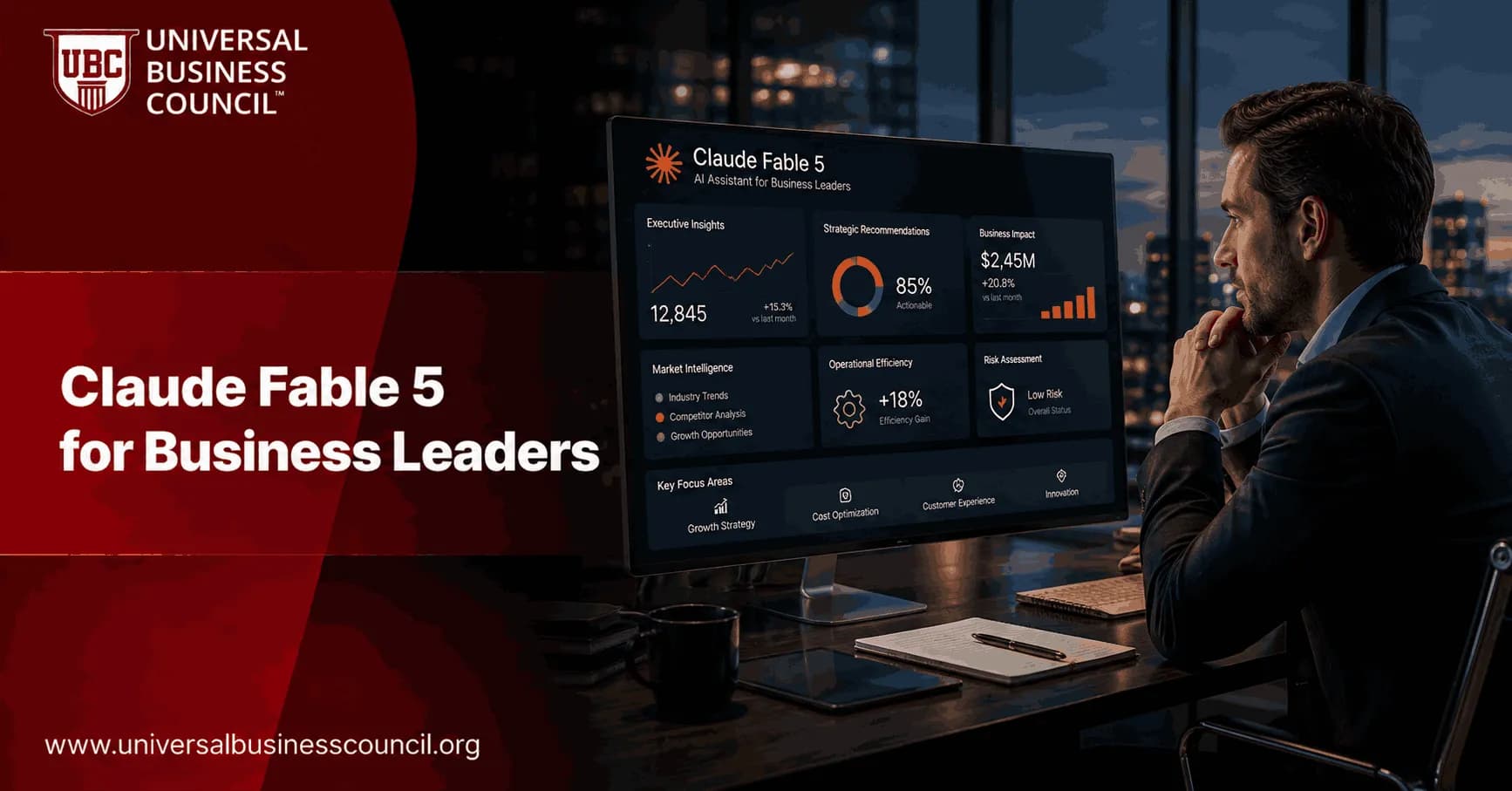
Claude Fable 5 for Business Leaders is becoming an important topic as enterprises evaluate frontier AI models for complex knowledge work, software engineering, analytics, and governed automation. Anthropic positions Claude Fable 5 as a Mythos-class model built for long-running projects, agentic workflows, and high-stakes enterprise tasks where accuracy, safeguards, and integration matter.
For executives, the strategic question is not whether Claude Fable 5 can answer prompts. The more important question is whether it can help teams delegate multi-step work safely across engineering, finance, legal, analytics, and operations. Based on current platform integrations with Microsoft, Databricks, Snowflake, and GitLab, the model is being positioned for production-grade enterprise adoption rather than isolated experimentation.

As enterprise adoption of Claude and other advanced AI systems accelerates, a Claude AI Expert Certification can help professionals build a deeper understanding of AI workflows, governance frameworks, prompt engineering, and the practical implementation of AI solutions across business and technology functions.
What Is Claude Fable 5?
Claude Fable 5 is Anthropic's newest Mythos-class frontier model, designed for ambitious, long-horizon knowledge work. It is a general-purpose enterprise AI model that supports reasoning, content creation, code execution, research synthesis, and autonomous task management across multiple domains.
It is also described as the safer counterpart to Claude Mythos 5. While the two models share underlying capabilities, Claude Fable 5 includes additional safeguards and restrictions intended for broad enterprise use. This distinction matters for leaders in regulated sectors, where model capability must be balanced with responsible AI controls.
Why Claude Fable 5 Matters for Enterprise AI Strategy
Traditional AI assistants often require users to break work into small prompts, inspect every response, and manually coordinate the next step. Claude Fable 5 moves closer to project-level delegation. It can plan an approach, use tools, check progress against goals, and refine outputs over longer workflows.
For business leaders, this creates a shift from AI as a productivity assistant to AI as an autonomous collaborator. The model is built for multi-stage and asynchronous work, including research, software modernization, document review, and governed analytics.
Key Features of Claude Fable 5
1. Long-horizon autonomy
One of the most important Claude Fable 5 features is its ability to sustain complex tasks over extended runs. GitLab has highlighted its support for multi-day, goal-directed software development workflows, while Microsoft frames it as a foundation for the next generation of autonomous agents in Microsoft Foundry and GitHub Copilot.
Plans multi-step work before execution
Maintains context across long workflows
Coordinates tool use, code execution, and review steps
Supports parallel sub-agents for complex projects
2. Advanced reasoning and correctness
Databricks has presented Claude Fable 5 as Anthropic's most intelligent generally available model. Independent evaluation from Artificial Analysis placed it at the top of its Intelligence Index with a score of 64.9, and benchmark reporting shows strong performance on complex reasoning, agentic tasks, and software engineering problems.
For enterprises, higher first-attempt correctness can reduce rework, review cycles, and operational friction. This is especially relevant in functions where errors are expensive, such as compliance reporting, software release management, and financial analysis.
3. Multimodal and document intelligence
Claude Fable 5 can interpret text, diagrams, charts, tables, and structured information embedded in files and PDFs. This makes it relevant for document-heavy industries such as financial services, insurance, legal services, healthcare administration, and operations.
Databricks has reported strong performance on OfficeQA Pro, a benchmark focused on difficult document question answering with tool use. The model achieved 57.9 percent correctness and used fewer tool calls than Claude Opus 4.8, although it was slower and generated more output tokens. This illustrates both its strength and the need for cost-aware deployment.
4. Strong software engineering capability
Claude Fable 5 is heavily optimized for software engineering. It has been associated with an 80.3 percent score on SWE-Bench Pro, with the next best model reported to be roughly 11 percentage points behind. GitLab also notes improvements in bug-finding recall and code review quality.
Practical use cases include:
Large-scale code refactoring
Multi-repository feature implementation
Legacy code migration
Automated code review and defect detection
DevOps workflow analysis and improvement
For technology leaders, this makes Claude Fable 5 a candidate for semi-autonomous software modernization, especially when deployed through controlled platforms such as GitHub Copilot, GitLab Duo, or Microsoft Foundry.
As AI-assisted development becomes more integrated into enterprise engineering workflows, a Tech Certification can help professionals strengthen their understanding of modern software platforms, automation frameworks, cloud technologies, and the infrastructure required to manage these emerging capabilities effectively.
5. Enterprise governance and safeguards
Claude Fable 5 is designed with additional safety controls, particularly for sensitive areas such as cybersecurity, biology, and chemistry. Anthropic and its partners emphasize that the broadly available model includes restrictions, while more permissive capabilities are reserved for vetted use cases.
Governed deployment is also a major advantage. Databricks offers access through Unity AI Gateway, while Snowflake is integrating Claude Fable 5 into Snowflake Cortex AI within the Snowflake security perimeter. These environments allow enterprises to manage identity, access, data governance, auditability, and tool permissions centrally.
Enterprise Use Cases for Claude Fable 5
Software development and modernization
Claude Fable 5 can support end-to-end feature delivery, system-level builds, refactoring, test generation, and migration planning. A reported TrueFoundry example described a migration across a 50-million-line codebase completed in a single day when the model was orchestrated through an appropriate agentic workflow.
This does not remove the need for engineering oversight. Instead, it changes the role of developers from writing every line manually to supervising, validating, and improving AI-generated implementation plans.
Finance, risk, and investment research
Financial institutions can use Claude Fable 5 to analyze earnings transcripts, filings, market data, credit documentation, and regulatory materials. Its document understanding capabilities are useful for extracting meaning from charts, tables, exhibits, and cross-referenced reports.
Potential applications include investment research summaries, credit risk analysis, compliance review, scenario modeling, and internal audit support.
Legal and compliance workflows
Legal teams can use Claude Fable 5 for contract review, due diligence, clause identification, first-pass memos, and regulatory analysis. Human experts remain essential for final judgment, but the model can help scale review coverage across large document sets.
Data analytics and business intelligence
With Databricks and Snowflake integrations, Claude Fable 5 is well positioned for governed analytics. It can help generate SQL, coordinate Python or Spark analysis, summarize data findings, document pipelines, and produce narrative reports.
This supports a move toward agent-driven analytics, where AI systems do more than answer questions. They can orchestrate analysis, inspect results, and prepare decision-ready outputs under enterprise governance.
Strategic Advantages for Business Leaders
Process automation: Delegate complex workflows that previously required extensive manual coordination.
Quality improvement: Use stronger reasoning and bug detection capability to reduce rework and cost-of-quality.
Governed adoption: Deploy through established platforms with identity, access, and data controls.
Faster modernization: Accelerate code migrations, analytics projects, and document-heavy reviews.
Existing ecosystem leverage: Adopt through Microsoft, GitLab, Databricks, and Snowflake rather than building every component from scratch.
Trade-offs and Implementation Considerations
Claude Fable 5 is a premium model. Reported API pricing is $10 per million input tokens and $50 per million output tokens, with prompt caching discounts available for repeated context. Third-party analysis also suggests it is roughly twice the price of Claude Opus 4.8.
Leaders should therefore avoid using Claude Fable 5 for every task. A better approach is targeted deployment:
Use Claude Fable 5 for high-value, complex, long-running workflows.
Use lower-cost models for routine summarization, classification, and simple drafting.
Apply prompt caching and output controls to manage token costs.
Keep humans in the loop for legal, financial, security, and compliance decisions.
Monitor fallback behavior, latency, quality, and audit logs.
Skills Business Leaders Need to Govern Agentic AI
Adopting Claude Fable 5 successfully requires more than technical access. Leaders need practical knowledge of AI governance, workflow redesign, data strategy, risk management, and performance measurement. This is where structured professional education becomes important.
Universal Business Council certification pathways in areas such as AI strategy, digital transformation, business analytics, project management, marketing technology, and technology leadership can support professionals building competence in enterprise AI adoption.
Conclusion: Claude Fable 5 as a Strategic AI Platform
Claude Fable 5 for Business Leaders represents a meaningful step toward autonomous, governed, enterprise-grade AI. Its strengths are clearest in long-horizon workflows, complex reasoning, software engineering, document intelligence, and data-driven decision support.
The strategic advantage is not simply faster task completion. It is the ability to redesign work around AI agents that can plan, execute, review, and improve multi-step processes. Organizations that combine Claude Fable 5 with strong governance, targeted use cases, and workforce upskilling will be better positioned to capture value while managing operational and regulatory risk.
FAQs
1. What Is Claude Fable 5?
Claude Fable 5 is presented as an advanced generative AI model designed to support business decision-making, knowledge work, automation, content creation, and enterprise productivity initiatives.
2. Why Should Business Leaders Pay Attention to Claude Fable 5?
Business leaders are increasingly evaluating AI solutions that can improve efficiency, reduce operational costs, accelerate innovation, and enhance employee productivity across departments.
3. What Are the Key Features of Claude Fable 5?
Key features may include advanced reasoning, long-context processing, content generation, document analysis, workflow automation, coding assistance, and natural language interactions.
4. How Does Claude Fable 5 Support Executive Decision-Making?
It can help summarize reports, analyze information, identify trends, generate insights, and provide decision-support recommendations based on available data.
5. How Can Claude Fable 5 Improve Organizational Productivity?
By automating repetitive tasks, streamlining knowledge management, and accelerating information retrieval, it can help teams work more efficiently.
6. What Business Functions Can Benefit from Claude Fable 5?
Functions such as marketing, sales, customer support, operations, finance, human resources, product development, and research can benefit from AI-powered assistance.
7. How Can Marketing Teams Use Claude Fable 5?
Marketing teams can use it for content creation, campaign planning, audience analysis, SEO optimization, email marketing, and performance reporting.
8. How Can Sales Teams Benefit from Claude Fable 5?
Sales professionals can use it for lead qualification, proposal generation, account research, customer communication, and sales enablement activities.
9. What Role Can Claude Fable 5 Play in Customer Support?
It can assist with customer inquiries, knowledge base management, case summarization, automated responses, and support workflow optimization.
10. How Can Claude Fable 5 Support Knowledge Management?
Organizations can use it to organize information, summarize documents, retrieve knowledge quickly, and improve access to internal resources.
11. Can Claude Fable 5 Help with Business Research?
Yes, it can assist with market research, competitive analysis, trend identification, document review, and information synthesis.
12. How Does Claude Fable 5 Support Innovation Initiatives?
It can accelerate brainstorming, idea generation, strategic planning, product development discussions, and problem-solving processes.
13. What Advantages Does Claude Fable 5 Offer for Enterprise Workflows?
Potential advantages include scalability, faster information processing, workflow automation, enhanced collaboration, and improved operational efficiency.
14. How Can Business Leaders Measure the Value of Claude Fable 5?
Value can be measured through productivity improvements, cost savings, reduced task completion times, employee efficiency, customer satisfaction, and revenue impact.
15. What Are Common Use Cases for Claude Fable 5 in Enterprises?
Common use cases include document analysis, executive reporting, customer support automation, content creation, workflow orchestration, coding assistance, and internal knowledge management.
16. What Risks Should Organizations Consider Before Adoption?
Organizations should evaluate data privacy, security requirements, governance frameworks, accuracy limitations, compliance obligations, and change management needs.
17. How Can Businesses Implement Claude Fable 5 Successfully?
Successful implementation requires clear objectives, governance policies, employee training, workflow integration, performance monitoring, and ongoing optimization.
18. How Does Claude Fable 5 Compare to Traditional Business Software?
Unlike traditional software that follows predefined workflows, AI systems can analyze information, generate content, provide recommendations, and adapt to a broader range of business tasks.
19. What Strategic Advantages Can Claude Fable 5 Provide?
Strategic advantages may include faster decision-making, improved operational efficiency, greater scalability, enhanced customer experiences, and stronger competitive positioning. Executives have spent years asking teams to do more with less; AI is the first technology that occasionally makes that request sound slightly less unreasonable.
20. What Is the Long-Term Strategic Value of Claude Fable 5 for Business Leaders?
The long-term value lies in enabling intelligent automation, accelerating digital transformation, improving organizational agility, enhancing workforce productivity, and helping businesses adapt to an increasingly AI-driven economy.
Related Articles
View All
Claude Ai
How Can You Access and Use Claude Fable 5.1 for Free?
Want to access Claude Fable 5.1 for free? Explore its current availability, supported Claude plans, access options, and what users should know before getting started.

Claude Ai
Using Claude Fable 5 to Improve Business Decision-Making and Operational Efficiency
Claude Fable 5 can improve business decision-making and operational efficiency through document analysis, workflow automation, coding support, and governed AI deployment.
Claude Ai
What Is Claude Duet? Features and Capabilities
Claude Duet is Anthropic’s proactive AI agent app. Learn its key features, what it can do, how its approval and safety controls work, who can join the US waitlist, and how it compares with Meta Muse and OpenAI Dots.
Trending Articles
The Role of Blockchain in Ethical AI Development
How blockchain technology is being used to promote transparency and accountability in artificial intelligence systems.
AWS Career Roadmap
A step-by-step guide to building a successful career in Amazon Web Services cloud computing.
Top 5 DeFi Platforms
Explore the leading decentralized finance platforms and what makes each one unique in the evolving DeFi landscape.