

AI Accountability Audit: Verifying Ownership and Human Oversight
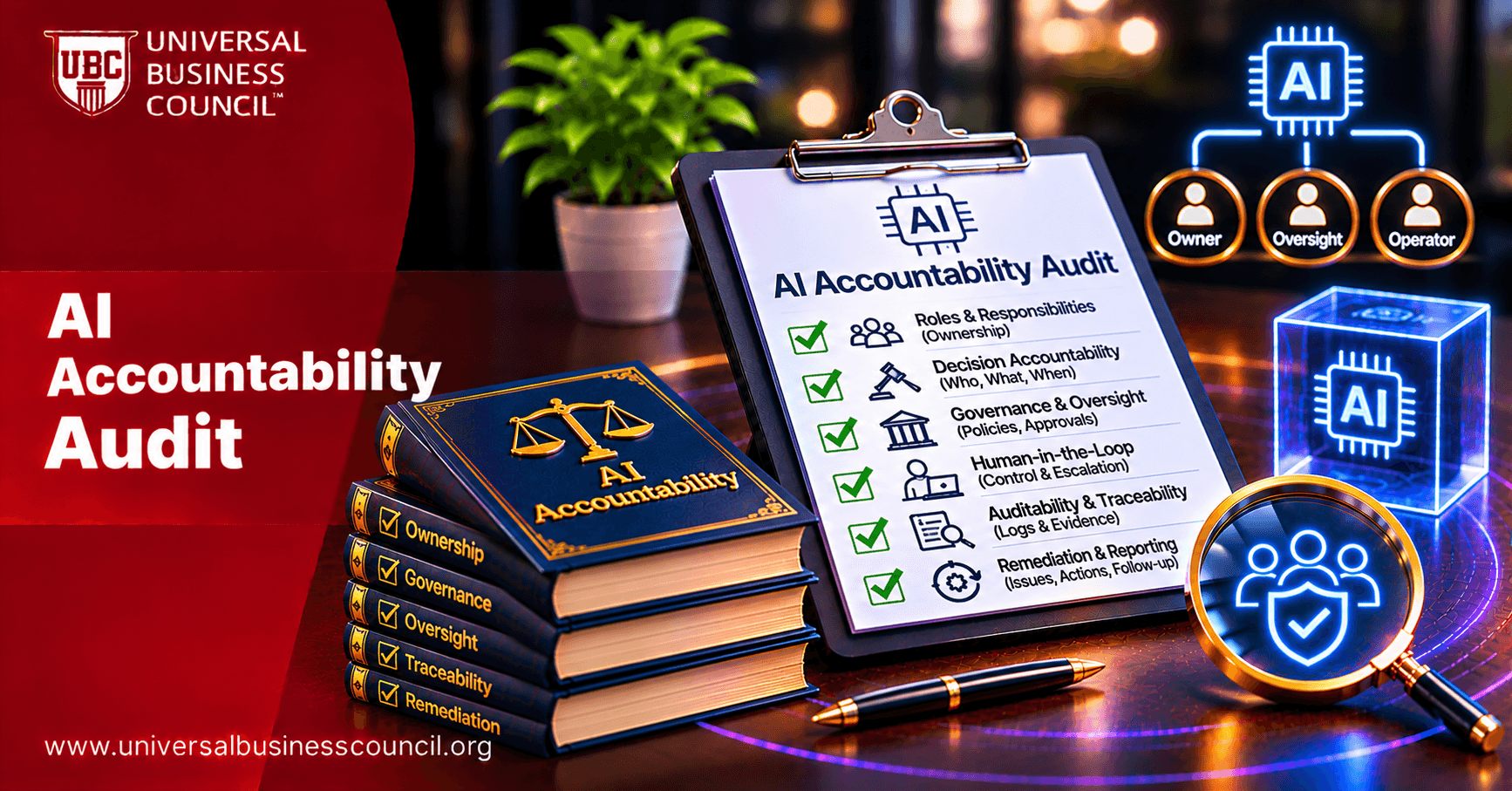
Ask who owns this model. Then wait. The length of the pause is your first audit finding. In many organizations the answer arrives as a committee, a vendor or a shrug, and that is exactly the problem an AI accountability audit is built to expose. This guide shows how to verify that every AI system has a real owner, that human oversight does something and that someone can be found, and held answerable, when things go wrong. If you want formal training for this work, the Certified AI Audit Professional program from Universal Business Council is a strong option.
What is an AI accountability audit?
An AI accountability audit is an independent review of whether an organization has assigned clear ownership for its AI systems and whether human oversight works in practice. It tests that named people hold real authority, that decisions can be traced to them and that review steps catch problems instead of stamping them through.

The audit looks at people and process more than technology. The model may be flawless. If nobody can pause it, explain it or answer for it, accountability has failed.
The find-the-human test
The simplest and most revealing test costs nothing. Pick ten recent decisions made or influenced by an AI system, such as loan denials, account closures or flagged transactions. For each one, try to trace the line from the decision to the model version, the owner who approved that version, the reviewer who saw the output (if any) and the person who would answer for a complaint.
Count how many trails end in a name. Count how many end in a team mailbox, a retired employee or silence. Those numbers go straight into the report.
Checking ownership
Ownership is more than a name in a spreadsheet. For each system in your sample, check the following.
What to verify | How to test it | Evidence |
A named owner exists | Compare the inventory with the org chart and ask HR whether the person still holds the role | Inventory, HR confirmation |
The owner has authority to pause the system | Read the policy and ask the owner whether they have ever used it, or could | Policy text, interview notes |
A deputy covers absences | Ask who acts when the owner is on leave | Delegation record |
The role is part of the owner's job | Check job descriptions and performance goals | Role documents |
Decision rights are written down | Look for a RACI or similar document and test it against a real change | RACI, change tickets |
Escalation works | Run a short drill: report a fictional issue and time the response | Drill log |
Checking human oversight
Many organizations point to human review as their safety net. The audit asks whether the net has holes.
Look at the numbers behind the review
Pull data from the review tool. How many cases does each reviewer handle per hour? How long do they spend on each one? What share do they approve? A reviewer who clears hundreds of cases a day at a few seconds each and approves almost all of them is not providing oversight, whatever the policy says. Compare the override rate with what you would expect given the model's known error rate. A near-zero rate is a warning light.
Check what the reviewer can see and do
Do they have the information needed to judge the case, including key factors, confidence and known limits? Can they override the system without penalty? Do they know when to escalate? Sit with a reviewer for an hour and watch. Observation tells you more than a procedure manual.
Test for automation bias
Feed a small set of known-wrong outputs into the review queue, with agreement from the system owner, and see how many get caught. If reviewers miss most of them, training and design need work.
Review training and independence
Check that reviewers have training records, clear guidance and no incentive to approve quickly. Confirm that the person reviewing a decision is not the person measured on how fast it is made.
Governance bodies: do they govern?
Read committee minutes from the past year. Look for decisions with consequences: systems sent back, conditions attached, launches delayed. A body that has approved everything put in front of it may be a rubber stamp. Check that attendees include people with the authority and the knowledge to say no, and that actions from one meeting appear as agenda items at the next.
When something went wrong
Choose the last real incident or complaint involving an AI system and trace it end to end. Who noticed? Who decided what to do? How long did it take? What changed afterward, and where is that change recorded? Accountability is easiest to see in the aftermath. If the story ends with "we looked into it" and no record, treat it as a gap.
Vendors and shared responsibility
Contracts can divide technical duties, but they cannot remove the buyer's accountability to its own customers and regulators. Check that every third-party AI tool has an internal owner, that the contract covers incident notice, audit rights and change notification and that someone actually tracks vendor updates.
What a finding might look like
Here is an illustrative example. Condition: reviewers approved 99.6 percent of flagged cases, with a median review time of four seconds. Criteria: the policy requires meaningful human review of high-impact decisions. Cause: queue targets reward speed and the review screen shows only a score. Effect: the human step adds little protection. Recommendation: show key factors, cap daily volume, add quality sampling and report override rates monthly.
Customer-facing claims need an owner too
Someone should own what the public is told about an AI product, as well as how it behaves. Marketing leaders who want a stronger grounding in campaign governance can look at the Certified Digital Marketing Expert program.
Skills, records and the people you hire
An accountability auditor reads logs, queries tools and interviews senior people, often in the same week. The programming and technology certifications from Global Tech Council can help build the technical side. Decision and approval records matter most when they cannot be quietly rewritten, and teams curious about tamper-evident approaches can explore the deep tech certifications from Blockchain Council. For reviewer and owner roles, a skills test shows who can really do the job, and HireValid offers AI-proof pre-employment tests with an Integrity Score that supports human review.
Conclusion: what an AI accountability audit proves
An AI accountability audit checks that every AI system has a real owner and that human oversight does real work. The find-the-human test sets the tone: trace a sample of decisions to a model version, an approver, a reviewer and a person who would answer for a complaint, and count how many trails end in a name. Ownership checks go further, verifying that the owner exists, holds authority to pause the system, has a deputy, carries the duty in their role and works within written decision rights and an escalation path that has been tested.
Oversight checks look past policy into data: reviewer volumes, time per case, approval and override rates, what the reviewer can see and do, how many planted errors they catch and whether training and incentives support careful work. Governance minutes should show real decisions, past incidents should show real follow-through and vendor arrangements should still leave an internal owner. Try the find-the-human test on ten decisions this month and write down how many trails reach a person. The Certified AI Audit Professional program mentioned at the start can help your team turn that exercise into a full AI accountability audit.
FAQs
1. What is an AI accountability audit?
An independent review of whether AI systems have real owners and whether human oversight works in practice.
2. What is the find-the-human test?
Tracing sampled AI decisions back to a model version, an approver and a named person who would answer for them.
3. What makes an AI system owner effective?
Clear authority, time, a deputy, written decision rights and the ability to pause the system.
4. How do we test human oversight?
Review volumes, time per case, override rates, reviewer access to information and results on planted errors.
5. What is rubber-stamping?
Approving machine outputs by habit without real review.
6. What override rate is healthy?
It depends on the model's error rate, but a near-zero rate usually warrants investigation.
7. What is automation bias?
The tendency to trust machine outputs too much, even when they are wrong.
8. Can we plant errors to test reviewers?
Yes, with approval from the system owner and a plan to avoid affecting real customers.
9. Who should run the audit?
An independent function such as internal audit or an external reviewer.
10. What documents prove ownership?
The AI inventory, role descriptions, delegation records and decision rights documents.
11. What is a RACI?
A chart showing who is responsible, accountable, consulted and informed for each activity.
12. Do committees count as accountability?
Only if minutes show real decisions and named people follow through.
13. What about vendor-provided AI?
The buyer still needs an internal owner, contract rights and a process to track vendor changes.
14. How do we audit incident response?
Trace a real case from detection to fix and check the records and changes made.
15. How often should we audit accountability?
Yearly, and after reorganizations, major incidents or large system changes.
16. What is an escalation drill?
A practice exercise where a fictional issue is reported and the response is timed.
17. Do reviewers need training?
Yes, on how the system works, its limits and when to escalate.
18. What goes in the report?
Scope, sample, findings with data, owner responses and dated actions.
19. Can small organizations do this?
Yes. Even a short find-the-human test on a few decisions is revealing.
20. Where can I learn more?
The Certified AI Audit Professional program and published guidance on human oversight from regulators and standards bodies.
Related Articles
View All
Artificial Intelligence
AI Ethics Audit: Evaluating Fairness, Transparency and Accountability
Explore what an AI ethics audit involves and how organizations evaluate AI systems for fairness, transparency, accountability, privacy, and potential bias. Learn about key audit areas, assessment methods, and how ethical reviews help identify concerns and support responsible AI development and deployment.
Artificial Intelligence
AI Governance Audit: Reviewing Policies, Roles and Oversight
Understand what an AI governance audit involves and how organizations evaluate their AI policies, controls, accountability structures, and risk management practices. Explore the key areas of review, common audit methods, and how governance audits help ensure AI systems are managed responsibly and consistently.

Artificial Intelligence
Overreliance on AI: How to Design Effective Human Oversight
Learn why overreliance on AI can weaken human judgment and increase decision-making risks. Explore how organizations can design effective human oversight through clear accountability, meaningful review processes, user training, and safeguards that keep people actively involved in AI-driven decisions.
Trending Articles
The Role of Blockchain in Ethical AI Development
How blockchain technology is being used to promote transparency and accountability in artificial intelligence systems.
AWS Career Roadmap
A step-by-step guide to building a successful career in Amazon Web Services cloud computing.
Top 5 DeFi Platforms
Explore the leading decentralized finance platforms and what makes each one unique in the evolving DeFi landscape.