

AI Ethics Audit: Evaluating Fairness, Transparency and Accountability
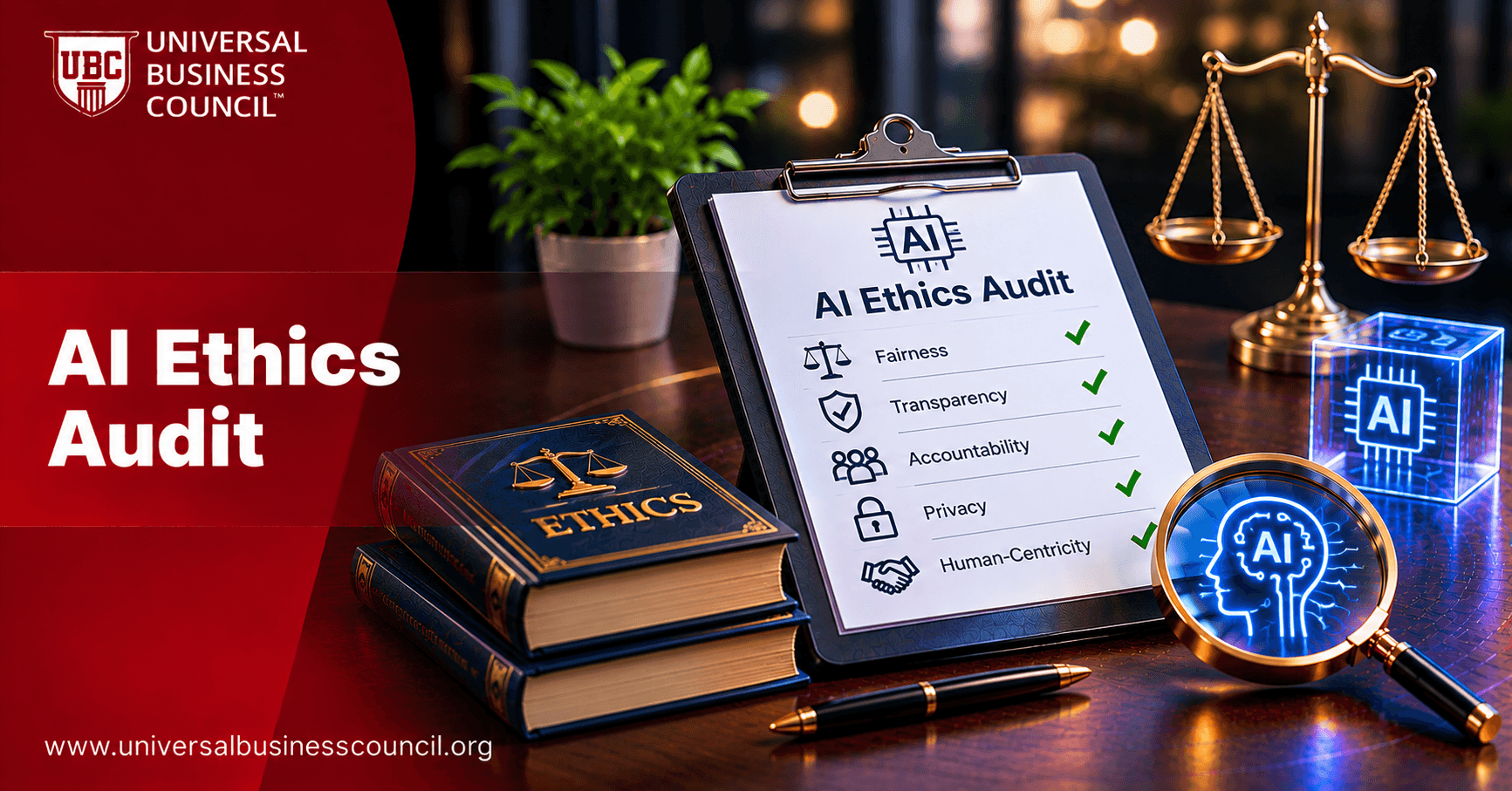
Every company has an AI ethics statement. Far fewer can prove it. The gap between a page on the website and what happens inside a model is where trust breaks, and it is the gap an AI ethics audit goes looking for. This guide shows how to turn principles into claims you can test, gather evidence that is more than paperwork and report results without pretending that ethics reduces to a single score. For readers who want to do this work professionally, the Certified AI Audit Professional program from Universal Business Council is a strong option.
What is an AI ethics audit?
An AI ethics audit is a structured, independent evaluation of whether an organization's AI systems and practices live up to its stated ethical commitments, particularly on fairness, transparency and accountability. The auditor checks promises against evidence: what the company says, what the system does and what the people affected experience.

Unlike a compliance audit, it does not stop at what the law requires. Unlike a technical test, it does not stop at what the model can do. It asks whether the whole arrangement deserves trust.
Turn promises into claims you can test
Ethics statements are written to be agreed with, not checked. Your first job is to translate. Take each principle and rewrite it as a claim with an observable test.
What the statement says | Testable claim | How to check it |
We treat people fairly | Outcomes do not differ unjustifiably across groups | Compare approval rates and error rates by group on recent data |
We are transparent about AI | Users are told when AI is involved and what it does | Walk the user journey and capture every notice |
People stay in control | A named person can review and override high-impact decisions | Sample decisions and trace each to a reviewer and a log entry |
We respect privacy | Data use matches the purpose people were told | Compare notices with the data map |
If a principle cannot be turned into a claim, record that as an observation. Vague commitments are hard to keep and impossible to audit.
Three questions that organize the work
Is it fair?
Look at data, model behavior and outcomes. Who is represented in the training data and who is missing? Do error rates differ by group? Does the process include a route for people who think the system got it wrong? A full bias analysis can be its own engagement. In an ethics audit you check that one exists, that its method makes sense and that someone acted on its results.
Is it open?
Review what users, customers and regulators are told. Check that notices are visible, honest and written for the people reading them. Check that explanations given to affected people match how the system really works.
Is someone answerable?
Find the owner. Read the decision logs. Look for a working appeal path. Ask what happened the last time something went wrong. A strong answer includes dates, names and changes made.
Evidence that counts, and evidence that doesn't
Documents are a start. Behavior is the test.
Stronger evidence: test results you reproduced, decision logs, complaint records, screenshots of the live product, records showing a system was paused or changed after a problem
Weaker evidence: policy documents, slide decks, signed attestations and statements from the team that owns the system
When the strong and weak evidence disagree, the strong evidence wins. Note the disagreement in the report.
Talk to the people on the other end
An ethics audit that only interviews staff sees half the picture. Read complaints and support tickets. Talk to front-line workers who use the system daily. Where possible, ask people who are affected by its decisions, or the groups that represent them. Their account of what happens often differs from the design document.
Keep this proportionate and respectful. Protect identities, explain how input will be used and do not put anyone at risk for speaking honestly.
When values collide
Real systems force trade-offs. A model tuned for the highest accuracy may treat some groups worse. Full transparency can expose security details or trade secrets. Speed and human review pull in opposite directions. Auditors should not pretend these tensions away, and they should not pick winners on their own.
Instead, check three things: was the trade-off recognized, who decided and on what grounds, and is the decision written down and open to review? A conscious, documented trade-off is a sign of a healthy program. An unexamined one is a finding.
Scoring without false precision
A maturity scale helps leaders see progress. Keep the descriptions concrete.
Level | What you would see |
1 Ad hoc | Principles exist, no consistent testing, ownership unclear |
2 Defined | Policies and owners exist, testing happens for some systems |
3 Managed | Tests and reviews run on a schedule, issues are tracked to closure |
4 Improving | Results feed design changes, outside challenge is welcome, records are reliable |
Use the scale to describe, not to rank people. A single number can hide the one serious problem in an otherwise decent program.
Red flags of ethics washing
Public commitments with no internal owner
An ethics board that has never said no to anything
Fairness tests that ran once, before launch, and never again
Explanations written for regulators and never shown to users
Complaints that are closed without a root cause
Claims on the website that engineering cannot support
Public claims and the marketing check
Statements about responsible AI often start in marketing copy. Auditors should read the public claims and ask engineering to back each one. Teams who want to see how those messages get built can look at the Certified Digital Marketing Expert program.
Skills and records
Ethics auditors do better work when they understand how models are built and tested. The programming and technology certifications from Global Tech Council can help close that gap. Findings and evidence also deserve careful storage, and those curious about tamper-evident approaches can explore the deep tech certifications from Blockchain Council. If you are building an audit team, a skills test beats a resume for showing who can really do the job, and HireValid offers AI-proof pre-employment tests with an Integrity Score that supports human review.
Conclusion: what an AI ethics audit proves
An AI ethics audit tests whether an organization behaves the way its principles claim. The work starts by translating statements like "we treat people fairly" into claims with checks attached. It then examines three questions: is the system fair, is it open about what it does and is someone answerable when it goes wrong. Strong evidence, such as reproduced tests, decision logs and complaint records, outweighs documents and attestations, and conversations with front-line staff and affected people add what the paperwork leaves out.
Real systems involve trade-offs between accuracy and fairness, openness and security, speed and review. The audit does not remove them. It checks that they were noticed, decided by the right people and recorded. A plain maturity scale, from ad hoc to improving, shows progress without reducing ethics to one number, and a list of red flags helps spot ethics washing early. Start small. Pick one public principle, write the claim behind it and find the evidence that supports or contradicts it. The Certified AI Audit Professional program mentioned at the start can help you grow that into a complete AI ethics audit practice.
FAQs
1. What is an AI ethics audit?
An independent evaluation of whether AI systems and practices match the organization's stated ethical commitments.
2. How is it different from a compliance audit?
A compliance audit checks legal requirements. An ethics audit also tests principles beyond the law.
3. What does it usually cover?
Fairness, transparency, accountability, privacy, safety and human oversight.
4. Who should conduct it?
An independent party such as internal audit, an external firm or a mixed team with ethics expertise.
5. Can ethics really be audited?
Not entirely, but commitments can be turned into testable claims and checked against evidence.
6. What standards can guide it?
The OECD AI Principles, UNESCO's recommendation, ISO/IEC 42001 and the NIST AI RMF are common references.
7. What evidence is most reliable?
Reproduced tests, logs, complaint records and screenshots of the live product.
8. Should affected people be consulted?
Where possible, yes, with attention to privacy and safety.
9. What is ethics washing?
Public ethical claims that are not backed by real practice.
10. How do auditors handle trade-offs?
They check that the trade-off was recognized, decided by the right people and documented.
11. Is a single ethics score useful?
Rarely. A scale helps show progress, but a number can hide serious problems.
12. How often should we run one?
Yearly for high-impact systems, and after major changes or incidents.
13. What if principles are too vague to test?
Record that as a finding and recommend rewriting them as testable commitments.
14. Do ethics boards count as evidence?
Only if records show real decisions, including cases where they pushed back.
15. How do we audit fairness inside an ethics audit?
Check that testing exists, the method is sound, results were reviewed and action followed.
16. What about third-party AI?
Review vendor documentation and test the system in your use case.
17. What goes in the report?
Scope, claims tested, evidence, findings, trade-offs observed and recommendations with owners.
18. Can small teams do this?
Yes, with a few principles, a short test list and honest follow-up.
19. How do we follow up?
Track recommendations to closure and retest the areas that changed.
20. Where can I learn more?
The Certified AI Audit Professional program and the OECD and UNESCO AI documents are good places to start.
Related Articles
View All
Artificial Intelligence
AI Accountability Audit: Verifying Ownership and Human Oversight
Explore how an AI transparency audit evaluates the information organizations disclose about their AI systems and how they communicate with users. Learn what to review in AI disclosures, system documentation, user notices, and decision explanations to ensure people understand when and how AI is being used.

Artificial Intelligence
AI Transparency Audit: Reviewing Disclosures and User Communication
Explore how an AI transparency audit evaluates the information organizations disclose about their AI systems and how they communicate with users. Learn what to review in AI disclosures, system documentation, user notices, and decision explanations to ensure people understand when and how AI is being used.

Artificial Intelligence
AI Fairness Audit Metrics: What to Measure and How to Interpret Results
Learn which fairness metrics are used in AI audits and how to interpret their results. Explore measures such as demographic parity, equal opportunity, equalized odds, and predictive parity, along with their applications, limitations, and role in identifying unfair outcomes across different groups.
Trending Articles
The Role of Blockchain in Ethical AI Development
How blockchain technology is being used to promote transparency and accountability in artificial intelligence systems.
AWS Career Roadmap
A step-by-step guide to building a successful career in Amazon Web Services cloud computing.
Top 5 DeFi Platforms
Explore the leading decentralized finance platforms and what makes each one unique in the evolving DeFi landscape.