

Internal AI Audit vs External AI Audit: Differences and Use Cases
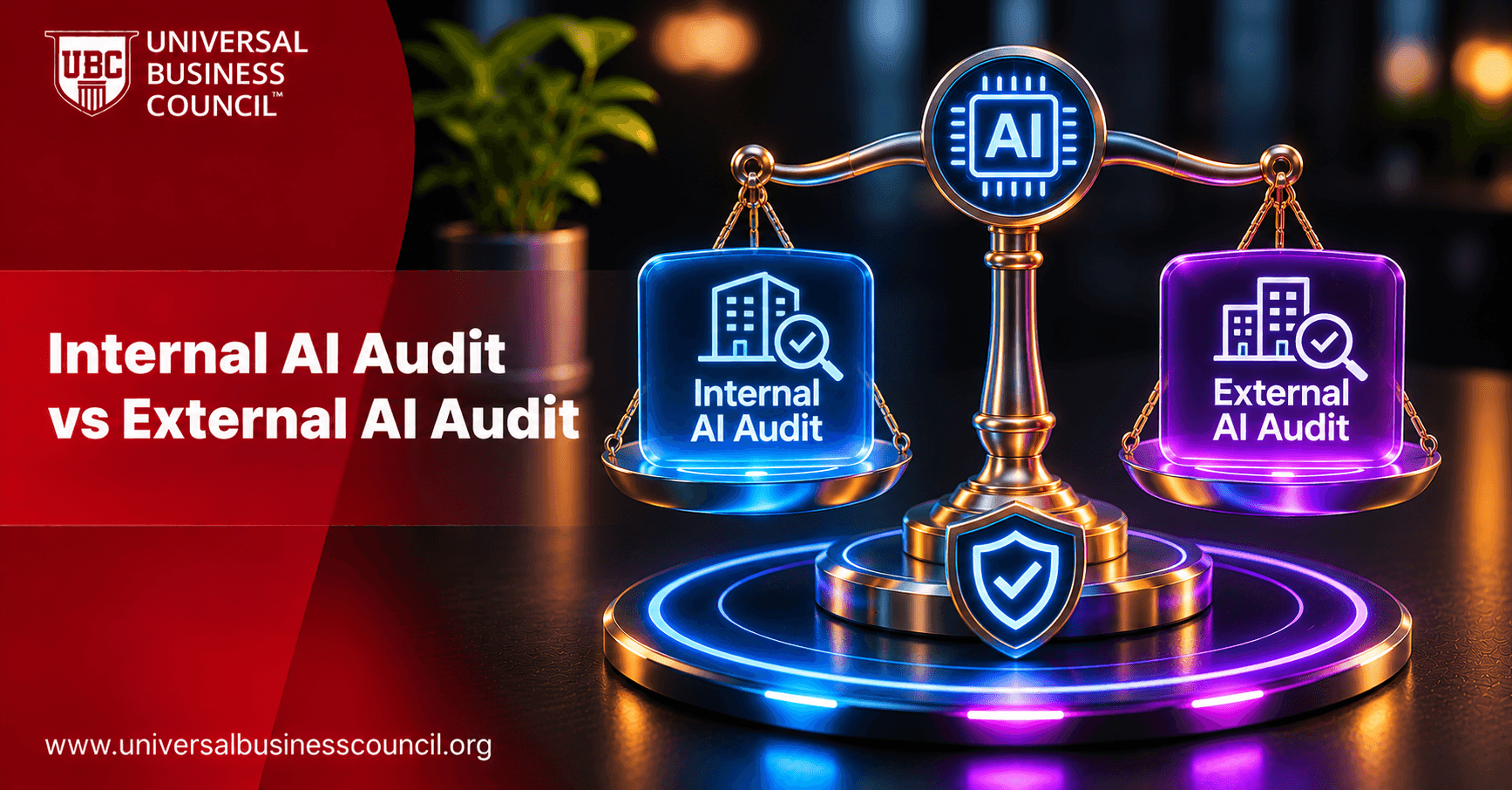
Think of an internal audit as playing on home turf with a coach who knows every player, and an external audit as a neutral referee who has never met the team. Both can call fouls. They call them differently, and they carry different weight with the people watching. Choosing between an internal AI audit and an external AI audit is really a decision about speed, depth, cost and credibility. This guide compares the two, shows when each fits and explains how mature programs use both. If you want training that supports either path, see the Certified AI Audit Professional certification.
What is the difference between an internal and an external AI audit?
An internal AI audit is performed by people inside the organization, such as an internal audit team or a separate assurance function. An external AI audit is performed by independent outside specialists. Internal audits offer speed, context and lower cost. External audits offer independence, specialist depth and credibility with outsiders.

Side-by-side comparison
Factor | Internal audit | External audit |
|---|---|---|
Independence | Moderate, depends on reporting lines | High |
Credibility with regulators and customers | Useful, but viewed with some caution | Strong |
Knowledge of the business | Deep | Needs time to learn |
Speed and flexibility | Fast and repeatable | Slower to schedule and onboard |
Cost per audit | Lower after setup | Higher |
Specialist skills | Limited to staff capacity | Access to niche expertise |
Risk of blind spots | Higher, from familiarity | Lower, from fresh eyes |
Internal AI audits: the home advantage
Internal auditors know the systems, the people and the history. They can run frequent, targeted reviews, follow up quickly and build institutional memory. Over time, they turn auditing into a routine that teams stop fearing.
Strengths
Lower marginal cost for repeat reviews
Deep understanding of processes and politics
Faster scheduling and tighter follow-up
Ability to build lasting audit capability
Watch-outs
Independence can wobble if auditors report to the same leaders who own the systems. Familiarity can dull curiosity. Skills may lag in fast-moving areas like generative AI security. Technical staff who join internal teams often strengthen their toolkit through tech certifications.
External AI audits: the neutral referee
External auditors bring independence and a wider view of how other organizations handle similar problems. Their conclusions carry weight with regulators, customers, investors and insurers precisely because they have no stake in the answer.
Strengths
Strong independence and external credibility
Specialist expertise in niche techniques such as adversarial testing
Fresh perspective that spots blind spots
Useful for certification or formal assurance
Watch-outs
Cost is higher and onboarding takes time. Outside teams need access to sensitive data, so privacy, confidentiality and security terms matter. Always verify the qualifications and backgrounds of the people who will touch your systems, through a service such as HireValid.
Do not confuse independence with perfection
An external audit is still a sample-based review at a point in time. Read the scope and limits before quoting the result.
When to use which
Here are practical use cases.
Choose internal when
You want regular health checks across many systems, you are building an audit program from scratch, you need fast follow-up on known issues or you are preparing ahead of a formal external review.
Choose external when
A regulator, major customer or investor wants independent assurance, the system is high-risk and consequential, you need niche skills your team lacks or you want an unbiased view after an incident or controversy.
Choose both when
Your program is maturing. A common pattern is a rolling internal schedule with a periodic external audit on the most critical systems, so the external reviewer can lean on internal work and focus on testing it.
Making either one work
A few practices apply to both.
Protect independence
Give internal auditors a reporting line to a board committee or senior leader outside the systems they review. For external work, avoid hiring the same firm that built or sold the system, unless conflicts are clearly managed.
Agree on scope, criteria and access
Write them down before work begins, including data handling and confidentiality terms. Evidence that cannot be quietly altered builds trust on all sides, and tamper-evident approaches appear in deep tech certifications.
Communicate results honestly
Say which type of audit was done, who did it and what it covered. Calling an internal check an "independent audit" invites criticism. A digital marketing course can help communications teams describe assurance work accurately.
Conclusion
Internal AI audits bring speed, context and lower repeat costs, and external audits bring independence, specialist depth and outside credibility. Use internal audits for routine coverage and capability building, external audits for high-stakes assurance and both together as your program matures. Protect independence, define scope in writing and describe results truthfully.
Frequently asked questions
These are the questions people ask most about internal and external AI audits.
1. What is an internal AI audit?
An audit performed by people within the organization.
2. What is an external AI audit?
An audit performed by independent outside specialists.
3. Which is better?
Neither alone. The right choice depends on risk, purpose and audience.
4. Which is cheaper?
Internal audits usually cost less per audit after setup.
5. Which is more credible?
External audits generally carry more weight with outsiders.
6. Can internal auditors be independent?
Partly, if they report outside the teams they review.
7. When do regulators prefer external audits?
For high-risk systems or where law requires independent assessment.
8. When should we start with internal audits?
When building a program, covering many systems or preparing for outside review.
9. Can we use both?
Yes, and many mature programs do.
10. How do we choose an external auditor?
Check expertise, independence, references, methods and confidentiality practices.
11. How do we verify auditor credentials?
Through certificates, references and verification services.
12. Is data safe with external auditors?
Only with strong contracts, access controls and privacy safeguards.
13. Can the system builder audit its own work?
Not credibly for assurance purposes.
14. What is a conflict of interest here?
When the auditor has a stake in the result, such as having built or sold the system.
15. Can external audits cover generative AI security?
Yes, specialist firms often provide red teaming and adversarial testing.
16. How often should external audits happen?
Periodically for critical systems, set by risk and stakeholder needs.
17. Does an external audit guarantee compliance?
No. It covers a defined scope at a point in time.
18. Can internal audits support external ones?
Yes, by providing organized evidence and early fixes.
19. How should audit reports be labeled?
Accurately as internal or external, with scope and limits stated.
20. What is the best first step?
Decide who needs assurance and what level of independence they expect.
Related Articles
View All
Artificial Intelligence
AI Privacy Audit: Assessing Personal Data Use and Protection
Understand how an AI privacy audit evaluates the collection, processing, storage, and use of personal data in AI systems. Explore key audit areas, privacy risk assessments, data protection controls, consent practices, and regulatory requirements that help organizations protect user information throughout the AI lifecycle.
Artificial Intelligence
AI System Inventory: How to Catalog Models, Tools and Use Cases
Learn how to create an AI system inventory to catalog the models, tools, applications, and use cases across an organization. Explore what information to document, how to track system ownership and risks, and why maintaining an accurate inventory supports AI governance, oversight, and compliance.

Artificial Intelligence
AI Audit vs AI Assessment vs AI Risk Assessment: Key Differences
Understand the differences between an AI audit, AI assessment, and AI risk assessment. Explore their purposes, processes, scope, and outcomes to learn when organizations should use each approach to evaluate AI systems, identify risks, and strengthen governance.
Trending Articles
The Role of Blockchain in Ethical AI Development
How blockchain technology is being used to promote transparency and accountability in artificial intelligence systems.
AWS Career Roadmap
A step-by-step guide to building a successful career in Amazon Web Services cloud computing.
Top 5 DeFi Platforms
Explore the leading decentralized finance platforms and what makes each one unique in the evolving DeFi landscape.