

AI Audit vs AI Assessment vs AI Risk Assessment: Key Differences
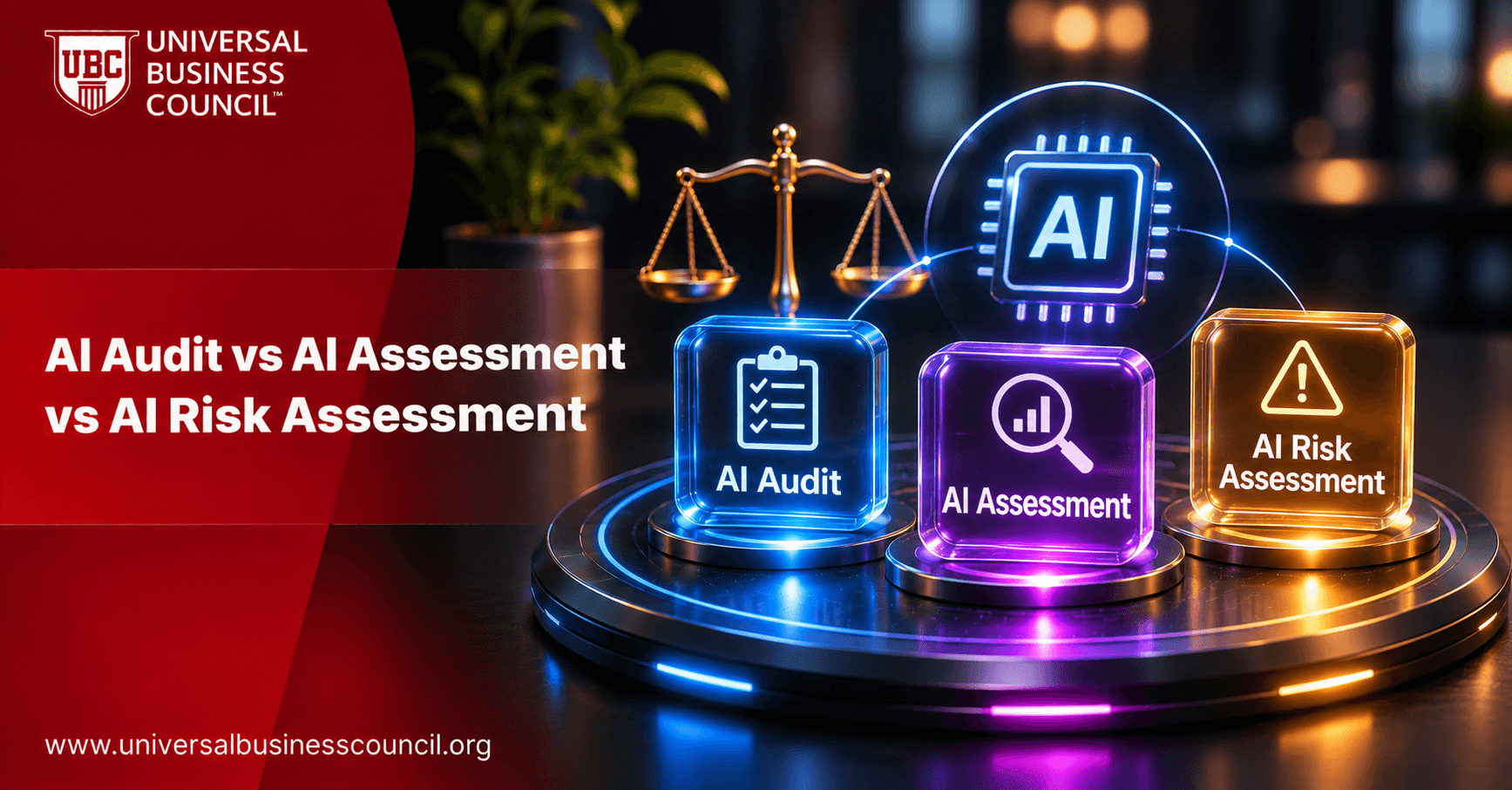
People swap these three terms in meetings every day. Regulators, auditors and contracts do not. Ask for an "AI assessment" and you might get a questionnaire. Ask for an "AI audit" and someone may want to see logs, test results and sign-offs. Mixing them up wastes budget and, worse, leaves gaps you only discover later. This guide separates the three, shows when each one fits and explains how they work together as a system and not as rivals. For a credential focused on the audit end of the spectrum, see the Certified AI Audit Professional certification.
What is the difference between an AI audit, an AI assessment and an AI risk assessment?
An AI audit is an independent, evidence-based test of whether a system and its controls meet defined criteria. An AI assessment is a broader evaluation of a system's suitability, impact or maturity, usually done by the owning team. An AI risk assessment identifies and rates what could go wrong. Assessments look forward and describe; audits look back and verify.

Here is the cleanest way to hold them in your head: a risk assessment asks "what might go wrong?", an assessment asks "is this a good idea and how ready are we?" and an audit asks "did what we said we would do actually happen, and can you prove it?"
Side by side
Feature | AI audit | AI assessment | AI risk assessment |
|---|---|---|---|
Main question | Do controls exist and work, with proof? | Is the system suitable, and how mature are we? | What could go wrong, and how badly? |
Timing | Periodic, often after deployment | Before launch and at milestones | Before launch and on a cycle |
Who does it | Independent reviewer | Owning team with advisers | Risk, product and technical teams |
Output | Findings, ratings, recommendations | Evaluation, scores or readiness view | Risk register entries and mitigations |
Evidence standard | High, verified | Moderate, often self-reported | Moderate, judgment-based |
AI audit: the verifier
An audit tests claims. If your policy says every high-risk model is bias-tested before launch, the auditor pulls a sample of models and asks to see the tests. Independence is the point: the auditor should not be marking their own homework. Findings are graded, and the organization owes a response.
Use an audit when
You need credible assurance for regulators, customers, insurers or the board, you are validating that controls operate in practice or you want to confirm that earlier fixes worked.
AI assessment: the broad evaluation
"Assessment" is an umbrella word. It can mean an impact assessment before launch, a maturity assessment of your governance, a suitability review of a vendor tool or a readiness check against a standard. Because the term is loose, always ask what the assessment will examine and what it will produce.
Use an assessment when
You are deciding whether to build or buy, judging how mature your program is or looking at effects on people and society before deployment. Teams that need technical depth for these reviews often build it through tech certifications.
AI risk assessment: the early warning system
A risk assessment lists plausible harms, estimates likelihood and impact, and picks responses: reduce, transfer, avoid or accept. Its output usually lands in a risk register with owners and deadlines. It is forward-looking and judgment-heavy, which is a strength and a weakness. It surfaces problems early, but it can miss what nobody imagined.
Use a risk assessment when
You are planning a new AI use, changing an existing one or setting priorities for controls and testing.
How the three fit together
Picture a relay race. The risk assessment runs the first leg, spotting what could go wrong. The assessment runs the next, shaping design and deciding whether to proceed. The audit runs the final leg, confirming that the controls promised in the earlier stages exist and work.
The feedback loop
Audit findings feed the next risk assessment. A control that failed in the audit raises the likelihood score for that risk. A risk nobody listed but the audit uncovered gets added to the register. Over time the three tighten each other up.
A quick decision guide
Planning something new: start with a risk assessment and an impact assessment
Checking readiness or maturity: run an assessment against a framework
Needing proof that controls work: commission an audit
Responding to a regulator or major customer: expect to need all three
Avoiding the terminology trap
When you write a contract, an RFP or a policy, define the term you mean, the standard it follows and the deliverable. "AI audit" in one document may mean a full independent examination, and in another a spreadsheet exercise. Clear definitions save arguments. When you describe your work publicly, match the label to the substance. Calling a self-completed questionnaire an "audit" invites criticism, and a digital marketing course can help communication teams label assurance work accurately.
Check the people and the proof
Whichever method you use, confirm that the people doing it are qualified, using verification such as HireValid, and keep the resulting records secure and tamper-evident, a theme covered in deep tech certifications.
Conclusion
An AI risk assessment asks what could go wrong. An AI assessment asks whether a system is suitable and how ready you are. An AI audit asks whether your claims are true and provable. Use them together, define each term in writing and let audit findings feed the next round of risk thinking.
Frequently asked questions
These are the questions people ask most about these three terms.
1. What is the main difference between an audit and an assessment?
An audit verifies claims with evidence, and an assessment evaluates suitability or readiness.
2. Is a risk assessment part of an audit?
Auditors review your risk assessment, but the assessment itself is a separate activity.
3. Who performs each?
Independent reviewers audit, while owning teams and advisers usually assess.
4. Which comes first?
Risk and impact assessments usually come first, with audits later.
5. Can one team do all three?
Yes, but audits benefit from independence.
6. What is an AI impact assessment?
A review of a system's effects on people, rights and society before deployment.
7. What is a maturity assessment?
An evaluation of how developed your AI governance practices are.
8. What does a risk assessment produce?
Rated risks, owners and mitigation plans, often in a risk register.
9. What does an audit produce?
Findings, severity ratings and recommendations.
10. Are audits more expensive?
Often, because of independence and evidence requirements.
11. Do regulators require all three?
Requirements vary by law and sector, so check your obligations.
12. Is a questionnaire an audit?
Not unless answers are tested against evidence.
13. How often should each be done?
Risk assessments on a cycle and at changes, audits on a risk-based schedule.
14. Can audit findings change risk ratings?
Yes. Failed controls raise the likelihood of related risks.
15. What is forward-looking versus backward-looking?
Assessments predict, and audits verify what has happened.
16. Do vendors do their own assessments?
Many do, but treat their results as claims to verify.
17. Which one do customers ask for?
It varies, so ask what they mean and what evidence they expect.
18. Can small companies skip the audit?
They can scale it down, but should still verify key controls.
19. How should I define these terms in contracts?
State the method, standard, independence level and deliverable.
20. Which is best?
None alone. They work best as a connected cycle.
Related Articles
View All
Artificial Intelligence
AI Risk Management Audit: Identifying and Testing AI Risks
Understand how an AI risk management audit evaluates the way organizations identify, assess, monitor, and mitigate risks associated with AI systems. Explore the audit process, key risk areas, assessment methods, and how regular audits support responsible AI practices and stronger risk controls.
Artificial Intelligence
Internal AI Audit vs External AI Audit: Differences and Use Cases
Understand the differences between internal and external AI audits, including their objectives, processes, independence, and scope. Explore when organizations should use each approach, who conducts the audits, and how both can support AI governance, risk management, and regulatory compliance.

Artificial Intelligence
AI Audit Checklist: Key Areas Every Organization Should Review
Use this AI audit checklist to review the key areas that affect AI system performance, fairness, security, and compliance. Learn what organizations should examine across data quality, algorithmic bias, transparency, privacy, accountability, and risk management to support responsible AI practices.
Trending Articles
The Role of Blockchain in Ethical AI Development
How blockchain technology is being used to promote transparency and accountability in artificial intelligence systems.
AWS Career Roadmap
A step-by-step guide to building a successful career in Amazon Web Services cloud computing.
Top 5 DeFi Platforms
Explore the leading decentralized finance platforms and what makes each one unique in the evolving DeFi landscape.