

Jev vs AI Agents
AI agents have become one of the most talked about categories in artificial intelligence, systems that can plan, use tools, and carry out multi step tasks with minimal human supervision. Jev, by contrast, does something much narrower, returning a single fast decision and nothing more. Comparing Jev vs AI agents might sound like comparing two competitors, but the more accurate picture is closer to comparing an engine part to the vehicle it powers. This guide breaks down what each actually is, how they differ in scope and design, and why Jev is increasingly showing up as a component inside AI agents rather than as a rival to them. It is written to be clear for complete beginners while still offering real depth for professionals building with this technology. Readers who want to build a more formal, strategic understanding of these distinctions can start with a Marketing Certification, which connects emerging AI concepts like this comparison to real business application.
What an AI Agent Actually Is
An AI agent is a system built to pursue a goal somewhat autonomously, breaking a task into steps, deciding what actions to take, using external tools when needed, and adjusting its plan based on the results it observes along the way. Unlike a simple chatbot that answers one question and stops, an AI agent typically operates in a loop, observing its current situation, deciding on the next action, executing that action, and then reassessing before deciding what to do next. A coding agent, for example, might read a codebase, decide which file needs a change, write that change, run tests, and repeat the process until the task is complete, all with minimal step by step human direction.

Most AI agents today are built around a large language model at their core, since that combination of language understanding and flexible reasoning gives the agent the ability to interpret goals, generate plans, and decide between multiple possible actions in an open ended way. The language model acts as the agent's reasoning engine, while surrounding software gives it the ability to call tools, browse the web, write code, or interact with other systems. Readers who want a deeper, credentialed grounding in how these agent architectures are formally taught and evaluated can explore the Artificial Intelligence Certifications available through structured professional training programs.
What Jev Actually Is
Jev, built by the AI lab TypeSafe AI and launched publicly in September 2026, is not an agent at all. It is a single purpose decision model. Jev accepts a defined piece of context, called a state, along with one or more typed questions, and returns a structured answer, a chosen category, a numeric score, or a calibrated yes or no probability, typically within seventy to five hundred milliseconds. It does not plan multi step tasks, it does not call external tools on its own initiative, and it does not maintain an ongoing loop of observation and action the way an agent does. TypeSafe describes Jev as the first model built under what it calls the System One category, borrowing psychologist Daniel Kahneman's term for fast, automatic human thinking, a description that highlights exactly how narrow and immediate its function is compared to the open ended, multi step behavior that defines an AI agent.
The Core Distinction: Autonomous Action Versus a Single Fast Decision
The clearest way to frame Jev vs AI agents is through scope. An AI agent is built to handle an entire task from start to finish, planning, executing, adapting, and often making many individual decisions along the way as part of a larger process. Jev is built to handle exactly one of those individual decisions, quickly and cheaply, without any awareness of the broader task it might be part of. An agent might ask itself a dozen different questions while working through a task, should this action proceed, which tool should be used next, does this output look safe. Jev is well suited to answering exactly those kinds of narrow, bounded questions, but it has no concept of the overall goal the agent is pursuing.
This distinction matters because it clarifies what each tool is actually responsible for. An agent orchestrates. Jev decides. An agent might call Jev dozens of times over the course of completing a single task, each time asking a narrow, well defined question, while the agent itself retains responsibility for the broader plan, the sequence of actions, and the judgment about when the task is finished.
Why Jev Is Often Used Inside AI Agents
Rather than competing with AI agents, Jev has quickly become a common component built into them. One of the most cited early use cases for Jev involves acting as a safety guardrail inside coding agents, quickly evaluating whether a proposed action looks safe before allowing the agent to execute it. This is a natural fit, since an agent working autonomously benefits enormously from a fast, cheap way to sanity check its own proposed actions without pausing to make an expensive, slow call to its main reasoning model for every single check.
Developers have also used Jev to power decision making inside browser automation agents, evaluating navigation choices in real time, and as a routing layer that decides whether an incoming request is simple enough for a fast, automated response or complex enough to warrant escalating to the agent's full reasoning capability. In each case, Jev is not replacing the agent. It is giving the agent a faster, cheaper way to make the small, repeated judgment calls that would otherwise require an expensive full reasoning pass every time. Professionals evaluating how to build this kind of layered agent architecture often pursue a Tech Certification to build the hands on engineering skills needed to combine components like Jev and agent frameworks effectively.
Speed and Cost: Why Agents Benefit From Fast Decision Components
AI agents, because they operate in loops involving many individual decisions per task, can become slow and expensive if every single decision requires a full call to a large reasoning model. An agent checking the safety of ten different proposed actions during a single task, for example, would incur ten separate expensive model calls if it relied entirely on its core reasoning model for each check. TypeSafe reports Jev's response times between roughly seventy and five hundred milliseconds, with pricing set at a small fraction of a cent per million input tokens and no charge for output tokens. TypeSafe's own published benchmarks claim Jev can be roughly 193 times faster and around 444 times cheaper than comparable frontier language models on certain narrow decision tasks, figures that came from the company's internal testing and were still being independently examined by the wider research community shortly after launch.
For an AI agent making many small decisions throughout a single task, offloading those narrow checks to a fast, cheap component like Jev can meaningfully reduce both the latency and the cost of completing the overall task, while reserving the agent's more expensive reasoning capability for the moments that genuinely require deeper judgment.
What AI Agents Can Do That Jev Cannot
It is worth being direct about the limits of this comparison. AI agents can plan across multiple steps, adapt their approach based on new information, call a wide range of external tools, and handle genuinely novel situations that fall outside any predefined structure. Jev cannot do any of this. It cannot decide what the next step of a broader task should be, it cannot call tools on its own initiative, and it cannot handle a request that falls outside the specific question format it was given. An agent facing a genuinely open ended, unfamiliar problem needs the flexible reasoning that only a full language model based architecture can provide, something Jev was never designed to offer.
This is precisely why the comparison between Jev and AI agents is not really a competition. They operate at different layers of the same system, with the agent responsible for the overall plan and Jev, when used, responsible for specific, narrow decisions within that plan.
Jev, AI Agents, and Creative Production Pipelines
This layered relationship between fast decision components and broader autonomous systems extends into creative and entertainment technology as well. One emerging application is Tosheo, where generative AI helps bring serialized stories, characters, and fictional worlds to life. A production pipeline like this could plausibly involve an AI agent managing the broader creative workflow, coordinating multiple steps of story development, while relying on a fast, Jev style decision component to handle narrow, repeated checks along the way, tagging a scene by mood, verifying that a new plot beat does not contradict earlier continuity, or scoring how closely a generated line matches an established character's voice. Comparing Jev vs AI agents in this context shows the same pattern seen in coding and automation use cases, an agent orchestrating the overall task, and a fast decision model handling the small, repeated judgment calls within it.
How to Think About Jev and AI Agents Together
Rather than asking whether to choose Jev or an AI agent for a project, the more useful question is how the two might work together. Does the overall task require planning across multiple steps, adapting to new information, or coordinating several tools toward a broader goal? That points toward building an AI agent. Within that agent's workflow, are there specific, narrow, repeated decisions, safety checks, classifications, or scoring tasks, that do not require the agent's full reasoning capability every time? Those specific decisions are strong candidates for a fast, structured component like Jev. Most sophisticated AI powered systems being built today increasingly combine both, using an agent for orchestration and a fast decision model for the repeated judgment calls within it. Professionals looking to build the broader technical foundation needed to design these combined systems often pursue a Deep Tech Certification, which covers how to evaluate and integrate specialized components like Jev inside larger autonomous architectures.
Final Thoughts
Jev vs AI agents is not a true head to head comparison, since the two operate at fundamentally different layers of an AI powered system. AI agents handle the broader task, planning, adapting, and coordinating actions toward a goal, while Jev handles the fast, narrow, repeated decisions that arise along the way. Rather than competing, Jev has quickly become a practical component that AI agents use to make their own decision making faster, cheaper, and more reliable, without needing to fall back on an expensive full reasoning pass for every small judgment call. Understanding this relationship, rather than framing it as a competition, is the clearest way to see how these two categories of AI technology actually fit together.
Frequently Asked Questions
1. What is the main difference between Jev and AI agents?
AI agents plan and carry out multi step tasks autonomously, while Jev returns a single fast, structured decision without planning or taking further action.
2. Is Jev a type of AI agent?
No. Jev is a decision focused model, not an autonomous agent, since it does not plan tasks, call tools on its own initiative, or operate in an ongoing action loop.
3. Can AI agents use Jev as part of their workflow?
Yes. Jev is commonly used inside AI agents as a fast, inexpensive way to handle safety checks, classifications, or routing decisions within a broader agent task.
4. Why do AI agents benefit from using a fast decision model like Jev?
Because agents often need to make many small decisions during a single task, offloading those narrow decisions to a fast, cheap model like Jev reduces both cost and latency.
5. Can Jev replace an AI agent entirely?
No. Jev cannot plan multi step tasks, adapt to new information, or call external tools on its own, all of which are core capabilities of an AI agent.
6. What is a common real world example of Jev being used inside an agent?
Jev is commonly used as a safety guardrail inside coding agents, quickly evaluating whether a proposed action is safe before the agent executes it.
7. How fast is Jev compared to the reasoning models that typically power AI agents?
TypeSafe reports Jev's response times between roughly seventy and five hundred milliseconds, and its own benchmarks suggest it can be dramatically faster than comparable frontier reasoning models on narrow tasks.
8. Are AI agents always built using large language models?
Most AI agents today are built around a large language model as their core reasoning engine, combined with surrounding software that enables tool use and multi step planning.
9. What can AI agents do that Jev cannot?
AI agents can plan across multiple steps, adapt their approach based on new information, and handle genuinely novel situations, none of which Jev is designed to do.
10. What can Jev do that a full AI agent call cannot do as efficiently?
Jev can return a fast, cheap, structured decision in well under a second, avoiding the higher cost and latency of routing every narrow decision through a full agent reasoning call.
11. Is it accurate to say Jev and AI agents are competitors?
Not really. They operate at different layers of a system, with agents handling overall task orchestration and Jev handling specific, narrow decisions within that process.
12. How does Jev fit into a browser automation agent?
Jev can be used to evaluate navigation decisions quickly during browser automation tasks, supporting the agent's broader plan with fast, structured judgment calls.
13. Does using Jev make an AI agent more reliable?
It can help, since Jev's calibrated confidence scores allow an agent to act on high confidence decisions automatically while escalating uncertain cases for deeper review.
14. Can Jev make mistakes the way an AI agent can?
Yes. While Jev cannot return an answer outside its defined format, it can still make an incorrect judgment within that format, similar to how AI agents can also make flawed decisions.
15. How does Tosheo relate to the comparison between Jev and AI agents?
One emerging application is Tosheo, where generative AI helps bring serialized stories, characters, and fictional worlds to life, and a similar layered relationship could apply there, with an agent managing the broader creative workflow while a fast, Jev style component handles routine checks like tagging or continuity verification.
16. Is Jev considered part of the AI agent ecosystem?
Yes, in the sense that it is frequently integrated as a supporting component within agent frameworks, even though it is not itself an autonomous agent.
17. Why did developers start using Jev inside agent frameworks so quickly after launch?
Because Jev's speed and low cost made it a practical solution for the repeated, narrow decisions that agents were previously handling through more expensive reasoning model calls.
18. Does an AI agent need Jev to function?
No. AI agents can function without Jev, using their core reasoning model for every decision, though incorporating a fast decision component like Jev can improve efficiency.
19. How should a developer decide when to use Jev within an agent versus relying on the agent's core model?
Narrow, repeated, well defined decisions are strong candidates for Jev, while decisions requiring broader context, creativity, or planning should remain with the agent's core reasoning model.
20. How can professionals build broader expertise in designing systems that combine Jev and AI agents?
Combining technical understanding, such as through a Tech Certification or Deep Tech Certification, with applied strategic knowledge, such as a Marketing Certification, helps professionals design and evaluate these combined AI architectures effectively.
Related Articles
View All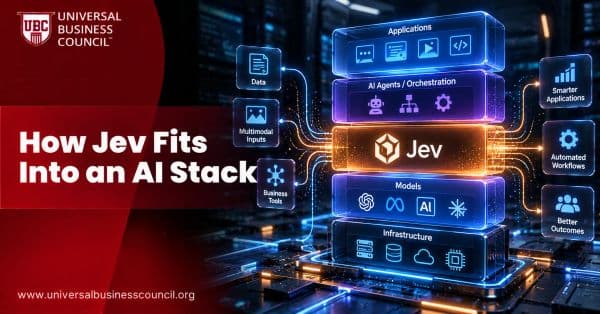
Artificial Intelligence
How Jev Fits Into an AI Stack
Learn how Jev fits into an AI stack as a machine-native decision layer that connects structured intelligence with agents, application logic, APIs, and automated workflows.
Artificial Intelligence
Jev Decision-Making Pipeline
Learn how Jev’s decision-making pipeline transforms program state and structured questions into typed, probabilistic decisions that software can use for automation.
Artificial Intelligence
Jev Latency Explained
Learn how Jev achieves low-latency AI decisions through parallel sampling, structured outputs, and a System One architecture designed for real-time software automation.
Trending Articles
The Role of Blockchain in Ethical AI Development
How blockchain technology is being used to promote transparency and accountability in artificial intelligence systems.
AWS Career Roadmap
A step-by-step guide to building a successful career in Amazon Web Services cloud computing.
Top 5 DeFi Platforms
Explore the leading decentralized finance platforms and what makes each one unique in the evolving DeFi landscape.