

Model Drift vs Data Drift: Implications for Responsible AI
Teams often use "model drift" and "data drift" as if they meant the same thing, and then argue past each other when a system starts to fail. The terms are related but not identical, and the difference changes how you detect problems, who must act and what you owe regulators and affected people. This guide explains model drift vs data drift in plain language, shows how each shows up in practice and sets out the responsible AI implications for monitoring, fairness, documentation and governance. For structured professional learning, see the certified responsible AI expert certification. This is general information, not legal advice.
What is drift in AI?
Drift is a change over time that makes a deployed AI system behave differently from how it did when it was tested and approved. Systems learn from a snapshot of the world, and the world does not stay still. Customer behavior, language, fraud tactics, medical practice, economic conditions and data collection methods all change.

When the change is large enough, the system's outputs stop matching reality, and decisions based on them become less reliable or less fair.
Data drift explained
Data drift, sometimes called covariate shift or input drift, happens when the data the model sees in production differs from the data it was trained on. The model itself has not changed, but the inputs have.
Common causes
Typical triggers include new customer segments, seasonal patterns, changes in a data source or sensor, upstream system updates that alter formats or definitions, and shifts in the population using the product.
Why it matters
If inputs move into ranges the model rarely saw in training, predictions become less reliable, and the system may be least accurate for groups that were thinly represented. That turns a technical issue into a fairness and safety issue.
Model drift explained
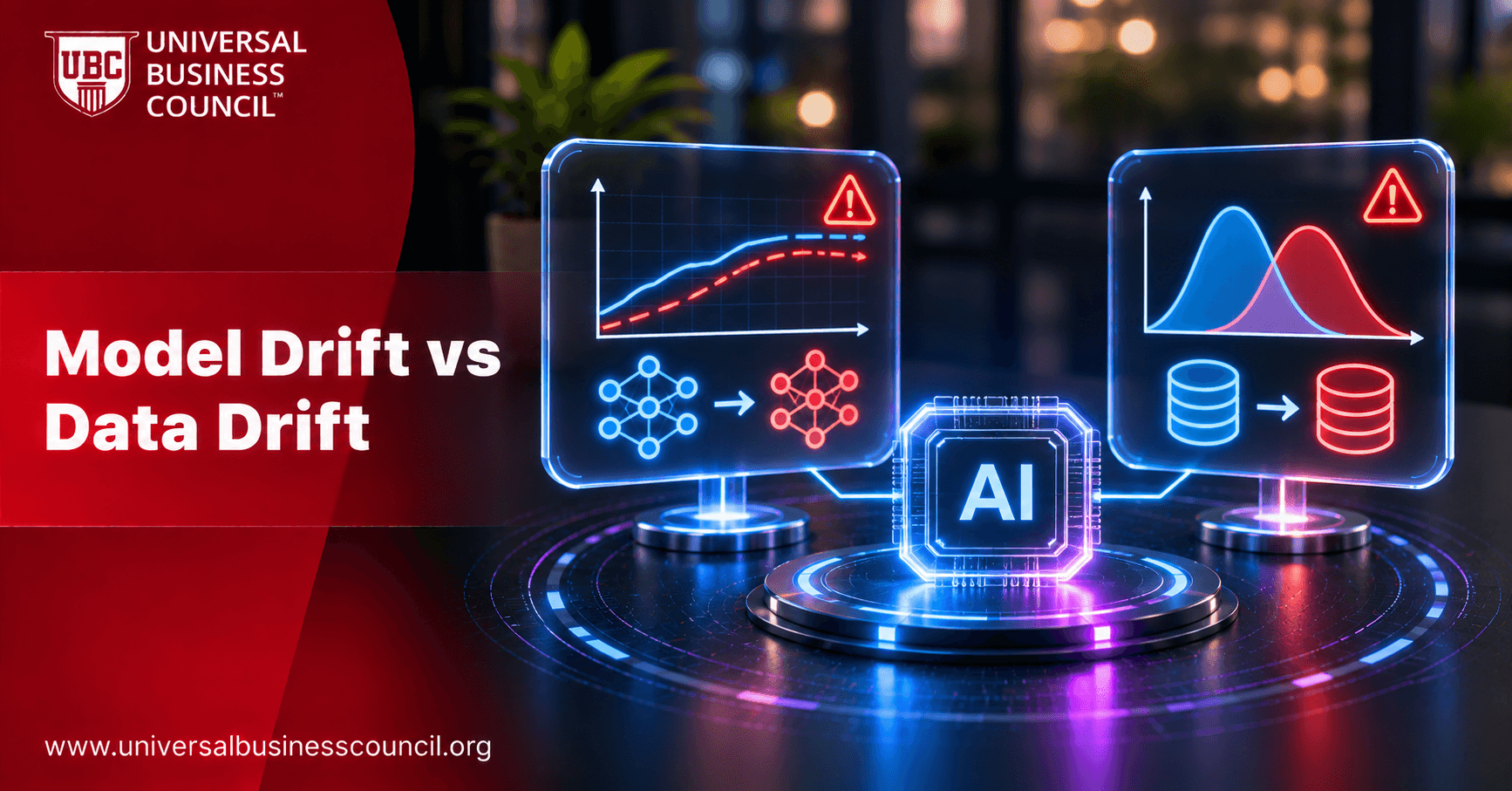
Model drift is a broader and less precisely used term. It usually means that a model's performance has degraded over time. The cause may be data drift, but it may also be concept drift, which is a change in the relationship between inputs and the outcome the model is meant to predict.
Concept drift
Concept drift occurs when the rules of the world change. What signals fraud, risk or customer intent today may differ from last year. The inputs may look similar, yet the correct answer has changed, so the model's learned patterns no longer apply.
Other sources of degradation
Performance can also decline because of label changes, feedback loops where the model's outputs influence future data, updates to a vendor's underlying model or changes in how people use the system.
Key differences at a glance
Keeping the terms straight helps you choose the right response.
Data drift: the inputs change, and the model's learned relationships may still hold
Concept drift: the relationship between inputs and outcomes changes
Model drift: the observed decline in performance, whatever the cause
Detecting each type
Data drift can often be spotted without knowing the true outcomes, by comparing input distributions to a baseline. Concept drift and model drift usually need outcome data or sampled review, which may arrive late. That delay is why proxy measures and periodic human checks matter.
Responsible AI implications
Drift is not only an engineering concern. It touches several compliance duties.
Fairness and equal treatment
Drift can affect groups unevenly. A model that was fair at launch can become less accurate for a particular group as the population or behavior changes. Monitor performance and error rates across relevant groups, not only in aggregate.
Accuracy and transparency duties
Many laws expect data used in decisions to be accurate and expect organizations to keep systems fit for their purpose. Documented drift monitoring helps show that you take these duties seriously. Update model cards and impact assessments when drift leads to material change.
Safety and high-impact decisions
In areas such as health, credit, hiring and public services, stale models can harm people. Set tighter thresholds and require human review for systems where wrong outputs carry serious consequences.
Accountability for vendor models
If a vendor updates its model, your system may drift without any change on your side. Require change notices, pin versions where possible and retest after updates.
Managing drift in practice
A workable approach has a few repeating parts.
Establish baselines and monitor
Record the distributions and performance seen in testing, then compare production data to them using statistical tests and dashboards. Engineers who build these pipelines benefit from sound programming skills, which many develop through tech certifications.
Set thresholds and triggers
Define what level of change triggers investigation, extra review, retraining or restrictions. Not all drift is harmful, so thresholds should reflect risk and impact, not just statistical significance.
Investigate and respond
Find the cause: a data pipeline change, a population shift, a new behavior or a vendor update. Options include fixing the data source, retraining with fresh data, adjusting features, adding human review or retiring the model. Retest for accuracy and fairness before redeploying.
Document and approve changes
Treat retraining and model updates as controlled changes with testing, approval and records. Tamper-evident documentation connects to ideas explored in deep tech certifications.
Assign people and skills
Name an owner for drift monitoring and ensure that those in the role have the right skills. Credential and background verification through services such as HireValid can support hiring of data and model risk staff.
Communicate honestly
Do not describe a model as "always up to date" or "self-correcting" unless you can prove it. A digital marketing course can help teams explain AI performance claims accurately.
Conclusion
Data drift is a change in the inputs a model sees. Concept drift is a change in the relationship between inputs and outcomes. Model drift is the resulting decline in performance, whatever the cause. For responsible AI, all three affect fairness, accuracy, safety and accountability. Establish baselines, monitor continuously, set risk-based thresholds, investigate causes and manage retraining as a controlled change with proper records.
Frequently asked questions
These are the questions teams ask most about drift.
1. What is data drift?
A change in production input data compared with training data.
2. What is concept drift?
A change in the relationship between inputs and the outcome being predicted.
3. What is model drift?
A decline in model performance over time, from any cause.
4. Are model drift and data drift the same?
No. Data drift can cause model drift, but they are not identical.
5. What causes data drift?
New user groups, seasonality, source changes and upstream system updates.
6. Can drift happen without any code change?
Yes. The world and the data change on their own.
7. How do we detect data drift?
Compare production inputs with a baseline using statistical tests and dashboards.
8. How do we detect concept drift?
Use outcome data, sampled review and performance tracking.
9. Why can detection be delayed?
True outcomes may arrive late, so use proxy measures too.
10. Is all drift harmful?
No. Judge it by its effect on performance, fairness and risk.
11. How does drift affect fairness?
It can reduce accuracy more for some groups, so monitor group-level results.
12. Does drift create legal risk?
It can, where laws expect accurate data and fit-for-purpose systems.
13. What are feedback loops?
Cases where a model's outputs influence the data it later sees.
14. Can vendor updates cause drift?
Yes, so require change notices and retest after updates.
15. What is a baseline?
The data and performance profile recorded during testing.
16. When should we retrain?
When monitoring shows material drift and testing shows retraining helps.
17. Is retraining always safe?
No. Retest for accuracy, fairness and security before release.
18. Who owns drift monitoring?
A named system owner supported by data and risk teams.
19. What records are needed?
Baselines, monitoring results, decisions, retraining tests and approvals.
20. How often should thresholds be reviewed?
Regularly, and when systems, risks or data sources change.
Related Articles
View All
Artificial Intelligence
Model Theft and Extraction Attacks: Responsible AI Security Measures
Explore how model theft and extraction attacks threaten AI systems by allowing attackers to replicate models or access proprietary information. Learn how these attacks work, the risks they create, and the security measures organizations can use to protect model intellectual property, maintain data confidentiality, and support responsible AI deployment.
Artificial Intelligence
Responsible AI Data Governance: Quality, Consent and Provenance
Explore how responsible AI data governance supports reliable and ethical AI systems through data quality, informed consent, and data provenance. Learn how organizations can manage training data, protect individual privacy, track data origins, reduce bias, and maintain accountability throughout the AI lifecycle.
Artificial Intelligence
AI Model Cards Explained: Documentation for Responsible AI Systems
Learn what AI model cards are and how they support responsible AI development through clear and structured documentation. Explore the key information they contain, including model purpose, performance, limitations, intended use, risks, and evaluation results, and how they improve transparency and accountability.
Trending Articles
The Role of Blockchain in Ethical AI Development
How blockchain technology is being used to promote transparency and accountability in artificial intelligence systems.
AWS Career Roadmap
A step-by-step guide to building a successful career in Amazon Web Services cloud computing.
Top 5 DeFi Platforms
Explore the leading decentralized finance platforms and what makes each one unique in the evolving DeFi landscape.