

Responsible AI Checklist for AI Developers, Data Scientists and Product Managers
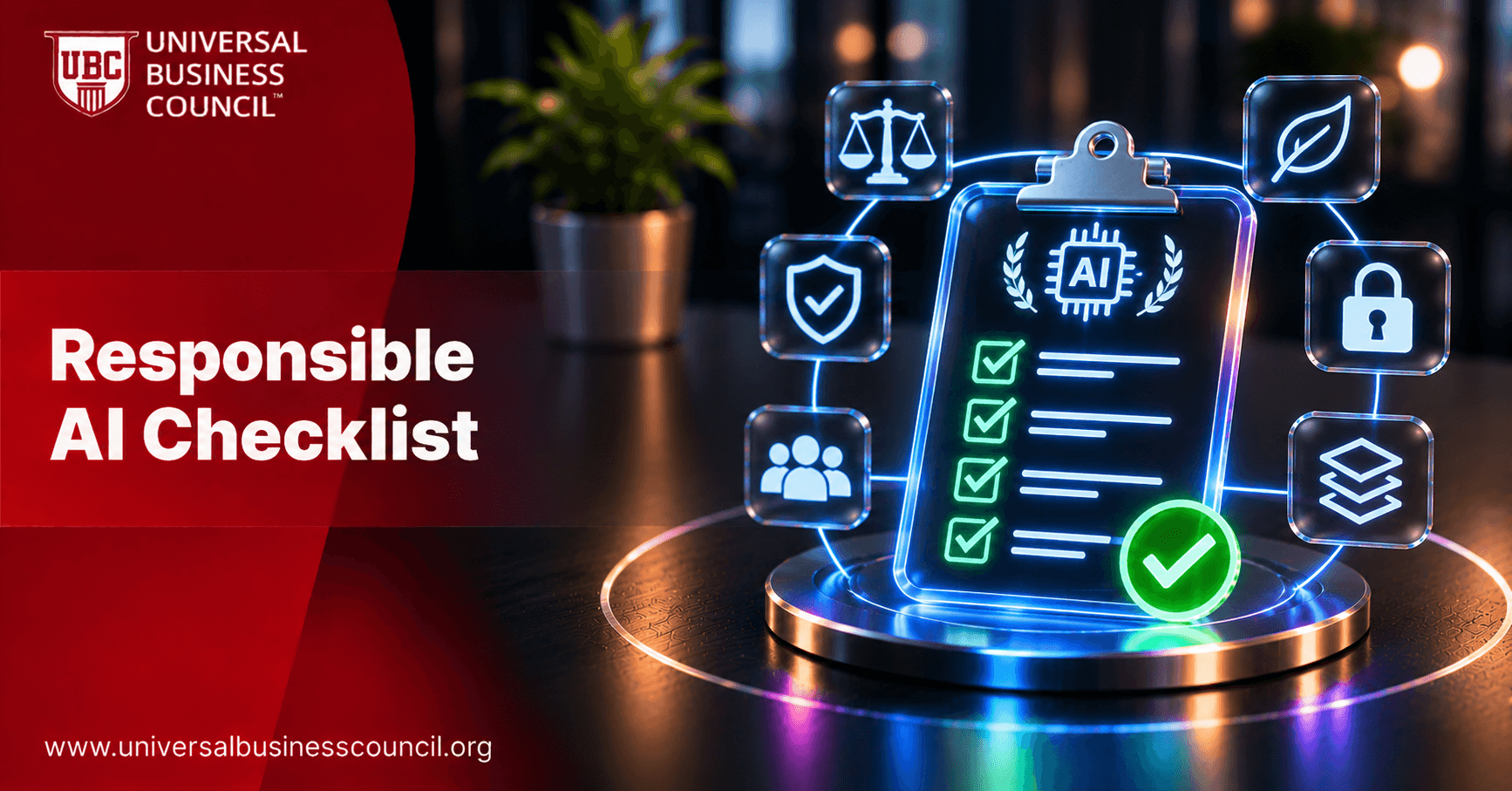
Developers write the code, data scientists build and test the models, and product managers decide what ships. Each of them makes choices that decide whether an AI system is safe, fair and compliant, yet responsible AI guidance is often written for executives rather than for the people doing the work. This checklist is written for those three roles. It follows the lifecycle from idea to monitoring and shows who should check what at each stage. For deeper professional training, see the certified responsible AI expert certification. This is general information, not legal advice.
What is a responsible AI checklist?
A responsible AI checklist is a short, structured list of questions and checks that teams complete at key points in an AI project. It does not replace judgment or formal assessments for high-risk systems. It makes sure that common issues are caught early, that responsibilities are clear and that evidence exists afterward.

Checklists work best when they are brief, specific and part of normal workflow, such as a project template or a release gate.
Stage 1: Define the purpose and scope
Most responsible AI problems begin with unclear purpose. Product managers lead here, with input from the data and engineering teams.
Is the purpose clearly stated, and is AI the right tool for it?
Who will be affected, and could any group be harmed or excluded?
Which laws, policies and contracts apply, including data protection and sector rules?
Is this a higher-risk use that needs formal assessment and senior approval?
Who is the named owner of the system?
Decide what the system must not do
Write down uses that are out of scope and outcomes that are unacceptable. These become requirements for testing and guardrails later.
Stage 2: Data
Data scientists and engineers share responsibility for data. Product managers should know the answers too.
Source, consent and quality
Confirm where the data came from, whether you have a lawful basis and permission to use it for this purpose and whether it is accurate, current and relevant. Check that it represents the people and conditions the system will meet.
Privacy and minimization
Collect only what you need, remove or protect identifiers and limit access. Decide retention periods and deletion rules before collecting.
Document the data
Record origin, collection method, known gaps and limitations in a dataset datasheet or equivalent. This helps reviewers and future maintainers understand the risks.
Stage 3: Model development and testing
Here the model takes shape. Data scientists lead, with developers and product managers reviewing the results.
Choose approaches thoughtfully
Prefer simpler or more explainable models when they perform well enough for the use. Record why you chose the approach and what alternatives you considered.
Test beyond accuracy
Overall accuracy can hide serious problems.
Compare performance and error rates across relevant groups
Test robustness against noise, edge cases and adversarial inputs
Check for privacy leakage, such as memorization of personal data
For generative systems, test for harmful, inaccurate and off-policy outputs
Record limits, failure modes and conditions where the model should not be used
Write a model card
Summarize purpose, data, performance, limitations and monitoring plans in a model card. Keep it updated with each version. Developers who build the pipelines behind these tests benefit from strong programming skills, which many develop through tech certifications.
Stage 4: Build and deploy
Developers take the lead when the model becomes a product.
Security and access
Apply standard secure development practice to models, data stores and APIs. Use least privilege, protect keys and secrets, validate inputs, log activity and test for AI-specific attacks such as prompt injection and data extraction.
Human oversight and fallback
Decide where a person reviews, approves or overrides the system, and build interfaces that give reviewers context and authority. Plan fallback behavior for errors, downtime and unexpected outputs.
Transparency to users
Tell users when they are interacting with AI, explain what the system can and cannot do and provide a route to ask questions or appeal. Product managers own the wording and the experience.
Approval and records
Obtain the required reviews, such as legal, privacy, security and compliance, before launch. Store test results, approvals and versions in a traceable system. Tamper-evident record keeping connects to ideas explored in deep tech certifications.
Stage 5: Monitor and improve
Responsibility continues after launch.
Track what matters
Monitor performance, drift, fairness metrics, security events, user complaints and override rates. Set thresholds that trigger review, and assign someone to respond.
Handle incidents and changes
Know how to report an AI incident, who decides to pause a system and how to notify affected people if needed. Re-run testing and approvals after significant changes to the model, data or use.
Review vendors and people
Third-party models and data carry your risk, so check their documentation, testing and contract terms. Confirm that team members with sensitive access or approval rights have verified credentials, with services such as HireValid supporting the process.
Communicate honestly
Marketing and sales descriptions should match tested performance. Product teams can improve accurate, credible messaging with help from a digital marketing course.
Conclusion
A responsible AI checklist gives developers, data scientists and product managers a shared, practical way to build better systems. Define purpose and scope, check data for source, consent, quality and privacy, test beyond accuracy, build in security and oversight, document and approve before launch and monitor afterward. Keep the list short, tie it to your workflow and update it as your systems and the rules change.
Frequently asked questions
These are the questions technical and product teams ask most about responsible AI checklists.
1. What is a responsible AI checklist?
A short list of checks completed at key points in an AI project.
2. Does a checklist replace formal assessment?
No. High-risk systems still need full assessments.
3. Who owns the checklist?
Each item has an owner, and the system owner is accountable overall.
4. When should we use it?
At each lifecycle stage and before release.
5. What should product managers check first?
Purpose, affected people, legal context and risk level.
6. What data checks matter most?
Source, consent, quality, representativeness and privacy.
7. What is a dataset datasheet?
A document describing a dataset's origin, content and limits.
8. Why test beyond accuracy?
Overall accuracy can hide errors that affect certain groups.
9. What is a model card?
A summary of a model's purpose, performance and limitations.
10. Should we prefer simpler models?
When they perform well enough, yes, because they are easier to explain and review.
11. What security tests apply to AI?
Standard application tests plus prompt injection, extraction and poisoning checks.
12. How do we plan human oversight?
Define review points and give reviewers context and authority.
13. What should users be told?
That AI is involved, what it does and how to seek review.
14. What approvals are needed?
Typically legal, privacy, security and compliance, scaled to risk.
15. What should we monitor after launch?
Performance, drift, fairness, security events and complaints.
16. When should we retest?
After changes to the model, data or use case.
17. How do we handle third-party models?
Review documentation, testing and contract terms, and assess them like your own.
18. What records should we keep?
Test results, approvals, versions and incident logs.
19. How do we avoid checklist fatigue?
Keep it short, specific and part of normal workflow.
20. How often should the checklist be updated?
Regularly, and whenever laws, tools or lessons learned change.
Related Articles
View All
Artificial Intelligence
Responsible AI Data Governance: Quality, Consent and Provenance
Explore how responsible AI data governance supports reliable and ethical AI systems through data quality, informed consent, and data provenance. Learn how organizations can manage training data, protect individual privacy, track data origins, reduce bias, and maintain accountability throughout the AI lifecycle.
Artificial Intelligence
Responsible AI in RAG Systems: Data Privacy, Accuracy and Governance
Learn how to apply responsible AI principles to retrieval-augmented generation (RAG) systems. Explore key considerations for protecting data privacy, improving response accuracy, reducing bias, and establishing effective governance to build secure, transparent, and trustworthy RAG applications.
Artificial Intelligence
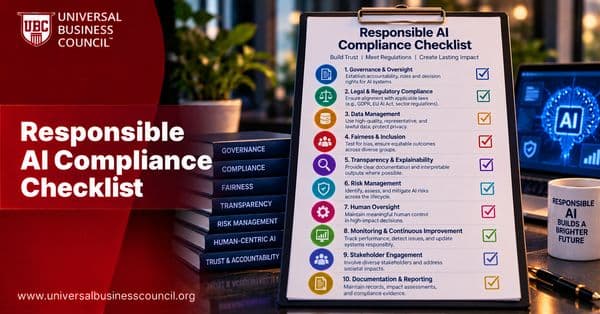
Responsible AI Compliance Checklist for Businesses
Explore a practical responsible AI compliance checklist for businesses to support ethical AI development and deployment. Learn how to assess AI risks, ensure data privacy, address algorithmic bias, maintain transparency, establish accountability, and align AI systems with relevant regulatory requirements.
Trending Articles
The Role of Blockchain in Ethical AI Development
How blockchain technology is being used to promote transparency and accountability in artificial intelligence systems.
AWS Career Roadmap
A step-by-step guide to building a successful career in Amazon Web Services cloud computing.
Top 5 DeFi Platforms
Explore the leading decentralized finance platforms and what makes each one unique in the evolving DeFi landscape.