

Responsible AI Audit: Principles, Controls and Best Practices
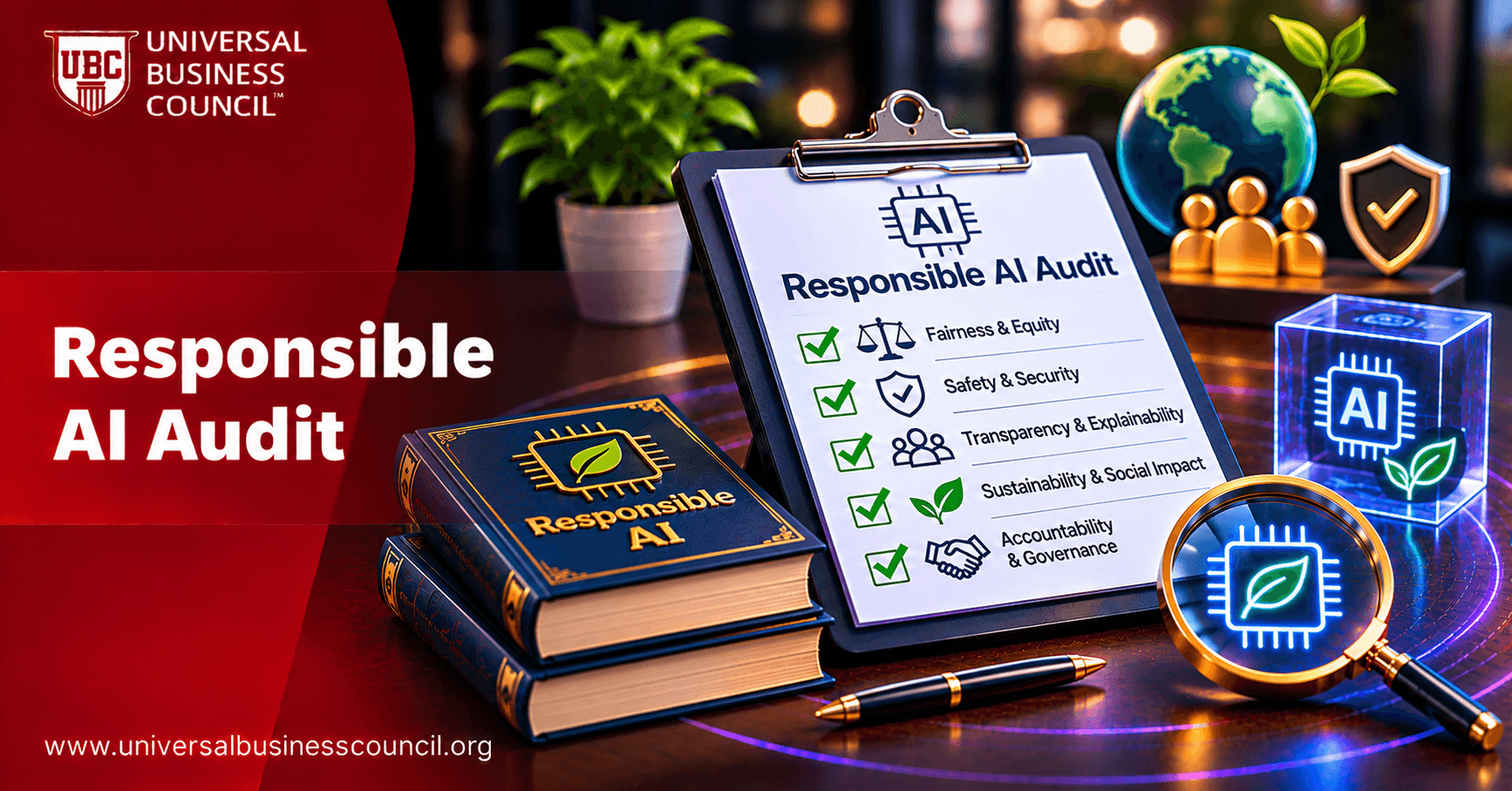
What would an auditor find if you handed over your responsible AI principles and asked for the proof? Most teams discover that the principles are clear and the proof is scattered across six tools and four people's memories. A responsible AI audit pulls that proof into one place and tests it. This guide shows how to move from principle to control, run the audit step by step and apply the habits that separate a useful review from a stack of paperwork. If you want formal training for this role, the Certified AI Audit Professional program from Universal Business Council is designed for it.
What is a responsible AI audit?
A responsible AI audit is an independent review of an organization's AI program that tests whether its principles are backed by working controls. It covers governance, data, models, deployment and monitoring, and it produces a rated set of findings and recommendations.

Think of it as a program-level inspection. Other audits drill into one topic, such as bias or privacy. This one asks whether the whole machine hangs together: policies, owners, tests, records and fixes.
From principle to control
Principles describe what you want. Controls are the specific actions that make it happen. The audit lives in the space between them, so build a control library before you start. Each principle should connect to several concrete controls, each with an owner and a trace.
Principle | Example controls | What an auditor asks for |
Fairness | Pre-release bias testing, periodic outcome review | Test reports, reviewer sign-off, retest dates |
Transparency | User notices, model documentation, explanation process | Screenshots, model cards, sample explanations |
Accountability | Named system owner, escalation path, incident log | Ownership register, incident records |
Privacy | Data minimization, retention rules, access limits | Data map, deletion records, access reviews |
Safety and security | Adversarial testing, monitoring, rollback plan | Test logs, alert history, rollback drill notes |
Human oversight | Review step with power to override | Review logs, override counts, training records |
Controls that stop problems and controls that catch them
A balanced program needs both kinds. Preventive controls work before harm: approval gates, design reviews, access limits, mandatory impact assessments. Detective controls work after the fact: monitoring, audits of outputs, complaint analysis, drift alerts. When something does slip through, a response plan decides how fast it gets fixed.
Auditors should check the balance. A program that is all gates and no monitoring will miss slow drift. A program that is all monitoring and no gates will fix the same mistakes forever.
The audit, step by step
Plan around risk
Start from the AI inventory and rank systems by impact. Decide how deep to go on each. A customer-facing credit tool gets a full review. An internal drafting assistant gets a light touch.
Gather the paper trail
Request policies, risk assessments, test results, model documentation, approvals, monitoring reports and incident logs. Note what is missing, since absence is information.
Test the controls
Choose a sample of systems and walk each control. Reperform a fairness test. Ask to see the last three monitoring alerts and what happened next. Try to reach the owner named in the register and see how long it takes.
Interview across levels
Speak with executives, product managers, engineers, data scientists and the people who handle complaints. Differences between their accounts point to weak spots.
Report and rate
Group findings by theme and severity. Say plainly what is working. Give each recommendation an owner and a date.
Follow up
Revisit closed findings after a few months. A fix that disappears is a finding all over again.
Best practices that separate real audits from paperwork
Keep the audit independent from the teams that build and run the systems
Sample by risk, not by convenience
Use data analysis where you can, such as scanning decision logs for odd patterns, instead of relying on interviews alone
Compare against a recognized framework such as ISO/IEC 42001, ISO/IEC 23894 or the NIST AI RMF, and say which one
Bring in domain experts when the subject needs them, such as a clinician for a health tool
Share draft findings with owners early to correct facts, without trading away conclusions
Measure the program over time with a few steady indicators, such as the share of high-risk systems with current assessments
Evidence requests that save time
Send a standard request list at the start. A typical one asks for:
The AI inventory with risk tiers and owners
The last two impact assessments for high-risk systems
Model documentation for the sampled systems
Bias, safety and security test results with dates
Monitoring reports for the period
Incident and complaint logs, including closed cases
Training records for people who run or review the systems
Vendor contracts and due diligence files
The marketing function belongs in scope
Customer targeting, content generation and chatbots sit close to the public, so include them in the sample. Auditors who want to learn how those teams plan and measure campaigns can look at the Certified Digital Marketing Expert program.
Building the team and keeping records safe
A responsible AI audit team needs people who understand models, data and governance. Technical depth comes from practice and study, and the programming and technology certifications from Global Tech Council can support it. Workpapers carry weight when they cannot be quietly changed, and teams interested in tamper-evident approaches can look at the deep tech certifications from Blockchain Council. When hiring auditors, a short skills test shows more than a resume, and HireValid offers AI-proof pre-employment tests with an Integrity Score that supports human review.
Conclusion: what makes a responsible AI audit worth running
A responsible AI audit checks that an organization's principles are backed by controls that actually operate. It begins with a control library that links each principle, whether fairness, transparency, accountability, privacy, safety or human oversight, to specific actions, owners and evidence. It looks for a balance between controls that stop problems, such as gates and reviews, and controls that catch them, such as monitoring and complaint analysis.
The process runs from risk-based planning through evidence gathering, control testing, interviews across levels, a rated report and follow-up. The habits that make it credible are independence, risk-based sampling, data analysis, a named framework as the yardstick, expert help where needed, early fact-checking with owners and a few steady indicators tracked over time. Use a standard evidence request list to save weeks. To begin, choose one principle in your policy and trace it to one working control with one piece of evidence. If you cannot, you have found your first finding. The Certified AI Audit Professional program mentioned at the start can help your team build a repeatable responsible AI audit.
FAQs
1. What is a responsible AI audit?
An independent review that tests whether an organization's responsible AI principles are backed by working controls.
2. How does it differ from an AI ethics audit?
It is program-level and control-focused, while an ethics audit focuses on values and outcomes.
3. What does it cover?
Governance, data, models, deployment, monitoring and incident handling.
4. What is a control library?
A list of specific controls mapped to principles, each with an owner and evidence.
5. What are preventive and detective controls?
Preventive controls stop problems before they happen. Detective controls spot them afterward.
6. Which frameworks can I audit against?
ISO/IEC 42001, ISO/IEC 23894 and the NIST AI RMF are common choices.
7. Who should run the audit?
An independent function such as internal audit or an external firm.
8. How do we choose which systems to sample?
Rank by impact and risk, then pick a mix that covers the highest tiers.
9. What if the organization has no AI inventory?
Report it as a finding and build a starter inventory to scope the audit.
10. How often should it happen?
Annually for the program, and more often for high-risk systems.
11. Can data analytics help?
Yes. Scanning logs and outcomes can reveal patterns interviews would miss.
12. Should auditors share findings early?
Share draft facts with owners to correct errors, but keep conclusions independent.
13. How do we measure program health over time?
Track a few indicators, such as assessment coverage, open findings and incident closure time.
14. Are vendor systems included?
Yes. Review contracts, documentation and your own testing of vendor tools.
15. What if controls exist but nobody uses them?
That is a finding about operating effectiveness.
16. What should the report include?
Scope, method, ratings, findings, owner responses and dates.
17. How do we follow up?
Revisit closed findings after a few months and retest the fixes.
18. Is an external audit better than an internal one?
Each has strengths. External work adds independence, internal work adds context.
19. Can small organizations do this?
Yes, with a short control list and a few sampled systems.
20. Where can I get trained?
The Certified AI Audit Professional program is one route, alongside the published AI frameworks.
Related Articles
View All
Artificial Intelligence
Data Privacy in Artificial Intelligence: Risks, Controls and Best Practices
Explore the key data privacy risks associated with artificial intelligence and how organizations can address them. Learn about sensitive data exposure, unauthorized access, consent, data protection controls, and best practices for safeguarding personal information throughout the AI lifecycle.
Artificial Intelligence
AI Data Governance Audit: Quality, Consent, Lineage and Access Controls
Explore how an AI data governance audit evaluates the policies, processes, and controls used to manage data across the AI lifecycle. Learn what auditors review, including data quality, access controls, data lineage, documentation, privacy, and compliance, to ensure AI systems rely on properly governed data.

Artificial Intelligence
Generative AI Copyright and Intellectual Property: Responsible Practices
Explore the copyright and intellectual property challenges surrounding generative AI. Learn how AI-generated content, training data, ownership rights, licensing, and attribution raise important legal and ethical questions, along with responsible practices for protecting creators and using AI-generated material.
Trending Articles
The Role of Blockchain in Ethical AI Development
How blockchain technology is being used to promote transparency and accountability in artificial intelligence systems.
AWS Career Roadmap
A step-by-step guide to building a successful career in Amazon Web Services cloud computing.
Top 5 DeFi Platforms
Explore the leading decentralized finance platforms and what makes each one unique in the evolving DeFi landscape.