

Responsible AI in Banking and Finance: Fraud Detection, Credit Risk and Compliance

Banks were using statistical models long before the current AI wave, which makes responsible AI in banking and finance both easier and harder than in other sectors. Easier, because model risk management is an established discipline. Harder, because newer systems are less transparent, change faster and touch more of the customer relationship. This guide covers how to apply responsible AI to fraud detection, credit risk and compliance work, and what to put in place to satisfy customers, auditors and regulators. For readers who want formal training, the Certified Responsible AI Expert program is a good starting point.
What is responsible AI in banking and finance?
Responsible AI in banking and finance means using AI for decisions about money, credit, risk and compliance in ways that are fair, explainable, secure, well-governed and compliant with financial regulation. The stakes are high because these decisions shape people's access to credit, housing and financial stability, and errors can cause both customer harm and institutional loss.

Financial institutions also operate under strict supervision. Regulators expect firms to understand their models, validate them, document them and be able to explain decisions to customers and examiners.
Where AI is used in financial services
Detecting fraud in payments, cards and accounts
Scoring credit applications and setting limits and prices
Anti-money laundering and sanctions screening
Know-your-customer checks and identity verification
Customer service assistants and personalized offers
Trading, portfolio and risk analytics
Reporting and regulatory document review
Fraud detection: catching bad actors without punishing good customers
The balance to strike
Fraud models flag suspicious activity. Set them too loose and fraud gets through. Set them too tight and legitimate customers face blocked cards, frozen accounts and long calls. Both errors cost money and trust, so measure false positives as carefully as missed fraud.
Responsible practices
Test for uneven impact, since some groups may be flagged more often because of spending patterns or location
Give customers a fast, humane route to resolve a blocked transaction
Keep analysts in the loop for serious actions such as closing an account
Refresh models regularly, because fraudsters adapt and patterns change
Guard against attacks on the model itself, including attempts to learn and evade its rules
Credit risk: fair, explainable decisions
Fairness in lending
Credit decisions are covered by fair lending and anti-discrimination rules in many markets. AI can make bias harder to see, because variables that look neutral, such as postal code or shopping behavior, can act as proxies for protected characteristics. Test outcomes across groups, review the inputs a model relies on and document the business reason for each.
Explainability
Customers who are declined often have the right to understand why, and rules in some markets require specific reasons. Choose models and explanation methods that let you give accurate, useful reasons, and make sure the explanation reflects what the model actually did.
Use of alternative data
New data sources can widen access to credit, but they also raise privacy, accuracy and fairness questions. Check data quality, consent and legal basis before use.
Compliance and governance
Model risk management
Banks already run frameworks for developing, validating and monitoring models, and these extend naturally to AI. Keep an inventory of models, with owners, purpose, inputs, limits and validation status. Require independent validation before use and ongoing monitoring afterward.
Regulation to watch
Supervisors around the world are issuing expectations for AI in finance, and some regimes treat credit scoring as high risk. Alongside AI-specific rules, long-standing requirements on data protection, consumer protection, outsourcing and operational resilience still apply. Check the rules in each market where you operate.
Third-party and vendor risk
Many institutions rely on external models and platforms. Ask vendors about data sources, testing, explainability and change management, and build audit and exit rights into contracts. Responsibility for customer outcomes stays with the institution.
A minimum set of records
Model inventory and documentation
Validation reports and performance monitoring
Fairness test results and remediation actions
Decision logs sufficient to reconstruct individual outcomes
Customer complaints and how they were resolved
Customer communication and marketing
Personalized offers, pricing and outreach depend on customer data and carry fairness and consent obligations. Clear, honest communication supports trust in a sector built on it. Marketers in financial services can look at the Certified Digital Marketing Expert program.
Skills, records and trusted people
Quantitative and engineering teams need solid technical foundations, which the programming and technology certifications from Global Tech Council can help provide. Audit trails for models and decisions are strengthened when records are hard to alter, and teams exploring that can look at the deep tech certifications from Blockchain Council. In a regulated sector, screening of staff and contractors is part of risk control, and HireValid can help verify backgrounds and credentials.
Conclusion: responsible AI in banking and finance in practice
Responsible AI in banking and finance builds on the sector's strong tradition of model risk management and extends it to newer, less transparent systems. In fraud detection, the aim is to catch bad actors without punishing good customers, which means watching false positives, testing for uneven impact, keeping analysts involved in serious actions and refreshing models as criminals adapt. In credit risk, the priorities are fairness checks that look past proxies, explanations that are accurate and useful and careful use of alternative data.
In compliance and governance, keep a model inventory, require independent validation and monitoring, follow supervisory expectations in every market and hold vendors to clear standards. Maintain records that let you reconstruct decisions, and give customers a real route to challenge them. Start with the highest-impact models, usually credit decisions and account-closure triggers, and confirm they are documented, tested for fairness and explainable. The Certified Responsible AI Expert program mentioned earlier can help teams deepen their skills in responsible AI in banking and finance.
FAQs
1. What is responsible AI in banking and finance?
Using AI for money, credit and risk decisions in ways that are fair, explainable, secure and compliant.
2. How is AI used in fraud detection?
Models analyze transactions and behavior to flag suspicious activity for action or review.
3. Why do false positives matter in fraud models?
They block legitimate customers, creating cost, frustration and lost trust.
4. Can AI credit models be biased?
Yes, especially through proxy variables that correlate with protected characteristics.
5. What is a proxy variable?
An input that looks neutral but stands in for a protected trait.
6. Do customers have a right to an explanation?
In many markets, yes, particularly for credit denials. Check local rules.
7. What is model risk management?
A discipline for developing, validating, monitoring and governing models.
8. Does model validation apply to AI?
Yes. AI models should be independently validated before use and monitored afterward.
9. Is credit scoring regulated as high risk?
In some regimes, such as the EU AI Act, yes. Rules vary by market.
10. Can banks use alternative data?
Yes, with attention to accuracy, consent, legal basis and fairness.
11. How do we manage third-party AI vendors?
Ask about data, testing and explainability, and build audit and exit rights into contracts.
12. Who is accountable for AI decisions?
The institution, with named owners and senior oversight.
13. Should humans review fraud alerts?
For serious actions such as account closure, yes.
14. How often should models be retrained?
As often as monitoring shows drift or new patterns emerge, especially for fraud.
15. What records should banks keep?
Inventories, validation, fairness tests, decision logs and complaint handling.
16. How do we test for fair lending?
Compare approval rates and terms across groups and review the variables the model uses.
17. Do AI chatbots in banking need controls?
Yes, including accuracy checks, privacy safeguards and handoff to a person.
18. Can AI help with anti-money laundering?
Yes, but alerts need review and the models need validation and monitoring.
19. Can smaller fintechs follow these practices?
Yes. Scale the effort to risk, but keep documentation, testing and oversight.
20. Where can I learn more?
Training such as the Certified Responsible AI Expert program and guidance from financial supervisors.
Related Articles
View All
Artificial Intelligence
Deepfakes and Synthetic Media: Responsible AI Detection and Prevention
Understand what deepfakes and synthetic media are and explore how responsible AI can help detect and prevent their misuse. Learn about detection techniques, ethical challenges, digital authenticity, and practical strategies for reducing misinformation, protecting privacy, and promoting responsible AI use.

Artificial Intelligence
Responsible AI Regulations in India: Laws, Guidelines and Compliance Considerations
Explore the regulatory landscape for responsible AI in India, including government policies, legal frameworks, and key guidelines governing artificial intelligence. Learn how Indian organizations can address AI ethics, data privacy, algorithmic bias, transparency, and accountability while aligning with responsible AI practices.
Artificial Intelligence
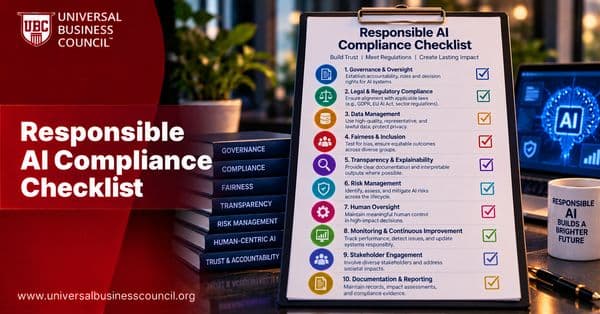
Responsible AI Compliance Checklist for Businesses
Explore a practical responsible AI compliance checklist for businesses to support ethical AI development and deployment. Learn how to assess AI risks, ensure data privacy, address algorithmic bias, maintain transparency, establish accountability, and align AI systems with relevant regulatory requirements.
Trending Articles
The Role of Blockchain in Ethical AI Development
How blockchain technology is being used to promote transparency and accountability in artificial intelligence systems.
AWS Career Roadmap
A step-by-step guide to building a successful career in Amazon Web Services cloud computing.
Top 5 DeFi Platforms
Explore the leading decentralized finance platforms and what makes each one unique in the evolving DeFi landscape.