What Are Multi-Agent Systems?
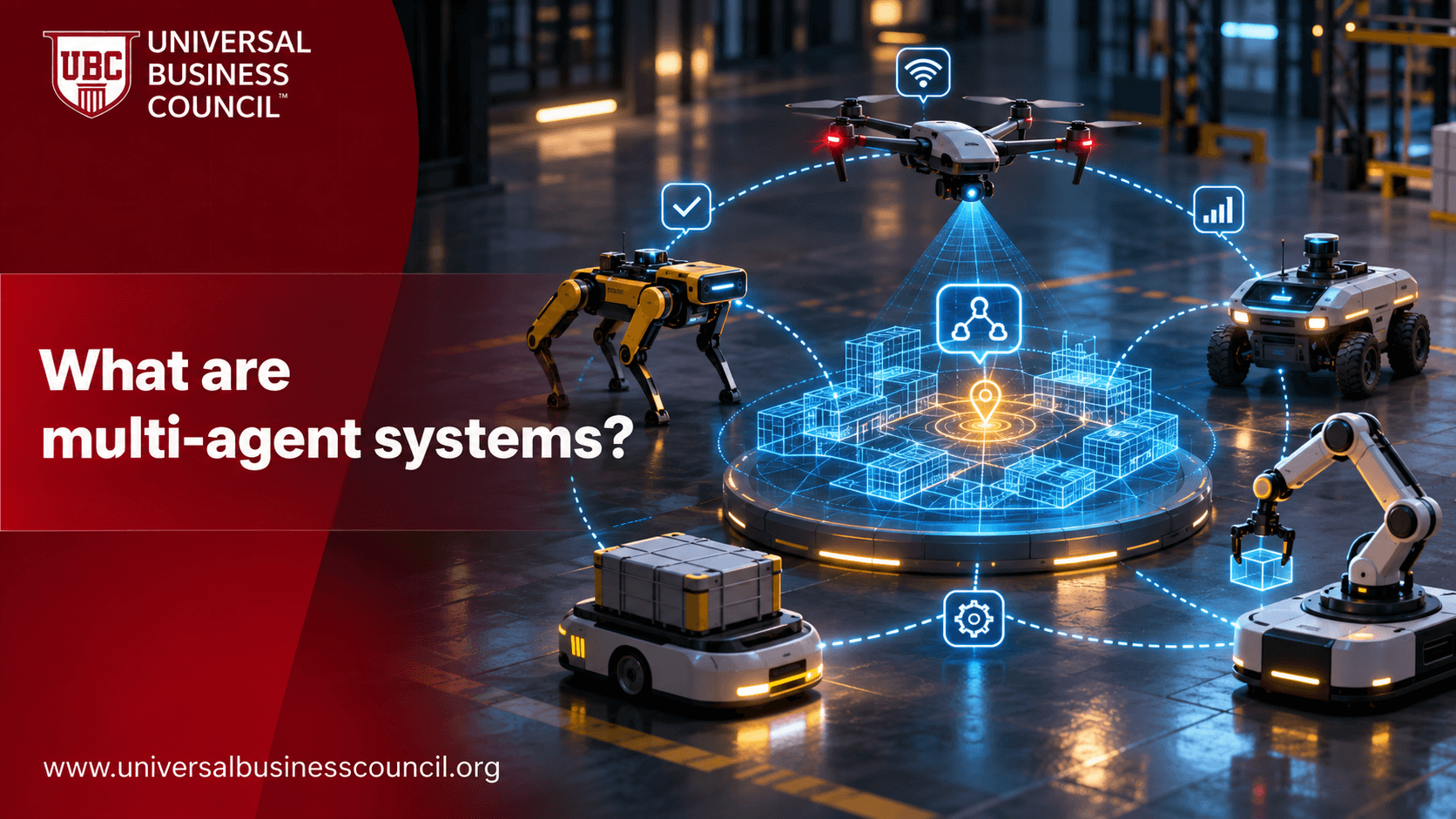
Multi-agent systems are showing up in marketing and research workflows as teams try to hand AI more than one job at a time. Instead of asking a single agent to research a market, check the numbers, review the rules and write the report, a multi-agent system gives each job to a different agent. This guide covers what multi-agent systems are, why teams build them, the common structures, a market research example and the problems that appear when agents work together. If you want the marketing skills behind this kind of analysis, the Digital Marketing Course from Universal Business Council is a good place to start.
What are multi-agent systems?
A multi-agent system consists of two or more AI agents that interact or coordinate to complete a shared task or related objectives. Each agent is a piece of software that uses an AI model to decide what to do next and uses tools to do it. In a multi-agent system, several of them work toward a larger result.

Four features define the setup:
Each agent may have a specific role, such as researcher, analyst or reviewer.
Agents can exchange information with one another.
Tasks can be divided between them.
Their outputs contribute to a larger result that no single agent produces alone.
The idea is older than language models. Researchers studied cooperating software agents in robotics and logistics for decades. What changed is that an agent can now reason and communicate in plain language, so building a team of specialists no longer needs hand-written rules for every interaction.
Why use multiple agents?
A single agent becomes hard to manage when a task spans several areas of expertise. Its instructions grow long, its tool list gets crowded and a mistake is hard to trace to its source. Splitting the work helps in five ways:
It divides complex assignments into parts that are easier to describe and check.
It lets separate tasks run at the same time, which can shorten the wait.
It assigns specialist responsibilities, so each agent has a short brief and only the tools it needs.
It allows outputs from different agents to be compared, such as two analysts reaching the same conclusion on their own.
It coordinates connected workflows, where the result of one step feeds the next.
None of this comes free. More agents mean more model calls, more handoffs and more things to monitor. A team should be able to name what a second agent does that the first can’t. If it can’t, a single agent is probably the better build.
Common structures of multi-agent systems
Most multi-agent systems follow one of four structures, and many real ones mix them.
Structure | How it works | Suits |
|---|---|---|
Hierarchical | A supervisor coordinates other agents | Open-ended goals where the steps aren’t known upfront |
Sequential | Agents complete tasks one after another | Pipelines where each step needs the one before |
Parallel | Agents work on separate tasks simultaneously | Independent parts, like research on different regions |
Collaborative | Agents exchange information to reach a result | Tasks that benefit from review or debate |
A hierarchical setup gives you one point of control. The supervisor assigns work, collects results and decides when the job is done. The trade-off is that the supervisor becomes a bottleneck, and if it misjudges the task, every agent below it follows.
Sequential flows are simple and predictable. They’re also slower, and an error in an early step travels down the line. Parallel flows are faster, but they need a merge step that reconciles the results, especially when agents disagree.
In collaborative setups, agents critique and refine each other’s work. This can improve quality, but each round of discussion adds cost, so give the agents a rule for when to stop.
Technical teams who will build and maintain these systems can look at the Tech Certifications from Global Tech Council for the programming and tooling side.
Example: market research with multi-agent systems
Say a business wants to evaluate a new market. A multi-agent system could divide the work like this:
A research agent gathers industry information, such as market size, trends and customer segments.
A competitor agent examines competing businesses, including their pricing and positioning.
A finance agent evaluates costs and potential returns.
A compliance agent reviews relevant requirements, like licensing or advertising rules.
A reporting agent combines the findings into a single document.
In practice, the research and competitor agents can run in parallel, since neither needs the other’s output. The finance agent waits for their results, while the compliance agent can work alongside them. A supervisor or a fixed sequence then passes everything to the reporting agent, and a person reviews the report before it reaches decision-makers.
The structure shows why teams like these systems. Every agent has a narrow brief, so its work is easy to inspect. If the finance numbers look off, you know which agent to check. It also shows the dependencies: the final report is only as good as its weakest input.
What can go wrong?
Agents working together can fail in ways a single agent doesn’t. Five problems come up most often:
Agents may produce conflicting information. The research agent reports a growing market while the competitor agent describes a crowded one, and without a rule for settling the conflict, the report may blend them into nonsense.
One agent may pass incomplete data to another. A missing column or a cut-off summary becomes the next agent’s whole picture.
Tasks may be duplicated. Two agents search the same sources and the bill doubles.
Communication can fail. A tool times out, a message reaches the wrong agent or an agent stops waiting and carries on without input.
Incorrect outputs can spread through the system. A wrong figure early in the chain looks like a fact by the final report.
Most of the fixes are design choices. Write down each agent’s role and expected output. Check data at each handoff, not just at the end. Give each agent a clear boundary so work doesn’t overlap. Add retries for failed communication, and have the system stop and flag a problem instead of guessing. Keep logs so a person can trace where a bad number came from.
The risk shows up at the project level too. Gartner predicted in June 2025 that more than 40% of agentic AI projects will be canceled by the end of 2027, citing rising costs, unclear value and weak risk controls. Multi-agent designs raise all three, so the added complexity has to earn its place.
What makes multi-agent systems effective
Four things decide whether a multi-agent system helps or just adds complexity.
Coordination comes first. Something has to decide who works when and what happens after each step, whether that’s a supervisor agent, a workflow or a fixed order. Clear roles come next. Each agent needs a narrow, written job, a defined output format and a list of tools it may use.
Reliable information matters just as much. Agents need good data sources and checks on what they pass along, and a shared record of the task’s state helps everyone work from the same facts. Finally, appropriate supervision keeps people involved. They review high-stakes outputs, approve actions that can’t be undone and watch costs. How much supervision you need depends on what a mistake would cost.
Leaders who follow how AI, blockchain and other deep technologies are shaping software buying can read more through the Deep Tech Certifications from Blockchain Council.
How to start
Pick one process that has clearly separable parts, like the market research example. Write each agent’s role, inputs, outputs and tools on one page. Start with two agents, not five, and run them beside your manual process for a few weeks. Measure time saved and errors caught, and add another agent only when you can name the specific job it will do.
Conclusion
Multi-agent systems divide work between AI agents with different responsibilities, so complex tasks can be split, run at the same time and checked from several angles. The common structures are hierarchical, sequential, parallel and collaborative, and a market research project shows how research, competitor, finance, compliance and reporting agents could fit together. The risks are conflicting information, incomplete handoffs, duplicated work, failed communication and errors that spread. Effectiveness depends on coordination, clear roles, reliable information and appropriate supervision. Start with a small setup, check the data at each handoff and keep a person on high-stakes outputs. Used that way, multi-agent systems turn a crowded single agent into a team that’s easier to test, trace and trust.
FAQs
1. What is a multi-agent system?
A setup where two or more AI agents interact or coordinate to complete a shared task or related objectives.
2. How is it different from a single AI agent?
A single agent handles the whole task itself. A multi-agent system divides it among specialists.
3. Why use more than one agent?
To split complex tasks, run work in parallel, assign specialist roles and compare outputs.
4. What are the common structures?
Hierarchical, sequential, parallel and collaborative.
5. What is a hierarchical structure?
A supervisor agent coordinates the other agents and combines their results.
6. What is a sequential structure?
Agents complete tasks one after another, with each output feeding the next step.
7. What is a parallel structure?
Agents work on separate tasks at the same time, and the results are merged later.
8. What is a collaborative structure?
Agents exchange information and critique each other’s work to reach a result.
9. Can agents have different roles?
Yes. Each agent may have a specific role, such as research, finance or compliance.
10. How do agents share information?
Through shared task state, direct messages or a coordinator that relays information.
11. What is an example of a multi-agent system?
A market research setup with research, competitor, finance, compliance and reporting agents.
12. Do multi-agent systems cost more?
Usually, because every agent makes its own model calls and handoffs add overhead.
13. Are they more accurate than one agent?
Not automatically. Review by another agent can catch errors, but mistakes can also spread.
14. What happens if agents disagree?
You need a rule to resolve conflicts, such as a supervisor decision or a human review.
15. Can one agent’s mistake affect the others?
Yes. Incorrect outputs can pass down the chain and look like facts by the end.
16. How do you prevent duplicated work?
Give each agent a clear boundary and a defined task.
17. Do humans stay involved?
Yes. People should review high-stakes outputs and approve actions that can’t be undone.
18. When should I not use a multi-agent system?
When one agent can do the job well. Extra agents add cost and failure points.
19. What does Gartner predict about agentic AI projects?
That more than 40% will be canceled by the end of 2027, citing cost, unclear value and weak risk controls.
20. How should I start?
Pick one process, write each agent’s role, begin with two agents and test them beside your manual process.
Related Articles
View All
Artificial Intelligence
AI Accessibility and Inclusion: Designing Systems for Diverse Users
Explore how accessible and inclusive AI systems can serve users with different abilities, languages, backgrounds, and needs. Learn how to identify design barriers, reduce bias, improve usability, and build AI tools that provide fair and meaningful access to everyone.

Artificial Intelligence
DevSecOps for AI Systems: Integrating Security and Governance
Explore how DevSecOps practices can strengthen AI systems by integrating security and governance throughout the development lifecycle. Learn how teams can automate security testing, manage data and model risks, enforce access controls, monitor deployed systems, and support responsible AI adoption.
Artificial Intelligence
Prompt Injection Risks in AI Systems: Prevention and Mitigation
Learn how prompt injection attacks exploit vulnerabilities in AI systems to manipulate outputs, expose sensitive information, or trigger unauthorized actions. Explore common attack methods, real-world risks, and practical prevention and mitigation strategies to strengthen AI security and protect applications powered by large language models.