

What Is a Responsible AI Certification?
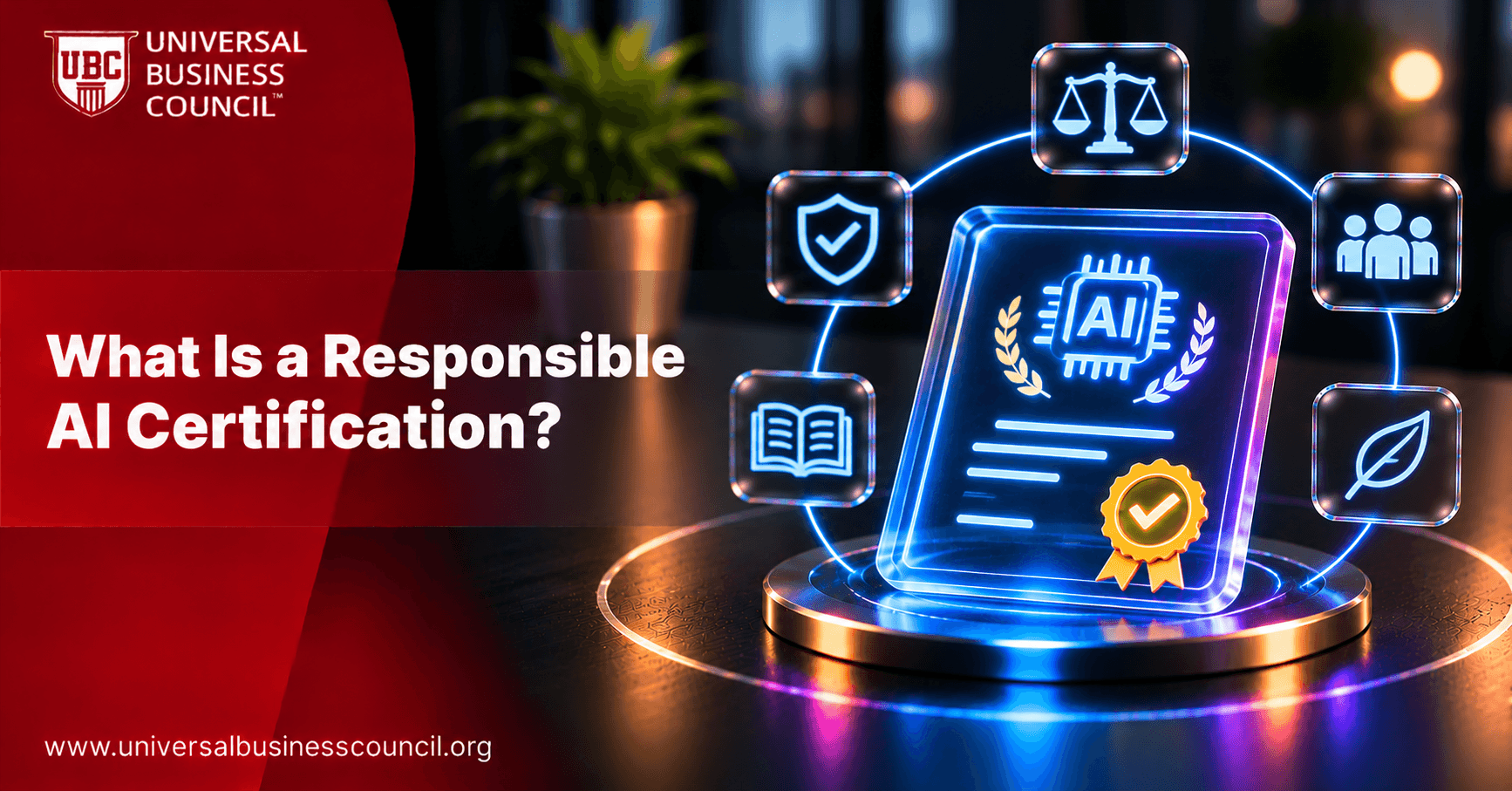
Job descriptions are starting to include phrases such as AI governance, AI risk and trustworthy AI, and employers want proof that candidates understand them. A responsible AI certification is one way to show that proof. It signals that a professional can help an organization use AI in ways that are fair, transparent, secure and compliant.
This article explains what a responsible AI certification is, what you learn, the skills and benefits it offers and the careers it can open. If you are comparing programs, the Certified Responsible AI Expert certification from Universal Business Council is one option to review.

What Is a Responsible AI Certification?
A responsible AI certification is a credential that validates knowledge of how to design, deploy, govern and monitor artificial intelligence ethically and safely. It typically covers AI ethics, governance frameworks, bias and fairness, explainability, privacy, security, risk management and regulatory compliance.
It differs from a general AI course. A general course teaches how models are built or used, while a responsible AI program focuses on how to control the risks and responsibilities that come with them. The audience is wide: technologists, compliance officers, lawyers, auditors, product managers, consultants and business leaders all use these skills.
Why Responsible AI Skills Are in Demand
Three forces drive demand. Regulation is growing, with laws such as the EU AI Act and guidance such as the NIST AI Risk Management Framework and ISO/IEC 42001 expecting documented risk management and oversight. Public scrutiny of bias, hallucinations and privacy harm has risen. And organizations now deploy AI in hiring, lending, healthcare and customer service, where mistakes carry legal and reputational cost.
Many companies lack people who can translate these pressures into policy and practice. That gap creates room for professionals who understand both the technology and the governance side.
Skills You Typically Build
Governance and Compliance Skills
You learn how to read and apply frameworks and laws, write AI policies, classify risk, assign accountability and prepare for audits. These skills support roles in compliance, legal and risk functions.
Technical Literacy for Non-Engineers
Good programs explain how models, data and generative AI behave without requiring you to code. You learn what bias, drift, hallucination and prompt injection mean so you can ask engineers sharper questions. If you want to go deeper technically, short tech certifications can complement a governance-focused credential.
Practical Competencies
Running AI risk and impact assessments
Testing for bias and explaining model decisions
Applying privacy and data governance principles
Evaluating AI vendors and third-party risk
Setting up monitoring and incident response
Communicating AI risk clearly to executives and customers
Benefits of Getting Certified
A certification gives structure to a fast-moving subject. Instead of piecing together blog posts and standards, you follow a curriculum that connects ethics, law and operations. It also gives employers a quick signal of competence, which matters when hiring managers screen many applicants.
Other benefits include confidence in conversations with technical and legal teams, a shared vocabulary for cross-functional work and a credential that can be verified. Employers often verify qualifications during hiring, and services like HireValid help organizations confirm that credentials and experience are genuine, which is one reason to choose a certification with an online verification option.
For people changing careers, a certification can ease the move into AI governance without a technical degree. For existing professionals, it can extend a compliance, audit or legal background into a growing field.
Career Opportunities
Responsible AI skills apply across sectors, including technology, healthcare, finance, consulting, government and research. Typical job titles include:
Responsible AI specialist
AI governance consultant
AI ethics advisor
AI compliance manager
AI risk management specialist
Trustworthy AI analyst
AI policy coordinator
Existing roles are also changing. Product managers, data protection officers, internal auditors and procurement leads increasingly handle AI questions as part of their jobs. Marketers need to understand AI disclosure and content rules, and a Digital Marketing Course alongside responsible AI knowledge can help them apply those rules in campaigns.
How to Choose a Responsible AI Certification
Look at several factors before enrolling:
Curriculum coverage: does it include governance, bias, privacy, security, risk and generative AI?
Framework alignment: does it reference the EU AI Act, NIST AI RMF, ISO/IEC 42001 and OECD principles?
Practical content: are there hands-on exercises, case studies or projects?
Flexibility: is it self-paced, and does it suit your schedule?
Verification: can employers verify your credential online?
Updates: is the content kept current as laws change?
Be realistic as well. A certificate shows knowledge, but employers also value experience, so pair the credential with real projects such as drafting an AI policy or running a sample risk assessment.
Staying Current After Certification
AI regulation and technology change quickly, so treat certification as a starting point. Follow updates to major laws and frameworks, join professional communities and watch adjacent technologies. Resources such as Deep Tech Certifications offer helpful background on fields that increasingly intersect with AI.
Conclusion
A responsible AI certification validates your ability to help organizations use AI safely, fairly and lawfully. It builds governance, risk and technical literacy skills, supports career moves across industries and gives employers a credential they can verify. Choose a program with broad coverage, practical content and regular updates, then keep learning. The FAQs below answer common questions.
Frequently Asked Questions
What is a responsible AI certification?
A credential that validates your knowledge of ethical, safe and compliant AI governance.
Who should take one?
Technologists, compliance and legal professionals, auditors, product managers, consultants and leaders.
Do I need technical skills?
Not necessarily. Many programs start from the foundations.
What topics does it cover?
Ethics, governance, bias, explainability, privacy, security, risk management and compliance.
How is it different from an AI course?
It focuses on governing AI risks, not on building models.
Is responsible AI a good career?
Demand is growing as regulation and AI adoption expand, though outcomes depend on experience and market.
What jobs can it lead to?
Roles such as AI governance consultant, AI compliance manager and AI risk specialist.
Which frameworks should a program cover?
The EU AI Act, NIST AI RMF, ISO/IEC 42001 and the OECD AI Principles.
How long does it take?
It varies from a few hours of content to several months, depending on the program.
Is a certification enough to get hired?
It helps, but employers also want experience, so pair it with practical projects.
Can I study online?
Yes, many programs are self-paced and online.
Can employers verify the credential?
Many issuers provide a verification portal.
Does it help non-technical professionals?
Yes, it gives them the literacy to work with technical and legal teams.
What is AI governance?
The policies, roles and controls that direct how AI is used responsibly.
Does it cover generative AI?
Current programs should include generative AI risks and governance.
How do I choose a program?
Check curriculum, framework alignment, practical content, flexibility, verification and updates.
Will it keep me up to date on laws?
It gives a foundation, but you should follow regulatory changes continuously.
Can career changers benefit?
Yes, it offers a structured entry into AI governance.
What should I do after certification?
Apply the skills in projects, build a portfolio and keep learning.
Related Articles
View All
Artificial Intelligence
How to Become a Responsible AI Expert: Skills, Learning Path and Certification
Learn how to become a Responsible AI expert with a clear learning path covering essential skills, relevant qualifications, and industry certifications. Explore how to build expertise in AI ethics, governance, risk management, compliance, and responsible AI practices.
Artificial Intelligence
Federated Learning and Responsible AI: Benefits, Risks and Limitations
Explore how federated learning supports responsible AI by allowing machine learning models to train across decentralized data sources without directly sharing raw data. Learn about its benefits for privacy and collaboration, along with risks, technical limitations, security concerns, and practical applications.
Artificial Intelligence
Responsible AI Data Governance: Quality, Consent and Provenance
Explore how responsible AI data governance supports reliable and ethical AI systems through data quality, informed consent, and data provenance. Learn how organizations can manage training data, protect individual privacy, track data origins, reduce bias, and maintain accountability throughout the AI lifecycle.
Trending Articles
The Role of Blockchain in Ethical AI Development
How blockchain technology is being used to promote transparency and accountability in artificial intelligence systems.
AWS Career Roadmap
A step-by-step guide to building a successful career in Amazon Web Services cloud computing.
Top 5 DeFi Platforms
Explore the leading decentralized finance platforms and what makes each one unique in the evolving DeFi landscape.