What is Human in The Loop AI
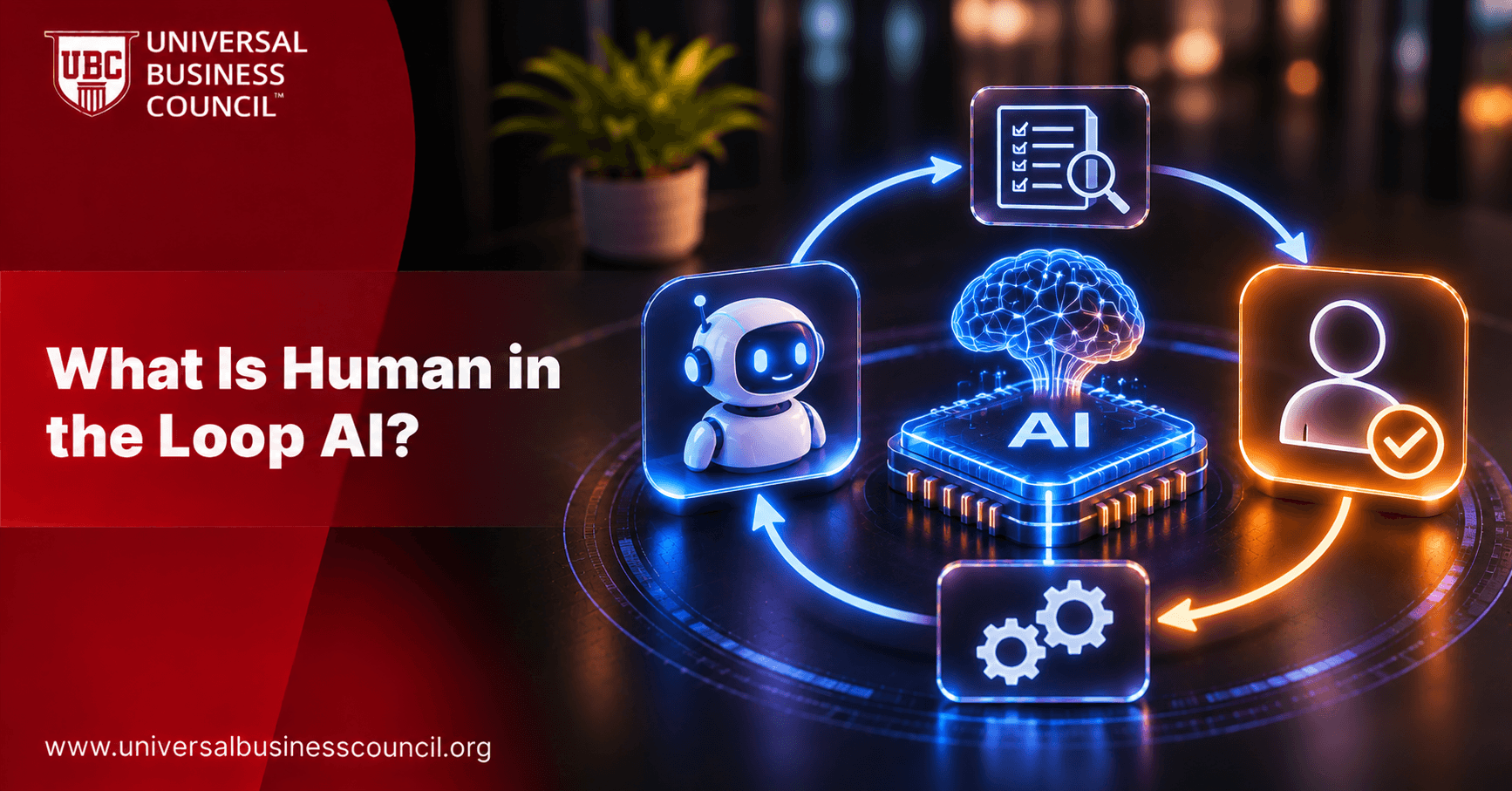
Human-in-the-loop AI is a way of building AI systems so that a person stays involved at the points where judgment matters most. The machine does the heavy lifting, and a human reviews, corrects or approves what it produces. That single design choice separates a tool you can trust with real customers from one that quietly makes costly mistakes at scale. This guide covers what the approach means, how it works, where it fits and how to set it up without slowing your team to a crawl, and teams that want to build the skills behind it can start with digital marketing courses from Universal Business Council.
What is human-in-the-loop AI?
Human-in-the-loop AI, often shortened to HITL, describes systems where people take part in the AI’s work cycle. Humans may label training data, review the model’s outputs, approve high-impact actions or step in when the system isn’t sure. The AI handles speed and volume, and the person supplies context, ethics and accountability.

The idea is simple. Machines are good at patterns and bad at nuance. People are slower but understand situations a model has never seen. HITL combines the two so each covers the other’s weak spots.
Loop, on the loop or out of the loop?
These three terms describe how much control a person keeps. In the loop means a human approves or corrects each important output before it takes effect. On the loop means the AI acts on its own while a person monitors and can intervene. Out of the loop means the system runs fully on its own, with no routine human involvement.
The right setting depends on risk. A tool that suggests email subject lines can run mostly on its own. A tool that influences hiring, lending or medical decisions should keep a person firmly in the loop.
How human-in-the-loop AI works
A HITL system usually involves people at three stages: before the model runs, while it runs and after it acts.
Before, humans prepare and label the data the model learns from, and they set the rules about what the AI may and may not do. While it runs, the system flags low-confidence or high-risk cases and routes them to a reviewer instead of acting alone. After, people check outcomes, correct errors and feed those corrections back so the model improves.
Confidence thresholds and escalation
Most setups rely on a confidence threshold. When the model is sure and the stakes are low, it proceeds. When it’s unsure or the decision is sensitive, it escalates to a person. Setting those thresholds well is half the craft. Too loose, and mistakes slip through. Too tight, and reviewers drown in routine cases.
Teams building and tuning these systems need solid fluency in data, programming and system design, and structured Tech Certifications can help build that foundation.
Where businesses use it
HITL fits wherever AI output affects people, money or reputation.
Content moderation: AI flags questionable posts and moderators make the final call
Healthcare support: AI highlights possible issues in scans or records and clinicians confirm
Finance and fraud: AI flags suspicious transactions and analysts decide what to block
Customer support: AI drafts replies and agents approve them for sensitive cases
Marketing is a natural fit too. AI can draft copy, suggest audiences and schedule posts, but a person should approve anything customer-facing, because one off-brand message can travel far. Marketers who want to pair automation with sound strategy can build that skill through the Certified Digital Marketing Expert certification.
Hiring is another area where oversight matters. Screening and verification tools save time, but they affect real people, so a human reviewer should make the final decision. Many employers pair such tools with verification services like HireValid while keeping a person responsible for the outcome.
Why it matters
The case for HITL rests on a few practical benefits. It improves accuracy, because people catch errors and edge cases the model misses. It builds trust, since customers and staff are more comfortable knowing someone is accountable. It supports compliance, because many organizations need to show that meaningful oversight exists. And it makes the system better over time, because human corrections become training signals.
There’s a simpler benefit too. When something goes wrong, a clear point of human responsibility makes it far easier to find the cause and fix it.
Where it goes wrong
Putting a person in the loop doesn’t automatically make a system safe. Several failure modes are common.
Automation bias is the tendency to trust the machine’s answer without really checking it. Reviewers who approve hundreds of items a day often slide into rubber-stamping. Fatigue makes this worse, and so does a design that shows the AI’s answer before the reviewer forms their own view. Bottlenecks are the opposite problem: if too many cases land with humans, the process slows and people start looking for shortcuts.
Reviewers need authority, not just a button
A reviewer who can’t override the system, or who is penalized for slowing things down, isn’t really in the loop. For oversight to be meaningful, the person needs enough time, information and authority to disagree with the AI and have that decision stick.
Compliance and accountability
Some regional rules require meaningful human oversight for certain automated decisions, especially those affecting employment, credit, health or legal rights. Requirements vary by place, so check what applies to your business and your customers.
Whatever the rules say, good practice is consistent. Name an owner for each automated decision. Keep records of what the AI recommended, what the person decided and why. Where personal data is involved, apply consent, retention and data protection rules as you would for any other system.
How to design a good human-in-the-loop process
Start by sorting decisions by risk. Reversible, low-stakes choices can lean on automation. Irreversible or high-impact ones need review. Then build the process around a few firm principles:
Decide in advance which cases go to a person and why.
Give reviewers context, not just the AI’s answer.
Measure how often reviewers override the AI, because a rate near zero may signal rubber-stamping.
Log every decision so it can be audited later.
Feed corrections back into the system on a regular schedule.
Leaders who want to see how AI sits alongside other emerging technologies can explore the deep tech certifications from Blockchain Council, which cover areas that increasingly work together with AI.
Conclusion
Human-in-the-loop AI keeps a person involved where judgment, ethics and accountability matter most, while the machine handles speed and scale. It works best when decisions are sorted by risk, reviewers have real authority and every outcome is logged and learned from. It fails when people become rubber stamps or when the process buries them in routine cases. Build it with clear thresholds, honest measurement and a named owner for each decision, and AI becomes a dependable partner instead of an unsupervised risk.
Frequently asked questions
1. What is human-in-the-loop AI in simple terms?
It’s AI designed so that a person reviews, corrects or approves the system’s work at important points.
2. Why is human-in-the-loop important?
It catches errors, adds judgment and creates clear accountability, especially for decisions that affect people.
3. What’s the difference between human-in-the-loop and human-on-the-loop?
In the loop means a person approves outputs before they take effect. On the loop means the AI acts while a person monitors and can step in.
4. What does human-out-of-the-loop mean?
It means the system runs fully on its own without routine human involvement.
5. Where is human-in-the-loop AI used?
Common areas include content moderation, healthcare support, fraud detection, customer support and hiring.
6. How does a human-in-the-loop system decide what to escalate?
It usually uses confidence thresholds and risk rules, sending uncertain or high-impact cases to a person.
7. What is a confidence threshold?
It’s a set level of certainty. Above it, the AI proceeds. Below it, the case goes to a human.
8. Does human-in-the-loop slow things down?
It can if too many cases are escalated. Good threshold design keeps people focused on the cases that need them.
9. What is automation bias?
It’s the tendency to trust the AI’s answer without properly checking it.
10. How can teams avoid rubber-stamping?
Give reviewers time and context, let them form a view first and track how often they override the AI.
11. Do reviewers need special training?
Yes. They need to understand the system’s limits, the decision criteria and how to spot common errors.
12. How do humans help train AI?
They label data, correct mistakes and provide feedback that the model learns from.
13. Is human-in-the-loop required by law?
Some regional rules require meaningful human oversight for certain automated decisions. Check what applies where you operate.
14. What should be logged in a human-in-the-loop process?
The AI’s recommendation, the person’s decision, the reason and the time, so decisions can be audited.
15. Can small businesses use human-in-the-loop AI?
Yes. It can be as simple as a team member approving AI-drafted content before it goes out.
16. How does it apply to marketing?
AI can draft and suggest, while a person approves anything customer-facing to protect brand voice and trust.
17. How does it help with bias?
Human reviewers can spot unfair patterns and correct them, though reviewers can carry bias too, so testing still matters.
18. How do you measure whether it’s working?
Track accuracy, review time, override rates and the number of errors caught before they reached customers.
19. Can human-in-the-loop be reduced over time?
For some low-risk tasks, yes, once the system has a strong track record. Keep review for high-stakes decisions.
20. Where should a business start?
Pick one AI-assisted process, sort its decisions by risk, set escalation rules and assign a named owner.
Related Articles
View All
Artificial Intelligence
AI Accountability Audit: Verifying Ownership and Human Oversight
Explore how an AI transparency audit evaluates the information organizations disclose about their AI systems and how they communicate with users. Learn what to review in AI disclosures, system documentation, user notices, and decision explanations to ensure people understand when and how AI is being used.

Artificial Intelligence
Overreliance on AI: How to Design Effective Human Oversight
Learn why overreliance on AI can weaken human judgment and increase decision-making risks. Explore how organizations can design effective human oversight through clear accountability, meaningful review processes, user training, and safeguards that keep people actively involved in AI-driven decisions.
Artificial Intelligence
AI Human Factors and Automation Bias: Keeping People in Control
Understand how human behavior, cognitive biases, and trust influence interactions with AI systems. Explore automation bias, its causes, real-world risks, and how human factors affect decision-making when people rely on AI-generated recommendations.