What Is an AI Agentic Workflow?
Most teams already have workflows, the repeatable sequences that take a lead from a form to a follow-up or a report from raw data to a manager’s inbox. An agentic workflow changes who makes the decisions inside those sequences. This guide covers the AI agentic workflow: what it is, the pieces it’s made of, five design patterns, a worked marketing example, when to use one and when not to, and the guardrails that keep it safe. If you want marketing skills to go with it, the Digital Marketing Course from Universal Business Council is a good place to start.
What is an AI agentic workflow?
An AI agentic workflow is a multi-step process in which AI agents make some of the decisions about what happens next, inside a structure people have designed. Instead of following a fixed path, the process lets an agent choose tools, order its steps and adjust when results change, while people set the goal, the limits and the approval points.

Anthropic’s engineering team draws a useful line. In its description, workflows are systems where models and tools follow predefined code paths, and agents are systems where the model directs its own process and tool use. Real systems blend them. The skeleton is fixed. The agent has freedom at the steps where the right move can’t be known in advance.
That’s why the idea fits business work. A weekly report has a fixed shape, but a campaign that underperforms needs judgment about why. An agentic workflow supplies both: reliable structure around flexible reasoning.
The building blocks
Most agentic workflows share the same parts.
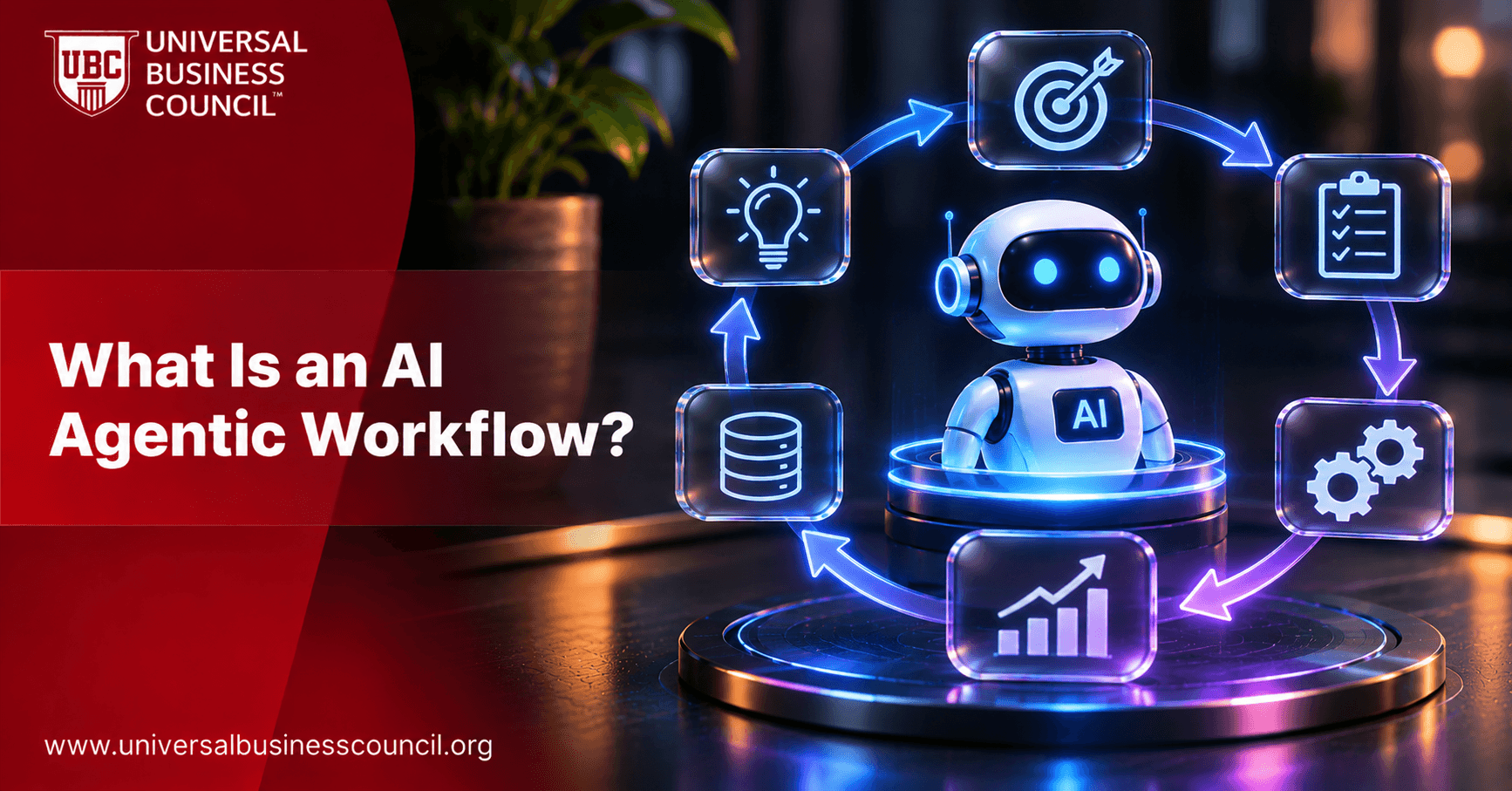
A trigger starts the process: a new lead, an incoming invoice, a Monday morning. A goal and instructions tell the agent what finished work looks like and what it must not do. The agent itself, usually driven by a large language model, reasons about the next step. Tools let it act in your CRM, email platform, spreadsheet or ticketing system. Memory holds the context of the task and any reference material, like brand guidelines. Checkpoints pause the process for a person before risky steps. And logs record what happened, so someone can audit it.
Teams usually spend their energy on the agent and underinvest in the last two. Checkpoints and logs decide whether a workflow is safe to run on real customers and real money.
Five workflow patterns
Anthropic’s published guidance on building agents describes patterns that cover most designs. Here they are with marketing examples.
Prompt chaining breaks a task into steps with a check between each one. A content workflow drafts, then checks facts, then checks brand voice.
Routing classifies an input and sends it to the right path. A reply to a lead goes to sales, support or billing depending on what the message says.
Parallelization runs pieces at the same time, or runs the same task several times to compare answers. Three agents each draft a subject line and a fourth picks the strongest.
The orchestrator-worker pattern has a central agent break a goal into subtasks and hand them to workers. A launch brief becomes research, copy and scheduling tasks.
The evaluator-optimizer loop has one step produce work and another critique it, repeating until it clears a checklist. A draft goes through a compliance reviewer until no unapproved claims remain.
Real workflows combine these. Pick the simplest pattern that fits and add complexity only when a test shows you need it.
A worked example: promoting a webinar
Take a webinar promotion. A person defines the goal: 300 registrations in three weeks, no discounts, brand voice rules attached.
An agent starts by pulling last quarter’s webinar results and the audience segments from the CRM. A second step drafts three email variations and two social posts, using the brand guidelines from memory. A review step checks the drafts against approved claims and flags anything off. A person approves the campaign, because it’s going to customers. The workflow then schedules the sends, and after 48 hours an agent checks registrations, compares segments and proposes changes to the follow-up. The person approves or edits those changes, and the loop continues until the date.
Count the human checkpoints: one before launch and one before changes. Count the agent decisions: which segments to target, which variation to favor, what to change. That’s the shape of a good agentic workflow, with people at the risky gates and agents on the repetitive judgment.
When to use one, and when not to
The simplest solution that works is usually the right one. Anthropic’s advice is to find the simplest approach first and add agentic complexity only when it clearly improves results, since agents add cost and delay.
A fixed rule beats an agent when the task is predictable, high-volume and must follow the same steps every time, such as a payment run. A single well-written prompt beats a workflow when the task is one-off and a person will review it anyway.
An agentic workflow earns its place when the work has several steps, messy inputs, a need to touch other software and judgment calls along the way. Lead handling, reporting and content production fit. Technical teams who will build and maintain these systems can look at the Tech Certifications from Global Tech Council for the programming and tooling side.
Guardrails and metrics
Give each agent the least access the task requires. Set spending and volume caps inside the connected platforms, not only in the agent’s instructions. Require a human yes for money, customer commitments and legal wording. Keep logs someone reads, and test the workflow against known cases before it runs live.
Measure it like any other process: time per task, error rate, how often a reviewer overrules the agent, how often the agent escalates and cost per run. Compare each number with the old process during a pilot of about 30 days.
The wider data explains the caution. Gartner predicted in June 2025 that more than 40% of agentic AI projects will be canceled by the end of 2027, citing rising costs, unclear value and weak risk controls. Leaders who follow how AI, blockchain and other deep technologies are reshaping software buying can read more through the Deep Tech Certifications from Blockchain Council.
Conclusion
An AI agentic workflow is a multi-step process where agents decide some of what happens next, inside a structure that people design and supervise. Its parts are a trigger, a goal, an agent, tools, memory, checkpoints and logs. Five patterns cover most designs: prompt chaining, routing, parallelization, orchestrator-workers and evaluator-optimizer loops. A webinar promotion shows how agents handle the repetitive judgment while people approve the risky steps. Use an agentic workflow for multi-step, messy, tool-heavy work, and use plain rules or a single prompt when the task is simple. Set limits, keep humans on approvals, log everything and measure against the old process before widening the scope. Start small, and let the results decide how far an AI agentic workflow goes.
FAQs
1. What is an AI agentic workflow?
A multi-step process where AI agents make some decisions about next steps, inside a structure people design.
2. How is it different from a regular workflow?
A regular workflow follows fixed paths. An agentic one lets agents choose tools and steps as results change.
3. How is it different from an AI agent?
An agent is one component. The workflow is the whole process around agents, tools, checkpoints and logs.
4. What are the parts of an agentic workflow?
A trigger, a goal, an agent, tools, memory, checkpoints and logs.
5. What is prompt chaining?
Breaking a task into steps with a check between each one.
6. What is routing?
Classifying an input and sending it to the right path or specialist.
7. What is parallelization?
Running pieces of a job at the same time, or running one task several times to compare answers.
8. What is the orchestrator-worker pattern?
A central agent splits a goal into subtasks and hands them to worker agents.
9. What is an evaluator-optimizer loop?
One step produces work and another critiques it, repeating until the work passes a checklist.
10. Where do humans fit in?
At approval points before risky actions, such as sending campaigns, spending money or changing legal wording.
11. What marketing tasks suit agentic workflows?
Lead handling, campaign reporting, content production with brand checks and webinar promotion.
12. When should I not use one?
When the task is predictable and high-volume, or one-off and reviewed by a person anyway.
13. Are agentic workflows expensive?
They cost more per run than fixed rules because agents make model calls.
14. How do I keep one from running up costs?
Cap steps, time and spend inside the connected platforms.
15. What metrics should I track?
Time per task, error rate, reviewer overrides, escalations and cost per run.
16. How long should a pilot run?
About 30 days, with a person reviewing every output.
17. What does Gartner predict?
That more than 40% of agentic AI projects will be canceled by the end of 2027.
18. What access should an agent have?
The least it needs, written down as what it may read, change and send.
19. Can I build one without code?
Some platforms offer low-code options, but technical review of permissions and logging is still needed.
20. How do I start?
Pick one repeated, multi-step process, split rule-based steps from judgment steps and pilot it with approvals in place.
Related Articles
View All
Artificial Intelligence
What Is Agentic Workflow Automation?
Learn what agentic workflow automation is, how it works, and how AI agents manage multi-step tasks with greater autonomy. Explore its key components, practical applications, benefits, and limitations, along with how agentic workflows differ from traditional automation and support more adaptive business processes.
Artificial Intelligence
Real-World Applications of Agentic AI
Explore how agentic AI is being used across industries to automate complex tasks, support decision-making, and manage multi-step workflows. Discover real-world applications in healthcare, finance, customer service, education, manufacturing, and other sectors, along with practical examples, benefits, and challenges of adopting agentic AI.
Artificial Intelligence
Agentic AI vs Generative AI
Understand the difference between agentic AI and generative AI, how each technology works, and where they are used. Explore their capabilities, key differences, real-world applications, and how generative AI models can power AI agents to complete tasks with greater autonomy.