AI Agents vs. Chatbots: What’s the Difference?
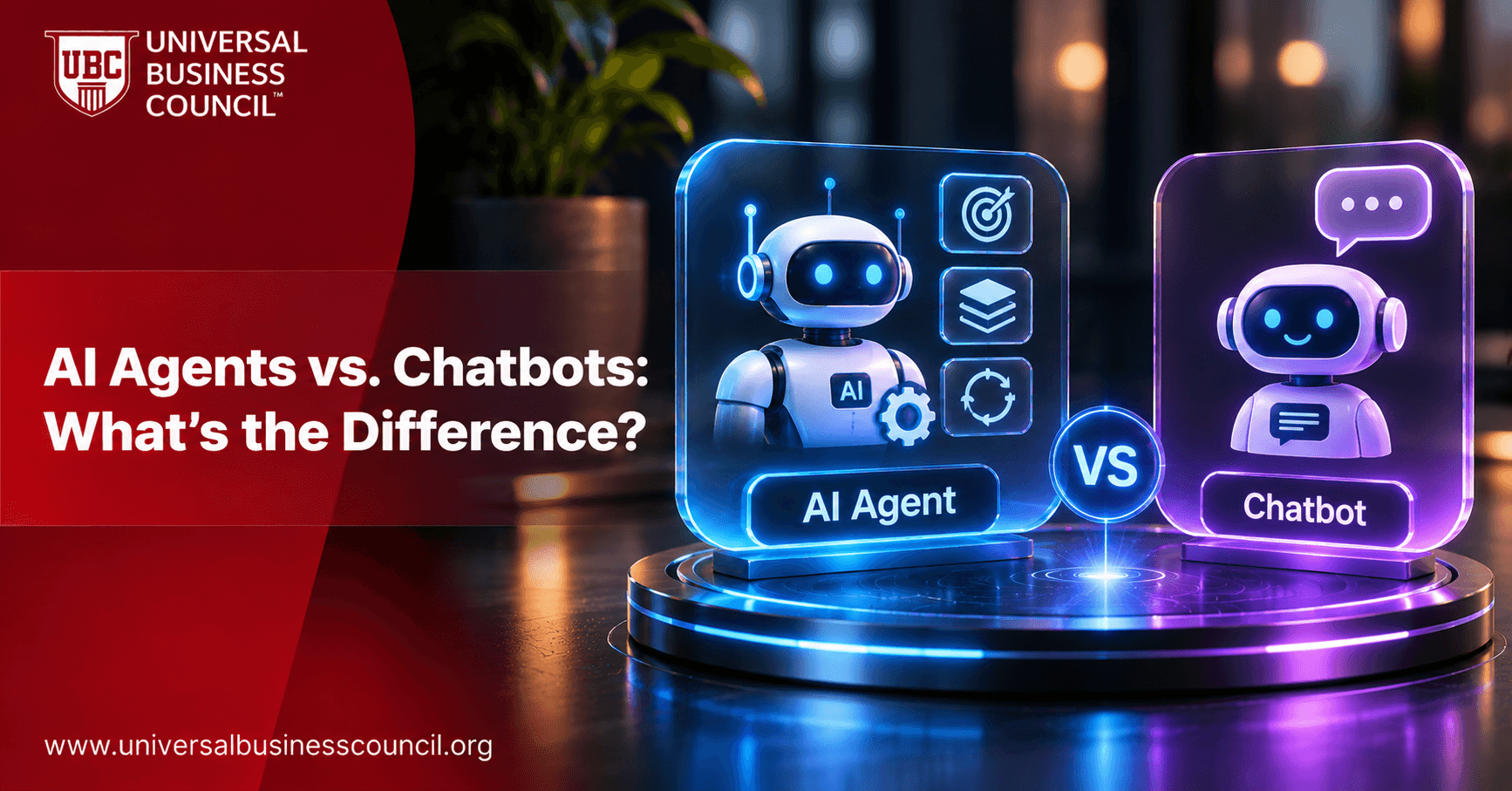
Vendors now use “agent” and “chatbot” almost interchangeably, and buyers pay for the confusion. A tool that answers questions in a chat window and a tool that works through a task on your behalf are different products with different costs, risks and results. This guide sets AI agents vs. chatbots side by side: what each one is, how they differ, what each can do in marketing, what to watch for on cost and risk, and how to decide which one you need. If you want marketing skills alongside, the Digital Marketing Course from Universal Business Council is a good place to start.
What are AI agents and chatbots?
A chatbot is software that talks with people through text or voice. Older ones follow scripts and decision trees. Newer ones use large language models to hold flexible conversations. Either way, the core job is the same: respond to what a person says.

An AI agent is software that pursues a goal across several steps. It plans, uses tools such as a calendar, a CRM or an email platform, takes actions, checks the result and adjusts. A person sets the goal and the limits, then the agent works within them.
Here’s the practical split. A chatbot waits for your next message. An agent keeps going after you’ve stopped typing. Ask a chatbot why last week’s newsletter underperformed and it offers an opinion. Ask an agent and it can open your email platform, pull the numbers for the last ten sends, compare them and come back with evidence.
AI agents vs. chatbots: the main differences
Chatbot | AI agent | |
|---|---|---|
Main job | Converse and answer | Complete tasks toward a goal |
Starts when | A person sends a message | A person sets a goal, or an event triggers it |
Steps | One response per turn | Many steps, planned and adjusted |
Tools | Few or none | Central: apps, databases, APIs |
Memory | Usually the current chat | Task state, often longer-term memory |
Works without you | No | Yes, within limits |
Main risk | A wrong or off-brand answer | A wrong or unwanted action |
Initiative is the clearest gap. OpenAI described its dots, launched in September 2026, as always-on agents that keep working between conversations. A chatbot can’t do that, because it has nothing to do until you speak.
Tool access is the second gap, and it drives the risk. A chatbot that gives a bad answer costs you a correction. An agent with access to your ad account that makes a bad move can cost you money.
The line is also blurring. Many chatbots now call a few tools, such as order lookups, and some agents chat as their main interface. Treat it as a spectrum, and ask where a product sits on it.
What each can do in marketing
Chatbots fit front-door jobs. They can answer common questions about pricing and shipping, capture leads, book demos and route visitors to the right page. They shine when the questions repeat and the answers are known.
Agents fit back-office and multi-step work. An agent can compile Monday’s campaign numbers from your ad platforms and email tool, write a summary and flag results that look off. It can research an account before a sales call and update the CRM afterward. It can turn a webinar into email drafts and a social calendar for an editor to approve.
Many teams will use both: a chatbot that talks to customers and an agent that handles the work behind it, such as creating a ticket, updating a record and scheduling a follow-up.
Cost, risk and control
Agents usually cost more to run. They make many model calls per task, and a stuck loop can burn through a budget. Chatbots are cheaper and more predictable, since each message gets one response.
Risk differs in kind. A chatbot’s risk is mostly about what it says: invented facts, wrong policy, an unhelpful tone. An agent adds risk in what it does. It can send, change, delete or spend. That’s why agents need limits that chatbots don’t: the least access the task needs, spending caps set inside the connected platforms, logs someone reads and a human yes before anything involving money, customers or legal wording.
The wider data shows why this matters. Gartner predicted in June 2025 that more than 40% of agentic AI projects will be canceled by the end of 2027, citing rising costs, unclear value and weak risk controls. Deloitte’s State of AI in the Enterprise 2026 survey found only 21% of leaders reported mature governance for agentic AI. Technical teams building agent integrations can look at the Tech Certifications from Global Tech Council for the programming and tooling side.
Which one do you need?
Start from the job. Choose a chatbot when the work is conversation: repeated questions, known answers, simple routing. Choose an agent when the work is a process: several steps, other software involved, and results to monitor and act on.
A few questions help:
Does the task need to touch other systems, or only talk?
Does it have several steps that depend on each other?
Should it keep working without a prompt?
What happens if it gets one step wrong?
If most answers lean toward conversation, a chatbot will do. If they lean toward action, look at an agent, and plan for review.
Be wary of labels. Gartner has used the term agentwashing for vendors that rename chatbots and assistants as agents. Ask what the product decides on its own, what it can touch and who approves the risky steps.
A simple test for any vendor’s claim
Ask for a live demo of a task with at least three steps and one unexpected result, such as a missing field or a failed lookup. A chatbot will usually stop or apologize. A real agent will try another route, ask for a decision or report what it couldn’t do. Then ask to see the log of what it did.
Leaders who track how AI, blockchain and other deep technologies are reshaping software buying can read more through the Deep Tech Certifications from Blockchain Council.
Conclusion
The AI agents vs. chatbots question comes down to conversation versus action. A chatbot responds to messages and is cheap, predictable and good for front-door questions. An agent pursues goals across steps, uses tools and can work without a prompt, which makes it better for multi-step marketing and operations work and also riskier and costlier. The line between them is blurring, so judge a product by what it decides, what it can touch and who approves its risky steps. Pick a chatbot for repeated, known questions and an agent for processes with several steps, and put limits and human review around any agent that can spend, send or change things. Watch for agentwashing, and test vendors with a task that includes an unexpected result.
FAQs
1. What is the main difference between an AI agent and a chatbot?
A chatbot responds to messages. An agent pursues a goal across steps and takes actions.
2. Can a chatbot use tools?
Some can, such as looking up an order, but an agent plans and acts across many steps.
3. Can an agent chat?
Yes. Many agents use chat as their main interface.
4. Do agents work without being prompted?
They can keep working after a goal is set, within the limits you define.
5. Is ChatGPT a chatbot or an agent?
Plain chat use is chatbot-style. Features built on the same models can act as agents when they plan and use tools.
6. What are examples of chatbots in marketing?
FAQ bots, lead-capture bots and demo-booking assistants.
7. What are examples of AI agents in marketing?
Reporting agents, campaign monitors, account researchers and content repurposing agents.
8. Are agents more expensive than chatbots?
Usually, because they make many model calls per task.
9. Which is riskier?
Agents, because they can take actions. Chatbots mostly risk wrong or off-brand answers.
10. Do agents need human oversight?
Yes, especially for money, customers and legal content.
11. Can I use both together?
Yes. A chatbot can talk to customers while an agent handles the work behind it.
12. What is agentwashing?
Gartner’s term for vendors relabeling chatbots and assistants as agents.
13. How do I tell if a product is a real agent?
Ask what it decides on its own, what it can touch and who approves risky steps.
14. What does a good vendor demo look like?
A multi-step task with an unexpected result, plus a log of what the agent did.
15. What access should an agent have?
The least it needs, written down as what it may read, change and send.
16. Are chatbots obsolete?
No. For repeated questions with known answers, they’re often the better choice.
17. How do agents handle failures?
Good ones retry, take another route, ask for a decision or report what failed.
18. What does Gartner predict about agentic AI?
That more than 40% of projects will be canceled by the end of 2027, citing cost, unclear value and weak risk controls.
19. What does Deloitte report about governance?
Its 2026 survey found only 21% of leaders reported mature governance for agentic AI.
20. How should a small business start?
With a chatbot for common questions, then pilot one agent on a repeated, low-risk process with human review.
Related Articles
View All
Artificial Intelligence
How Do AI Agents Work?
Discover how AI agents work, from understanding goals and processing information to planning actions and using tools. Explore the key components of AI agents, their decision-making process, and how they complete tasks with varying levels of autonomy.
Artificial Intelligence
Red-Teaming AI Agents: Methods, Scenarios and Safety Checks
Learn how red-teaming AI agents helps identify security vulnerabilities, unsafe behaviours, and weaknesses in autonomous systems. Explore common attack scenarios, testing methods, potential risks, and best practices for evaluating agent permissions, tool use, decision-making, and resilience before deployment.
Artificial Intelligence
What Is Gemini 4 Neon and How Does It Work?
What is Gemini 4 Neon? Google’s new mid-tier AI model, launched November 18, 2026, pairs adjustable thinking levels with a 1M-token context window. Learn how it works, what it costs and how it compares with Carbon and Hydrogen.