

How Do AI Agents Work?
Demos of AI agents look like magic: you type a goal and software books the meeting, pulls the report and tidies the spreadsheet. Underneath, the process follows a repeatable pattern, and knowing it helps you judge what an agent can handle and where it will trip. This guide walks through how AI agents work one layer at a time: the model, the loop, the tools, memory, planning and the guardrails around them. A weekly marketing report runs through the examples. For the programming and tooling behind agents, the Tech Certifications from Global Tech Council are a solid starting point.
What is an AI agent?
An AI agent is a software system that uses an AI model to pursue a goal by deciding which actions to take and carrying them out through tools. The model supplies the reasoning. The surrounding system supplies everything else: access to apps, memory of what has happened, rules about what’s allowed and a loop that keeps going until the job is done or a limit is hit.

A chatbot differs because it answers and stops. An agent keeps working. Ask a chatbot why last week’s newsletter underperformed and you get an opinion. Ask an agent and it can open your email platform, pull the numbers for the last ten sends, compare them and bring back evidence.
The agent loop
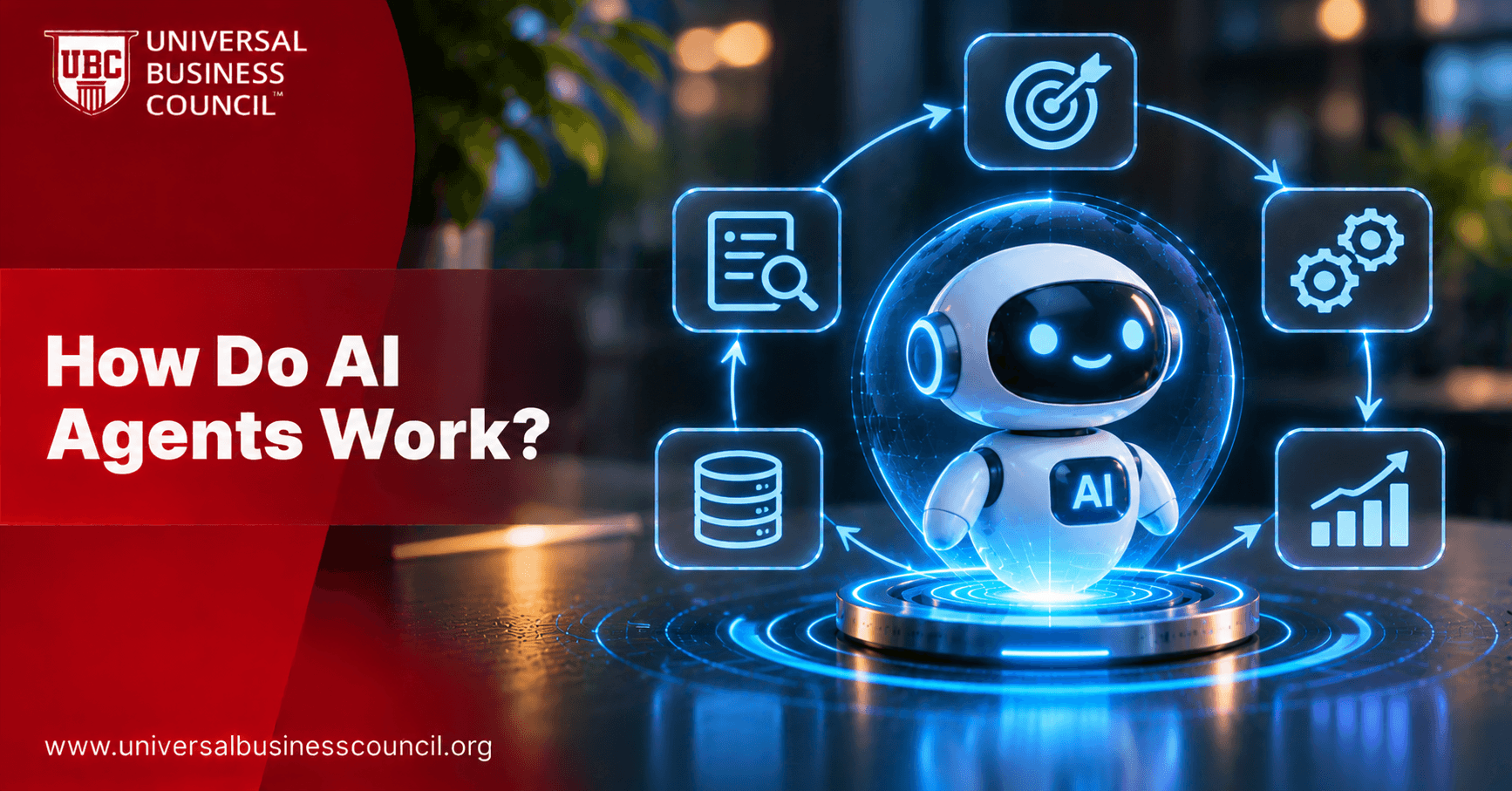
Nearly every agent runs the same cycle:
It takes in the goal and the current situation, including results from earlier steps.
It reasons about what to do next, often by splitting the goal into smaller steps.
It acts, usually by calling a tool such as a search, a database query or an API.
It reads the result and checks whether the step worked.
It repeats, or stops and reports back.
Run that on the newsletter question. The agent receives the goal and decides it needs send data. It queries the email platform and sees that open rates dropped on two sends. It notices both used long subject lines, so it checks a third send to test the idea. Then it writes a summary and asks whether you want the next subject lines shortened.
Each pass is cheap. Dozens of passes are where agents become useful, and where the bill grows.
The parts inside an agent
Five parts work together, and each one can be the weak link.
The model is the reasoning engine. Most business agents use a large language model that reads the context and picks the next action.
Tools are the agent’s hands. They’re functions the model can call, from sending an email to querying a database, each with a description the model reads to decide when to use it.
Memory comes in two kinds. Short-term memory is the running context of the current task. Long-term memory is stored information, like your brand guidelines or past decisions, that the agent can look up later.
Planning is how the agent splits a goal into steps and reorders them when something fails.
Guardrails are the rules around everything else: what it may access, which actions need approval, spending limits and when to stop.
For a business buyer, guardrails matter most. Two agents running the same model can behave very differently depending on their permissions and limits. One can read your ad account. The other can also change budgets. The second needs a much stricter review process.
How agents connect to tools and to each other
Tools usually connect through function calling and APIs. The developer describes each tool, the model returns a structured request, and the system runs it. Standards are emerging to cut the custom work. The Model Context Protocol, introduced by Anthropic, gives agents a common way to reach tools and data sources. Google’s Agent2Agent protocol aims to let agents built on different platforms talk to one another.
You don’t need to implement either one. When a vendor mentions them, they’re telling you the agent can plug into other systems without a custom build each time.
Where agents go wrong
Understanding the loop also explains the failures.
An agent picks the wrong tool or misreads a result, then builds on the mistake.
It gets stuck retrying a failed step, burning time and money.
The model invents a fact, and later steps rely on it.
It reads untrusted content, like a web page or inbound email, that contains hidden instructions meant to steer it. This is called prompt injection.
It has too much access, so a single error touches too many systems.
Each of these is manageable. Limit how many steps an agent can take, cap its spending, restrict its permissions, log every action and put a person in front of anything that can’t be undone. Gartner predicted in June 2025 that more than 40% of agentic AI projects will be canceled by the end of 2027, partly because of weak risk controls, so these basics aren’t optional extras.
Designing an agent that behaves
Write the setup like a job description. State the goal in one sentence. List the tools it may use and the systems it may read or change. Define what finished work looks like, who reviews it and when it must stop and ask.
For a marketing report agent, that could read: compile Monday’s numbers from the ad platform and email tool, write a summary under 200 words, flag anything more than 20% off the four-week average and send it to the channel manager for approval. It can read both platforms. It can’t change budgets.
Marketers who want to pair this kind of setup with stronger campaign skills can start with a Digital Marketing Course from Universal Business Council. Readers following how AI connects with blockchain and other deep technologies can find wider context in the Deep Tech Certifications from Blockchain Council.
A quick test for any agent you’re evaluating
Ask four questions. What can it read? What can it change? What happens when a step fails? Who sees the log? An agent that can’t answer all four isn’t ready for work that matters. Run it on a low-stakes task first, check its output against your own process for a few weeks and widen its access only after it earns it.
Conclusion
Knowing how AI agents work takes the mystery out of them. A model reasons, a loop repeats the cycle of planning, acting and checking, tools let it affect other software, memory keeps context and guardrails hold it inside limits. That structure explains both the value and the failures: agents can work through many steps on their own, and they can also repeat a mistake dozens of times if nobody set limits. Write a job description for each agent, give it the least access it needs, cap its steps and spending, keep a log and put a human on anything irreversible. Start with a low-stakes marketing task like a weekly report, compare the agent’s work with your own process and expand slowly.
FAQs
1. What is an AI agent?
A software system that uses an AI model to pursue a goal by choosing actions and carrying them out through tools.
2. How do AI agents make decisions?
The model reads the goal and the current context, then picks the next action. It repeats this after each result.
3. What is the agent loop?
The cycle of taking in information, planning, acting, checking the result and repeating.
4. What are tools in an AI agent?
Functions it can call, such as searching, querying a database or sending an email.
5. Do AI agents have memory?
Yes. Short-term memory holds the current task context, and long-term memory stores information it can look up later.
6. How is an agent different from a chatbot?
A chatbot answers and stops. An agent keeps working through steps toward a goal.
7. What model do agents use?
Most business agents use a large language model, though the design works with different models.
8. What is planning in an agent?
Splitting a goal into steps and reordering them when something fails.
9. What are guardrails?
Rules about access, approvals, spending and stopping conditions that limit what the agent can do.
10. What is function calling?
A method where the model returns a structured request that the system runs as a tool.
11. What is the Model Context Protocol?
A standard introduced by Anthropic that gives agents a common way to reach tools and data sources.
12. What is the Agent2Agent protocol?
A standard from Google meant to let agents from different platforms communicate.
13. Why do agents fail?
Wrong tool choices, misread results, invented facts, endless retries, hidden instructions and excess access.
14. What is prompt injection?
Hidden instructions in content an agent reads that try to steer its behavior.
15. How do you stop an agent from running up costs?
Cap its steps and spending, and set limits inside the connected platforms too.
16. Can an agent work while I’m away?
Yes, if it’s built to run continuously or on a schedule, within the limits you set.
17. How should I test an agent?
Run it on a low-stakes task, compare its output with your own process and review every result at first.
18. Who is responsible for what an agent does?
The person who owns the process it runs.
19. Do agents need human oversight?
Yes, especially for anything involving money, customers or legal content.
20. How do I start with agents in marketing?
Choose a repeated task like weekly reporting, write its job description and pilot it with human review.
Related Articles
View All
Artificial Intelligence
AI Red Teaming vs AI Auditing: How They Work Together
Understand the differences between AI red teaming and AI auditing, including their goals, methods, and roles in evaluating AI systems. Explore how red teaming uncovers vulnerabilities through simulated attacks while auditing reviews controls, risks, and compliance, and how both approaches work together to strengthen AI security and accountability.
Artificial Intelligence
Red-Teaming AI Agents: Methods, Scenarios and Safety Checks
Learn how red-teaming AI agents helps identify security vulnerabilities, unsafe behaviours, and weaknesses in autonomous systems. Explore common attack scenarios, testing methods, potential risks, and best practices for evaluating agent permissions, tool use, decision-making, and resilience before deployment.

Artificial Intelligence
Agentic AI for business: how autonomous AI agents are changing marketing and operations
Discover how agentic AI is transforming business marketing and operations through autonomous AI agents. Explore how businesses use AI agents to automate workflows, manage campaigns, analyze data, improve customer interactions, and support decision-making while understanding the benefits and challenges of adoption.
Trending Articles
The Role of Blockchain in Ethical AI Development
How blockchain technology is being used to promote transparency and accountability in artificial intelligence systems.
AWS Career Roadmap
A step-by-step guide to building a successful career in Amazon Web Services cloud computing.
Top 5 DeFi Platforms
Explore the leading decentralized finance platforms and what makes each one unique in the evolving DeFi landscape.