What Are AI Agent Memory Systems?
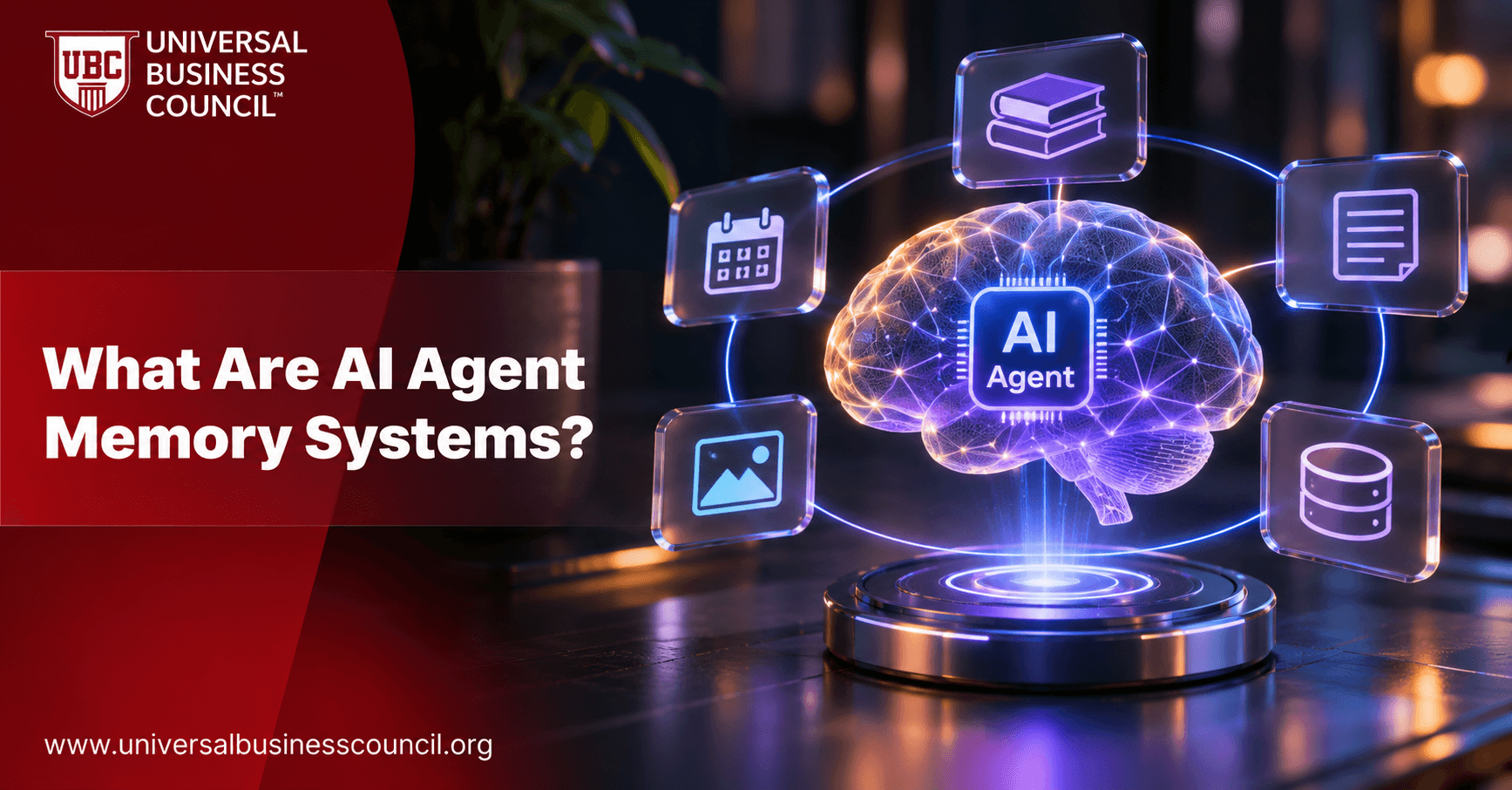
Ask an AI agent the same question on Monday and again on Friday, and without memory it starts from zero both times. Memory decides whether an agent can keep a brand voice, recall a customer’s last request or learn from a campaign test that flopped. This guide covers AI agent memory systems: the types of memory, how they work under the hood, where marketing and operations teams can use them, what goes wrong and how to keep them trustworthy. If you want campaign skills to pair with it, the Digital Marketing Course from Universal Business Council is a good place to start.
What are AI agent memory systems?
AI agent memory systems are the mechanisms that let an agent store, find and reuse information beyond a single prompt. The language model at the center of most agents doesn’t remember anything on its own. Each call starts fresh, with only the text you send it. Memory is built around the model: a place to keep information, rules for what gets saved, and a way to pull the right pieces back in when they’re needed.

Think of it as the difference between a temp worker and a team member. The temp reads the brief and forgets it by tomorrow. The team member remembers your style guide, last quarter’s results and that one client who hates exclamation points. Memory is what moves an agent from the first category toward the second.
A memory system usually answers four questions. What should be saved? Where does it live? How does the agent find it later? And when should it be updated or forgotten?
Short-term memory vs. long-term memory
Short-term memory is the working context of the current task. It holds the conversation so far, the results of tool calls and any instructions the agent has been given. It lives inside the model’s context window, which is limited in size and costs money to fill. When a long task overflows it, teams trim old messages or replace them with a summary.
Long-term memory lives outside the model. It might sit in a database, a set of files or a vector store, and it survives between sessions. This is where brand guidelines, customer preferences and past decisions go. The agent doesn’t carry all of it around. It looks things up when it needs them.
Long-term memory is often split into three kinds, borrowing terms from cognitive science:
episodic memory stores what happened, such as the subject lines tested last month and how they performed
semantic memory stores facts, such as your pricing, product names and approved claims
procedural memory stores how to do things, such as the steps for building a weekly report or rules about tone
Most teams need all three, though they’ll start with semantic memory because it’s the easiest to set up.
How memory works under the hood
The pattern is the same across most systems. The agent decides something is worth keeping and writes it down, often as a short summary or a fact. The system stores it, commonly as an embedding in a vector database so it can be found by meaning, not just by keywords. Later, when a new task arrives, the system searches for relevant items, ranks them by similarity, recency or importance, and slips the best ones into the prompt.
That last step is often called retrieval-augmented generation. The model never “remembers” in a human sense. It simply gets handed a few relevant notes before it answers.
A marketing example makes it concrete. An agent drafting a launch email retrieves your brand voice rules (procedural), the product’s approved claims (semantic) and the results of two earlier subject-line tests (episodic). Without those three pulls, the draft would be generic. With them, it sounds like your company.
Where memory helps in marketing and operations
Continuity is the biggest gain. A campaign agent that remembers what was tried last quarter won’t suggest the same failed headline twice. A support agent that recalls a customer’s earlier ticket doesn’t make them repeat the story. A reporting agent that remembers your preferred format stops asking.
Personalization follows. An agent can hold audience notes, purchase history and stated preferences and use them across email, chat and ads, with the right consent.
Memory also lets an agent keep working over time. OpenAI’s dots, launched in September 2026, are always-on agents that carry context across conversations and channels. They can inherit memories from ChatGPT and form their own, and OpenAI’s documentation says users can’t view, edit or delete individual dot memories. Deleting them means deleting the dot. That’s a useful example of a design trade-off: convenience on one side, control on the other.
Risks and limits of agent memory
Memory adds failure modes that a stateless chatbot doesn’t have.
Wrong or stale memories persist. If an agent saves an outdated price or a misread preference, it will reuse the error with confidence.
Memory can be poisoned. Hidden instructions in a web page or email can get saved as “facts” and steer later behavior.
Privacy exposure grows. Stored personal data raises questions about consent, retention and deletion rights.
Retrieval can miss or overload. Pull too little and the agent lacks context. Pull too much and it gets confused or runs up costs.
Governance is thin in many companies. Deloitte’s State of AI in the Enterprise 2026 survey found only 21% of leaders reported mature governance for agentic AI, and memory rarely gets its own policy. Technical teams building these systems can look at the Tech Certifications from Global Tech Council for the programming and data tooling behind them.
How to design memory you can trust
Start by deciding what an agent should not remember. Payment details, health information and anything covered by strict privacy rules usually shouldn’t be stored at all.
Then set rules for the rest:
Give each memory an expiry or a review date, so prices and policies don’t go stale.
Keep memory separate by user, team or client, so one account’s data never leaks into another’s.
Let people see, correct and delete what the agent has stored about them.
Log every write, so someone can trace where a wrong “fact” came from.
Test retrieval with real questions before launch and again after changes.
Treat the memory store like any other system of record. It needs an owner, access controls and an audit trail. Leaders who follow how AI, blockchain and other deep technologies are reshaping software buying can read more through the Deep Tech Certifications from Blockchain Council.
Conclusion
AI agent memory systems turn a model that forgets everything into an agent that can work across days and projects. Short-term memory holds the current task, long-term memory stores episodes, facts and procedures outside the model, and retrieval brings the right notes back at the right moment. The gains show up in continuity, personalization and learning from past results, especially in marketing and support work. The risks are stale or wrong memories, poisoned content, privacy exposure and messy retrieval. Decide what an agent shouldn’t remember, set expiry dates, separate data by user, let people correct or delete entries and log every write. Teams that treat AI agent memory systems as managed data, not magic, get the benefits without the surprises.
FAQs
1. What is AI agent memory?
The ability for an agent to store information and reuse it beyond a single prompt.
2. Do language models remember on their own?
No. Each call starts fresh, so memory has to be built around the model.
3. What is short-term memory in an agent?
The working context of the current task, held in the model’s context window.
4. What is long-term memory in an agent?
Information stored outside the model, such as in a database, that survives between sessions.
5. What is episodic memory?
A record of what happened, such as past actions and their results.
6. What is semantic memory?
Stored facts, such as product details, prices and approved claims.
7. What is procedural memory?
Stored instructions for how to do tasks, such as steps and style rules.
8. What is a vector database?
A store that finds items by meaning using embeddings, often used for agent memory.
9. What is retrieval-augmented generation?
A method where relevant stored notes are retrieved and added to the prompt before the model answers.
10. How does an agent decide what to save?
Through rules or prompts that tell it which facts, summaries or preferences are worth keeping.
11. How does memory help marketing agents?
It preserves brand voice, past test results and audience notes across campaigns.
12. Can agents forget?
Yes, if the system is built with expiry dates, deletion tools or summarizing and trimming.
13. What is memory poisoning?
When hidden instructions or false information get saved and later steer the agent.
14. Can I see what an agent remembers?
It depends on the product. OpenAI’s documentation says users can’t view or edit individual dot memories.
15. Is stored memory a privacy risk?
It can be, especially with personal data, so consent, retention and deletion rules matter.
16. What should an agent never store?
Highly sensitive data such as payment details or health information, unless there’s a clear legal basis and strong controls.
17. How do I stop one client’s data leaking into another’s?
Keep memory separate by user, team or client.
18. How do I test agent memory?
Run real questions through the agent, check what it retrieves and repeat after every change.
19. Does more memory always help?
No. Too much retrieved context can confuse the agent and raise costs.
20. Who should own agent memory?
A named person or team, treated like any other system of record with access controls and logs.
Related Articles
View All
Artificial Intelligence
What Is AI Agent Orchestration
Understand what AI agent orchestration is, how it works, and how it coordinates multiple AI agents to complete complex tasks. Explore orchestration patterns, key components, real-world applications, and the role of workflows, communication, and task management in building effective agentic AI systems.
Artificial Intelligence
What Is an AI Agent Framework
Discover what an AI agent framework is, how it works, and why developers use it to build and manage intelligent agents. Explore its key components, common types, popular frameworks, and practical applications, along with how these tools support agent development, coordination, and automation.

Artificial Intelligence
What Are Multi-Agent Systems?
Learn what multi-agent systems are, how they work, and how multiple AI agents collaborate to complete tasks. Explore their key components, common architectures, real-world applications, benefits, and challenges, along with how they differ from single-agent AI systems.