What Is Agentic Workflow Automation?
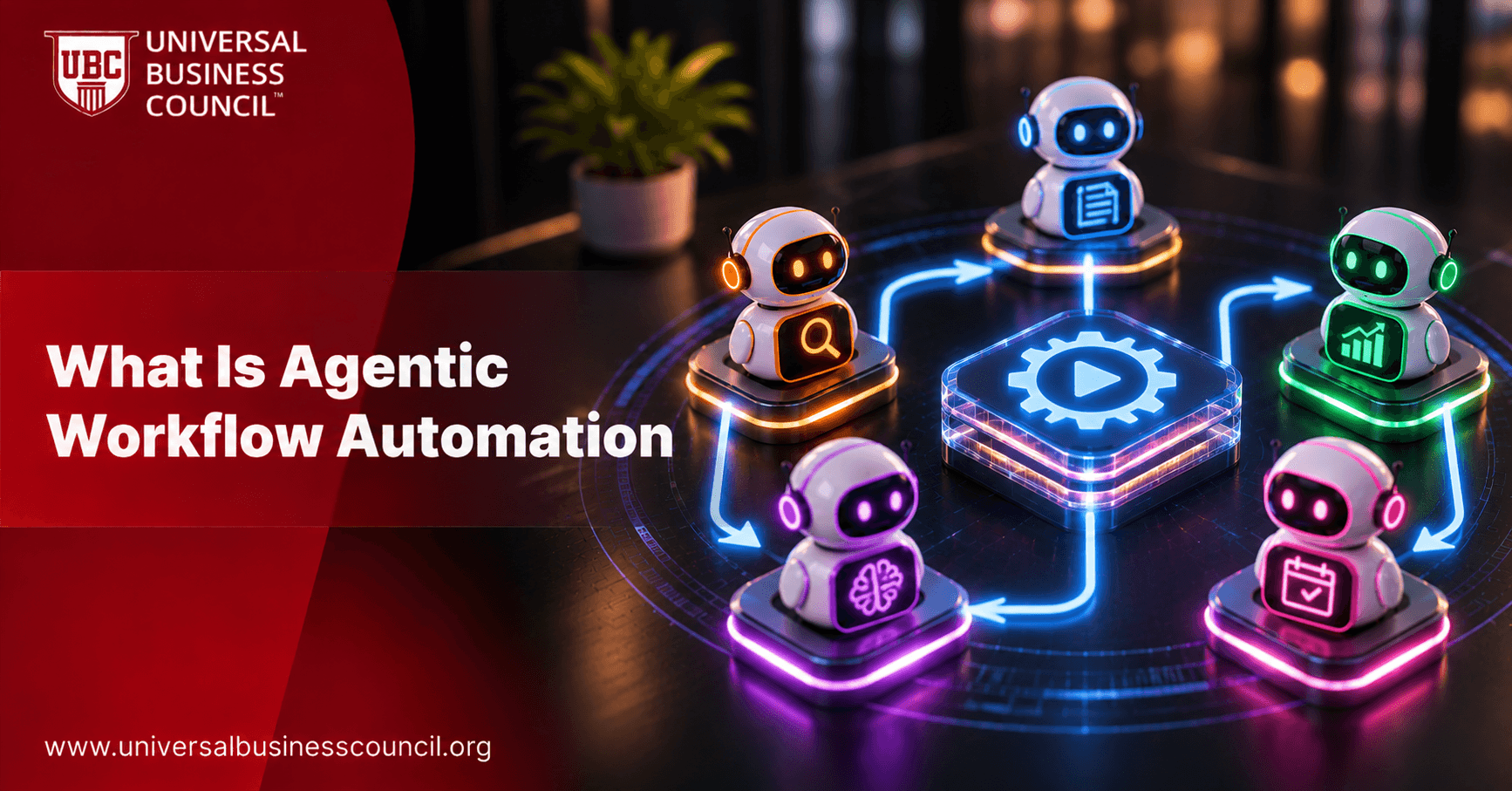
Most teams already run some form of workflow automation: a form is submitted, a rule fires and an email goes out. The newer layer sits on top of that, with AI that can handle the steps nobody wrote a rule for. This guide covers agentic workflow automation in practical terms: how it differs from rule-based automation, the parts of an agentic workflow, the design patterns teams use, examples from marketing and operations, the risks and a simple way to start. If you want the marketing skills to go with it, the Digital Marketing Course from Universal Business Council is a good place to start.
What is agentic workflow automation?
Agentic workflow automation uses AI agents inside a business process so the system can plan, choose tools, act and adjust, instead of running a fixed sequence of steps. A person defines the goal, the limits and the approval points. The agent handles the variation in between.

Traditional automation, including robotic process automation, follows if-then rules. It works well until the input changes: a supplier sends an invoice in a new format, or a customer replies with something the rules never imagined. Then it stops, or worse, carries on and gets it wrong. An agentic workflow can read the messy input, decide what it means and pick the next step.
Anthropic’s engineering team draws a useful line here. In its description, workflows are systems where AI models and tools follow predefined code paths, while agents direct their own process and tool use. Most real agentic workflows blend the two. The skeleton is fixed, and agents make decisions at the steps where the path isn’t predictable.
How it differs from traditional automation
The two approaches solve different problems, and mixing them up leads to expensive mistakes.
Rule-based automation | Agentic workflow automation | |
|---|---|---|
Input | Structured and predictable | Messy, varied or unstructured |
Path | Fixed in advance | Adapts to what the agent finds |
When something unexpected happens | Stops or errs | May reroute, but can also be wrong |
Setup | Map every case | Define the goal, limits and checkpoints |
Cost per run | Low | Higher, since agents make model calls |
Best for | Stable, high-volume tasks | Variable tasks that need judgment |
Don’t treat the table as a case for replacing everything. A payment run that must follow the same steps every time should stay rule-based. A rule is cheaper, faster and easier to audit than an agent. The sensible split is simple: use rules for the predictable parts and agents for the exceptions and judgment calls.
The parts of an agentic workflow
Most agentic workflows share the same building blocks, even when the tools differ.
A trigger starts the process, such as a new lead, an incoming invoice or a scheduled report.
A goal and instructions tell the agent what finished work looks like and what it must not do.
The agent, usually powered by a large language model, decides the next step.
Tools and connections let it act, whether that’s your CRM, email platform, spreadsheet or ticketing system.
Memory holds the context of the task and any reference material, like brand guidelines or past decisions.
Approval checkpoints pause the process for a person before risky steps.
Monitoring and logs record what happened, so someone can audit it later.
The checkpoints and logs are the parts teams skip when they’re excited about the agent. They’re also the parts that decide whether a process is safe to run at all.
Common patterns for agentic workflows
A handful of design patterns cover most business uses. These five come from Anthropic’s published guidance on building agents, and many real workflows combine them.
Prompt chaining breaks a task into steps, with a check between each one. A content process might draft, then check facts, then check brand voice. Routing classifies an input and sends it to the right specialist, like a support message that goes to billing or technical help. Parallelization splits a job into pieces that run at the same time, or runs the same task several times to compare answers. In an orchestrator-worker setup, a central agent breaks a goal into subtasks and hands them to workers. An evaluator-optimizer loop has one step produce work and another critique it until it clears a checklist.
Teams building these patterns will need the technical foundations behind them, and the Tech Certifications from Global Tech Council cover the programming and tooling side.
Examples in marketing and operations
These are illustrations, not product recommendations, but they show where the approach fits.
Lead handling is a common starting point. A form submission triggers the workflow. An agent checks the lead against your CRM, scores it, drafts a tailored reply and routes large accounts to a salesperson for approval. Small leads get the reply automatically, with a log.
Content production works well with a chain. A brief goes to a drafting step, then a brand-voice check, then a compliance check against approved claims, then scheduling. A human editor approves anything that goes public.
Reporting is the easiest win. Every Monday, an agent pulls numbers from the ad platforms and email tool, writes a short summary and flags results that look off.
On the operations side, invoice processing suits an agent that reads varied formats, matches invoices to purchase orders and flags mismatches for a person. Support triage works similarly: classify the ticket, retrieve the relevant policy, draft a reply and escalate anything unusual.
Risks and guardrails
Agents add flexibility, and flexibility adds risk. Errors can compound, because a wrong output at step two becomes the input for step three. Costs can climb when an agent loops on a failing step. Data can be exposed if an agent has broader access than the task needs. And accountability gets fuzzy if nobody owns the process.
Adoption data shows why this matters. Gartner predicted in June 2025 that more than 40% of agentic AI projects will be canceled by the end of 2027, citing rising costs, unclear value and weak risk controls. Deloitte’s State of AI in the Enterprise 2026 survey found only 21% of leaders reported mature governance for agentic AI.
The fixes are practical. Give each agent the least access the task requires. Set spending and volume caps inside the connected platforms, not only in the agent’s instructions. Require a human yes for payments, customer commitments and legal wording. Keep logs someone reads, and test the workflow against a set of known cases before it runs live. Leaders who follow how AI, blockchain and other deep technologies are reshaping software buying can read more through the Deep Tech Certifications from Blockchain Council.
How to start with agentic workflow automation
Pick one process that repeats, has several steps and involves messy inputs. Write down every step as it works today. Mark each step as either rule-based or judgment-based. Keep the rule-based steps as plain automation, and give the judgment steps to an agent.
Next, decide where a person must approve, and name one owner for the whole process. Run the new workflow beside the old one for about 30 days, with a person reviewing every output. Measure time per task, error rate, how often the agent escalates and cost per run. If the numbers beat the old process, widen the scope one step at a time. If they don’t, you’ve learned something cheaply.
Conclusion
Agentic workflow automation puts AI agents inside a business process so the system can handle the steps that rules can’t cover. It differs from traditional automation in how it handles messy input and unexpected cases, and it costs more per run, so rules still belong on the predictable steps. A typical workflow includes a trigger, a goal, an agent, tools, memory, approval checkpoints and logs, and common patterns include prompt chaining, routing, parallelization, orchestrator-workers and evaluator-optimizer loops. Marketing and operations teams can start with lead handling, content production, reporting, invoice processing and support triage. The risks are compounding errors, runaway costs, data exposure and unclear ownership, which is why Gartner expects many projects to be canceled. Start with one repeated process, split the rule-based steps from the judgment steps and keep a human on approvals. Done that way, agentic workflow automation gives you flexibility without giving up control.
FAQs
1. What is agentic workflow automation?
Using AI agents inside a business process so the system can plan, choose tools, act and adjust, within limits people set.
2. How is it different from traditional workflow automation?
Traditional automation follows fixed rules. Agentic automation handles messy input and unexpected cases by deciding the next step.
3. How is it different from RPA?
RPA repeats fixed clicks and keystrokes and can break when screens or formats change. Agents can adapt, though they cost more per run.
4. Is it the same as an AI agent?
No. An agent is one component. Agentic workflow automation is the whole process built around agents, rules and approvals.
5. What is an agentic workflow?
A process where AI agents handle some decisions and actions inside a defined structure.
6. Does it replace rule-based automation?
No. Good designs keep rules for predictable steps and use agents for judgment.
7. What are the main parts of an agentic workflow?
A trigger, a goal, an agent, tools, memory, approval checkpoints and monitoring.
8. What is prompt chaining?
Breaking a task into sequential steps, with a check between each one.
9. What is routing?
Classifying an input and sending it to the right specialist step or agent.
10. What is an orchestrator-worker pattern?
A central agent splits a task into parts, assigns them to workers and combines the results.
11. What is an evaluator-optimizer loop?
One AI step produces work and another critiques it, repeating until it passes a checklist.
12. What are good marketing use cases?
Lead handling, content production with brand checks, campaign reporting and audience segmentation.
13. What are good operations use cases?
Invoice matching, support triage, procurement requests and supplier follow-ups.
14. What kind of process suits agentic automation?
Repeated, multi-step work with messy inputs and a person who can review the result.
15. What kind of process doesn’t suit it?
One-off tasks, steps that must follow a strict script and anything where mistakes can’t be undone.
16. Where should humans stay involved?
Approvals for money, customer commitments, legal wording and unusual cases.
17. What are the main risks?
Compounding errors, runaway costs, data exposure and unclear accountability.
18. What does Gartner predict?
That 40% of enterprise applications will include task-specific agents by the end of 2026, and that over 40% of agentic AI projects will be canceled by the end of 2027.
19. How do I measure success?
Track time per task, error rate, escalation rate and cost per run against the old process.
20. How should I start?
Pick one repeated process, split rule-based steps from judgment steps, add approval points and pilot for about 30 days.
Related Articles
View All
Artificial Intelligence
What Is an AI Agentic Workflow?
Learn what an AI agentic workflow is, how it works, and how AI agents plan, execute, and manage multi-step tasks with varying levels of autonomy. Explore its key components, common patterns, practical applications, benefits, and limitations, along with how agentic workflows differ from traditional automated processes.
Artificial Intelligence
Real-World Applications of Agentic AI
Explore how agentic AI is being used across industries to automate complex tasks, support decision-making, and manage multi-step workflows. Discover real-world applications in healthcare, finance, customer service, education, manufacturing, and other sectors, along with practical examples, benefits, and challenges of adopting agentic AI.
Artificial Intelligence
AI Human Factors and Automation Bias: Keeping People in Control
Understand how human behavior, cognitive biases, and trust influence interactions with AI systems. Explore automation bias, its causes, real-world risks, and how human factors affect decision-making when people rely on AI-generated recommendations.